


Please consider supporting our mission to help everyone better understand and become smarter about the Jewish world. A gift of any amount helps keep our platform free of advertising and accessible to all.
This is a guest essay by Sheri Oz, an investigative writer documenting Israel and Israeli society.
You can also listen to the podcast version of this essay on Apple Podcasts, YouTube Music, YouTube, and Spotify.
At 2 in the morning, the up and down shrieking of the siren shakes my world — but it no longer chills me to the bone.
Against the total darkness, my backyard light is like a projector on the patio, allowing me to walk securely down the first six stairs; a fall in the dark is its own danger.
I turn to the left and walk the last three steep steps to the basement door. I see my neighbours in the next building calmly descending the staircase to their bomb shelter. And I know that at least a million Israelis, probably more, are in synch with our movements.
The siren stops as I turn the key in the door and silence descends as I enter the basement, closing but not locking the door behind me in case a rescue team needs to find me. I go down two more steps to the innermost part of the basement, windowless and not in line with the door. The ceiling is cement with iron rods reinforcing it. It is probably not up to official standards, but it is better than what many of my compatriots have.
I sit on a plastic garden chair alongside a shelf unit attached to the wall loaded with fabrics waiting for me to cut and sew, fabrics that I collect wherever I travel (some of them were purchased in Guatemala 50 years ago). Bottles of water, candles, and a change of clothes are ready in case I will have to spend hours here. I take my transistor radio and laptop with me every time I have to go downstairs.
Except in the middle of the night, it is almost a relief when a siren pierces the air. The endless anticipation of the next alert keeps my body in a state of low-level adrenaline-infused alertness that is tiring. After a siren, I know that I will likely get a few quiet hours during which my body will not be on edge. That doesn’t mean that my heart doesn’t skip a beat when someone outside slams a car door.
Many people outside Israel imagine the war as a constant barrage. For me, it is not like that at all, yet I have been aware of the fact that those living along the Confrontation Line (the northern border with Lebanon, where Hezbollah attacks from) don’t get breaks like I do. It made me wonder about the difference between what people living there experience compared with those in the rest of the country.
I decided to track sirens across the country and discovered not all Israelis are living the same war that began on February 28th. By March 3rd, we settled into a largely bifurcated pattern of sirens. Broadly speaking, we can divide the country into those in the north close to the Lebanese border and those in the rest of the country. The difference can be illustrated by comparing a typical day along the Confrontation Line and those in the central region (see Figure 1). Of course, the situation is more complex than this, but this gives us a general idea of siren realities we live with.
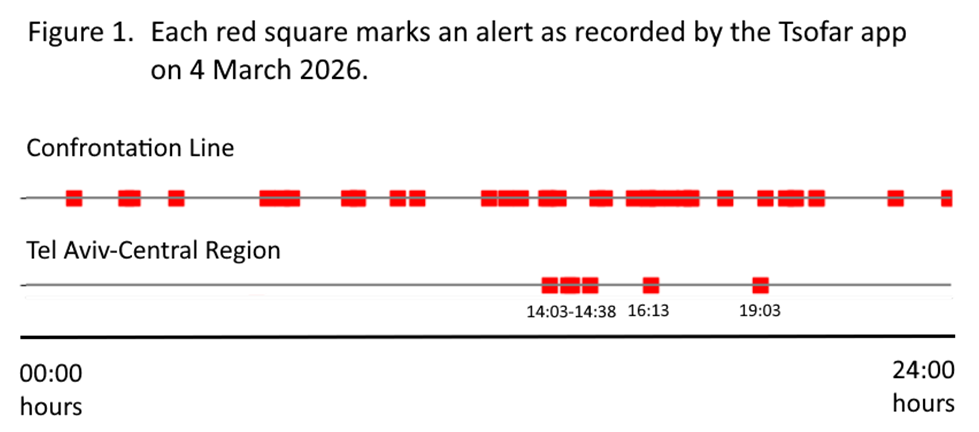
Along the northern border, sirens sound throughout the day, scattered across morning, afternoon, and night. In the center of the country the pattern is different: Hours can pass in complete quiet, and then suddenly a cluster of alerts sends millions of people running for shelter.
The alert log reveals a pattern: For the center of the country, the war often arrives in clusters. Several alerts can come within minutes of each other, followed by hours of quiet. The quiet allows people to return to “normal” routines. Then suddenly another cluster appears and the entire cycle begins again. Over time, the mind begins to expect that another interruption may arrive at any moment.
The first days of the war were loud and shocking. What followed was relentlessness. We learned how to live inside a pattern of repeated interruption.
For civilians, the experience of war is not measured by the number of missiles. It is shaped by the rhythm of the alerts. For some, a single cluster in the middle of the night can feel more overwhelming than alerts scattered across the day. For others, the interruptions in daily schedules are harder to bear. This can almost feel as if they are being bombarded 24/7.
While I don’t feel “bombarded” 24/7, I feel “on” the whole time because my antennae never stop testing the air, registering every sound. I don’t need to hear a car backfire in the distance, or an ambulance carrying patients to the hospital emergency room less than a kilometer from my home, or people chatting on the sidewalk outside. But in my heightened state, I hear it all.
If the incoming missile is from Iran, the siren itself is only the final moment in a longer event. The phone buzzes first with an early warning. For several minutes I wait, watching the app on my phone and listening for the siren that may or may not come. Those minutes are enough to pull me out of whatever I was doing. It is disturbing even if I do not get a siren. It has happened before — no siren when there should have been one.
Here is an example of what I experience when no siren follows the early-warning alert:
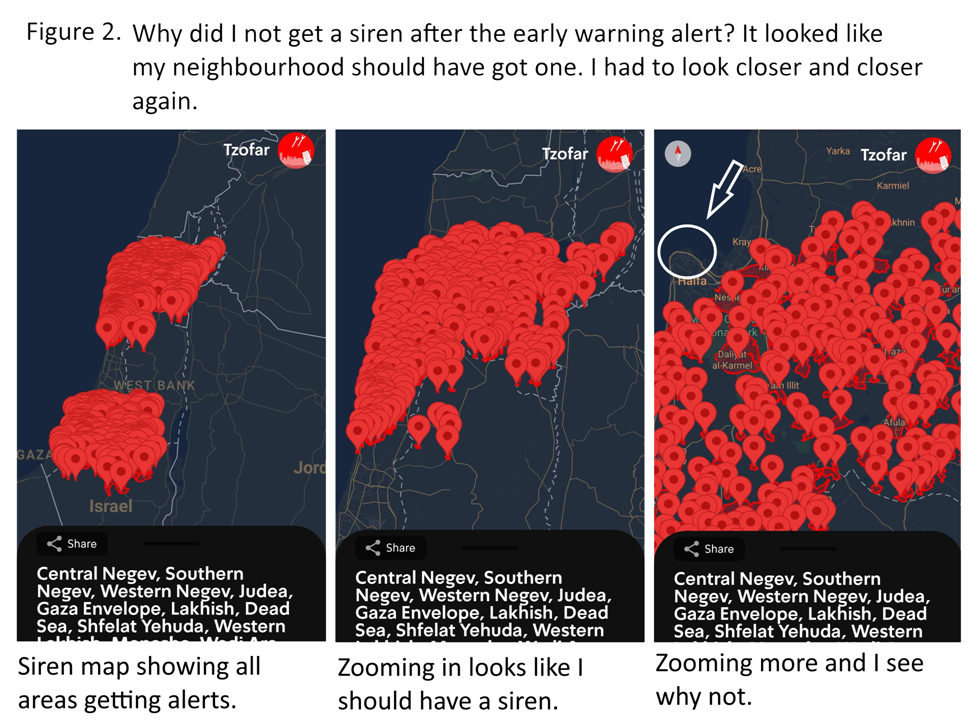
Those along the northern border don’t even get that warning alert for rockets and drones from Lebanon. They have a few seconds between the siren and the interception or impact, and sometimes they do not even get a siren at all. If Hezbollah targets Haifa, which is in northern Israel but not that far north, I get 30 to 90 seconds between the siren and booms of interception, assuming the interception is successful.
Oren Dvoskin, a resident of Kibbutz Snir on the Lebanese border, told me about driving his daughter home from a nearby junction and suddenly seeing a rocket whose trajectory would go directly over his car. With no time to jump out of the car and lie down as we are told to do, he could only hope that the rocket debris from the interception directly above him would not fall on their car.
“Hezbollah is the direct threat to being able to live here,” he said. “Iran is more distant.” The alerts reflect that difference. Long-range missiles from Iran trigger early-warning notifications but rarely sirens along the northern border. Communities close to the Confrontation Line are targeted by Hezbollah rockets and drones.
Dvoskin described life along the border not as constant panic, but as moving between what he calls “bubbles of sanity” —
“The upper Galilee is at its most striking springtime beauty; everything is green, blossoming, flowing rivers, snow on the Hermon. My favorite time of year. On the other hand, we have immediate threats. We want to continue normal life, work, exercise, family time, but have to make calculated-risk decisions. Move between and to safer and less targeted ‘bubbles,’ where each person and family has a different balance of resilience, comfort, and tolerance of fear.”
That calibration assumes there will be quieter days. But for those along the Confrontation Line, there haven’t been since Hezbollah joined the war on March 2nd. In contrast to the rest of the country, for them the previous war with Hezbollah (from October 8, 2023 to November 27, 2024) never ended.
“Since the ceasefire began (in November 2024) and since we returned home in June (2025), there has not been a single day that was fully quiet in the area,” Dvoskin said.
When sirens warn of an incoming Iranian ballistic missile, the scale in urban areas becomes visible. Entire neighborhoods move at once: Office towers empty into stairwells, traffic stops, pedestrians enter the nearest public shelter, residents at home drop what they were doing and gather in the protected room in their apartments, on their floors, or in the basement. For several minutes, millions of people are doing the same thing: finding their way to the nearest shelter.
When damage is done, it is “photogenic.” Large buildings are devastated, rows of cars crushed — and that is just from the debris of an intercepted missile. Some debris pieces as large as a bus.
The siren lives on for those who walk or drive past the site on their way to work or shopping. I still startle when I pass by the government building in Haifa, hit by an Iranian missile last summer and left unrepaired. But who remembers the house in a northern community destroyed by a Hezbollah rocket? Who remembers the fires in the hills?
Between settling myself in my chair in the basement and hearing the all-clear, I listen for ambulance and police car sirens, hoping for silence — a silence that tells me that nothing bad happened in my neighbourhood.
This time.

I cannot imagine how horrific your lives are at the moment. All I can do is offer you my love and prayers. 🙏
God bless Israel 🇮🇱 🙏