


Please consider supporting our mission to help everyone better understand and become smarter about the Jewish world. A gift of any amount helps keep our platform free of advertising and accessible to all.
This is a guest essay by Dory Benami, an Israeli-American writer and author of the book “Bad Jew: How October 7 Changed Everything I Thought I Knew.”
You can also listen to the podcast version of this essay on Apple Podcasts, YouTube Music, YouTube, and Spotify.
Israelis have a word for what I am trying to describe here: ביצים (beitzim).
Literally, it means eggs. In Hebrew slang, it means balls.
Not chutzpah. Chutzpah is audacity. Gall. Beitzim are something else. They are what you need when the choices are bad, the consequences are enormous, and the decision is yours.
I have been thinking about that since October 7th.
I was born in Israel and raised in America, and I have spent most of my life looking at one country partly through the eyes of the other. In America, military service belongs to a relatively small part of society. In Israel, the military runs through families, workplaces, and neighborhoods. The reservist disappearing for months is not an abstraction. He is your cousin, your neighbor, your coworker, the father you saw at school drop-off.
That changes the way Israelis think about leadership. Did you see it coming? Were you prepared? Did you listen to the right people? When your assumptions failed, did you adjust? When everyone else was losing his head, did you keep yours?
Maybe that is one reason Israel has spent so much of its history turning generals into politicians.
But a great commander does not necessarily make a great prime minister. A commander is given a mission. A prime minister has to decide what the mission is, what it is worth, and when it ends.
For me, that question begins with Golda Meir, the four prime minister of Israel, serving from 1969 to 1974, as well as our country’s first and, to date, only female prime minister.
Golda looks different to me after October 7th. For most of my life, the 1973 Yom Kippur War arrived already interpreted. Israel was surprised. The intelligence failed. The first days were disastrous. Israel recovered. Golda eventually resigned.
Then October 7th happened, and some of 1973 became easier for me to understand. October 7th showed me what it feels like to wake up and discover that assumptions you trusted were wrong and institutions you believed were watching had failed to see what was in front of them. I had my own reckoning afterward, with Israel, America, antisemitism, security, and my own Jewishness. Somewhere in that process, I started looking at Golda again.
My family makes that complicated. My uncle Yossi Peer’s younger brother was Ze’ev Peer, Zeevik. He was 19 when the Yom Kippur War began and served in a tank unit. On October 7, 1973, his tank was hit by Egyptian antitank fire in Sinai. The commander was killed. Zeevik got out wounded with two other crewmen. The other two were recovered. Zeevik was not. His body has never been found.
I never met Zeevik. I was not born yet. I know his story because my uncle Yossi lost his little brother and never got him back. My uncle Udi had a different story. He happened to be off when the war started. His best friend was not. He was killed and is buried in Ness Ziona. I never met him either. Udi survived and carried guilt about that for the rest of his life. I do not pretend to know exactly what that felt like.
This is how the Yom Kippur War came down to me. It was not only something I learned about in history books. My family had been shaped by people who did not come home. So when I reconsider Golda after October 7th, I am not looking for a reason to excuse what happened in 1973.
Israel’s political and military leadership was surprised, and Golda was prime minister. The failures before the war remain part of her record. But so does what happened after the attack began.
Then there is one of the darkest questions from those first days. Later testimony from Arnan “Sini” Azaryahu described Israeli Defense Minister Moshe Dayan raising a nuclear “demonstration” option amid fears about the Golan Heights front. According to Azaryahu, two other cabinet members opposed it and Golda rejected it. Other accounts, including Seymour Hersh’s “The Samson Option,” allege that Israel took additional nuclear preparatory steps. The evidence remains contested, and Israel has never publicly confirmed possessing nuclear weapons.
What matters here is the decision Golda faced. The people in that room did not know how the war would end. They were contemplating what Israel should do if its conventional defenses failed.
America was part of Golda’s calculation too. Henry Kissinger was born into a Jewish family in Germany, fled the Nazis for America, and by October 1973 was the United States secretary of state. His biography connected him intimately to the Jewish experience, but his job was to represent American interests. Washington ultimately mounted a massive airlift to replace Israeli losses while Kissinger was simultaneously thinking about the Soviet Union, the Arab states, oil, détente and where the war would end.
Israel and America were allies. They were not the same country.
That tension has never disappeared. An Israeli prime minister has to know when Washington is right, when to push back, how much American support Israel can depend on and what happens when the two governments agree about the threat but disagree about the response.
Sometimes restraint takes beitzim too.
Golda was 75 and privately undergoing treatment for lymphoma while all of this was happening. I do not need to turn her into the honorary man implied by that old line about her being “the only man in the cabinet.”
She was Golda. And Golda had beitzim.
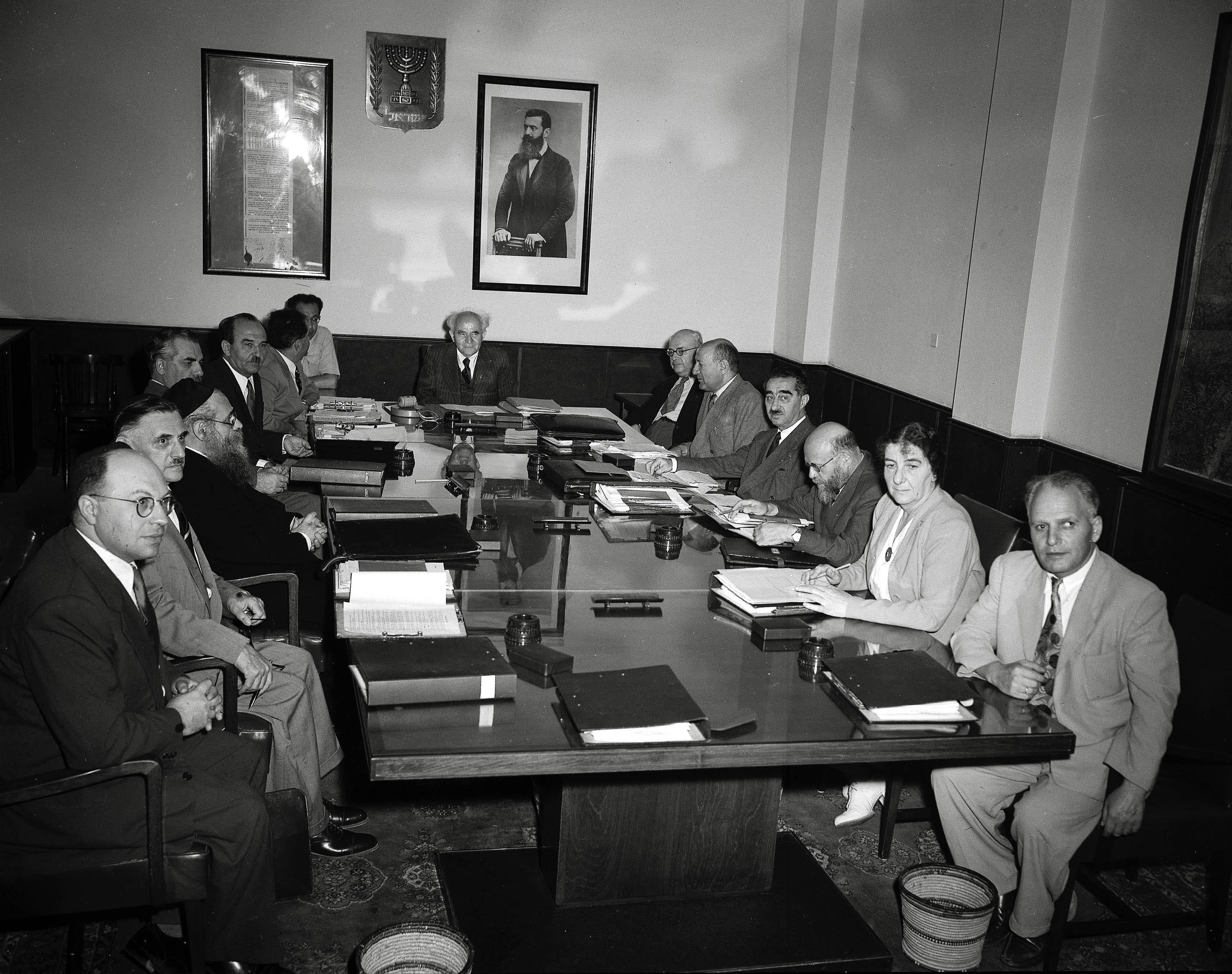
On May 14, 1948, with fighting underway and neighboring Arab armies preparing to enter the war, David Ben-Gurion declared the establishment of the State of Israel. There was no modern IDF, no Iron Dome, and no American military relationship remotely resembling today’s. Hindsight turns dangerous choices into dates on a calendar.
Levi Eshkol may be the least glamorous example, which is partly why he belongs here. In May 1967, Egypt moved forces into Sinai and closed the Straits of Tiran. Israel mobilized, but Eshkol first pursued diplomacy and accepted American requests not to initiate hostilities while Washington explored an international response.
When diplomacy failed, Eshkol expanded his government, gave Moshe Dayan the defense portfolio, and authorized the June 5th strike. Six days later, the strategic map of the region had been transformed.
Eshkol did not know on June 4th that there was going to be a Six -Day War. He knew the straits were closed, Egyptian forces were in Sinai, diplomacy had not solved the crisis, and waiting carried risks of its own.
There is something important about Eshkol handing the defense ministry to Dayan. Beitzim does not require pretending you can do everything yourself. A prime minister has to decide who should be in the room and who should be given authority.
Menachem Begin’s record complicates any attempt to equate nerve with aggression. In 1981, his government ordered the airstrike that destroyed Iraq’s Osirak nuclear reactor. But Begin also made peace with Egypt and agreed to return Sinai. Those decisions pointed in opposite directions, but both carried enormous strategic and political consequences. Beitzim is not simply a willingness to use force.
In 1976, Israeli and Jewish hostages were held at Entebbe Airport in Uganda. The rescue plan required commandos to fly across Africa, defeat hijackers and Ugandan forces, free the hostages, and bring them home. On July 3rd, Rabin’s government approved the military plan. About an hour later, he told the chief of staff: “Let the troops take off.”
Entebbe became Entebbe because it worked. Rabin had to decide before anyone knew that it would.
During the Gulf War, Saddam Hussein fired Scud missiles at Israel. The United States pressed Israel not to retaliate, fearing that an Israeli strike could damage the coalition against Iraq. Shamir’s government chose restraint.
That same year, Operation Solomon airlifted more than 14,000 Ethiopian Jews to Israel in roughly 36 hours. One decision was not to strike back. The other was to move thousands of Jews out of a collapsing country with extraordinary speed. The point is not that the decisions were equivalent. They were not. It is that leadership does not always look like charging forward.
Ariel Sharon makes the distinction between commander and prime minister particularly clear. His military reputation was built on audacity: Unit 101, paratroopers, becoming a general, and the Suez crossing in 1973. I think Sharon’s beitzim were easier to see before he became prime minister.
As prime minister, the courage demanded of him was less cinematic and more consequential. His government launched Operation Defensive Shield in 2002. Three years later, a man associated for decades with the Israeli Right carried out the unilateral disengagement from Gaza, fought much of his own political camp over it, left Likud and formed Kadima. General Sharon could charge. Prime Minister Sharon had to calculate.
A commander asks how to take the hill. A prime minister has to decide whether the hill is worth taking.
Which brings me to Benjamin Netanyahu.
October 7th happened while he was prime minister. That fact is not going anywhere. But responsibility and a complete historical explanation are not the same thing. We still do not know everything that was warned, dismissed, assumed, or misunderstood in the years and hours before the attack.
The record will become fuller as investigations, testimony, and archival material accumulate. People who sat in the rooms will tell their stories. Historians will argue about what Netanyahu knew, what the military knew, what the intelligence services believed, what Hamas understood about Israel, and which assumptions failed. That is why I keep coming back to Golda.
I grew up with half a century of hindsight about 1973. We do not have that with October 7th. wWe are still inside it.
The American relationship is different now too. Earlier this year, I sat in the room at the Israeli-American Council National Summit in Florida and listened to retired General Michael “Erik” Kurilla, the former commander of U.S. Central Command, talk about Iran. He recalled a conversation with U.S. President Donald Trump and U.S. Special Envoy to the Middle East Steve Witkoff, in which Kurilla said, “If we’re ever going to take action, I want to phone a friend, and that friend is Israel.”
Kurilla explained that Israel had unique capabilities and emphasized the friendship between the two countries. Israel still needs America, but America also sees strategic and military value in Israel. An Israeli prime minister still has to know what to do when the interests of two close allies overlap, and when they do not.
Looking across these decisions, what interests me is not aggression. Some of the choices were to attack. Others were to wait, withdraw, negotiate, rescue, or restrain. Eshkol waited in 1967 and then authorized war. Golda rejected proposals for a preemptive strike in 1973 and then had to lead through the consequences. Begin bombed Osirak and made peace with Egypt. Shamir absorbed Iraqi Scuds without retaliating. Sharon spent much of his life associated with taking territory and then, as prime minister, withdrew from Gaza.
That is what I mean by beitzim. The person sitting in the prime minister’s office does not get the history book first. There is intelligence, pressure from Washington, generals arguing, families waiting for soldiers to come home, and sometimes no good option at all.
Someone still has to decide. Someone still has to have beitzim.
"Which brings me to Benjamin Netanyahu. October 7th happened while he was prime minister. That fact is not going anywhere. But responsibility and a complete historical explanation are not the same thing. We still do not know everything that was warned, dismissed, assumed, or misunderstood in the years and hours before the attack."
That is because, in stark contrast to Golda, who established the Agranat commission just six week after October 6, 1973, while Israeli troops were still in Syria and across the Suez canal in Egypt, Netanyahu has blocked the establishment of a commission of inquiry for the last three years. To the point that former chief of staff Halevy had to appoint internal IDF commissions of inquiry, in spite of the bad look of the army investigating itself, because learning from its mistakes - and taking personal responsibility, including tendering your resignation - is so central to the IDF ethos. But less so, apparently, to Israel's current ruling coalition's ethos.
So, indeed, not all leaders are blessed with Golda's leadership qualities.
It is not the same to be a “Monday-morning quarterback” and second-guess decisions made by others after the fact with the benefit of hindsight as being in the game.