

Please consider supporting our mission to help everyone better understand and become smarter about the Jewish world. A gift of any amount helps keep our platform free of advertising and accessible to all.
You can also listen to the podcast version of this essay on Apple Podcasts, YouTube Music, YouTube, and Spotify.
During a recent press conference, Israeli Prime Minister Benjamin Netanyahu paraphrased American historian Will Durant, arguing that justice and morality alone are insufficient to overcome forces of evil.
The quote in question comes from “The Lessons of History,” the slim 1968 masterwork Durant wrote with his wife, distilling a lifetime of historical study into its starkest conclusions.
The passage reads:
“Nature and history do not agree with our conceptions of good and bad; they define good as that which survives, and bad as that which goes under; and the universe has no prejudice in favor of Christ as against Genghis Khan.”
In other words, the universe does not protect the righteous simply because they are righteous. It does not guarantee that the gentle outlast the brutal, that the civilized outlast the barbaric, or that the good outlast the ruthless. The contrast between Jesus Christ and Genghis Khan is chosen precisely because it is so stark — to drive home the point that even the most profound moral distance between two figures offers no guarantee of physical survival.
The Hebrew prophets wrestled with exactly this problem repeatedly, across centuries, with a raw honesty that modern readers often underestimate. Jeremiah, standing amid the ruins of his world, asked directly: “Why does the way of the wicked prosper? Why do all the faithless live at ease?” Job observed that “the tents of robbers are at peace, and those who provoke God are secure,” and pressed the point further: “Why do the wicked live on, growing old and increasing in power?” listing in forensic detail how the violent and the godless thrive, raise families, and die in comfort, having never been made to account.
Habakkuk, surveying a world in which Babylon devoured nations, could not reconcile what he saw with what he believed: “Your eyes are too pure to look on evil,” he told God, “yet you remain silent while the wicked swallow up those more righteous than themselves.” Malachi echoed the same grievance from the mouths of the disillusioned: “Surely the evildoers prosper; even when they put God to the test, they escape.”
And in perhaps the most psychologically brutal of these passages, the author of Psalm 73 confesses that his faith nearly broke entirely: “I envied the arrogant when I saw the prosperity of the wicked” — watching them grow “fat and sleek,” free from the burdens that crushed better people, until he could barely see the point of virtue at all.
This is where the Anglo-Irish writer, philosopher, and politician Edmund Burke’s famous formulation becomes essential. If the universe has no inherent prejudice in favor of the righteous, then that preference must be created and maintained by human agency. Goodness is not a physical law. It does not enforce itself. Peace is not a natural condition; it is a constructed one, and its construction requires people willing to defend it.
Will Durant makes this concrete. He asks what would have become of Europe’s classical and Christian heritage had Charles Martel’s Frankish infantry not held at Tours in 732. The Renaissance, the Enlightenment, the very moral frameworks through which we now debate these questions — all of it was contingent, at that moment, on soldiers who were not debating philosophy. The culture was the passenger. The military was the vehicle.
More recently, we have seen what happens when the vehicle fails: the Buddhas of Bamiyan, dynamited by the Taliban. The antiquities of Mosul, systematically erased by ISIS. No argument of cultural or spiritual value slowed them. Only force, eventually, did.
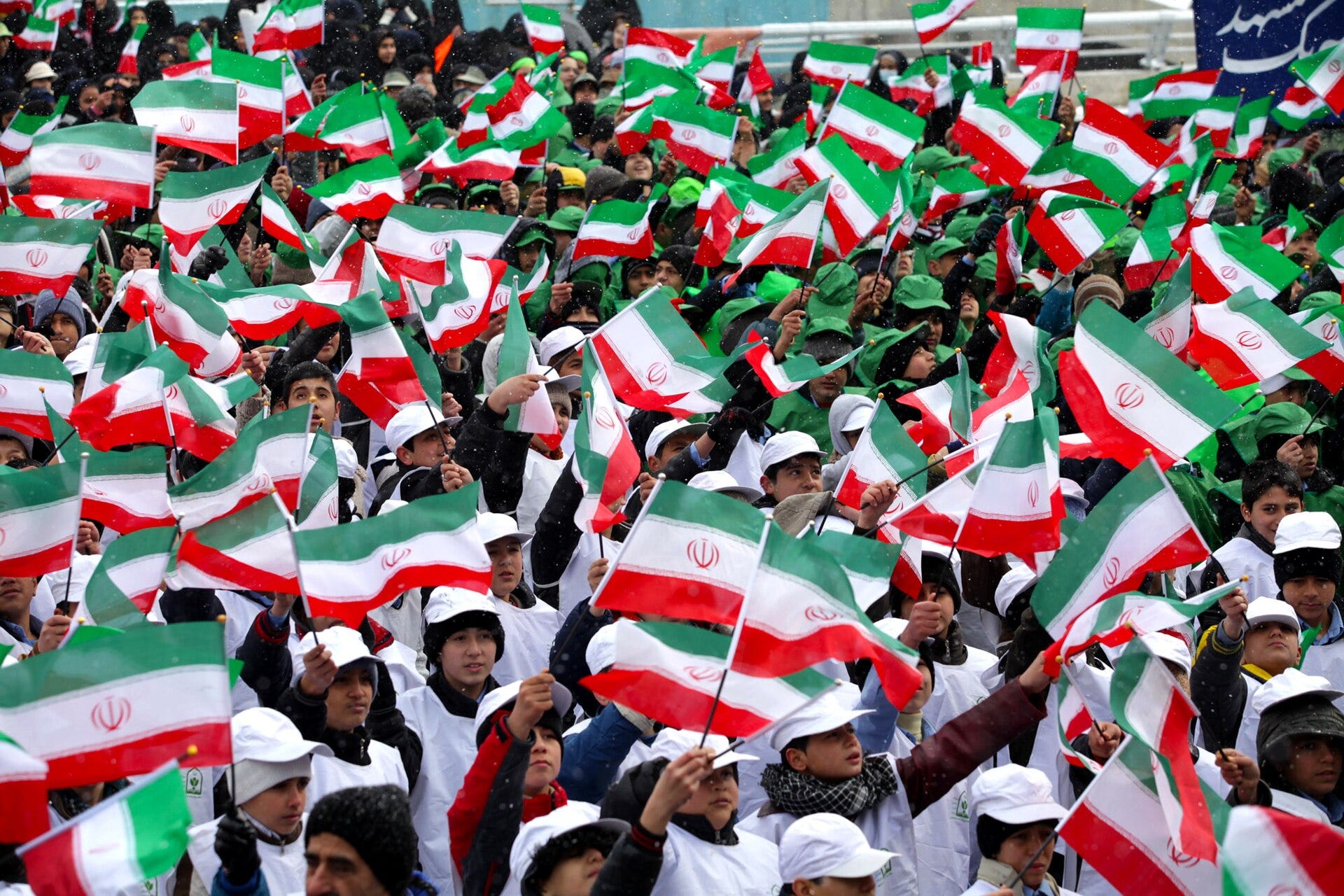
To think that the Islamic Republic of Iran is capable of reform is laughable. They are putting on a masterclass in gaslighting, accusing their self-proclaimed adversaries of everything they’ve done since Islamists overtook Iran in 1979.
It is a misconception that the Islamic Republic wages war only on other nations. Its first and most enduring war has been against its own people — beginning in 1979 and continuing, in different forms, to this day. A regime that sustains itself through internal coercion is not simply a geopolitical actor; it is a system of control that cannot reform without ceasing to be what it is.
Iranian officials have told the countries mediating between the Islamic Republic and the United States that they fear being fooled again after repeated U.S. deception — despite years of Iran’s insincere promises, inspections, and negotiations.
Iran’s foreign minister tried to rationalize the issue with insurance companies wary of ships in the Strait of Hormuz, saying: “Ships hesitate because insurers fear the war of choice … No insurer — and no Iranian — will be swayed by more threats. Try respect.” This after decades of making “Death to America” and “Death to Israel” trademarks of their hegemonic aspirations.
Iranian officials are claiming that the U.S. must recognize Iran’s “natural, legal right” over the Strait of Hormuz, while claiming that Jews have no natural or legal rights to our indigenous homeland in Israel.
Western discourse often draws a clean distinction between the regime and “the Iranian people.” In reality, after decades of totalitarian rule, that line is far harder to draw. Entire generations have lived within, adapted to, or been shaped by the system in ways that blur the boundary between state and society. This does not negate the courage of those who resist, but it does complicate the assumption that the regime can be cleanly separated from the population it governs.
Under such conditions, survival itself becomes a form of accommodation. Some keep their heads down, others perform loyalty, and still others integrate into the system’s institutions. Over time, this produces not just compliance, but entanglement — making any meaningful transformation more difficult, and more consequential.
Regimes like the Islamic Republic do not interpret restraint as goodwill; they interpret it as weakness. Their ideology is not a peripheral feature; it is the operating system. Concessions are banked, not reciprocated. Agreements are tools, not commitments. To expect transformation under pressure is to misunderstand the nature of revolutionary regimes, which often double down when challenged, not reform.
Even the phrase “regime change” obscures more than it clarifies. It can mean anything from superficial concessions to a fundamental transformation of power. But partial change (stripping capabilities while leaving the system intact) does not resolve the underlying threat. A regime built on ideological expansion and coercion will adapt, regroup, and return.
To such a regime, negotiation is not a path to resolution, but a tool of strategy. It signals not mutual respect, but the possibility that pressure can be outlasted and adversaries divided. Each round of talks, absent decisive consequences, reinforces the belief that time is on its side. The Islamic Republic is not simply an external threat; it is a system sustained by internal coercion, ideological rigidity, and strategic patience. It does not negotiate in order to transform; it negotiates in order to survive. And survival, for such a regime, is victory.
The free world now faces an inflection point. It is not enough to debate sanctions, inspections, or diplomatic posturing. If the Islamic Republic is allowed to survive, the precedent is clear: Brutality and deception pay. Survival will be mistaken for strength, inaction for acquiescence. The lesson will echo across Iran and beyond, emboldening regimes that see morality as irrelevant to power.
What happens in Iran will not stay in Iran. Every adversarial regime is watching — Russia, China, North Korea, and non-state actors who draw the same lesson from Western hesitation. If the Islamic Republic survives after direct confrontation, the conclusion will not be subtle: The free world lacks the will to finish what it starts. Deterrence, once eroded, is not easily restored. It invites testing, probing, escalation. The cost of inaction today compounds into the cost of conflict tomorrow.
We have seen this pattern before. Lines drawn and not enforced do not preserve peace; they invite escalation. When consequences disappear, so does restraint. The refusal to confront aggressive regimes early rarely prevents conflict; it postpones it, allowing the threat to grow more dangerous, more entrenched, and more costly to defeat.
The argument against decisive action is familiar: the fear of escalation, of another endless war, of unintended consequences. These concerns are not trivial. But they rest on a flawed assumption that inaction is the safer path. History suggests otherwise. The choice is not between war and peace, but between confronting danger at a manageable stage or facing it later under far worse conditions.
But to finish the job — to dismantle the regime and neutralize its capacity for tyranny — is to recognize history as it truly is: a battlefield in which only those willing to wield strength judiciously ensure that good, civilization, and decency persist. To “finish the job” does not mean blind escalation or indefinite occupation. It means ensuring that the regime can no longer project terror, destabilize regions, or threaten annihilation as policy. It means removing not just capabilities, but the belief (deeply embedded in its leadership) that time and deception will always secure its survival.
Hence the paradox of this moment. The universe does not favor the righteous. Civilization, security, and the very survival of the free world depend on human courage, resolve, and action. Justice is not automatic; it is defended. Peace is not inevitable; it is enforced.
And in the case of the Islamic Republic of Iran, delay risks more than deterrence; it risks the collapse of the moral and strategic logic upon which the free world rests. At this inflection point, history waits for a decision: Either allow evil to outlast virtue, or act decisively to ensure that it does not.
History does not remember intentions. It remembers outcomes. At this inflection point, the question is not what the free world believes — but what it is willing to do to ensure that those beliefs survive.
First class article.
The conclusion is carefully evidenced by the historical and contemporary facts explained all the way through every fascinating part of the article.
I hope, I PRAY that Trump has the courage to finish the job.
Iran Delenda Est
This is a primer on the nature of good and evil, and that victory of the moral and just reside not in the abstract, but in the hands, will and action of humans willing to to go beyond mere defense of those tenants and fight, physically, technologically, and intellectually to eliminate the humans, individuals and groups, that hold back moral progress of our societies.
Good job, Joshua. This essay should be placed on the desks of every member of the governing bodies of the countries of the free world.