


Please consider supporting our mission to help everyone better understand and become smarter about the Jewish world. A gift of any amount helps keep our platform free of advertising and accessible to all.
This is a guest essay by Nachum Kaplan, a longtime journalist and commentator who writes the newsletter, “Moral Clarity.”
You can also listen to the podcast version of this essay on Apple Podcasts, YouTube Music, YouTube, and Spotify.
Geography has long dictated Israel’s military doctrine.
Israel was small, its enemies were close, and it expected to fight short, devastating wars within a few hundred kilometers of home. The Israel Defense Forces was built around mobilization, rapid maneuver, air superiority, and destroying its enemies before a long war could grind down the small country.
That strategic grammar is being rewritten.
Much attention has been paid to Israel’s decision to manufacture more of its own weapons, reduce its dependence on the United States, and revive capabilities it abandoned during the long era of American military abundance. Israel has committed hundreds of billions of shekels to a decade-long force buildup and revamp; domestic munitions production is being expanded; and senior officials are contemplating building indigenous combat aircraft again.
But industrial sovereignty is only part of the story. Israel is also buying additional American F-35 and F-15IA fighter jets, an important reminder that greater strategic autonomy does not mean autarky. Even countries determined to become more self-reliant know the value of state-of-the-art American fighter jets.
The more consequential transformation is operational. Israel is developing an army that will be able to see farther; remain in combat longer; strike at continental range; absorb simultaneous attacks from several theaters; and connect machines, sensors, and human commanders at speeds that would have been impossible a generation ago.
The clearest evidence comes from the IDF itself. Its new 2026-to-2030 plan, Hoshen (חושן) — named for the biblical High Priest’s breastplate, whose 12 stones represented the 12 tribes of Israel — identifies 12 corresponding core areas for development. Among them are strengthened borders, air defense, “third-circle and depth” operations focused especially on Iran, intelligence collection, digital systems and artificial intelligence, robotics and autonomy, space, renewed ground maneuver, and the ability to keep operating under fire.
The categories reveal a conceptual shift: The IDF is envisaging a future battlefield that stretches from the fence outside a kibbutz to Iranian airspace and into orbit above it. That is an extraordinary enlargement of Israel’s military geometry.
Iran sits roughly 1,500 kilometers from Israel. Yemen is farther still. For decades, the IDF could think of such places primarily as intelligence problems, covert-operation arenas, or exceptional long-range strike targets. They are going to become ordinary parts of the IDF’s operational map.
During Operation Rising Lion, the 12-day military campaign conducted by Israel against Iran in June 2025, Israeli unmanned aircraft accumulated thousands of flight hours over Iran and carried out more than 500 strikes and interdictions, while Israel’s satellite constellation produced more than 12,000 images of Iranian territory. Fighter aircraft operated deep over Iran after Iranian air defenses had been taken out. Distance was no longer dividing Israel’s tactical battlefield from its strategic one.
The arrival of the KC-46 aerial refueler makes that shift more durable. Tankers are unglamorous, but military power has always depended on unglamorous things such as fuel and logistics and things that Netflix will never make a series about. A fighter jet that cannot refuel is a local weapon. With aerial refueling it becomes part of a regional strike architecture. Israel received its first KC-46 in May 2026, the beginning of a six-aircraft fleet intended to extend its fighter jets’ endurance and range.
New F-15IAs will add increased payload. The F-35 contributes stealth and sensor fusion; the F-15 offers exceptional carrying capacity and range. Combined with tankers, long-range munitions, electronic warfare, and persistent intelligence, Israel will have an air force built for sustained campaigns well beyond its borders rather than exceptional raids at extreme range.
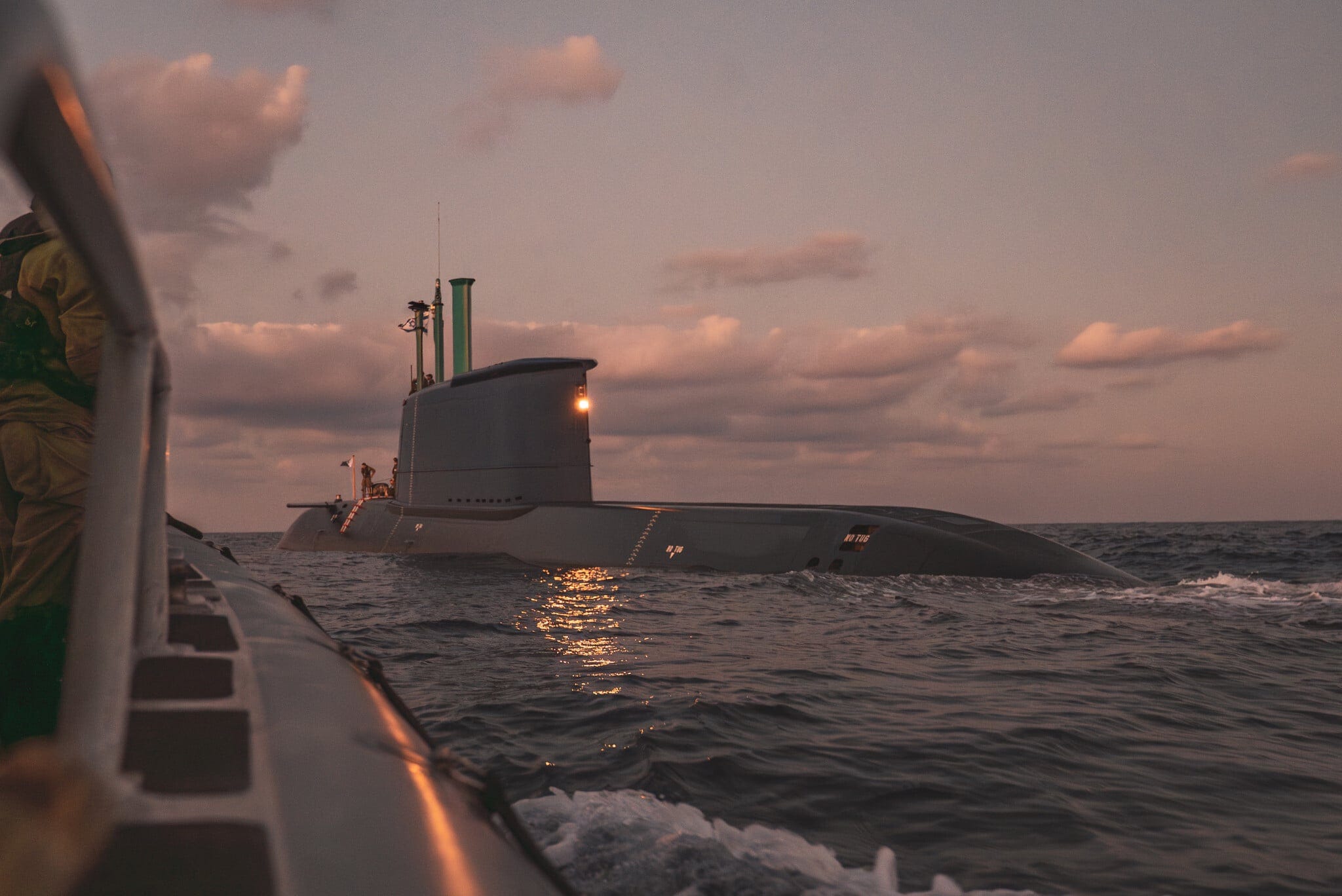
The same logic is visible at sea. INS Drakon, Israel’s sixth submarine, arrived in Haifa this month. Its air-independent propulsion allows for prolonged submerged operations, while the next-generation Dakar class is already under construction. Much about Drakon’s weapons fit remains classified. Naval analysts have speculated that its unusually enlarged sail suggests it will have vertical-launch tubes, which would allow it to launch cruise missiles more efficiently, including ones with nuclear warheads as part of the Jewish state’s nuclear triad.
Israel is keeping mum on this, which is rather the point of submarines. Their great virtue is that the other side does not know precisely where they are, what they are doing, or even what they can do. They provide persistence, survivability, and the ability to position hidden military power a long way from home. They are also increasingly important because Middle Eastern powers almost across the board are investing heavily in submarines.
Yet range is only half the transformation; the other is time. Modern war is increasingly a contest over the interval between detecting something and acting upon it. Militaries once organized intelligence, command, and firepower as related but recognizably separate functions. Digital warfare compresses them into what strategists call a sensor-to-shooter chain.
A satellite photographs a location; software compares the image with earlier imagery; signals intelligence adds another layer; algorithms identify anomalies; analysts evaluate the information; commanders decide what action is warranted; a drone, missile or aircraft can then be tasked.
The decisive variable is becoming latency: how quickly information can become military effect. In warfare, as elsewhere, everyone would now like the loading screen to disappear.
Israel is investing heavily to shorten that interval, and the Ministry of Defense created a dedicated AI and Autonomy Administration last year. Officials have described the recent conflict as Israel’s “first robotics war,” claiming tens of thousands of autonomous systems have been fielded across air, land, and sea. Hoshen makes AI and autonomy independent pillars of force development rather than specialist adjuncts.
Space is likewise being reconceived as a warfighting domain, an idea that disappeared somewhat from public imagination after the Cold War but never entirely from military planning. After the launch of the Ofek 19 reconnaissance satellite last year, Israel announced it would spend billions over the coming decade on a satellite constellation to provide persistent surveillance across the Middle East.
This is where fashionable discussion of “AI warfare” requires greater precision. AI does not abolish the fog of war. Nothing so convenient is on offer. It changes its scale and, more importantly, the speed at which decisions can be demanded.
The IDF says systems such as Habsora and Lavender assist analysts in organizing and cross-referencing enormous quantities of intelligence rather than autonomously authorizing attacks. Target identification and strike approval remain human decisions. Media investigations have nevertheless questioned whether wartime pressure could weaken safeguards or produce excessive trust in algorithmic recommendations.
The issue matters because the speed that AI delivers creates a permanent tension between acceleration and scrutiny. Every military seeking a shorter kill chain will confront it. The machine can make information arrive faster. It cannot make judgment infallible.
Autonomy also changes the economics of war. A fighter aircraft is extraordinarily capable and extraordinarily expensive. Small unmanned systems can be expendable. Swarms, loitering munitions, cheap reconnaissance drones, and robotic vehicles allow a military to distribute sensing and firepower among thousands of nodes instead of concentrating everything in a few exquisite platforms. The future of warfare appears to involve $100 million aircraft sharing a battlefield with machines that look as though they were assembled in somebody’s garage.
Israel’s decision in 2025 to buy thousands of locally manufactured FPV drones for its ground forces points toward a battlefield in which an infantry formation possesses forms of reconnaissance and precision attack that once belonged to considerably higher commands.
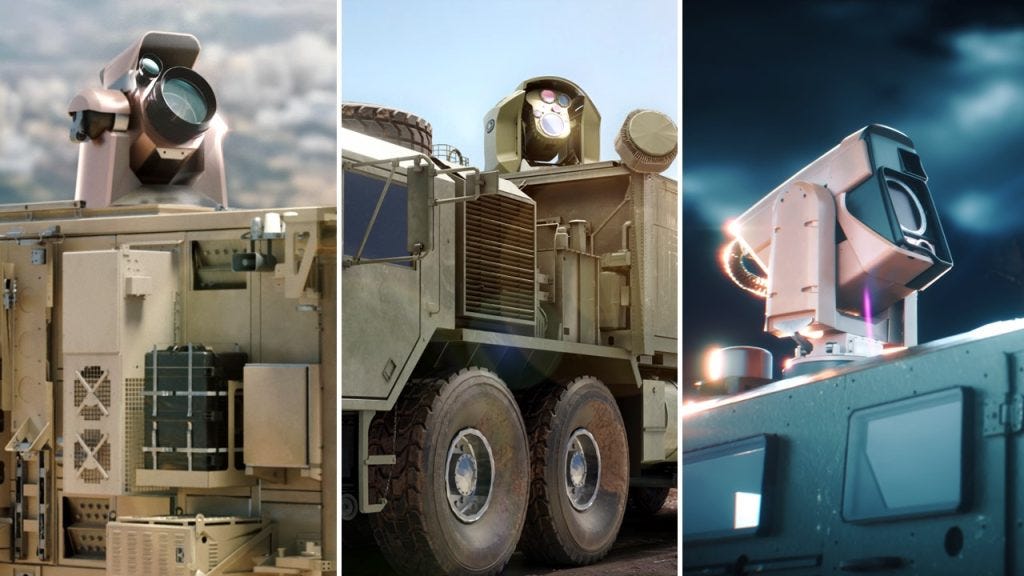
Defensively, the same economic problem appears in reverse. Israel cannot indefinitely shoot down every cheap drone or rocket with hugely expensive interceptors. Shooting down a flying lawnmower with something priced like a small house has limits. So Iron Beam, the high-power laser system delivered to the IDF at the end of 2025, represents something more interesting than another layer on an already elaborate air-defense diagram. Lasers alter the economics of interception.
Israel’s missile-defense systems Iron Dome, David’s Sling, and Arrow remain necessary for threats and conditions in which directed energy cannot provide the answer, while Iron Beam adds a weapon whose magazine is constrained principally by energy generation rather than finite interceptor stocks. Israel is trying to build a defensive architecture that can survive saturation rather than just shooting down individual incoming weapons.
All of this might suggest a future IDF composed of software engineers, satellites, and unmanned machines, with soldiers being reduced to supervising an aggressive collection of laptops.
Yet October 7th produced the opposite lesson as well. Technology could not hold territory, physically defend communities, or substitute for sufficient forces at the point of attack.
Under Chief of Staff Eyal Zamir, the IDF has begun adding formations rather than just digitizing existing ones. Plans include another maneuver division, additional reserve formations, a new reserve tank brigade, strengthened eastern-border forces, more defensive positions and obstacles, and drones and local firepower for units guarding Israel’s frontiers. Zamir has said that Israel cannot rely on a minimal force structure and requires “wide security margins.” That may prove the most difficult change of all.
For years, advanced militaries have conceived of wars as pitting mass against sophistication. Large armies supposedly belonged to industrial warfare; small, exquisitely networked forces belonged to the information age. Israel’s recent experience points toward a synthesis.
Tanks are being connected to drones. Infantry receives its own aerial sensors. Satellites feed distant strike networks. Algorithms process volumes of information that humans could never absorb unaided. Lasers supplement missile interceptors. Submarines, tankers and unmanned aircraft stretch the theater while new brigades thicken the home frontiers. Apparently the tank is not obsolete after all. It has just acquired Wi-Fi and will be deployed differently. Mass and sophistication are ceasing to be opposites.
The IDF emerging from this decade’s wars is difficult to describe using the old categories of “large” or “small,” offensive or defensive, conventional or technological. It is being constructed around redundancy, depth, and connectivity. A single force must simultaneously prepare for infiltration across a fence, missiles descending from the upper atmosphere, cheap drones approaching at treetop height, urban combat underground, and strikes against targets more than a thousand kilometers away.
Israel’s traditional strategic problem was its lack of geographic depth. Its emerging answer is to manufacture depth technologically and organizationally: being able to see and fight at greater distances beyond its borders, dispersing combat power among crewed and uncrewed systems, defending the homeland in multiple layers, and retaining enough physical mass to survive surprise.
This is a profound change for a country where the distance between Tel Aviv and its borders once dominated its military imagination. Israel’s operational map now extends from a sentry position on the Gaza perimeter to a reconnaissance satellite passing over Iran.
Increasingly, the same military network connects them.
It's very sensible to be prepared because Israel has so many enemies. It seems like almost the whole world is at war at the moment. The instability seems like the end of the world.
When I read about the various Israeli intelligent weapon systems it reminded me of what the 101st Airborne is doing at Fort Campbell, Kentucky in this vein. Read about it in the National infantry Association quarterly publication the "Infantry Bugler" of which I'm a Life Member. The 101 is working this technology down to the squad level which means, like Israel, they'll be able to get these ideas down to where the rubber meets the road. Israel is revealing this capability as is the 101st to give our enemies major pause.