


Please consider supporting our mission to help everyone better understand and become smarter about the Jewish world. A gift of any amount helps keep our platform free of advertising and accessible to all.
You can also listen to the podcast version of this essay on Apple Podcasts, YouTube Music, YouTube, and Spotify.
In the early 1950s, the Israeli government was teaching its citizens how to make meals out of powdered eggs, margarine, and whatever else happened to be available that week. Food was rationed, housing was scarce, and hundreds of thousands of Jewish refugees were living in tents and temporary transit camps.
Seventy-five years later, that same country is on the verge of becoming one of the 25 largest economies in the world.
According to the International Monetary Fund’s October 2026 forecast, Israel’s nominal GDP is expected to reach approximately $747 billion this year, placing it 25th globally for the first time. Israel now ranks ahead of Sweden and Ireland, and sits just behind Belgium and Argentina.
Israel, a country of just over 10 million people surrounded by adversaries and engaged in one military confrontation or another for much of its existence, has built an economy larger than those of countries with vastly more territory, resources, and decades — sometimes centuries — of industrial development.
Israelis did not discover enormous oil reserves in the desert. They did not inherit a sprawling colonial trading empire. They did not enjoy the luxury of peaceful borders or the convenience of selling products to most of its immediate neighbors. And they certainly did not begin with a thriving economy. So how did Israel get here?
The answer is considerably more interesting than the familiar story about startups, cybersecurity companies, and the Israeli military’s technological prowess. Israel’s economic transformation began long before anyone had heard of venture capital, artificial intelligence, or a 25-year-old Israeli selling his company to Google for an amount of money that would make his grandparents question their career choices.
One of the least appreciated facts about Israel’s economic development is that much of its institutional foundation was established before the modern State of Israel became a state. When David Ben-Gurion declared independence in May 1948, the Jewish community already had banks, agricultural cooperatives, labor organizations, hospitals, schools, research institutions, and a developing industrial sector.
The Technion, Israel’s leading technological university, began teaching students in Haifa in 1924, nearly a quarter-century before independence. Its first class consisted of 16 men and one woman. The Hebrew University of Jerusalem opened in 1925, and Chaim Weizmann established the Daniel Sieff Research Institute, the predecessor of the Weizmann Institute of Science, in 1934.
The Zionist movement understood that establishing a Jewish state required considerably more than securing territory and issuing a declaration of independence. A functioning country needed an economy capable of supporting its population, building infrastructure, producing goods, and eventually sustaining itself.
Indeed, much of the pre-state Jewish economy was already more sophisticated than the popular image of Zionist pioneers working the land might suggest. Agriculture was symbolically important, but banking, manufacturing, commerce, education, and professional services were also essential parts of its development.
Israel’s future economic success was therefore rooted in something that rarely makes for exciting headlines: institution-building. You cannot create a modern economy simply by encouraging people to invent things. First, you need universities that educate them, banks that finance them, roads that connect them, and a functioning system that allows their businesses to operate.
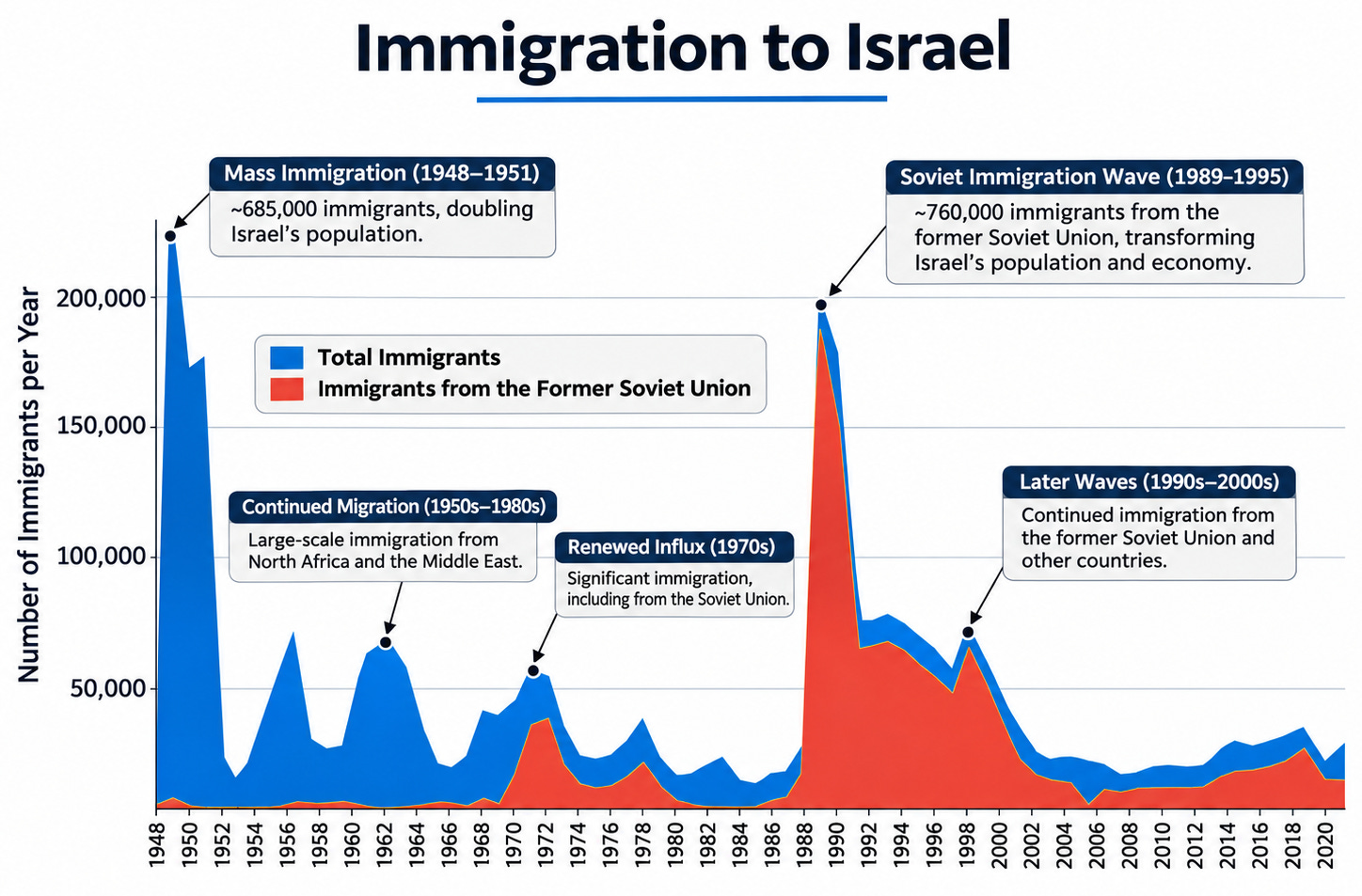
Israel’s next economic challenge was extraordinary: It had to absorb an enormous number of people while simultaneously fighting for its survival. Between independence in 1948 and the end of 1951, approximately 685,000 Jewish immigrants arrived, roughly doubling the country’s Jewish population. Many were Holocaust survivors from Europe. Others were Jews fleeing persecution, instability, and increasingly hostile conditions in countries across the Middle East and North Africa, including Iraq, Yemen, and Libya.
They arrived with very little money or property — and needed housing, food, employment, healthcare, transportation, and education. Israel had to provide all of these things while simultaneously developing the infrastructure of a new state. The result was tzena, the Hebrew term for the austerity period that defined Israeli life in the early 1950s.
The government introduced rationing for essential commodities, including food and clothing. Citizens received coupons and could purchase only limited quantities of certain goods. Powdered eggs became an unfortunate staple of Israeli cuisine, and the National Library of Israel still preserves government advertisements explaining how to substitute them for actual eggs. Imagine telling a Jewish mother that she could no longer buy enough eggs to feed her family, but the government had prepared a helpful pamphlet.
Yet behind the shortages, something remarkable was happening. Israel was converting an enormous humanitarian burden into the foundation of a much larger economy. The immigrants were not merely mouths to feed. They were future workers, business owners, teachers, engineers, doctors, farmers, and taxpayers.
Absorbing them was expensive, difficult, and often poorly managed. Many Mizrahi immigrants, in particular, endured years of hardship in underdeveloped transit camps and peripheral towns. But over time, successive waves of immigration expanded the country’s workforce, consumer market, and productive capacity. The population growth that initially threatened to overwhelm Israel’s fragile economy eventually helped power its expansion.
Israel’s early economic development depended heavily on money arriving from abroad. American assistance, loans, contributions from Jewish communities around the world, Israel Bonds, and reparations from West Germany all played important roles in financing the country’s development.
The 1952 Luxembourg Agreement, under which West Germany committed to paying Israel three billion Deutsche Marks in reparations, was particularly significant — and deeply controversial. For many Holocaust survivors, the notion of accepting compensation from Germany so soon after the murder of six million Jews was morally unbearable. Fierce protests erupted, and the debate exposed painful divisions within Israeli society.
But the economic consequences were substantial. The reparations helped finance imports of machinery, industrial equipment, ships, fuel, and other essential goods. Much of the compensation took the form of the physical equipment and supplies Israel needed to industrialize. By the mid-1960s, the reparations program had delivered equipment and supplies that helped expand Israel’s productive capacity.
Alongside these funds, American support and donations from diaspora Jews financed housing, infrastructure, and investment. The country attracted external capital and used much of it to construct the infrastructure of a functioning economy.
Between 1950 and 1965, Israel’s real gross national product grew at an average annual rate exceeding 11 percent. Some of that extraordinary growth reflected the rapid expansion of the population, but output per person also increased substantially. Israel was becoming an industrial economy, producing textiles, chemicals, manufactured goods, and agricultural exports.
And before Israel became synonymous with software and semiconductors, two of its best-known exports were oranges and polished diamonds — not exactly the product portfolio you’d expect from a future cybersecurity superpower.
No story better captures Israel’s early economic development than that of Simcha Blass, an engineer who helped pioneer modern drip irrigation. Blass was visiting a farm near Hadera (a city in northern Israel) during the 1930s when he noticed something peculiar: One tree was significantly larger than the others, despite receiving no obvious additional watering. Upon closer inspection, he discovered that a nearby pipe was leaking, allowing water to drip slowly into the soil around the tree’s roots.
Most people would have repaired the pipe. Blass saw a business opportunity. He began exploring whether water delivered slowly and directly to plant roots could produce better agricultural results than conventional irrigation. Years later, working with his son Yeshayahu, he developed a practical drip-irrigation system. In 1965, the technology became the foundation for Netafim, a company established in partnership with Kibbutz Hatzerim in the Negev Desert.
The results were striking. Early trials demonstrated that drip irrigation could dramatically reduce water consumption while improving crop yields. What began as an observation about a leaky pipe eventually became a globally important agricultural technology.
This illustrates something fundamental about Israel’s economic development. The country’s lack of natural resources did not automatically make it innovative. Rather, its constraints created strong incentives to develop technologies that would allow it to do more with less.
Limited water supplies encouraged irrigation technology and, eventually, desalination. Limited agricultural land encouraged more productive farming methods. Security threats encouraged investments in communications, aerospace, electronics, and defense technologies.
Scarcity alone does not produce innovation. Plenty of resource-poor countries remain poor. Israel’s advantage was combining the pressure of scarcity with engineers, research institutions, capital, and a growing willingness to commercialize new ideas. And that combination became increasingly important as Israel’s economy evolved.

When people discuss Israel’s technological rise, they generally begin in the 1990s. In reality, some of the most important developments occurred decades earlier.
Dov Frohman, a Jewish child born in Amsterdam in 1939, just months before World War II began, was entrusted by his parents to members of the Dutch resistance, who arranged for a Christian family to hide him during the Nazi occupation. His parents were murdered in the Holocaust. Frohman survived, immigrated to Israel in 1949, and eventually studied electrical engineering at the Technion.
He later moved to the United States, where he worked in Silicon Valley and joined Intel. While working there, he invented erasable programmable read-only memory, known as EPROM, an important breakthrough in semiconductor technology.
But Frohman wanted to help build a technological industry in Israel. In 1974, he returned and helped Intel establish a small development center in Haifa — the company’s first research and development operation outside the United States. Intel’s Israeli operations would grow into a major center for semiconductor design and manufacturing, helping establish the country’s position within the global technology industry.
Today, many of the world’s largest technology companies, including Google, Apple, Microsoft, Amazon, and Nvidia have established significant research and development operations in Israel. These companies are not simply opening offices to sell their products to Israeli consumers; they are employing thousands of Israeli engineers and scientists to develop technologies used by billions of people around the world.
What began as a small Intel development center in Haifa has evolved into a sprawling technological ecosystem in which some of the world’s most sophisticated companies come to Israel not merely to do business, but to innovate.
Israel’s transformation into a wealthy, technologically sophisticated economy was hardly inevitable.
By the early 1980s, the country was experiencing a severe economic crisis. Years of large government deficits, expansionary monetary policies, mounting economic imbalances, and the financial consequences of repeated wars had produced runaway inflation. In 1984, Israeli inflation reached approximately 445 percent. Israel’s currency was losing value so rapidly that the government eventually decided to eliminate three zeros from it.
In September 1985, the new shekel replaced the old shekel at a rate of 1,000 to one. But changing the currency was largely cosmetic. Stabilizing the economy required a much more fundamental transformation. In July 1985, Israel introduced an ambitious economic stabilization program combining major budgetary restraint, tighter monetary policy, exchange-rate measures, and agreements restraining wages and prices.
It worked. Inflation fell dramatically, reaching approximately 20 percent by the end of 1986. Although Israel still had years of economic reform ahead, the stabilization program marked a turning point.
Over the following decades, the country gradually moved away from the heavily state-directed economic model that had characterized its early development, liberalizing trade, strengthening private enterprise, and encouraging greater competition and international investment.
The same government-led institutions that had helped Israel survive its early decades were not necessarily the institutions best suited to producing the next generation of economic growth. Israel needed to preserve its investments in education, infrastructure, and scientific research while giving private businesses more opportunities to innovate, compete, attract investment, and sell to international markets.
In May of this year, the shekel reached approximately 2.80 per dollar, its strongest exchange rate since 1993.
Then came another extraordinary demographic transformation. Beginning in the late 1980s, hundreds of thousands of Jews arrived from the collapsing Soviet Union and its successor states. Between 1989 and 1995 alone, approximately 760,000 immigrants came to Israel, dramatically expanding the population.
This wave was different from many earlier immigration movements in one particularly important respect: A substantial share of the newcomers possessed advanced technical and professional qualifications. They included scientists, engineers, mathematicians, physicians, musicians, and highly educated professionals trained within the Soviet educational system.
Their arrival did not immediately translate into economic prosperity. Many struggled with Hebrew, the recognition of their professional credentials, and employment opportunities. A highly trained Soviet scientist could discover that finding work in Israel required considerably more than explaining the finer points of nuclear physics.
But as immigrants entered the workforce, founded businesses, and integrated into universities and research institutions, their skills expanded Israel’s human capital at a crucial moment. The immigration wave coincided with the early development of Israel’s modern technology industry, supplying an unusually large pool of scientists, engineers, and technically trained workers.
Once again, immigration initially created enormous financial and logistical pressures. Over time, it became a major source of economic growth. And once again, Israel’s long-standing commitment to absorbing Jewish immigrants ultimately reinforced its economic development.
By the early 1990s, Israel had many of the ingredients necessary for a thriving technological economy: world-class scientists, experienced engineers, universities, defense-related research, and a growing number of entrepreneurs. What it lacked was a sophisticated venture-capital industry capable of financing promising young companies.
In 1993, the government launched a program called Yozma, Hebrew for “initiative.” The program began with approximately $100 million in government funding and was designed to encourage the creation of private venture-capital funds investing in Israeli technology companies.
Rather than simply having bureaucrats choose which startups deserved government money, Yozma encouraged partnerships among Israeli investors, foreign venture-capital firms, and domestic financial institutions.
The government offered private partners an attractive opportunity to acquire its stake in successful funds after several years. Essentially, Israel used public money to attract private investment, transfer financial expertise, and create an industry that could eventually operate independently.
By the early 2000s, Israel’s venture-capital industry had become overwhelmingly private-sector driven. The program helped connect Israeli entrepreneurs with international capital, particularly from the United States, and strengthened the infrastructure required to commercialize technological innovations.
The country had spent decades developing people who knew how to build advanced technology. Now it was helping create a financial system that could turn those technologies into globally competitive companies. Companies such as Check Point, Amdocs, NICE, and later Mobileye, Waze, and countless others demonstrated that Israeli businesses could compete internationally.
The country’s relatively small domestic market also encouraged companies to think globally from the beginning. An American startup might build a successful business selling only to American customers. An Israeli startup generally had to consider international expansion much earlier. Silicon Valley turned out to be a particularly attractive alternative to Damascus.
By the early 2000s, Israel’s economic transformation was running into serious trouble.
The bursting of the dot-com bubble devastated the country’s emerging technology industry, while the Second Intifada dealt another blow to tourism, investment, and consumer confidence. Economic activity contracted in both 2001 and 2002, unemployment climbed into double digits, and government finances were deteriorating rapidly.
By 2003, Israel’s public debt had reached approximately 107 percent of GDP, while the central government’s budget deficit had ballooned to 5.6 percent of GDP. The country faced mounting pressure to bring its finances under control, even as its economy struggled to recover.
In early 2003, Prime Minister Ariel Sharon appointed Benjamin Netanyahu finance minister, placing him in charge of an economy facing one of its most difficult periods since the inflation crisis of the 1980s.
Netanyahu believed that Israel’s economic problems extended beyond the recession. In his view, the country had developed a bloated public sector, excessive government spending, high taxes, and a welfare system that discouraged too many people from participating in the workforce.
He famously compared Israel’s economy to a thin man carrying a fat man on his back. The thin man represented the private sector, which generated wealth and paid taxes. The fat man represented the public sector, which consumed an enormous share of the country’s resources. Eventually, Netanyahu argued, the thin man would collapse under the weight. His solution was to put the fat man on a diet — and he was not talking about skipping dessert.
Netanyahu introduced an aggressive economic reform program aimed at reducing government expenditure, encouraging employment, lowering taxes, privatizing state-owned businesses, and increasing competition. He cut ministry budgets, reduced welfare benefits and child allowances, tightened eligibility for certain benefits, and pursued reforms intended to encourage more Israelis to enter the workforce. He also restructured financially troubled pension funds and raised the retirement age.
At the same time, Netanyahu promoted reductions in income taxes, arguing that Israelis needed stronger incentives to work, invest, and build businesses. His ministry accelerated privatization efforts involving major state-controlled enterprises, including EL AL and the telecommunications company Bezeq, while advancing reforms to reduce the banking sector’s dominance over Israel’s financial markets.
According to the Bank of Israel, the 2003 Economic Recovery Plan helped prevent a financial crisis and restored credibility to government fiscal policy. And the recovery was substantial. Israel’s economy grew by 4.4 percent in 2004 and 5.2 percent in 2005. By the end of 2005, unemployment had declined to 8.8 percent, the central government’s budget deficit had fallen to just 1.9 percent of GDP, and the public-debt ratio was moving downward.
A country that had originally depended on extensive government intervention to develop its economy was now increasingly relying on private investment, international competition, entrepreneurship, and a smaller role for the state in commercial activity.

The most striking part of Israel’s latest economic milestone is the period during which it has occurred.
Since Hamas’ October 7th massacre in 2023, Israel has faced enormous military expenditures, repeated mobilizations of reservists, disruptions to tourism and construction, shortages of workers, and significant pressure on government finances. Hundreds of thousands of Israelis have had their ordinary lives interrupted by military service, while many businesses have struggled with employee absences, uncertainty, and reduced activity.
The economic costs have been substantial, yet Israel’s economy has continued to function. The Israeli economy’s capacity to withstand such shocks reflects decades of investment in human capital, export-oriented industries, financial institutions, and international economic relationships.
A company selling cybersecurity software to American financial institutions may continue generating revenue even when domestic construction projects are delayed or tourism collapses. Technology exports, particularly digital services, provide sources of revenue that are less dependent on the immediate conditions of Israel’s domestic market.
That does not make the economy immune to war. Military mobilization disrupts production, higher government spending creates fiscal pressures, uncertainty can discourage investment, and prolonged instability can encourage skilled workers and businesses to relocate. But the ability to absorb these shocks without experiencing a complete economic breakdown is a significant achievement.
Israel’s economy has undergone one of the most remarkable long-term transformations of any country established in the twentieth century.
It began as a small state struggling to absorb hundreds of thousands of impoverished refugees while financing a war and rationing basic necessities. It built industries through foreign capital, agricultural experimentation, public investment, and immigration. It developed world-class research institutions, survived a devastating inflation crisis, embraced private enterprise, attracted international technology companies, and constructed a venture-capital industry that helped turn scientific knowledge into commercial success.
And it accomplished all of this while facing security challenges that most developed economies have never experienced.
The most important lesson is that Israel never possessed a single economic advantage capable of guaranteeing its prosperity. Its greatest natural resource was not buried beneath the Negev or discovered beneath the Mediterranean Sea. It was the accumulated knowledge, ingenuity, ambition, and labor of the people who built the country.
And in 2026, nearly eight decades after independence, that effort has brought Israel into the world’s top 25 economies. From powdered eggs and ration coupons to a projected $747 billion economy, that is quite a return on investment.
Imagine if Israel's Arab neighbors had chosen peace rather than war ( at the various points in time they chose not to). Or chose peace today.
My dad invested in Israeli drip irrigation in the 1970s, by way of California wine. He put money into several companies that were investing in the use of Israeli drip-irrigation systems at California wineries. I thought of him while reading this great essay about how Israel went from rationing powdered eggs to building one of the world’s largest economies.
Israel’s greatest capital has always been its people. But people need somewhere to learn, somewhere to put their ideas to work, and somebody willing to put money behind them. The Technion was teaching engineers before Israel had a government. The young state took in hundreds of thousands of refugees when it barely had enough housing or food. Decades later, universities and businesses drew on the skills of engineers, scientists, and other professionals who arrived from the former Soviet Union. By the time anyone called Israel “Startup Nation,” generations of Israelis had already done much of the work.
Hoffman uses an IMF forecast to put a number on that achievement. I came away thinking about my dad. A country short on water had an engineer who paid attention to a leaky pipe. A kibbutz helped turn his idea into a business. And a generation later, my dad saw enough promise in that idea to put some of his own money into it. That’s a pretty good economic history in three sentences.