


Please consider supporting our mission to help everyone better understand and become smarter about the Jewish world. A gift of any amount helps keep our platform free of advertising and accessible to all.
This is a guest essay by Steven Dzik, a software engineer who lives in New York.
You can also listen to the podcast version of this essay on Apple Podcasts, YouTube Music, YouTube, and Spotify.
Earlier this month, mega-podcaster Joe Rogan made a remarkable claim on his enormously popular “The Joe Rogan Experience.”
Speaking with comedian Sam Tallent, Rogan suggested that Ashkenazi Jews (Jews from Eastern and Central Europe) are native Europeans rather than the dispersed descendants of the ancient Jewish population of the Middle East. He went further, claiming that Israel restricts genetic testing because it would reveal that many Israeli Jews are not really of Middle Eastern ancestry.
This is not a new idea. The claim that Ashkenazi Jews are Europeans with no ancestral connection to the Land of Israel has become a recurring theme in some anti-Zionist circles, frequently used to portray Jews as foreign colonizers rather than a people with ancient roots in the region.
Much has been written about Rogan’s comments, and I am not going to rehash arguments made elsewhere. Instead, I want to relate my own experience investigating my personal ancestry in ancient Israel. Incidentally, as a result of my DNA testing, I have received inquiries from people in Israel who have also undergone genetic testing and turned out to be close matches to me.
I am an American Ashkenazi Jew whose father was born in Warsaw, Poland. By Rogan’s reasoning, I am the perfect example of a European Jew whose ancestors came from somewhere other than the Middle East. There is essentially no difference between me and an Ashkenazi Israeli except where our parents or grandparents fled.
What I discovered about my ancestry tells a very different story. The evidence points strongly toward paternal ancestors who lived in or near ancient Judea some 2,500 to 3,000 years ago. And it all started with something my father told me as a boy, long before modern genetic testing existed.
My father told me that we were Cohanim, hereditary priests whose origins were in ancient Israel.
He inherited this status from his father, and I inherited it from him, as our ancestors had done since biblical times. His gravestone, like the one pictured below, bears the traditional symbol of the priestly blessing: two hands with the fingers parted in the middle. If you walk through a Jewish cemetery, you will likely encounter some of these. An estimated four to five percent of Jewish men are Cohanim.
In ancient Judea, the priests performed sacrifices and other religious duties in the Temple in Jerusalem. According to the Bible, we all descend from Moses’ brother Aaron. (Contrary to a misconception common in the media, not all Cohanim have the surname Cohen.)
Although the Temple has not existed for almost 2,000 years, this hereditary status is still passed from father to son, and more religious Jews continue to observe certain rules and traditions pertaining to Cohanim.
None of this mattered much to me when I first learned it, or for many years afterward. I am not particularly religious, and the theological significance of being a Cohen has never been especially important to me. Besides, there was no way to verify any of it. Perhaps my ancestors performed sacrifices thousands of years ago, or perhaps an ancestor a few generations back decided to call himself a Cohen for some personal benefit. Perhaps he wanted to impress a religious girl (just kidding).
In the early 1990s, Dr. Karl Skorecki, a Canadian-born physician and medical researcher living in Israel, was attending synagogue when he watched the Cohanim perform the Birkat Cohanim, the traditional priestly blessing.
He noticed something striking. The men performing the blessing had very different physical appearances. Some looked European, others Middle Eastern or North African. Yet all claimed the same hereditary status: descent through an unbroken paternal line from Aaron, the brother of Moses.
This raised a fascinating question: If Cohen status really had been passed from father to son for thousands of years, might these men share a detectable genetic inheritance despite their different geographic origins?
Skorecki recognized that the emerging science of Y-chromosome genetics might provide an answer. Unlike other chromosomes, the Y chromosome is passed from father to son essentially unchanged — just like Cohen status. (For those who need a refresher, females typically have two X chromosomes and males have an X and a Y. A father passes either an X or a Y chromosome to his offspring through his sperm.)
Occasionally, however, a mutation occurs on the Y chromosome and is inherited by succeeding generations. These mutations enable geneticists to trace paternal lines of descent and, by comparing the mutations between two men, estimate how long ago their most recent common ancestor lived.
Skorecki published his first paper on the subject in 1997. I read about it somewhere a couple of years later and was mildly curious, but I did nothing about it for more than 20 years.
As it turns out, that was probably for the best. DNA testing became more accessible and reliable, additional unrelated Cohen lineages were identified in 2009, and our understanding of the subject improved considerably. Unfortunately, my father has since passed away. He would have loved to learn about all this.
After I retired in 2022, my interest was rekindled. I had been encountering with increasing frequency the canard that Ashkenazim are not really Jews, but descendants of European converts with no ancestral connection to the Jews of ancient times.
If I was descended from the ancient Cohanim, I would have genetic evidence that I, personally, descended from the Jews who lived in ancient Judea. That was what mattered most to me, and why I decided to get a Y-chromosome test.
Not every DNA testing company can detect Cohen ancestry. Some test for the original Cohen markers identified in 1998, but much has changed since then. I had used 23andMe years earlier, but its classification of my Y chromosome was relatively superficial. FamilyTreeDNA, on the other hand, specialized in Y-chromosome testing.
About three years ago, I submitted a DNA sample to the company. I subsequently received an unsolicited message from the administrator of a FamilyTreeDNA-supported genetic genealogy group called J2a4 Levant Matches. (The Levant is the eastern Mediterranean region encompassing present-day Israel, Jordan, Lebanon, and Syria.)
Based solely on my Y-chromosome results, she identified my paternal lineage as one associated with the Cohanim. She did not even assume I knew what Cohanim were.
I had never told FamilyTreeDNA that I was a Cohen. The identification came entirely from my genetic results. My paternal lineage belongs to a branch designated J-FGC4992, which has been identified among Jewish men with traditions of priestly descent.
Scientists have constructed a Y-chromosome genetic tree tracing modern human paternal lineages back to Africa. As humans migrated out of Africa some 50,000 to 70,000 years ago, successive Y-DNA mutations gave rise to new branches of that tree, known as haplogroups.
J-FGC4992 is a sub-branch of the larger J2 (also called J-M172) haplogroup, an ancient paternal lineage found from Italy to India but centered around the Middle East. Many Syrian, Lebanese, Jordanian, Palestinian, and Jewish men belong to this group.
Since Skorecki’s original paper was published in 1997, some important discoveries have been made. Although the Bible says that all priests descend from Moses’ brother Aaron, researchers have repeatedly identified a handful of distinct paternal lineages among self-identified Cohanim with roots in the ancient Near East.
The largest lineage accounts for approximately 46 percent of the Cohanim studied, and the second-largest accounts for approximately 14 percent. I am one of those 14 percent. My lineage was identified as Cohen-associated in a 2009 paper, meaning that earlier tests would not have detected my status.
The most recent common ancestor of my lineage is estimated to have lived around 550 B.C.E., well within the timeframe of ancient Jewish history. Among the men found to share this paternal ancestor with me are Jews from India and Azerbaijan, communities whose histories date back to the Babylonian exile and the destruction of the First Temple in 586 B.C.E.
Despite centuries of geographic separation, Jewish families in different parts of the world had preserved both a common priestly identity and genetic evidence of shared paternal ancestry. This provided substantial evidence that the Cohen tradition preserved genuine historical ancestry dating back to ancient Israel and Judea.
A 2025 genetic-genealogy study published by Avotaynu examined the J-FGC4992 lineages, including my J-FGC4942 branch. Using detailed Y-chromosome results, the researchers reconstructed relationships among men from widely dispersed Jewish communities, dating important ancestral branching events to antiquity, broadly consistent with the era of the ancient Jewish kingdoms and the centuries surrounding the destruction of the First and Second Temples. They found a particularly strong association between these paternal branches and inherited Cohen identity.
I also have a personal connection to this research: My genetic results were included in the phylogenetic tree used by the researchers. In other words, my DNA is one of the pieces of evidence contributing to the reconstruction of this ancient paternal family.
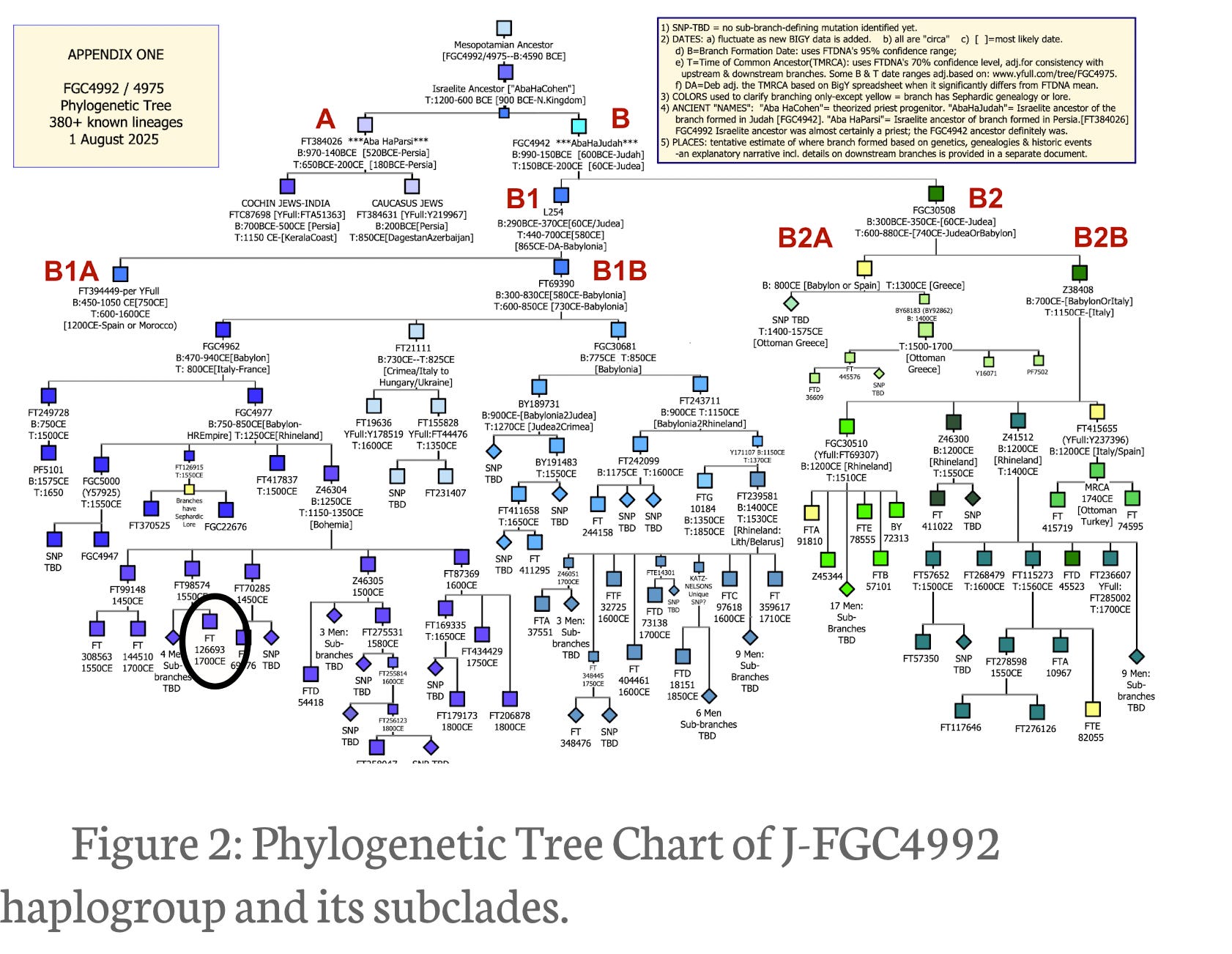
One of the most compelling aspects of this research is the geographic distribution of the men who share these lineages. Cohen-associated paternal branches occur among Jewish families whose more recent histories lie in Morocco, Italy, Turkey, the Caucasus, India, and Eastern Europe.
These communities developed in different cultural environments, spoke different languages, and were often separated for centuries. Yet some of their men inherited related Y-chromosome lineages and the same tradition of priestly descent.
How can we explain this? The most straightforward explanation is that these families inherited their paternal ancestry from an older Jewish population, before their ancestors dispersed into different regions.
Historical and archaeological evidence independently establishes that Jewish and Israelite populations inhabited the southern Levant in antiquity and that a hereditary priesthood was an important part of their religious institutions.
The oldest known written instance of the Birkat Cohanim was discovered in Israel and dated to between 650 and 600 B.C.E. It is essentially the same priestly blessing recited today in synagogues around the world. The genetic evidence fits into that historical picture. It does not allow me to identify the village where my ancestor lived 2,500 years ago, nor can it prove that he personally performed sacrifices at the Temple in Jerusalem.
Perhaps he lived in Jerusalem, or perhaps he lived in a nearby Judean town and traveled to the Temple whenever his priestly division was scheduled to serve. I sometimes amuse myself imagining an ancient ancestor commuting into Jerusalem for his turn on duty.
But the larger historical inference is substantial: My paternal ancestry, in all likelihood, comes from an ancient Jewish population living in Judea or the surrounding region.
Genetic testing has also revealed much more recent connections.
My closest Y-DNA match is a man whose father came from a town about 60 miles north of Warsaw, where my father was born. We believe our most recent common paternal ancestor lived in the early 19th century, although we have not yet established the precise genealogical connection. His daughter contacted me, and we have begun comparing our family histories.
That investigation is still incomplete, but it illustrates the extraordinary range of Y-DNA research. The same chromosome that connects me with a probable paternal relative from 19th-century Poland also places me within a lineage whose history extends back to ancient Jewish populations in the Near East.
Of course Ashkenazi Jews lived in Europe. My ancestors lived in Poland for generations. But geographic residence and ancestral origin are not the same thing. A family can live in one region for centuries while retaining ancestry from another, particularly when its ancestors were repeatedly expelled from their ancestral homeland and successive places of refuge.
Modern population-genetic research has repeatedly found that Ashkenazi Jews have both Middle Eastern and European ancestry. Their history includes migration, intermarriage, conversion, population bottlenecks, and centuries of life in European societies. That mixed history makes them no less Jewish, nor does it erase their ancestral connections to the ancient Jewish populations of the Levant.
My Y-chromosome results concern only one narrow part of my ancestry: the uninterrupted line from father to son, extending backward through the generations. They tell me little about the thousands of other ancestors who contributed to my genetic inheritance. But that single line can be investigated with unusual historical precision.
I am fortunate that this ancestral connection exists along a paternal line, extraordinarily fortunate that my ancestors passed down a message that survived thousands of years unmodified, and fortunate that researchers chose to investigate this phenomenon and publish their findings.
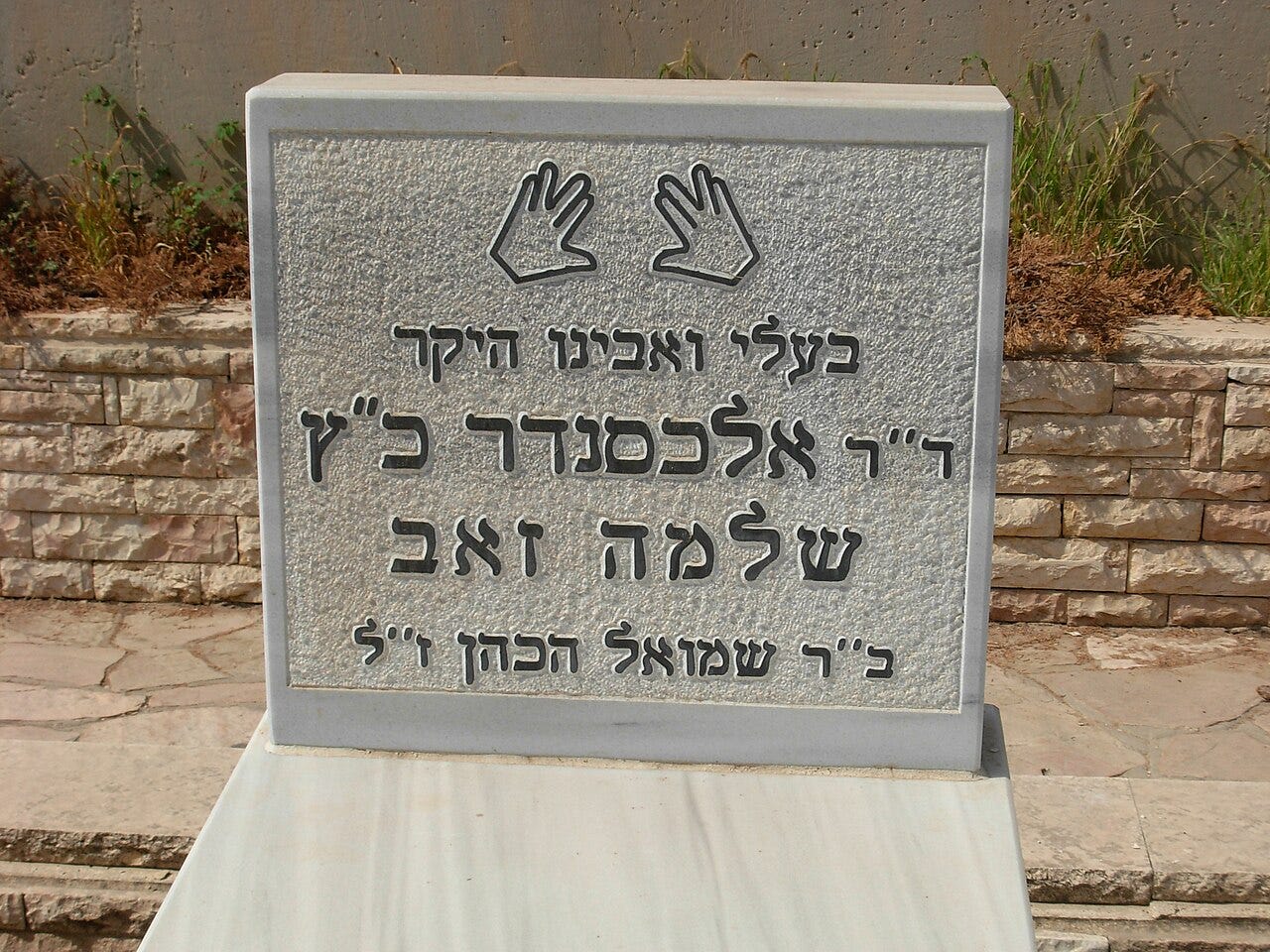
My family preserved a tradition of priestly ancestry. My father passed it down to me, and his gravestone bears the symbol associated with that tradition. My Y chromosome belongs to a lineage strongly associated with Cohanim across widely separated Jewish communities, and genetic research dates important branches of that lineage to antiquity.
Historical and archaeological research independently confirms the existence of ancient Jewish populations and priestly institutions in the region.
These different forms of evidence reinforce one another. There may be uncertainties about precisely where and when my ancestors lived, but the evidence does not point equally in every direction. It points toward the ancient Jewish world of Judea and the surrounding Near East.
What I am saying is that I am an Ashkenazi Jew who descends from the Jews of ancient Judea. I share common paternal ancestors with Jews in far-flung diaspora communities that have been separated for at least 2,000 years, and in some cases 2,500 years.
Our common ancestors passed down a message some 2,500 to 3,000 years ago that an estimated 96 percent of us have received unmodified: that we descend from the priests of the Temple. I have no idea who these ancestors were as individuals, but I know they existed. Historical research rarely affords us that degree of certainty about people who lived 2,500 years ago.
My paternal ancestry was particularly accessible because we are Cohanim. Several research studies have already done the hard work of identifying other Cohanim and analyzing their Y-DNA. It is reasonable to assume that other Jewish paternal lineages could be similarly traced if the same effort were made.
My father was born in Warsaw. His father and grandfather belonged to a Jewish community that had lived in Europe for generations. But their story did not begin in Poland.
Somewhere in the distant past, paternal ancestors of mine lived in the ancient Near East. Their descendants carried their Y chromosome through centuries of migration, dispersion, and changing political boundaries. Along the way, they also preserved a tradition that they belonged to the ancient Jewish priesthood.
Thousands of years later, my father passed that tradition to me, and modern genetic science has given me compelling reasons to believe that it reflects a genuine connection to the ancient Jewish people and their homeland.
I cannot tell you my ancestor’s name, where his house stood, or whether he ever walked through the gates of the Temple in Jerusalem. But I have good reason to believe that, long before my family lived in Warsaw, my paternal ancestors belonged to the Jewish people of ancient Judea.
That is not a statement of religious faith or a political slogan. It is a conclusion supported by the evidence.

All of this is true. Jews are definitely indigenous to Judea. Really all of this should go without saying but for the brainwashing going on. However I tire of these type of pocket turning out DNA explanations because: realistically even if every Jew from the ancient age except for the Kohanim and Leviim had been killed off and every Jew today was a convert they are still 100% Jewish, we can still do Judaism without turning it into some other religion like some people pretend and of course the land of Israel still belongs to a converted Jew as much as it does somebody who is related to Jacob directly. WE SHOULD NEVER SUBMIT TO THEIR BLOOD QUANTUM. IT'S A CLASSIC RACIST TACTIC USED BY ACTUAL COLONIZERS THROUGHOUT HISTORY!
I have some news for the Jewish nation:
Estimates for descendants of forcibly converted Jews
Estimates for the number of descendants of forcibly converted Jews range from roughly 5 million to nearly 200 million, depending on the historical scope and geographic regions included.
https://www.i24news.tv/en/news/international/culture/1663579057-nearly-200-million-people-worldwide-have-sephardic-roots
https://www.israelnationalnews.com/news/243824
Sephardic and Iberian Descendants (Anusim): Organizations like Reconectar and genealogical research estimate that nearly 200 million people globally—predominantly across Latin America, North America, and Europe—carry Sephardic Jewish ancestry stemming from the mass forced conversions and expulsions in Spain and Portugal (such as after 1492).
Diaspora Affairs Ministry Estimates: A report cited by the Israeli Ministry of Diaspora Affairs estimated roughly 95 million "lost Jews" or individuals with historical ties worldwide. This broader figure breaks down into:
5 million individuals who are direct descendants of converts or past converts.
35 million in communities with known historical Jewish roots.
60 million with potentially unrecognized or undeclared ancestry (including historical groups such as the Anusim in Iberia/Latin America, the Beta Israel/Falash Mura in Ethiopia, and others).
https://www.facebook.com/story.php?story_fbid=2512037625688973&id=NaomiLeiteAuthor
Christian and Islamic Conversions: While historical forced conversions to Christianity (such as during the Inquisition, Crusades, or under the Roman/Byzantine empires) and to Islam (across various Middle Eastern and North African eras) account for a substantial portion of these lineages, exact demographic headcounts are difficult to verify scientifically because centuries of intermarriage have heavily diluted distinct genetic markers.
https://en.wikipedia.org/wiki/History_of_the_Jews_and_Judaism_in_the_Land_of_Israel
https://en.wikipedia.org/wiki/Conversions_of_Jews_to_Christianity