


Please consider supporting our mission to help everyone better understand and become smarter about the Jewish world. A gift of any amount helps keep our platform free of advertising and accessible to all.
This is a guest essay by Rabbi Dr. Ed Rettig (pen name Anan Sahadei), an American-born Israeli attorney, rabbi, historian, and former director of the Israel/Middle East Office of the American Jewish Committee.
You can also listen to the podcast version of this essay on Apple Podcasts, YouTube Music, YouTube, and Spotify.
When Israel conquered the Gaza Strip during the Six-Day War in June 1967, it took about three days.
The defenders were Egyptian and Palestinian forces, including the Palestine Liberation Army, under Egyptian command. A study by the U.S. Army Command and General Staff College records just 55 Israeli and 626 Egyptian and Palestinian military casualties (killed and wounded combined) for the fighting in Gaza.
The contrast with Israel’s current war against Hamas is striking.
After two years of intense warfare and 13 months of uneasy ceasefire, Gaza has suffered significant destruction. Tens of thousands of Palestinians have been killed (predominantly terrorists and their families), thousands of Israelis killed or wounded, and large civilian populations displaced. Yet Hamas remains an organized force despite a ceasefire agreement intended to disarm it.
Many reasons explain this difference, including the opposing forces, Gaza’s urban environment, and the evolution of warfare since 1967. But one factor deserves more attention: Hamas’ extraordinary underground military infrastructure.
In February 2026, the Israeli military estimated Gaza’s tunnel network at 550 to 650 kilometers. This aligned with earlier estimates and research by the French Institute of International Relations, which placed the network at up to 600 kilometers.
To put 600 kilometers in perspective, consider some of the world’s great subway systems. The London Underground has about 402 kilometers of routes; the New York Subway roughly 399. Moscow’s Metro extends more than 500 kilometers, depending on the lines included. Even Shanghai’s immense subway network, among the world’s largest, extends about 900 kilometers.
Hamas built an underground network comparable in length to some of the world’s largest metropolitan rail systems. But there is an important difference. Greater London covers about 1,572 square kilometers, Moscow 2,561, and Shanghai more than 6,300. Gaza covers just 365. At an estimated 600 kilometers, Gaza contained about 164 kilometers of tunnels for every 100 square kilometers of territory.
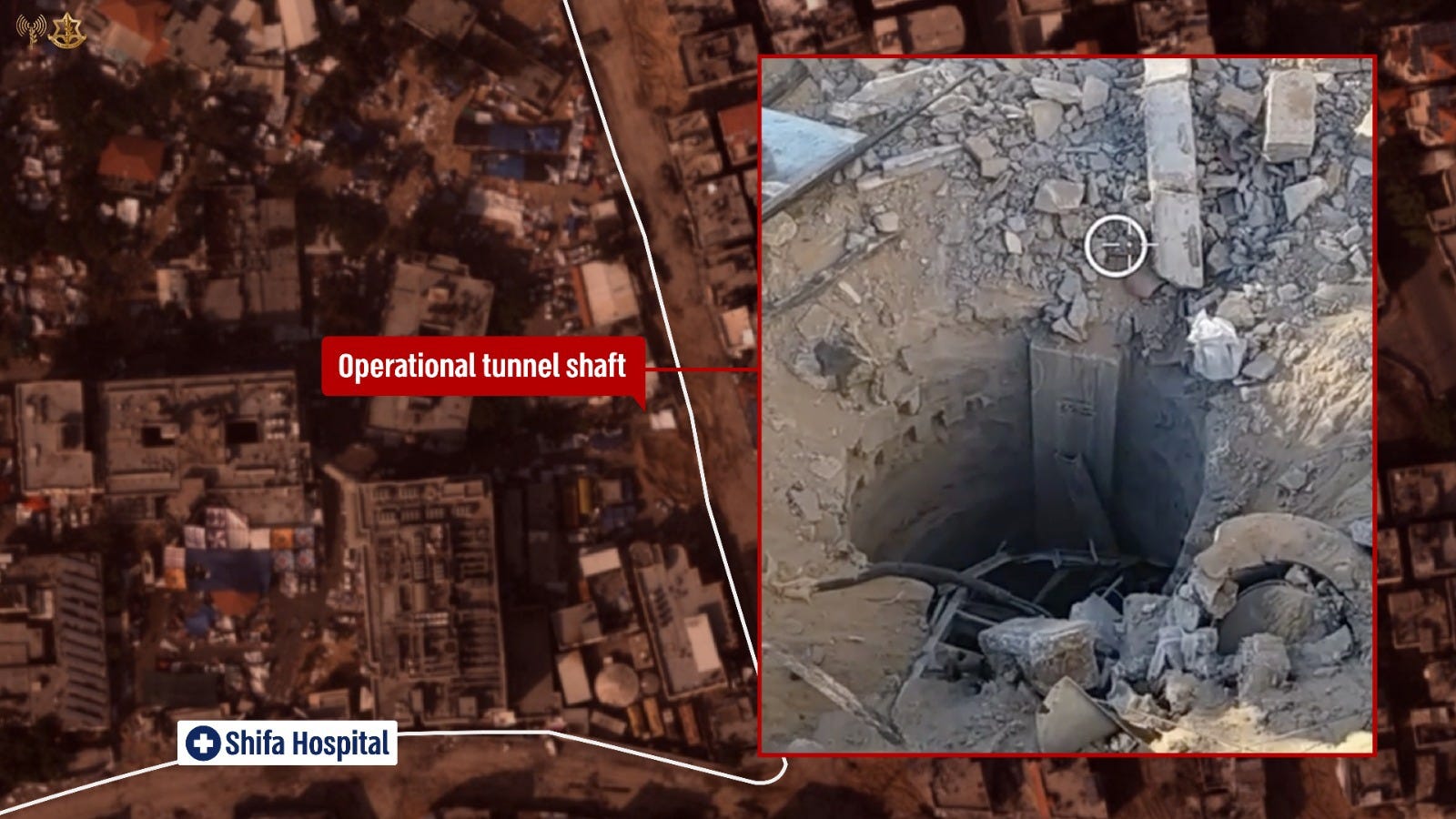
Hamas constructed an estimated 600 kilometers of tunnels with some 5,700 access shafts beneath Gaza’s 365 square kilometers, which averages out to 16 access shafts per square kilometer, providing its fighters with an extraordinarily extensive network of concealed routes between positions across the territory.
The comparisons are imperfect. Subway systems require stations, larger tunnels, electrical and ventilation infrastructure, and often include above-ground routes. Moreover, metropolitan administrative boundaries do not necessarily correspond to the areas served by their subways.
Nevertheless, the comparison conveys the extraordinary extent of Hamas’ underground infrastructure, concentrated beneath a territory whose prewar population density was about 6,000 inhabitants per square kilometer — comparable to major urban areas but considerably lower than some of the world’s densest cities.
The tunnels were not simply hiding places. They formed an extensive military infrastructure designed to carry out combat and support Hamas fighters. One principal purpose was to enable fighters to move between positions while reducing exposure to Israeli surveillance and fire.
The network reportedly included thousands of access shafts, command facilities, weapons stores, and connections between military positions. Some tunnels were deep enough to withstand air attacks.
American military researchers, including analysts at West Point’s Modern War Institute, have examined the exceptional difficulties this infrastructure created. It radically changed the battlefield. Israeli troops could capture buildings and streets without eliminating the armed forces beneath them. Hamas fighters could disappear underground, move between positions, and re-emerge to attack troops in areas that appeared secured.
Destroying the tunnels was another tough challenge. Finding an entrance did not reveal the network’s full extent. Underground operations required specialized equipment, engineering expertise, intelligence, and personnel. Destroying tunnels with explosives could damage buildings and infrastructure above. The visual impact of this warfare can be shocking and may encourage conclusions that the images alone cannot support.
Consider a recent declaration by actress Angelina Jolie. In October 2026, she published satellite images of Gaza’s destruction, observing, “You can now open Google Earth and see what was done to Gaza.” You can. Kind of.
But satellite images show only the surface of a battlefield that extends deep underground. They cannot reveal whether a destroyed building stood above a military tunnel, what operations occurred beneath it, or why a particular military decision was made. Failure to recognize this limitation means that Ms. Jolie is profoundly mistaken. You can only see a surface view, literally, of what was done to Gaza.
Jolie condemned the October 7th attack as terrorism and called for the release of the hostages. Yet her subsequent comments on Gaza, like much of the public discussion in the United States and Europe, have focused increasingly on Palestinian suffering, revealing a persistent blind spot concerning how and why the conflict — and that suffering — have been prolonged.
Photographs of destruction, however powerful, cannot alone establish the military circumstances, legality, or ethical viability of an attack. Any assessment ignoring the underground battlefield cannot adequately explain the war’s duration, the difficulties confronting Israeli forces, or the military consequences of Hamas’ strategy and, most important for our purposes, assess its moral valences.
The scale of Hamas’ preparations also raises questions about Israel’s failure to anticipate the threat. Israeli governments’ strategic conception allowed Hamas to consolidate its military position while Israeli policymakers continued to believe that it could be contained. Recognizing that failure does not diminish Hamas’ responsibility for the strategy it adopted.
Another aspect of this enormous network deserves examination. Gaza’s civilians endured prolonged bombardment, displacement, and suffering. Yet despite hundreds of kilometers of tunnels beneath them, there is little evidence that Hamas’ military network functioned as a civilian shelter system.
Consider London during the Second World War. During the German Blitz, Londoners descended into Underground stations to escape the bombing. Families slept on platforms. Entire communities established temporary lives beneath the streets. The photographic record is extensive, as are contemporary reports, personal recollections, and official records.
Now think about Gaza. An AI search via ChatGPT found accounts of civilians using older commercial smuggling tunnels connecting Gaza with Egypt. It found testimony from families who discovered Hamas had constructed military tunnels under their homes. It found extensive reporting about civilians sheltering in schools, hospitals, homes, and makeshift camps.
But it found no verified firsthand account of Gazan families sheltering in Hamas’ military tunnel network to escape Israeli bombardment.
If a network of this magnitude had sheltered civilians on any substantial scale, we would expect photographs, interviews, eyewitness accounts, or descriptions of how that sheltering was organized. Hamas would have had a public-relations advantage in showing its underground infrastructure protected Palestinian families, although military secrecy might have discouraged such publicity.
Instead, Hamas’ leadership publicly described the tunnels as intended only to protect its fighters. In an October 2023 interview with RT Arabic, senior Hamas official Mousa Abu Marzouk explained that the tunnels had been constructed to protect Hamas personnel from Israeli aircraft. Asked why comparable shelters had not been built for civilians, he blamed the United Nations for not protecting Gaza’s refugees.
An underground system of extraordinary scale protected a military force, while the civilian population had little choice but to seek safety largely above ground.
The tunnel network does not explain everything about the Gaza war, but the tunnels raise a separate and grave ethical question for Hamas: Having prepared an underground battlefield beneath a densely inhabited territory, what provision did it make for the protection of the civilians living above it? The answer appears to be next to none.
The underground network is as essential to understanding the conflict’s moral dimension as it is to understanding its technical military dimension, where it helps explain why occupying territory did not necessarily mean defeating its defenders, and why the war differed so profoundly from conventional campaigns, including Israel’s capture of Gaza in 1967.
It also raises a question unavoidable in any discussion of the war’s morality: How did Hamas allocate protection between its fighters and the civilian population under its governance?
The central fact is extraordinary. Beneath a territory of just 365 square kilometers lay a military tunnel network comparable in length to some of the world’s greatest subway systems; yet, while it did engage, to a degree, in emergency relief activities, civilians were left to fend for themselves when it came to protection against warfare prepared in advance.
This neglect of civilians’ safety in the planning of an armed conflict launched at Hamas’ initiative is only possible if it was a strategic decision arrived at through premeditation, and it is therefore iniquitous. As we saw in the case of Angelina Jolie, to its moral shame, public discussion of Gaza often disregards that iniquity.
Understanding the suffering of the Gazans necessitates examining not only what happened on Gaza’s streets and in its buildings, but also what was constructed beneath them, and who was, and was not, protected by it.

The ineptitude and carelessness of the Netanyahu government is appalling. Not only did they stand by with eyes closes, offering suitcases of cash, while Hamas built this network, they failed to prepare for a war in Gaza, ignored warnings of Hamas's attack, failed to guard the border, failed to come up with a strategy for winning the war, and have sacrificed by Gaza civilians and Israeli soldiers to a war that has only one purpose - to keep Likud in power and shield them from inquiry.
One cannot blame the international public—Ms. Jolie included—for viewing the staggering number of casualties in the Gaza conflict with horror. The toll is, indeed, heartbreakingly high.
In this, Hamas has achieved one of its war objectives: a significant public relations advantage.
This article clearly demonstrates that the terrorist organization deliberately sought to ensure as many Palestinian deaths as possible, purely for the sake of PR.
Therefore, the only appropriate response for Israel is to conduct a thorough and neutral investigation into the events leading up to and occurring during the conflict, before the International Court of Justice delivers its final verdict on the genocide charge.
Israel must surely be capable of such self-scrutiny—if only out of its own self-interest.