


Please consider supporting our mission to help everyone better understand and become smarter about the Jewish world. A gift of any amount helps keep our platform free of advertising and accessible to all.
This is a guest essay by Vanessa Berg, who writes about Judaism and Israel.
You can also listen to the podcast version of this essay on Apple Podcasts, YouTube Music, YouTube, and Spotify.
Every modern war has a story it tells the public, and a reality it conceals underneath the table.
In the case of the conflict with the Islamic Republic of Iran, the narrative has been dominated by nuclear threats, regional instability, and ideological confrontation. But beneath those shifting justifications lies something far more constant and far less discussed: the Strait of Hormuz.
It is one of the most important places on earth, and yet a healthy chunk of people probably cannot find it on a map. The Strait of Hormuz is a narrow, unassuming, and easy-to-overlook maritime corridor running approximately 100 miles long, through which a significant share of the world’s energy supply passes daily, and through which the balance of global power increasingly flows.
For centuries, the strait has been one of the most consequential passages on earth.
To its north sits Iran; to its south, the jagged Musandam Peninsula, divided between the United Arab Emirates and Oman. From the 16th century onward, empires understood its value instinctively. The Portuguese entrenched themselves there, only to be challenged by the British as global trade routes shifted and intensified. Geography made the strait unavoidable; history made it indispensable.
Today, that same geography explains far more about the U.S.–Israel–Iran conflict than most people know.
The conventional story of war with Iran is wrapped in familiar language: nuclear ambitions, regional instability, proxy militias. But beneath the surface, the logic is more structural, more enduring, and far less ideological. It runs through Hormuz. Roughly a fifth of the world’s oil supply passes through this corridor each day, alongside about a quarter of all seaborne oil trade and one-fifth of global liquefied natural gas. For Europe, it is “critical” to energy security. For Asia, it is lifeblood. And for China, it is something closer to a strategic vulnerability.
More than half of China’s imported oil flows through the Strait of Hormuz. That translates to roughly 40 percent of its total crude consumption — fuel that powers its industries, its cities, and its global ambitions. As the world’s largest oil importer, China draws over 55 percent of its imports from the Middle East, binding its economic stability to a maritime chokepoint it does not control. In a world increasingly defined by great power competition, that reality is not incidental; it is central.
Seen through this lens, the American calculus becomes clearer. The confrontation with Iran was never solely about Tehran. It was about leverage. Control, or even credible influence, over Hormuz offers something rare in geopolitics: the ability to exert pressure not just on an adversary, but on a rival superpower whose rise depends on uninterrupted energy flows. The battlefield may be the Middle East, but the audience is global, especially Beijing.
If conflict were to flare in East Asia, especially around Taiwan, the capacity to limit China’s energy imports would become a game-changer. Securing influence over the Strait of Hormuz isn’t merely a matter of the current crisis; it’s about shaping leverage for the battles that may lie ahead.
That is why, even as conflict escalated, Washington made moves that seemed contradictory on the surface. Just a few days ago, the U.S. Treasury Department relaxed sanctions on certain Iranian oil exports, easing pressure that had long been a cornerstone of American policy. The decision was framed as an attempt to stabilize surging gas prices, but it also revealed something deeper: The United States was calibrating pressure, not simply maximizing it. Total economic strangulation of Iran risked destabilizing oil markets in ways that would reverberate globally, including in ways that could undermine broader strategic goals.
Meanwhile, behind the scenes, the focus remains fixed on the waterway itself. More than 20 countries have been coordinating efforts to ensure the strait stays navigable. American officials signaled to their Israeli counterparts that military operations would be extended — not merely to degrade Iranian capabilities, but to create the conditions necessary for a U.S.-led effort to reopen and secure the passage. That operation, by some estimates, would take weeks. The implication was unmistakable: The war’s timeline was being shaped not just by battlefield dynamics, but by maritime strategy.
Iran, for its part, understood the stakes just as clearly. Reports indicated that the response from the Islamic Revolutionary Guard Corps (the regime’s most powerful military force) includes demands for a “new regime” in the strait. The proposal was striking in its ambition: Iran would effectively transform Hormuz into a toll gate, charging every vessel that passed through, much like Egypt does with the Suez Canal. Such a move would not merely generate revenue; it would formalize Iranian dominance over one of the world’s most critical energy arteries.
The reaction from the region has been swift and resolute. Gulf states, particularly Saudi Arabia, have rejected any arrangement that would grant Iran the upper hand in Hormuz. For them, the risk is existential. To concede control of the strait would be to place their own economic futures — and by extension, global energy markets — under the shadow of Tehran. Arab mediators have floated alternatives, including the creation of a neutral, regional body to oversee the passage and guarantee open navigation.
At the same time, the legal status of the Strait of Hormuz adds a deeper layer of complexity, one that has evolved over decades and remains unresolved. In 1959, Iran expanded its territorial sea to 12 nautical miles (22 kilometers) and declared that it would permit only “innocent passage” through these waters. Thirteen years later, Oman followed suit. By 1972, the result was striking: The entire strait fell within the overlapping territorial waters of Iran and Oman, effectively rendering it “closed” in a legal sense.
In practice, however, the 1970s saw little interference with maritime traffic. Neither Iran nor Oman attempted to block the passage of warships. That restraint began to erode in the 1980s, when both states advanced claims that diverged from established customary international law. When Oman ratified the United Nations Convention on the Law of the Sea in 1989, it reinforced its position by formalizing a 1981 royal decree: Only innocent passage would be allowed through its territorial waters, and foreign warships would be required to obtain prior authorization.
Iran took a similarly restrictive stance. Upon signing the convention in 1982, it declared that only states party to the agreement would be entitled to its rights, including the right of transit passage through international straits. A decade later, in 1993, Tehran codified this position into law, introducing regulations that conflict with UN provisions. These included requirements that warships, submarines, and nuclear-powered vessels seek permission before entering Iranian territorial waters, even for what would otherwise be considered lawful passage.
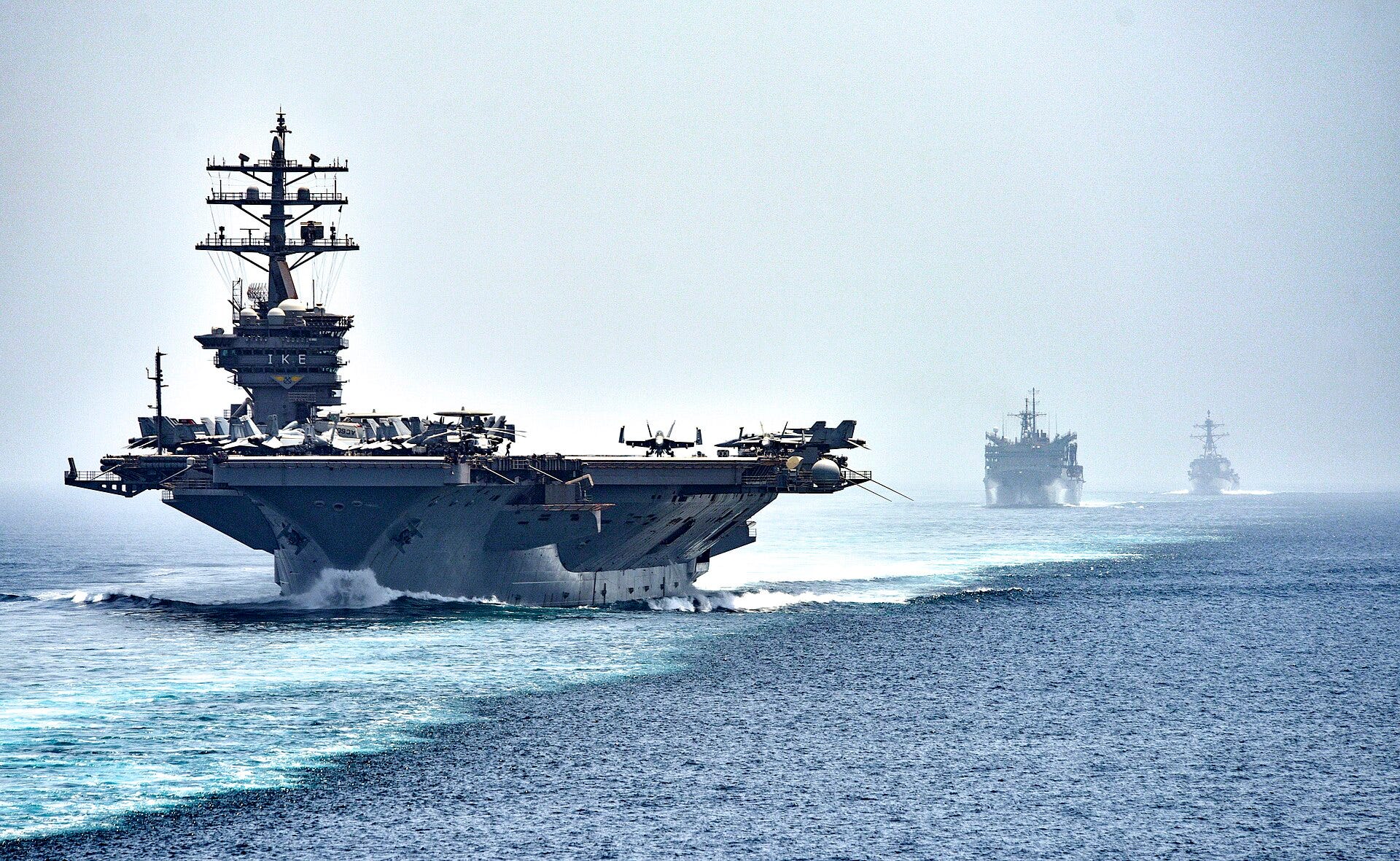
The U.S. has consistently rejected these claims. It does not recognize the restrictions imposed by either Iran or Oman and has actively challenged them, maintaining that the strait remains an international waterway where the right of transit passage cannot be curtailed by unilateral declarations. The result is a persistent gray zone, one where legal arguments and military realities intersect, and where enforcement ultimately depends on power rather than principle.
That tension is not theoretical. Iran has long possessed the means to disrupt traffic through Hormuz, including thousands of naval mines that can be deployed rapidly. Intelligence reports in 2025 suggested that Iranian forces had begun preparing such mines, raising alarms about a potential blockade. Though they were not ultimately deployed, the signal was clear: Tehran retains the ability to threaten the strait at will.
And the consequences of such a disruption would be immediate and severe. Even the suggestion of a blockade has historically sent oil prices surging. On Monday, Goldman Sachs sharply raised its oil price forecasts, expecting Brent crude oil to average $110 per barrel in March and April, up from a previous forecast of $98, or a 62-percent jump from the 2025 annual average, presuming that Hormuz flows remain at five percent of normal flows. Should Hormuz flows remain at five percent for 10 weeks, daily prices will likely exceed their 2008 record level, which hit about $147 per barrel in July 2008 before collapsing to around $40 within months as the global financial crisis crushed demand.1
Fatih Birol, the executive director of the International Energy Agency, warned that the situation in the Middle East is “very severe” and far worse than the two oil shocks in the 1970s, as well as the impact of the Russia-Ukraine war on gas, combined. Two weeks ago, the agency agreed to release 400 million barrels of emergency oil (the largest in its history) to stabilize global markets, with the U.S. contributing a significant portion (approximately 172 million barrels) from its Strategic Petroleum Reserve.
In other words, the vulnerability is systemic. As one assessment put it bluntly, major exporters like Saudi Arabia, Kuwait, Iraq, and Iran itself are “wholly locked into one tiny passage.” Hormuz is not just a route; it is a bottleneck that affects everything from oil and gas to petrochemicals, fertilizers, sulfur, and helium.
Ironically, that reality also constrains Iran. Its own economy depends heavily on the uninterrupted flow of oil exports, much of which is shipped through the very waters it threatens to close. At the center of this paradox lies Kharg Island, often called the “Forbidden Island.” Located hundreds of kilometers from Hormuz but inextricably linked to it, Kharg handles up to 90 percent of Iran’s oil exports and can store tens of millions of barrels. It is both a strategic asset and a strategic liability. Any disruption to the strait jeopardizes the lifeline that Kharg represents, especially Iran’s critical energy trade with China, its primary customer.
Efforts to bypass Hormuz have existed for years, but they remain limited. The United Arab Emirates has invested heavily in alternative infrastructure, including a pipeline that allows oil to be transported directly to the Gulf of Oman, avoiding the strait altogether. Storage facilities in the UAE have expanded accordingly, turning it into a growing hub for global energy trade. Yet these alternatives, while significant, cannot fully replace the capacity of Hormuz. The chokepoint endures.
So, what does Israel have to do with any of this?
At first glance, very little. The Strait of Hormuz means almost nothing to the Israelis. In fact, Israel’s primary maritime concern is the Strait of Tiran (whose closure helped trigger the 1967 Six-Day War) situated between Egypt’s Sinai Peninsula and Saudi Arabia’s Tiran Island.
But geopolitics rarely operates at the level of geography alone. The Iranian regime has defined itself in opposition to Israel since the Iranian Revolution and founding of the Islamic Republic of Iran in 1979, embedding anti-Israel hostility into the core of its identity and projecting that hostility through terror proxies across the region. Over time, that posture has made Iran not just Israel’s adversary, but a shared threat.
That convergence has quietly reshaped the Middle East. Many Arab states (some already aligned with Israel, others moving in that direction) have come to see Iran as the single greatest destabilizing force in the region. Its missile programs, network of terror proxies, and violent efforts to project power beyond its borders have made it a common denominator in regional insecurity.
For the United States, bringing Israel into the conflict served multiple purposes. On a practical level, it meant more firepower, better intelligence, and a more capable regional partner — factors that can compress timelines and increase the likelihood of a decisive outcome. A shorter war is not just militarily advantageous; it reduces economic disruption, including the risk of prolonged instability around Hormuz.
At the same time, Israel’s visible role provides Washington with a layer of political insulation. When necessary, responsibility can be diffused or redirected. Israel, for example, claimed credit for the assassination of Supreme Leader Ali Khamenei, a move that both reinforced its deterrence posture and absorbed some of the immediate backlash that might otherwise have been directed at the United States, some of whose populace is allergic to perceptions of “regime change.”
Even the way the two countries deployed their militaries made the distinction clear. Israel has been focused primarily on degrading Iran’s nuclear and ballistic missile programs, while U.S. forces have largely been oriented around securing and managing threats tied to the Strait of Hormuz. This division of labor has allowed both countries to pursue their core strategic objectives simultaneously.
For Israel, this amounts to a decisive strategic victory. It helped launch a massive, coordinated strike against its chief adversary — an operation it might otherwise have had to undertake alone, likely constrained by limited Arab support and the risk of an early, U.S.-brokered ceasefire, as witnessed last June.
Instead, the Israelis acted within a broader alignment of interests, allowing them to operate with greater freedom, sustain pressure longer, and achieve a more consequential outcome. In doing so, they not only degraded a longstanding threat but also reinforced Israel’s position as an indispensable partner in a rapidly evolving regional and global order.
“Oil tumbles nearly 11% after Trump puts hold on U.S. strikes against Iran energy infrastructure for five days.” CNBC.
Key Maritime Bottlenecks in the ME
Suez Canal Connects the Mediterranean Sea to the Red Sea. Critical for global shipping routes.
Strait of Hormuz Vital passage for oil shipments from the Gulf. Affects global oil prices and supply.
Bab el-Mandeb Strait Connects the Red Sea to the Gulf of Aden. Important for trade between Europe and Asia.
Conclusion
The importance of waterway bottlenecks is increasing in light of the sharp rise in oil prices (two-thirds of global oil trade is done by sea), since the closing of the Sueze Canal in the 70s by Egypt, the growing conflict between Iran, its proxies and the United States and Israel since 1979, the former attacks of the Houthis on economic maritime routes, the increase in Somali pirate activity near the Horn of Africa, the Islamic instability following the wave of anti-regime protests that swept North Africa and the Middle East since early 2011, and the growing awareness of the possibility of environmental disasters in narrow waterways.
Maritime bottlenecks in Egypt and the Middle East are not just geographical features; they are critical points that influence regional stability, economic health, and security. Addressing these vulnerabilities is essential for ensuring safe and efficient maritime trade in the region.
Even Saudi's diversion of its exports through the Red Sea still does not solve the bottlenecks in Bab el-Mandeb nor the Sueze Canal:
"Aramco’s Red Sea Lifeline: How the East-West Pipeline Became Saudi Arabia’s Only Oil Export Route"
by Abdul Mohammed
March 4, 2026
https://houseofsaud.com/aramco-east-west-pipeline-red-sea-yanbu-hormuz-bypass/
There are several practical solutions to solve this global pressure gage.
1) Extend the Saudi pipeline from the Red Sea to the Med. Sea.
2) Develop alternative energy sources in cooperation with Germany and Japan who are leading the pack in the development of hydrogen energy.
3) Safe nuclear energies.
4) Utilize existing clean energies like the sun, waves, hydroelectric and wind.
I looked at a Google map of the Musandam Peninsula. I am not an engineer, but I have been through the Panama Canal.
How about a joint effort by the Omanis and the USA and the Kuwaitis , the UAE and the Qataris to build a canal across the peninsula?