


Please consider supporting our mission to help everyone better understand and become smarter about the Jewish world. A gift of any amount helps keep our platform free of advertising and accessible to all.
This is a guest essay by Vanessa Berg, who writes about Judaism and Israel.
You can also listen to the podcast version of this essay on Apple Podcasts, YouTube Music, YouTube, and Spotify.
The opening phase of the war against Iran’s ruling regime marks one of the most consequential military and geopolitical moments in modern Middle Eastern history.
What began as a preemptive strike has evolved into a coordinated campaign with implications far beyond the battlefield — for Israel, for the Iranian regime, for the Middle East, and for the future balance of power across the world.
The war began on Saturday morning with the largest attack flight in the history of the Israeli Air Force. In the opening hours of the operation, codenamed “Roaring Lion,” approximately 200 fighter jets took part in a sweeping assault on Iranian leadership and military infrastructure across western and central regions of the country.
The initial flight wave, internally known as “Beresheet” (a Hebrew word commonly translated as “in the beginning”), was followed almost immediately by additional strikes targeting missile launch sites and defensive batteries. The scale, coordination, and precision of the operation signaled that this was not a symbolic show of force, but the opening blow of a sustained campaign.
Israeli leadership underscored the symbolic timing; the operation began on the Hebrew calendar date of the 11th of Adar, a date tied to the fall of early Zionist hero Joseph Trumpeldor at the Battle of Tel Hai more than a century earlier.
Tel Hai, today a small agricultural community on Israel’s northern frontier, began as a fragile outpost of early Zionist settlement in 1905. The land had been purchased during the waning years of the Ottoman Empire by Haim Kalvarisky, part of a broader effort to reestablish Jewish agricultural life in ancestral lands. Its remote location would later help define the northern boundary of the British Mandate for Palestine — the territory ultimately designated by the League of Nations as the Jewish national home.
From its earliest days, Tel Hai existed under constant threat. Its residents were not soldiers or conquerors, but farmers and laborers whose determination to work the land drew hostility from surrounding militias. In 1920, fighters from the Shiite region of Jabal Amil in southern Lebanon descended on the settlement. In the assault, eight defenders (six men and two women) were killed. Among them was Joseph Trumpeldor, the one-armed veteran of the Russo-Japanese War who had already become a symbol of Jewish courage and self-reliance.
The image of Trumpeldor, fighting with a single arm against overwhelming odds, quickly entered Zionist memory. The famous final words attributed to him — “It is good to die for our country.” — echoes both classical and modern traditions of patriotic sacrifice. Each year, his memory and the story of Tel Hai are commemorated as a defining moment in the ethos of Jewish self-defense and national revival.
Tactical Surprise and Intelligence Preparation
Roughly 12 hours after the first strikes, officials described the central achievement of the opening phase: Israel had managed to surprise Iran for the second time in less than a year.
Despite months of public speculation about a possible confrontation, the precise timing and method of the attack caught Iranian leadership off guard. Officials emphasized that this was a tactical surprise rather than a strategic one — Tehran had long anticipated conflict — but the unexpected timing fundamentally shaped the early success of the campaign.
The operation was the culmination of months of intensive intelligence work by Israeli military intelligence and the Mossad, in coordination with the CIA. Analysts mapped the routines of senior Iranian leadership, tracked meeting patterns, and identified windows of vulnerability when key figures would be least prepared for an attack.
Iran had reportedly been expecting a strike overnight. Instead, the operation began in the morning, creating an unexpected gap in readiness. Real-time intelligence enabled rapid targeting of high-value locations and senior figures in the opening minutes, before leadership could disperse or secure hardened facilities.
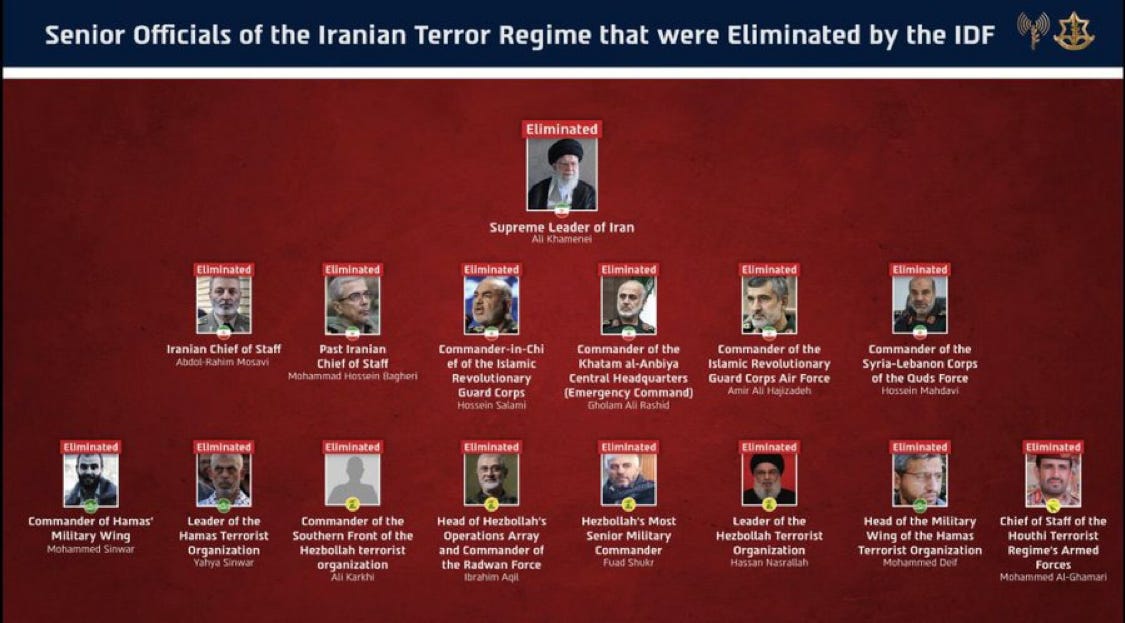
The result was a devastating first strike. Within the initial minutes, Iran’s Supreme Leader and around 40 senior officials were eliminated almost simultaneously, including Iran’s chief of staff, defense minister, and the head of Islamic Revolutionary Guard Corps. Mahmoud Ahmadinejad, a former Iranian president who said “Israel must be wiped off the map,” was also killed later in the day. Israeli officials described this as a deliberate attempt to decapitate the regime’s command structure before it could coordinate a coherent response.
The success of the opening strike was not only the result of intelligence gathering, but of a carefully constructed deception campaign. In the weeks leading up to the operation, Israeli political and military leadership worked to create the impression that no immediate action was imminent. Cabinet ministers and senior officials were instructed to avoid any unusual logistical preparations that might signal an impending strike. Routine activities continued. Public messaging remained deliberately ambiguous.
Even when ministers were briefed under strict secrecy agreements, they were told not to take visible preparatory steps, including avoiding early provisioning of emergency command centers. Some reportedly made ordinary purchases only after the operation had already begun.
External observers were similarly misled. Chinese satellite imagery assessments suggested that U.S. and Israeli forces were not preparing for immediate action. Analysts predicted that any Israeli strike would likely occur independently. In reality, the campaign emerged as a coordinated Israeli–U.S. operation once the first waves were underway.
The deception was designed to create maximum confusion among Iranian decision-makers. By the time Tehran grasped the scale and coordination of the assault, its leadership structure had already suffered severe disruption.
The Home Front: Civilian Impact and Preparedness
Even as the offensive unfolded, Iranian missile retaliation placed Israel’s civilian population under sustained threat. Airspace was closed to civilian flights, international routes were suspended, and aircraft were diverted as part of emergency security measures. Israeli carriers began relocating aircraft abroad to preserve operational capacity.
Authorities also issued global security warnings to Israelis and Jewish communities overseas, noting the increased likelihood of retaliatory attacks on Israeli or Jewish targets abroad. Citizens were advised to avoid publicizing their locations in real time, remain vigilant near Jewish or Israeli institutions, and exercise heightened situational awareness.
On the domestic front, the war has underscored the reality that modern conflict extends far beyond military installations. Missile strikes on civilian infrastructure have raised urgent questions about insurance, compensation, and recovery.
In Israel, standard property and vehicle insurance does not cover damage from war or hostilities. Instead, compensation for damage caused by missile strikes or security incidents is administered through a government compensation fund. The state assumes responsibility for restoring damaged structures and providing reimbursement for destroyed personal property.
The detailed legal and administrative guidance being circulated to civilians reflects the reality that this war is not abstract. It is being experienced in homes, neighborhoods, and daily life.
The Economic Front: How the War Is Reshaping Israel’s Economy
While missiles and fighter jets dominate headlines, another front of the war is unfolding quietly but decisively: Israel’s economy.
Since the first direct confrontation with Iran last June, Israel’s financial markets have been on a remarkably strong upward trajectory. The Tel Aviv Stock Exchange has posted consistent gains, with January standing out as particularly robust. Much of this momentum has not been accidental. Investors, both domestic and foreign, have been positioning themselves in anticipation of progress in the campaign to neutralize the Iranian threat, whether through coordinated action with the United States or independent Israeli operations.
In a very real sense, the market has already begun pricing in a future with reduced Iranian risk. What we are now witnessing is not merely speculation, but the early stages of that scenario beginning to materialize.
If Iran’s strategic position is dramatically weakened, or if its current regime faces meaningful disruption, the implications for Israel’s geopolitical risk profile could be profound. For decades, Israel’s economy has operated under a persistent risk premium tied directly to Iranian funding and coordination of regional proxy forces such as Hezbollah and Hamas. A significant reduction in that support structure would reverberate across the entire region.
The economic consequences could be substantial: less financing for militant proxies, greater regional stability, and a surge of foreign capital seeking exposure to Israel’s technology-driven and resilient economy.
Over the past year, there has already been a noticeable increase in foreign investment flowing into Israel, including capital from Persian Gulf countries that only recently began expanding economic ties with the Jewish state. Should the Iranian threat diminish further, that trend is likely to accelerate. A lower geopolitical risk environment makes Israel not merely a resilient market, but an increasingly attractive one.
Strategic Objectives: Beyond Containment
Behind the tactical operations lies a broader strategic objective that Israeli and allied officials increasingly describe in explicit terms: the dismantling or surrender of Iran’s current regime as the only durable path to long-term regional stability.
Within 24 hours of the opening attacks, the Washington Post broke a story that Saudi Crown Prince Mohammed bin Salman made multiple private calls to U.S. President Donald Trump over the past month advocating military action against the Iranian regime, despite publicly supporting diplomacy with it. The United Arab Emirates and Bahrain are also in firm support, as are other Arab countries more quietly.
For years, policymakers debated whether Iran could be contained through sanctions, diplomacy, and limited military deterrence to prevent it from achieving nuclear capability and expanding its network of regional terrorist proxies. The opening of this campaign signals a decisive shift away from containment toward confrontation.
Iran’s regime has served as the central node connecting multiple conflicts across the region. Its financial, military, and ideological backing has sustained terrorist proxies in the West Bank, Gaza, Lebanon, Yemen, Iraq, and beyond. Replacing that regime would trigger cascading effects across these theaters.
From this perspective, regime change in Tehran would not merely alter Iran’s domestic politics but reshape the entire regional equation. Proxy groups dependent on Iranian funding, training, and strategic direction could lose their operational foundation. Long-standing conflicts might shift or even de-escalate if that support disappears. One Israeli political commentator wrote, “If this event ends in regime change in Tehran — and we must strive for that — Hamas will lay down its weapons and leave Gaza” — describing the events in Hebrew as historia b’shidur chai (history broadcast live).1
In Lebanon, Hezbollah-aligned outlets Al-Akhbar and Al-Mayadeen conspicuously avoided reporting the death of Iranian Supreme Leader Ali Khamenei. The silence was telling. Khamenei was not merely a distant patron of Hezbollah; he was one of the most consequential figures in its evolution, widely regarded as a central architect in transforming the group from a localized militia into a globally networked terrorist organization with reach far beyond Lebanon’s borders.
Yet Hezbollah’s response has remained frozen. In recent months, the group has signaled that, as during the Gaza war, it would refrain from major escalation unless it sustained a direct and significant blow. It had also long framed any assassination attempt on Iran’s supreme leader as a red line that would demand retaliation. And still, even after reports of Khamenei’s death began circulating, Hezbollah did not rush to act.
The restraint was striking. Sheikh Naim Qassem, Hezbollah’s secretary-general, abruptly canceled a scheduled speech on Saturday without explanation. No mobilization was announced. No immediate retaliation followed. The organization that once positioned itself as the vanguard of Iran’s regional resistance appeared, at least for the moment, stunned into silence.
Netanyahu’s Master Stroke
On Sunday, Iranian President Masoud Pezeshkian declared that the killing of Iran’s supreme leadership was a “declaration of war against Muslims … everywhere in the world.”
This is desperation masked as religion. When regimes sense their power slipping, they reach not for strategy but for symbolism. By reframing a targeted military strike against the leadership of a revolutionary regime as an assault on Islam itself, Tehran is attempting to transform a geopolitical confrontation into a civilizational one. It is a familiar move, and a revealing one. When a regime cannot defend its power in strategic terms, it cloaks its weakness in theological outrage.
Contrast this with Israeli Prime Minister Benjamin Netanyahu. Where Iran’s leadership responds with rhetoric designed to inflame and mobilize, Netanyahu has responded with calculation. Since October 7th, arguably the darkest day in the State of Israel’s history, he has methodically transformed Israel’s strategic posture. What began as a national meltdown and two years of ongoing trauma has been recast into a regional chessboard on which tiny Israel is now calling many of the shots.
October 7th shattered the illusion that Iran’s network of proxies could be contained through limited deterrence. Instead of retreating into a defensive crouch, Israel recalibrated. It expanded the battlefield conceptually, — from Gaza and Lebanon outward toward the central node of the network: the Islamic Republic of Iran itself. The shift required not only military capability but diplomatic orchestration on a global scale.
Here is where Netanyahu’s maneuvering becomes most visible. Israel’s interests are straightforward: Remove the existential threats posed by Iran’s regime and its proxy network. For decades, Tehran has armed, funded, and directed militant groups surrounding Israel’s borders while advancing toward nuclear capability. From Jerusalem’s perspective, dismantling that infrastructure is not optional; it is the prerequisite for long-term survival.
America’s interests are broader — and more global. Washington is engaged in an ongoing strategic competition with China for influence across key regions of the world. U.S. national security doctrine increasingly emphasizes countering Chinese expansion and preventing rival powers from consolidating strategic footholds.
That competition has already played out in places like Venezuela, where U.S. intervention has been explicitly linked to curbing Chinese, Russian, and Iranian influence over energy resources and political alignment. Such actions are aimed not merely at regime change, but at weakening networks of cooperation among America’s global rivals.
Seen through this lens, the emerging alignment between Israel and the United States in confronting Iran reflects a convergence of interests rather than a simple alliance obligation. For Israel, neutralizing Iran removes the most significant existential threat in its history, and for Jews across the world. For the United States, pulling another consequential country out of the orbit of China and its partners weakens the strategic architecture of its primary global competitor.
Netanyahu’s master stroke has been recognizing this overlap and acting on it. He has framed Israel’s campaign not merely as a national security necessity but as part of a broader realignment that serves American strategic goals as well. In doing so, he has helped transform Israel from a small regional actor responding to attacks into a central player in a global contest over influence and order.
Iran’s leadership speaks the language of religious manipulation. Netanyahu speaks the language of strategy. And in the emerging regional chess match, strategy is what determines who sets the board.
“היסטוריה בשידור חי: שינוי משטר בטהרן יוביל לכניעת חמאס בעזה”. Channel 14.
What a well structured account of what has led up to the current conflict. The Persian people are an ancient proud people. King Cyrus in biblical history conquered the Babylonians and returned the Israelites to their country. The Persians are not our enemy but their Islamic overlords are our enemy. Praying that this action helps them recover their country and heritage
Excellent accounting of what has and is transpiring in Iran and the greater Middle East. this should be required reading for our so-called mainstream media outlets. I've been following this conflict obsessively and you've managed to teach me a few things. BTW, since you wrote this Hezbollah launched six missiles into Israel... So not completely shut down.