


Please consider supporting our mission to help everyone better understand and become smarter about the Jewish world. A gift of any amount helps keep our platform free of advertising and accessible to all.
This is a guest essay by Adam Hummel, a lawyer in Toronto.
You can also listen to the podcast version of this essay on Apple Podcasts, YouTube Music, YouTube, and Spotify.
Editor’s Note: The State of Israel will sue The New York Times over an op-ed alleging widespread sexual abuse and rape against Palestinian prisoners, said Prime Minister Benjamin Netanyahu and Foreign Minister Gideon Sa’ar in a joint statement Thursday.
Sometime in the late 1140s, in a royal court in England, a bishop named William Turbe stood up to defend his client. The client was a knight named Simon de Novers. The charge was murder.
De Novers had killed his moneylender, a Jewish banker named Eleazar, to whom he owed crushing debts from a disastrous crusade he had financed his participation in. The case was straightforward. The killer was known, the body was known, the motive was known. There was no tenable legal defence.
So Bishop Turbe invented one.
He told King Stephen that the trial could not proceed because there was a prior matter that had to be addressed first. Five years earlier, just outside Norwich, the body of a 12-year-old boy named William had been found in a wood. The boy’s uncle had at the time accused the local Jewish community of murdering him in some kind of ritual, but the accusation had gone nowhere. There was no evidence. Many had denounced it as an imposture. The sheriff had protected the Jews. The body had been buried. The story had faded. It was over.
Turbe brought it back. He stood before the king and declared that William had been tortured to death five years earlier by the Jews of Norwich in alleged mockery of Christ’s Passion. He insisted the entire Jewish community must answer for that killing before any Christian could be made to answer for the death of one of their Jewish moneylenders. King Stephen, prudent and overburdened, postponed everything.
De Novers eventually walked free. The debt evaporated. The blood libel was born.
It wasn’t a sincere belief; it was a courtroom move. A bishop, faced with an unquestionably guilty client and the political problem of an unpaid debt, reached for a rhetorical weapon that would work on his audience. He invented the accusation that would, over the next 800 years, kill more Jews than almost any other single idea in European history until the Holocaust. He did it on his feet, on a Tuesday, to win a case.
A year or two later, a monk named Thomas of Monmouth arrived in Norwich.
Thomas wasn’t from Norwich. He arrived at the Cathedral Priory around 1150, an outsider, ambitious, with literary instincts. He hadn’t been present at William’s death five years earlier. He hadn’t known the boy or his family. What he had was Turbe’s courtroom argument and an unused body in a churchyard, and he saw what could be done with them.
Over the next two decades, Thomas built the cult of William of Norwich: the boy killed by Jews so they could use his blood to make the Jewish unleavened flatbread matzah.
He gathered testimony from anyone he could find: William’s relatives, local residents who suddenly “remembered” seeing things they hadn’t realized they’d seen, and a Jewish convert to Christianity named Theobald who provided what Thomas treated as the masterstroke. Theobald said that Jewish leaders met every year in Narbonne to choose which European community would carry out the ritual murder of a Christian child.
This was Thomas’ “smoking gun” — a defector, an insider, a man who had crossed over and was now telling the truth. Nevermind the preposterousness of the whole thing, and the Jewish obsession with ridding anything they eat of blood.
The blood libel wasn’t what dim people believed in basements; rather, it was an elite production from beginning to end.
Thomas wrote it all up in a book called “The Life and Passion of William of Norwich.” It took him years as it was meticulous. It had the texture of careful reporting, with named witnesses and dated events and quoted dialogue. It read like the work of a sober, religious man committed to documenting a difficult truth.
The cult of William grew. Pilgrims came and the priory made money. Other towns took notice. Within a few generations, Gloucester had its martyred child, then Bury St Edmunds, then Lincoln, then dozens of others across Europe, century after century, all the way to Trent and Damascus and Kielce, each one a local replica of Turbe’s courtroom trick, dressed in Thomas’ literary clothes.
The original blood libel spread throughout Europe.
There’s an important detail to bear in mind about Thomas of Monmouth: He wasn’t a fanatic or a peasant. He was an educated Benedictine monk at one of the most important cathedral priories in England, writing for an audience of his peers: literate, networked, sophisticated.
The blood libel wasn’t what dim people believed in basements; it was an elite production from beginning to end. Turbe invented it in a royal court before the king. Thomas elaborated on it for a learned readership. The institutions that carried it forward were the most prestigious institutions of the age.
This is the part that most retellings of the blood libel episode skip, because it’s so uncomfortable. We prefer to think the libel spread because medieval people were gullible or naive. They weren’t, particularly. They had their share of skepticism.
But the reason it spread was that the people producing it were the people they trusted, and the people consuming it were the people they considered most careful.
This past Monday, the New York Times published an opinion piece by Nicholas Kristof, titled “The Silence That Meets the Rape of Palestinians.”
The column makes several allegations.
The most explosive is that Israeli prison guards have allegedly trained dogs to sexually assault Palestinian detainees. Kristof presents this as one item in a pattern, supported by interviews with allegedly anonymous victims and by reports from the Euro-Mediterranean Human Rights Monitor, an organization Israel has identified as a Hamas-aligned operation and whose founder Israeli authorities have linked to operatives celebrating the October 7th attacks.
The dog allegation has been circulating in particular subcultures since June 2024. I do not believe that it has previously made it into the “prestige” press. It has now.
The column was rightly criticized within hours of its publication.
The organization HonestReporting walked through the sourcing and found that one of Kristof’s witnesses had posted celebrations of the October 7th attacks in real time. The Israel Prison Service called the allegations entirely unfounded. Analysts pointed out that Euro-Med has also published organ-theft material against Israel, and that its founder is listed by Israeli authorities as a Hamas operative. Eli Lake wrote at length in The Free Press about, among other things, the physical impossibility of, yes, a dog raping a human.
Competent debunking is happening, but it will be ignored by many people.
The point, here, is not whether the dog allegation is true. (It’s not.) The interested reader can satisfy themselves on that question with about 20 minutes of research.
The point, here, is the structure of what we just watched happen, because we’ve seen this exact structure before. We have a name for it and a book about it. And the book makes uncomfortable reading not because it shows us what happened in the past, but because it shows us what is happening to us right now.
This isn’t a rhetorical comparison, rather an operational description.
Euro-Med is the instrumental inventor of the dog allegation, the courtroom advocate, the actor with a tactical problem who reached for a rhetorical weapon that would solve it. The tactical problem is the political delegitimization of Israel during the Israel-Hamas war started by Hamas on October 7, 2023; the rhetorical weapon is the construction of an Israeli sexual violence narrative that mirrors and answers Hamas’ rampant and barbaric sexual violence on October 7th — the documented widespread rape of Jewish victims during that heinous day.
And they videotaped much of it, to share with the world.
The function is exactly that of Bishop William Turbe: Throw up a competing accusation that prevents the original accusation from being prosecuted to its conclusion. If you can establish that Israelis rape Palestinians as policy, then the question of what Hamas did on October 7th becomes one of many. The ledger balances and the case for the prosecution loses its uniqueness. The client walks!
Like Turbe, Euro-Med isn’t a fringe outfit producing crank material. It has credentialed staff, official-looking reports, and citations to United Nations documents. It is at least trying to be institutionally serious in the way Turbe was institutionally serious. A bishop in the 12th century wasn’t a mere TikTok poster; he was the most senior religious authority in a major commercial city, speaking before a king. Euro-Med, similarly, occupies the credentialed end of the activist ecosystem, with reports designed to be cited.
And Nicholas Kristof is Thomas of Monmouth.
He arrives at the story years after its construction by interested parties. He has not been in any of the prisons. It doesn’t appear that he’s witnessed any of the events he describes. What he has is the corpus of testimony that Euro-Med and its allies have been building since 2024, plus a small number of interviews he has conducted himself, plus the literary instincts of a two-time Pulitzer Prize winner who knows how to organize sensational material into a tone of sober witness.
He does the work Thomas of Monmouth did. He takes the courtroom improvisation and gives it the texture of careful reporting. He names sources (where he can) and quotes their words. He places the material in a moral framework that locates him as a brave teller of difficult truths. He writes for an audience of his peers: educated, professional, anti-Israel, “progressive,” the kind of person who reads the New York Times over coffee on a Monday morning and feels their world to be in order if they have done so.
He even has his Theobald (the anti-Jewish Jew). The defector source, the insider who has crossed over and is now telling the so-called “truth,” recurs throughout the column in the form of former Israeli officials and dissident Israelis whose presence Kristof flags as a sort of authentication. The implicit argument is the same as that of Thomas of Monmouth. This cannot be propaganda! Look, even some of their own people say it is true!
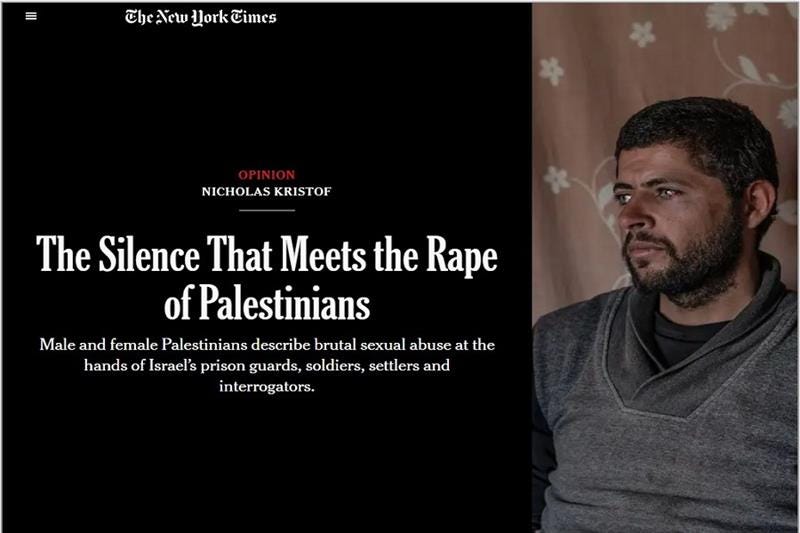
The deeper question is who the column was written for — not the journalist’s question of who regularly reads the New York Times, which is obvious. The harder question is who the column was constructed to serve.
A piece like Nicholas Kristof’s is not a piece of reporting in the ordinary sense. It’s a permission structure. It’s the moment at which a story that has been circulating in particular subcultures acquires the institutional credentialing it needs to be repeated in polite company.
Before Monday, a person at a dinner party who said, “I read that the Israelis are using dogs to rape Palestinian prisoners,” would have been understood to be reading material from one specific corner of the information ecosystem. After Monday, the same person can say the same sentence and now locate it in the New York Times. The sentence, the evidence, and the audience have not changed. What has changed is what the sentence costs to say. Kristof has lowered the cost.
This is what Thomas of Monmouth did for Bishop William Turbe’s courtroom argument. He took something a bishop had improvised in front of a king and gave it the form in which it could be carried by people who weren’t in the room.
“The Life and Passion of William of Norwich” was not, in itself, persuasive to skeptics. The skeptics remained skeptical. What Thomas’ book did was give the people who already wanted to believe an authorized version they could carry into their own communities and repeat.
The blood libel spread not because it convinced the unconvinced, but because it credentialed the willing.
The willing are who the piece is really about — because the willing are the part of this story we don’t like to look at. The audience for the dog libel is not, in the main, antisemites in basements. It is the educated, the credentialed, the careful. I’m talking about professors, doctors, editors, “progressive” pundits, the parents at school pickup, the people who pride themselves on their nuance.
They are the heirs of Thomas of Monmouth’s readers, the literate Benedictine network that carried his text from Norwich to Gloucester to Bury to Lincoln, each generation adding its own local martyr and its own confirming evidence, none of them ever doubting the underlying frame because the frame had become what serious people believed.
The frame has now been issued by the New York Times. The cost of believing it has dropped. The audience that was waiting for permission to believe it has been granted that permission.
EM Rose (born 1959), a historian of medieval and early modern England, wrote a book on Norwich. It has a careful chapter on how the libel moved after Thomas of Monmouth finished his manuscript.
It didn’t move because it was convincing, but because it was useful. Every town that wanted its own pilgrim trade, every priory that wanted its own martyr cult, every bishop with his own debtor problem found that the template Bishop William Turbe and Thomas of Monmouth had built could be adapted to local needs with minimal modification: Here’s something to throw at the Jews.
By the time you get to Hugh of Lincoln in 1255, no one is going back to check whether Norwich was credible. The libel has become its own evidence. The fact that other places have their own ritually murdered children is treated as confirmation that the original case was sound. Each new instance authenticates the rest. The whole structure becomes self-supporting.
So, we’re now at the Norwich moment. The Israeli dog libel has just received its first prestige ratification. The next versions are being drafted somewhere right now. They will be more elaborate, better sourced, harder to debunk piece by piece. They will appear in other publications, in other languages, in academic papers and human rights reports and UN sessions and museum exhibits, because the institutional infrastructure for replicating them now exists.
Each new version will be presented as additional evidence, and the cumulative weight will become the argument. At some point, perhaps in five years or 10 or 20, no one will be able to remember a time before the Israeli dog allegation was simply known.
This isn’t paranoia; it is the documented pattern. The book has been written.
The Catholic Church eventually disowned the cult of William of Norwich, but it took awhile — 818 years to be precise.
The dossier on the case was reviewed, the evidence was found insufficient, the cult was quietly removed from the calendar of saints. By the time this happened, the libel that William had inaugurated had killed Jews in Trent and Tirnavia and Polna and Kielce and a thousand places between. The disavowal came, it just came after the work was done.
Somewhere in the next year, the New York Times may issue some quiet form of walkback on Nicholas Kristof’s piece — perhaps an editor’s note or a follow-up piece, perhaps just silence on the subject from that author for a while. The walkback is not the point, and it never is. The point is what the libel does between now and the walkback, and after, in the years and decades when no one bothers to remember that there was ever any doubt.
Bishop William Turbe got his client off. The debt evaporated. Eleazar’s family had no recourse. The bishop went home, satisfied with a good day’s work, and almost certainly never thought about that courtroom argument again. He had no idea what he had set in motion or that his improvised rhetorical move would, 800 years later, still be running in updated form in the most prestigious newspapers of his linguistic descendants.
Kristof, similarly, is saying that he just wrote a piece about a human rights issue. He’s already being defensive when criticized — confident in his sources and proud of his moral seriousness. He’ll move on to other works, sure, but he’s just played a role in a structure the historians of the next century will recognize on sight.
That is the catch: The people who do this almost never say they are doing it. They may believe they are doing the opposite, believe they’re speaking truth to power, holding the powerful to account, breaking the silence around an atrocity. They are Thomas of Monmouth, several hundred years younger, in a different language, writing for the same audience with the same fundamental relationship to the material.
And the people who read them, the willing audience this whole structure is built to serve, do not know. They think they’re being courageous or simply just reading the news. They think they’re doing what careful, educated people do: following the evidence wherever it leads.
What they’re doing is exactly what Thomas of Monmouth’s readers did in 12th-century Norwich. They are accepting the credentialed version of a story that was invented elsewhere for tactical reasons. They are carrying it home to their dinner tables. They are repeating it to their children. They are letting it become what serious people believe.
In 800 years, if anyone is still keeping records, the historians will know exactly what to call this moment: a blood libel.

The NYT excels in salacious reporting and commentary. Always an agenda where the narrative is what counts not the facts or the truth. This has been true for decades. The 1619 project was peddled as history and the fact it received a pulitizer prize ( putz prize for brevity) is all the proof any honest person should need to understand where the paper and its so called journalists are coming from and the emotions they seek to manipulate. Beware of all your friends and neighbors ( and rabbis) who quote this rag as though it has any moral fiber.
I sighed with relief to see that the State of Israel is suing the NYT over the spreading of this abominable lie. I cancelled my NYT subscription in 2013 due to its flagrant bias against Israel. The paper represents the current version of yellow journalism.