


Please consider supporting our mission to help everyone better understand and become smarter about the Jewish world. A gift of any amount helps keep our platform free of advertising and accessible to all.
This is a guest essay by Vanessa Berg, who writes about Judaism and Israel.
You can also listen to the podcast version of this essay on Apple Podcasts, YouTube Music, YouTube, and Spotify.
For the State of Israel’s first three decades, elections were competitive. Political power was considerably less so.
The names changed — Mapai, the Alignment, Labor — but the basic arrangement remained remarkably stable: The political movement that had built many of the institutions of the pre-state Yishuv (Jewish communities in the Land of Israel prior to the founding of the State of Israel in 1948) also governed the country after independence.
Its leaders populated the cabinet. Its worldview shaped the bureaucracy. Its economic institutions were woven through Israeli life. Its cultural elite largely decided what respectable Zionism looked and sounded like.
And then there was Menachem Begin.
Begin had commanded the Irgun (a Zionist paramilitary organization that operated from 1931 to 1948), became the leader of Herut (a major conservative political party) after the establishment of the state, and spent decades sitting on the political margins while Israel’s Labor (socialist) establishment ran the country.
Today, knowing what came later, this feels almost impossible to imagine.
Likud has become so deeply associated with Israeli political power that it can be difficult to remember that its political ancestors were once the outsiders — which is important, because you cannot understand Likud without understanding that.
Likud was not born as the establishment. Likud was born as the rebellion against it. And that may be the most important fact in understanding why it eventually became Israel’s dominant political party.
Likud was formally created in 1973 as an electoral alliance bringing together Begin’s Herut, the Liberal Party, and several smaller movements on the Right. In its first election that year, it won 39 seats — a significant showing, but still behind the governing Alignment.
Then came 1977.
Israelis call what happened “HaMahapach” — the upheaval. That is not journalistic exaggeration. Likud won 43 seats with 33 percent of the vote, while the Alignment fell to 32. For the first time since the State of Israel’s founding, the political movement descended from Labor Zionism lost control of the government. Menachem Begin became prime minister.
It is tempting to explain this as a simple ideological shift to the Right, but it was much more than that. The trauma of the 1973 Yom Kippur War had badly damaged public confidence in the ruling establishment.
Something deeper had also been happening underneath Israeli society: Large numbers of Mizrahi and Sephardi Jews (many of whose families had arrived from the Middle East and North Africa) increasingly believed that the Labor establishment had treated them as culturally inferior, politically expendable, and socially peripheral. The 1977 election, in part, was the moment when Mizrahi social protest moved decisively into the political arena and helped carry Likud to power.
Menachem Begin understood something the establishment often did not: Politics is not merely about policy, it is about dignity. People do not simply vote according to marginal tax rates, territorial maps, and defense budgets. They vote according to who they believe sees them.
Begin saw Israelis who believed the old establishment did not. And they remembered.
This is one reason Likud’s relationship with many working-class, traditional, Mizrahi, and peripheral communities became so durable. It was not merely transactional. For many families it became emotional, cultural, and eventually generational.
You can disagree with that attachment. You cannot understand Israeli politics without it.
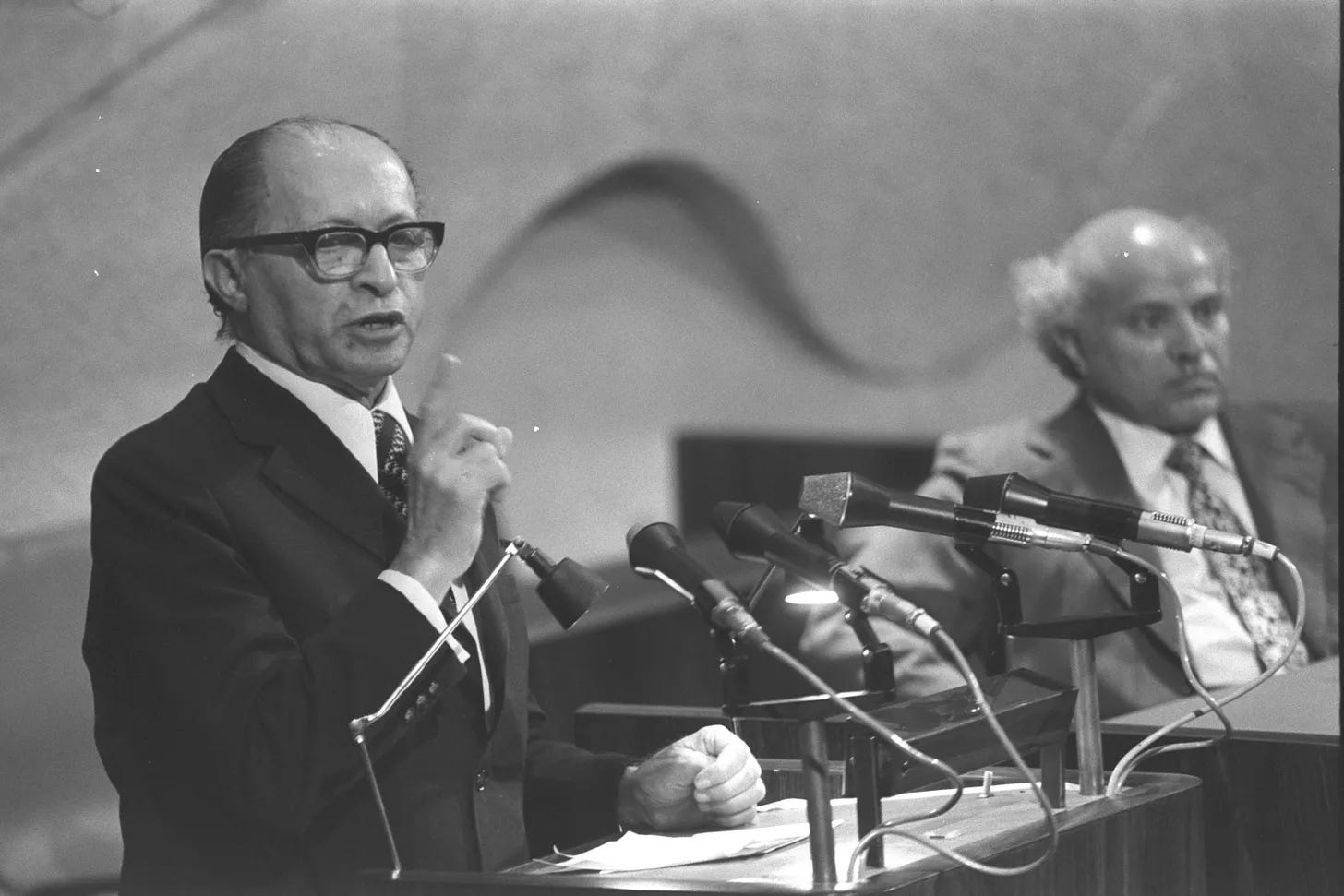
Political revolutions have a funny habit of eventually becoming exactly what they revolted against.
Likud was no exception.
Menachem Begin governed until 1983. Likud then remained at the center of power through national-unity governments, and Yitzhak Shamir served as prime minister for much of the period between 1986 and 1992. Labor returned to power under Yitzhak Rabin in 1992, demonstrating that 1977 had not simply replaced one permanent ruling party with another.
Likud did not destroy Israeli democracy when it broke Labor’s grip on power. It proved Israeli democracy worked. The people who had governed the State of Israel from its founding lost. They handed over power. Someone else governed. Then that someone else eventually lost too. This is what democracy looks like when stripped of all the tribalism: Sometimes your side loses.
In fact, Likud itself has provided some of the best evidence against the idea that Israeli politics is permanently rigged in its favor. It lost power in 1992. Benjamin Netanyahu brought it back in 1996, then lost in 1999. Ariel Sharon returned Likud to dominance, only to leave the party in 2005 and create Kadima. The defection devastated Likud. In the 2006 election, the party that had once won 48 seats collapsed to just 12.
Political obituaries practically wrote themselves. They were premature.
If Menachem Begin made Likud possible, Benjamin Netanyahu made it dominant. Netanyahu understood Israeli politics differently from almost everyone around him. Where Begin was ultimately the great insurgent, Netanyahu became the great survivor. He helped reposition Likud around a combination of security hawkishness, economic liberalization, skepticism toward the Palestinian leadership, and an extraordinarily sophisticated understanding of political communication.
But Netanyahu’s greatest political achievement may have been something less ideological: He convinced a large portion of Israelis that Likud was not simply one possible governing party. It was the natural governing party. That distinction is enormous. Parties become dominant when voters stop asking, “Why should we vote for them?” and their opponents have to start answering, “Why should we replace them?”
Beginning in 2009, Netanyahu governed continuously for 12 years. Likud won 27 seats in 2009, 30 in 2015, 35 in the April 2019 election, and 36 in 2020. Even when Netanyahu was finally pushed into opposition in 2021, Likud remained the largest individual party with 30 seats. It returned to government after the 2022 election with 32.
That is an extraordinary political run, but it was not magic. Likud had found the center of gravity of a changing Israel. Israel had become more Middle Eastern, more traditional, more skeptical of the so-called “peace process,” more economically market-oriented in important ways, and increasingly distrustful of institutions that parts of the Right viewed as controlled by an older political and cultural elite.
Likud spoke that language better than its competitors. And Netanyahu spoke it better than anyone.
Sometimes his opponents appeared unable to comprehend this. They would look at Likud voters and ask: How can these people still vote for Netanyahu? That question itself often revealed the problem. The better democratic question was: What are these voters telling us that we have failed to understand?
There is another complication in the story: The party caricatured internationally as Israel’s permanently uncompromising Right-wing movement has repeatedly behaved more pragmatically in government than its rhetoric might suggest.
Menachem Begin signed the peace treaty with Egypt and returned the Sinai Peninsula. Yitzhak Shamir participated in the Madrid peace process. Netanyahu continued elements of the Oslo Accords process and agreed to the Hebron redeployment. Ariel Sharon, as Likud prime minister, ultimately initiated Israel’s unilateral withdrawal from Gaza.
Likud’s formal nationalist ideology has repeatedly been tempered by political pragmatism once its leaders actually governed. That contradiction is not unique to Likud. It is what happens when ideology meets responsibility. Opposition parties can promise purity. Governing parties inherit reality. Perhaps that is another reason Likud survived. It became flexible enough to disappoint virtually everyone at some point — which, in a democracy, is often the sign that you have been governing for a very long time.
Israel votes again on October 27, 2026, in its first national election since the Hamas-led October 7th attack and the wars that followed. Israel’s proportional electoral system means voters choose party lists for the 120-seat Knesset, and because no party has ever won an outright parliamentary majority, governments depend on coalition building.
And this time, Likud looks unusually vulnerable.
Current polling suggests Netanyahu and the governing bloc face serious difficulty. Likud could lose roughly a third of its current Knesset (Israeli parliament) representation, although Israel’s fragmented coalition system means polling leads do not necessarily translate neatly into governing majorities.
There is an interesting problem inside Likud itself: One survey found that 55 percent of Likud voters wanted a government closer to the political center than Netanyahu’s outgoing coalition. Among registered Likud members choosing the party’s candidates, however, only about one-third favored such a center-Right configuration.
In other words, the party that once became powerful because it understood neglected Israeli voters may now have to ask whether it still understands some of its own. That is democracy too. October 7th changed Israel. Nearly three years of wars changed Israel.
Arguments over responsibility for the security failures surrounding October 7th, the judiciary, ultra-Orthodox military exemptions, the economy, religion and state, and the basic direction of the country have reordered political loyalties in ways that will not become fully visible until Israelis actually vote. Current polling suggests substantial dissatisfaction, including among voters who previously supported Likud.
Likud may remain Israel’s largest party. It may not. Netanyahu may somehow assemble another coalition. He may find himself sitting in opposition. Someone who appears electorally unstoppable today may look considerably less impressive once real ballots replace opinion polls. Nobody knows. And that is the beautiful part.
Western societies spend much time talking about democracy as though it means voters arriving at the correct answer. It does not. If people believe in democracy only when politicians they agree with are elected, they do not actually believe in democracy. They believe in their own politics and call it “democracy.”
True democracy is something considerably more difficult: It is trusting millions of strangers with the future of your country.
Israel’s political system is loud, fragmented, chaotic, and frequently infuriating. Governments are stitched together from parties that sometimes seem to agree on little beyond their desire to prevent somebody else from becoming prime minister. Coalitions collapse. Small parties become kingmakers. Politicians defect. Alliances considered impossible on Monday become unavoidable by Thursday.
Israel’s 2021 government demonstrated the possibilities particularly vividly: Parties ranging across much of the ideological spectrum joined together, including, for the first time in an Israeli governing coalition, an Arab party. Eighteen months later, the government collapsed and Netanyahu returned to power following another election.
That is not evidence that democracy is failing. That is democracy being democracy.
There is something remarkable about a country in which political power has changed hands again and again despite existential wars, terrorism, assassinations, enormous immigration waves, economic crises, social divisions, and almost permanent external threats.
In 1977, Israeli voters looked at the people who had governed their country since independence and said: Enough. They elected Menachem Begin. In 1992 they returned Labor to power. They elected Netanyahu. Then Barak. Then Sharon. Then Olmert. Then Netanyahu again. Then an extraordinary coalition formed largely around replacing Netanyahu. Then voters brought Netanyahu back. And now they get to decide again.
Likud’s history therefore contains a lesson larger than Likud: The party became powerful because Israeli democracy allowed people outside the old establishment to revolt against it. It remained powerful because millions of Israelis continued choosing it. And someday — perhaps this year, perhaps many elections from now — those voters may choose something else.
There is no contradiction there. That is the entire point.
The election of 1977 reminds us that political establishments can fall. The collapse of Likud in 2006 reminds us that supposedly permanent parties can nearly disappear. Netanyahu’s return reminds us that politicians declared finished are occasionally anything but finished. And the election of 2026 may give us another surprise.
That uncertainty should not terrify us. It should reassure us — because the most beautiful thing about democracy is not whether we agree with the people who cast the votes. It is that the decision belongs to them.
The best unfiltered unbiased most accurate definition of what Democracy is and is not. Which was not intended to be the the theme of this Brilliant Essay ---or was it? Anyhow it was genius ms Berg. enlightened me.
THANK YOU
God forbid that should happen again.
.................................................................................................................................................................................................
"Israel’s 2021 government demonstrated the possibilities particularly vividly: Parties ranging across much of the ideological spectrum joined together, including, for the first time in an Israeli governing coalition, an Arab party".