


Please consider supporting our mission to help everyone better understand and become smarter about the Jewish world. A gift of any amount helps keep our platform free of advertising and accessible to all.
You can also listen to the podcast version of this essay on Apple Podcasts, YouTube Music, YouTube, and Spotify.
When Ronald Lauder speaks, the Jewish world should listen.
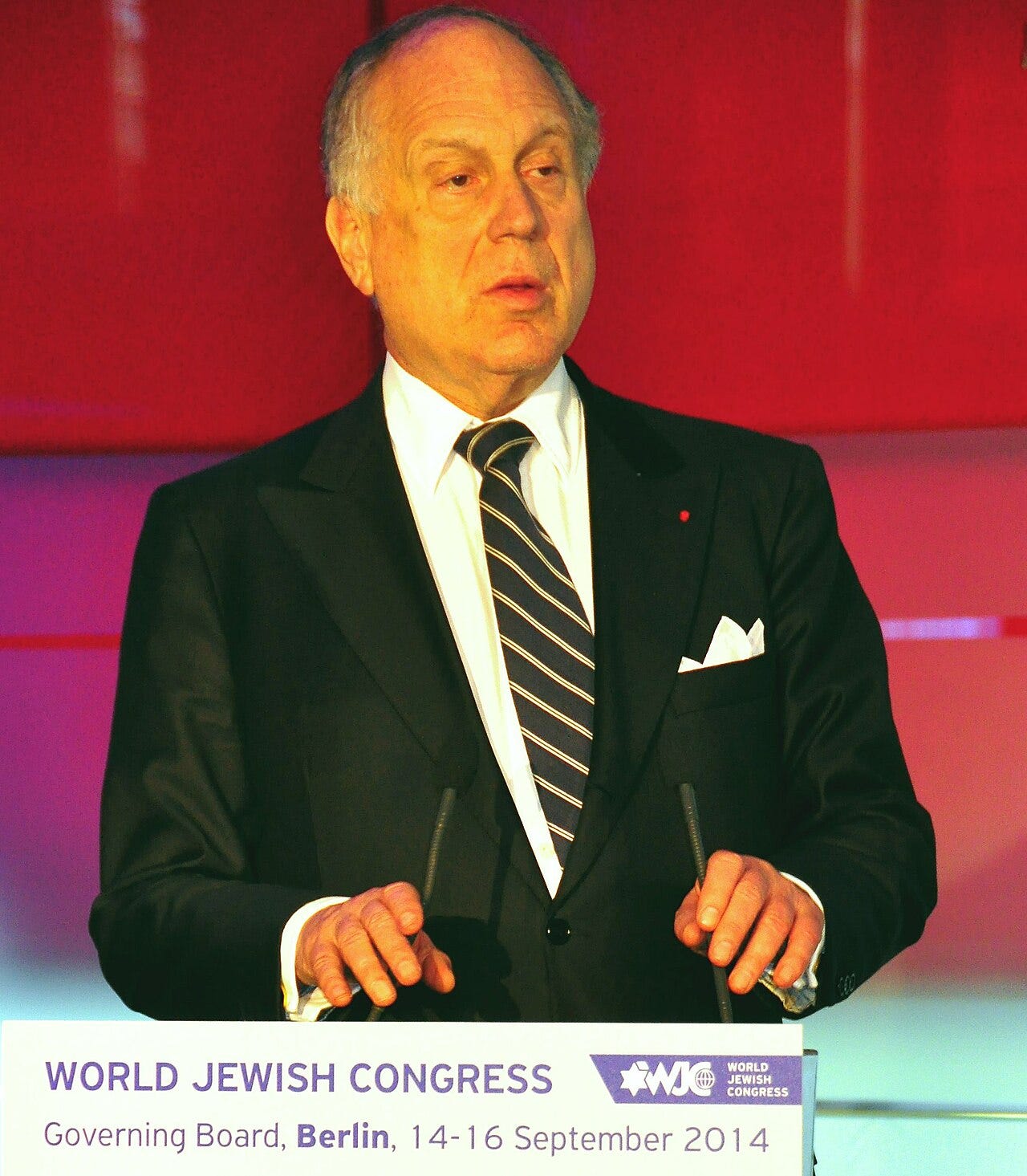
In addition to being the sole heir to The Estée Lauder Companies, he occupies one of the most influential positions in global Jewish life as President of the World Jewish Congress.
And when Mr. Lauder called this week for the creation of a new global Jewish media and public relations operation backed by a $1 billion budget, he did something important: He acknowledged the stark reality that Israel and the greater Jewish world have a communications problem.
More accurately, we have a narrative problem, a scale problem, a coordination problem, and an image problem.
I am not talking about the loud, obnoxious minority of “anti-Zionists,” antisemites, and committed Jew-haters. Nor am I talking about the Jews who have become disconnected from their Jewish identity, or those who are Jewish in name only.
I’m talking about everyone else.
The real battleground is the vast majority of people — perhaps 80 percent of the population — who don’t wake up thinking about Jews or Israel at all. They aren’t ideological activists. They aren’t deeply informed. They aren’t committed to either side. Their opinions are often shaped by whatever narratives, headlines, videos, influencers, and social media content they encounter most frequently.
Since October 7th, much of that information environment has been dominated by anti-Israel and anti-Jewish narratives, regardless of whether those narratives are inaccurate, half-truths, misleading, or outright lies.
This 80 percent are the people we should be most concerned about. They can be persuaded, they can be influenced, and they can move in either direction. And right now, many of them are moving away from us — because we have a mounting narrative problem, a scale problem, a coordination problem, and an image problem.
Judaism did not create these problems. Zionism did not create these problems. The current Israeli government or any past ones did not create these problems. October 7th and its aftermath did not create these problems, but it did expose them.
For decades, anti-Israel and antisemitic narratives have been spreading through universities, media organizations, social media platforms, activist networks, entertainment, culture, and politics. The result is that while Jews represent just 0.2 percent of the global population, we have become the target of a wildly disproportionate amount of hatred, misinformation, and violence.
The events that followed October 7th demonstrated something many Jews had never fully understood: We are not merely fighting a military war. We are fighting an attention war, a narrative war, a culture war, a relationship war and, most importantly, we are fighting a distribution war.
Ronald Lauder is correct that substantial resources are required, but where we disagree is in the solution — and if you’re reading this, Ronald, the question isn’t whether we should spend $1 billion. The question is whether we’re going to spend it building another institution, or building a movement.
The organized Jewish world’s instinct has always been the same, more or less: Create a new organization, build a new headquarters, hire executives, form committees, commission reports, centralize authority, control messaging, push information downward. In other words, build another top-down institution.
That model worked in much of the 20th century, but the 21st century belongs to networks.
The Jewish world does not suffer from a lack of talking points. It suffers from a fixation on centralization.
Every week, Jewish organizations produce statements, press releases, campaigns, reports, webinars, social graphics, videos, podcasts, newsletters, and advocacy materials. Most of it never leaves the Jewish ecosystem. Most of it reaches people who already agree. Most of it is distributed through channels with limited influence over broader culture.
Meanwhile, our opponents have built decentralized systems. They do not wait for permission. They do not wait for approval. They do not wait for institutional or organizational or donor-driven consensus. Thousands of creators, activists, influencers, academics, journalists, entertainers, and organizers push narratives simultaneously across thousands of platforms.
Some are coordinated. Many are not. But collectively they create something powerful: unprecedented scale. The Jewish world has spent decades trying to compete with networks using institutions. That is why we keep losing ground.
If a billion dollars were available tomorrow, we would not spend it building a centralized communications machine. We would spend it building a decentralized global ecosystem. I and a few other ambitious, creative people came up with this concept in the weeks after October 7th, and the 32-page PowerPoint presentation is still sitting on my computer some two-and-a-half years later.
The goal would not be to create one powerful voice. The goal would be to create ten thousand powerful voices — because the present and future belong not to centralized messaging, but to distributed influence. The objective should be simple: Build the largest, most sophisticated, most influential global network of Jewish and Israeli storytellers, creators, thinkers, entrepreneurs, educators, activists, entertainers, and community builders in history.
The Jewish world does not need more employees, spokespersons, bureaucrats, or well-intentioned volunteers. We need more independent builders, creators, influencers, media operators — people who already know how to capture attention, people who already know how to shape culture, people who already know how to reach audiences. The good news is that there are already thousands of Jews across the world with audiences, platforms, and content — many of whom are doing tremendous work on their own.
This platform, Future of Jewish, is one of them. Since its inception in 2022, it has become one of the fastest-growing Jewish publications precisely because it was decentralized from the outset. We rely on guest writers, independent thinkers, entrepreneurs, educators, creators, and community leaders who are already writing, creating, and building on their own. We simply give them a larger stage.
We don’t have an editorial board dictating what people can and cannot write. We don’t have donor-approved processes. We don’t have content assignments moving through layers of approvals. People write because they have something important to say. They submit their work voluntarily. We amplify it. The audience decides what resonates.
That’s the power of a decentralized network. Instead of trying to manufacture influence from the top down, we harness influence that already exists across literally hundreds of writers (some longtime professionals, others brand new to the game) and help them grow. The result is more authentic voices, more diverse perspectives, greater speed, greater scale, and a model that becomes stronger with every new creator who joins it.
Now imagine applying that same principle to the entire Jewish world — backed by $1 billion.
The organized Jewish world largely thinks in terms of organizations and ecosystems.
Organizations move information, while ecosystems move culture. Organizations communicate, while ecosystems influence. Organizations create content, while ecosystems create movements. Organizations emphasize me, while ecosystems emphasize we.
This difference matters, because it is the difference between incremental success and game-changing success. And right now, the Jewish People are overdue for the kind of bold, ambitious thinking that changes the trajectory of history.
Imagine a world where thousands of Jewish and Israeli creators receive funding, amplification, production support, training, distribution, technology, audience development assistance, strategic partnerships, and access to major platforms — on top of their already-established expertise at creating, producing, and distributing content for every medium out there.
Imagine thousands of Jewish filmmakers, thousands of podcasters, thousands of YouTubers, thousands of journalists, thousands of academics, thousands of influencers, thousands of activists, thousands of community builders — all operating independently, all reaching different audiences, all telling different stories, all reinforcing a broader civilizational narrative. That network would be far more powerful than any centralized PR department ever could be.
Because today, now more than ever, people trust people more than they trust institutions. Jewish organizations still very much matter, and they can and should very well be part of this “new” world, but they should not drive it, because organizations are optimized for control, while decentralized networks are optimized for reach, and reach optimizes engagement and influence.
Organizations move slowly. Networks move at the speed of culture. Institutions communicate through official channels. Networks communicate through relationships, communities, and trusted voices.
Together, they can become a powerful force. Institutions can provide resources, infrastructure, credibility, and in-person communities. Networks can provide creativity, authenticity, agility, and digital reach. Institutions can build the foundation; networks can carry the message. Institutions can invest in the mission; networks can bring it to life.
But the moment institutions attempt to control the network, they diminish the very qualities that make it effective. The goal should not be to manage thousands of voices. The goal should be to empower thousands of voices, simultaneously, at scale.
A modern Jewish media ecosystem should focus investment across four strategic pillars.
1) Traditional Media
Television still matters. Film still matters. News still matters. Books still matter.
Instead of creating new media organizations from scratch, resources should be deployed into existing productions, existing distribution channels, and existing audiences — like supporting documentaries already in production, financing film and television projects, developing media-ready Jewish and Israeli experts and personalities, and creating pipelines into major news organizations.
Fund widespread distribution, not bureaucracy.
2) Podcasts and Streaming
Podcasting has become one of the most influential mediums in modern society.
The most important conversations increasingly happen on podcasts, YouTube channels, livestreams, and streaming platforms.
A billion-dollar strategy should place Jewish voices everywhere — both Jewish podcasts and on the biggest podcasts in the world across business, politics, technology, health, sports, entertainment, culture, and more.
The objective is not to create a Jewish media bubble. The objective is to enter the mainstream conversation.
3) Movers and Shakers
This is perhaps the most important pillar. Every major social movement in history has relied on influential individuals — thought leaders, creators, influencers, activists, celebrities, entrepreneurs, and public intellectuals.
The Jewish world has extraordinary talent, but much of that talent is disconnected, underfunded, underdeveloped, and underleveraged.
Instead of investing primarily in institutions, invest directly in people. Help them grow. Help them scale. Help them reach larger audiences. Help them become category leaders.
The ROI (return on influence) would dwarf the return on organizational overhead.
4) A Global Digital Home
The Jewish world also needs a destination, a place where attention can be captured, relationships can be deepened, communities can be built, and engagement can continue.
Imagine a global digital ecosystem that becomes the central hub for Jewish education, culture, identity, storytelling, experiences, events, community, and innovation.
We do not need another website or organizational portal. We need a living, evolving platform that continuously connects people with content, community, experiences, and opportunities — a platform capable of serving millions of people globally in different languages and regions, while remaining flexible enough to evolve with changing technologies.
The greatest mistake so much of the Jewish world repeatedly makes is funding certainty instead of potential.
Organizations are safe. Innovation is messy, but innovation creates outsized outcomes. The Jewish world needs an investment mindset. Fund 100 creators; 20 will succeed. Fund 1,000 creators; 200 will succeed. Fund 10,000 creators; we change history.
This is how venture capital works. This is how technology ecosystems work. This is how cultural ecosystems work.
But Jewish organizations do not make “risky” bets. They play it safe, constantly. Too safe. I know this because, since 2022, I have spent quite a bit of time sharing this vision with leaders across the Jewish world. I have spoken with executives, philanthropists, and decision-makers from some of the largest and most influential Jewish organizations on the planet. I could send the presentation to dozens of CEOs tomorrow morning.
Some would politely respond, a few might express mild interest, but none of them would invest — because it doesn’t fit the institutional playbook. It is easier to fund another fundraiser conference than a creator; easier to fund another committee than a community; easier to fund another report than a movement; easier to fund what already exists than what might exist.
Yet history is rarely changed by the safest investment in the room.
The irony is that the Jewish People themselves are one of history’s greatest examples of unconventional thinking. We disrupted across industries, technologies, companies, scientifics, and cultural institutions by embracing uncertainty and betting on possibility.
Somehow, when it comes to investing in our collective future, many people in the organized Jewish world all too often forget this lesson.
The next great leap forward for the Jewish People will not come from preserving the status quo more efficiently, or from a modest pivot here or there, or from a new organization with what appears to be the latest and greatest sexy, shiny object. It will come from fundamentally rethinking how the organized Jewish world operates, some of which I have laid out in this essay.
This conversation is often framed as a public relations challenge. That framing is too small.
The goal is not improving Israel or the Jewish People’s image. The goal is strengthening Jewish civilization. The goal is rebuilding confidence. The goal is restoring identity. The goal is increasing knowledge. The goal is expanding community. The goal is creating experiences. The goal is producing leaders. The goal is shaping culture. The goal is ensuring that the next generation of Jews feels connected to Judaism, connected to Israel, and connected to one another.
Narratives matter because people matter. Media matters because identity matters. Technology matters because community matters. This is ultimately not about communications. It is about continuity.
Ronald Lauder has correctly identified the scale of the challenge. The real question is whether the Jewish world is willing to embrace a fundamentally different model. A billion dollars spent on another centralized communications operation may create a larger institution, but a billion dollars invested into a decentralized global ecosystem could create something far more valuable:
A worldwide army of storytellers
A self-reinforcing network of creators
A permanent engine of Jewish engagement
A scalable system capable of reaching billions of people
The future will not be won by the organization with the largest headquarters. It will be won by the network with the greatest reach, distribution, and influence — empowering thousands of people to tell the stories that make Judaism, Israel, and the Jewish world respected, revered, and impossible not to appreciate, at a scale unlike anything the Jewish world knows today.
Dear Ronald, you are right that we desperately need a billion-dollar solution. We simply believe that solution should not be built in a centralized way, from the top down. It should be built in a decentralized way, from the bottom up.
And if we build it correctly, it may become the most important investment the Jewish People make in the 21st century.
Great ideas Joshua, though we should have thought about them long ago:
Our enemies have effectively understood and prepared these strategies long ago.
They even hired some of the best Jewish and Israeli public relations people to advance their narratives. Below are just a few examples.
Hopefully some of our leading economic players will pick up your ideas to enter this global market of ideas and narratives.
"America faces a silent invasion. Not of armies or navies, but of capital. Qatar, a tiny Gulf emirate with just 300,000 citizens, has deployed nearly $40 billion across our nation’s institutions since 2012. This is not mere investment. It is calculated influence.
Benjamin Baird’s meticulous investigation exposes the full scope of Qatar’s American enterprise. The numbers speak plainly: $33.4 billion into businesses and real estate; $6.25 billion to universities; $72 million to lobbyists. Qatar purchases access to our corridors of power while simultaneously funding Hamas terrorists who seek our destruction."
https://www.meforum.org/mef-reports/america-for-sale-qatars-40-billion-spending-spree-buys-influence-and-control-of-elite-institutions
Qatar invested over $65 million to manipulate US education, new report reveals
"According to the report, the funds were funneled through Qatar Foundation International, which worked with schools, universities, teacher-training programs, and national education networks."
https://www.jpost.com/middle-east/article-897723
Thank you, thank you. Finally, something productive to wake up to. The old Jewish organizations are dead, they just don’t know how to respond to today’s world. I can’t even stomach anymore the grovelling and polite thanks when sympathies are offered. I like in Montreal and we have a vibrant, mostly conservative Jewish community. At least 30% Sephardic. Everyone here has become more visibly Jewish since October 7th. There is a whole community here that you can start your project with. In more than two years I can’t think of any Jewish leader who has risen to the challenge. What’s going on here, where are our leaders? Please try to do whatever you can to have Mr. Lauder read your proposal. Thank you.