


Please consider supporting our mission to help everyone better understand and become smarter about the Jewish world. A gift of any amount helps keep our platform free of advertising and accessible to all.
This is a guest essay by Chico Muya, a writer, political communicator, and YouTuber.
You can also listen to the podcast version of this essay on Apple Podcasts, YouTube Music, YouTube, and Spotify.
If you genuinely believed a genocide was taking place, what would your first instinct be?
Mine would be simple: Get as many innocent people out of harm’s way as possible. Preserve human life first, argue about politics later.
That, after all, is what humanitarianism is supposed to mean. Before questions of borders, history, responsibility, or blame comes a more fundamental principle: Protect innocent life wherever possible. Everything else, however important, must come second.
Yet throughout the war in Gaza, one particular contradiction kept nagging at me. Whenever proposals emerged to allow Palestinian civilians to escape the fighting, even temporarily, many of the loudest voices in the “Free Palestine” movement objected. Suggestions that Egypt open its border were dismissed. Humanitarian corridors became politically contentious. Even Israeli-designated safe zones were often met with outright hostility rather than cautious support.
The contradiction was difficult to ignore. If preserving Palestinian lives was the overriding concern, why did so many activists appear more interested in ensuring that civilians remained inside an active war zone than in helping them escape it?
That question stayed with me, eventually leading to a much bigger one: What exactly is the “Free Palestine” movement trying to achieve?
The war in Gaza did not create this question. It merely forced it into the open. The catalyst, of course, was October 7th.
That morning, Hamas terrorists breached Israel’s border from Gaza, with some civilians following behind them. Together, they unleashed one of the most grotesque displays of barbarism ever caught on film. Men, women, and children were butchered. Families were torn apart. People were burned alive. Women were raped. Hostages, including elderly people and young children, were dragged back into Gaza.
Much of it was filmed by the perpetrators themselves. Unlike the atrocities the Nazis so often sought to conceal, these crimes were recorded, celebrated, and distributed as psychological warfare. The objective was not simply to kill Israelis, but to terrorize and humiliate them, to inflict wounds that would haunt an entire nation long after the shooting stopped.
The spectacle of October 7th revealed something far more disturbing than the brutality of war. Territorial disputes can help explain why people fight, but they cannot explain the pleasure people take in torture, humiliation, and desecration. October 7th was not merely an attempt to achieve a military objective. It was a celebration of cruelty itself, carried out by people who appeared to revel in the suffering they inflicted.
In that sense, October 7th was a moral test, not only for Israel but for the rest of the world. Moments like these expose the principles that actually guide us. They strip away the comforting language of political slogans and reveal what we instinctively condemn, excuse, or even celebrate when confronted with unmistakable evil.
And for some people, October 7th was not a day of horror. It was a beautiful day.
What happened in the aftermath of October 7th was almost as revealing as the massacre itself.
Before Israel had even begun its military response, demonstrations were already erupting across Western cities. While Israeli families were desperately searching for missing relatives and hostages were being dragged into Gaza, thousands of protesters gathered to denounce Israel. Posters of kidnapped civilians were torn down or defaced, while chants of “From the River to the Sea” echoed through city centers from London to Helsinki, New York to Sydney.
The speed of this response was extraordinary. There seemed to be remarkably little interest in understanding what had actually happened, much less in confronting the moral implications of the atrocities. Instead, October 7th was almost immediately absorbed into an existing political narrative in which Israel had already been assigned the role of villain, regardless of what had preceded its military response.
Over time, I came to understand why. Israel was no longer being treated as an ordinary nation, capable of making good decisions and bad ones, deserving of praise when it acted justly and criticism when it did not. It had become a symbol.
More specifically, Israel had become a vessel into which virtually every grievance of the modern activist imagination could be poured. Colonialism, racism, white supremacy, apartheid, imperialism, genocide, capitalism, American power — somehow, every great injustice of the modern world had converged on one tiny Jewish state.
This helps explain why so many contradictory accusations can coexist without creating the slightest intellectual discomfort. Israel is portrayed as a “colonial outpost” and a “foreign occupier,” despite the Jewish People’s historical roots in the land. It is condemned as uniquely “expansionist,” despite repeatedly exchanging territory for peace. It is accused of “genocide” while fighting an organization whose stated objective is the destruction of the Jewish state.
The individual accusations have become almost secondary to the larger story they are supposed to tell. Their purpose is no longer necessarily to describe Israel accurately, but to reinforce what Israel has come to represent.
And once a country becomes a symbol, facts begin to matter less than the role it has been assigned. Every action becomes additional evidence of its guilt, every piece of contradictory information is dismissed as propaganda, and any attempt to introduce nuance is treated as complicity.
That is why conversations about Israel so often feel impossible. You are no longer debating the policies or actions of a country. You are challenging an article of faith.
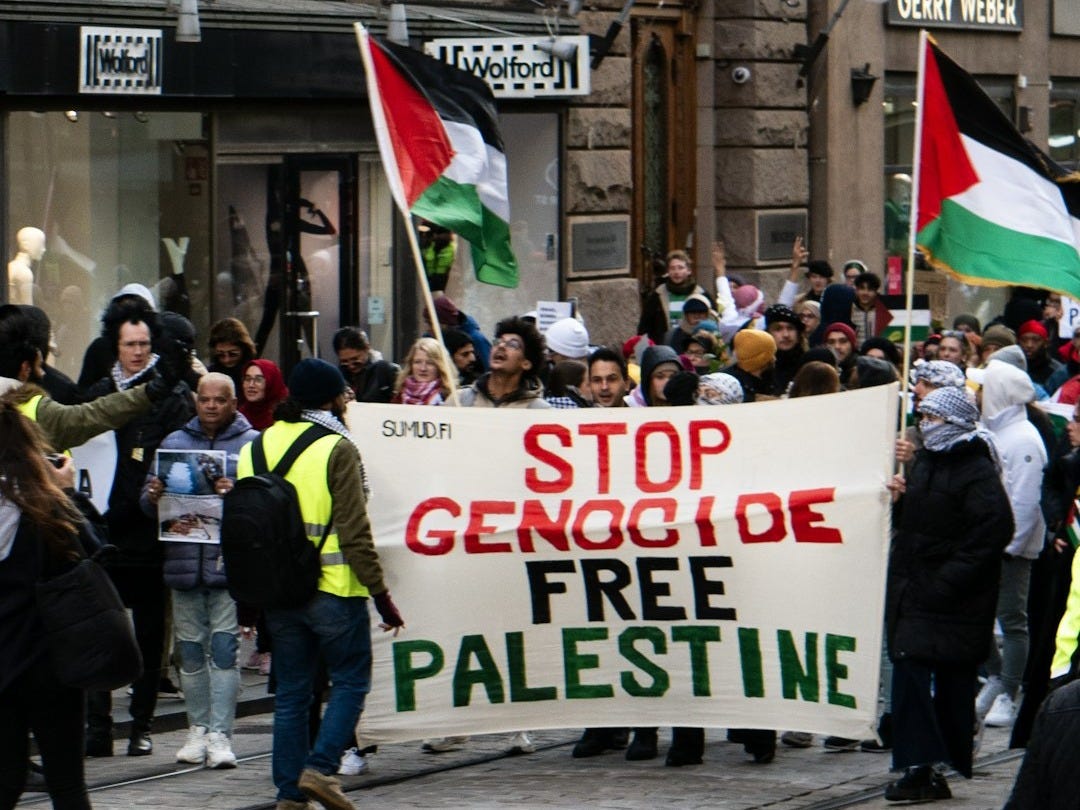
One of the most revealing ways to understand a political movement is not by listening to what it says about itself, but by observing what it rewards, what it condemns, and what it is willing to tolerate in pursuit of its objectives. This is especially important when a movement claims the moral high ground.
If humanitarianism is truly its organizing principle, then preserving innocent life must take precedence over everything else: politics, ideology, military victory, and even the question of who is ultimately responsible for the suffering. That principle seems so obvious that it should hardly need to be stated. And yet, throughout the war in Gaza, it was repeatedly subordinated to political considerations.
Whenever the possibility of moving Palestinian civilians away from the fighting was raised, many of the same activists who insisted a genocide was unfolding reacted with outrage. Suggestions that Egypt temporarily open its border were denounced. Proposals for neighboring countries to accept Palestinian refugees were dismissed as complicity in ethnic cleansing. Even temporary evacuations were often portrayed as morally unacceptable, regardless of the immediate danger civilians faced.
This struck me as extraordinary, particularly because the idea of civilians fleeing war is hardly unprecedented.
Every major war produces refugees. Ukrainians fled Ukraine. Syrians fled Syria. Millions of people throughout history have crossed borders in search of safety, often hoping to return home when the fighting ends. Seeking temporary refuge does not inherently erase a people’s identity, extinguish their national aspirations, or settle the political questions responsible for the war in the first place.
Why, then, was Gaza treated so differently?
If people genuinely believed that Palestinian civilians were facing extermination, one would expect them to welcome every reasonable opportunity to help those civilians escape, however imperfect.
Yes, displacement can create legitimate concerns about whether people will eventually be allowed to return. But that does not eliminate the immediate humanitarian imperative to save lives. Humanitarianism often requires confronting difficult trade-offs; it should not require innocent people to remain trapped in an active war zone while political arguments are settled around them.
Yet for many activists, the political implications of Palestinians leaving Gaza appeared to matter more than the immediate possibility of keeping them alive. Protecting the narrative had become more important than protecting the people.
It was around this point that I realized my disagreement with the “Free Palestine” movement was not primarily about Israel. It was about humanitarianism itself, and what happens when a movement that claims to be motivated by human suffering begins treating that suffering as politically indispensable.
The movement spoke constantly about Palestinian lives, yet seemed remarkably willing to subordinate those lives to a larger political objective. Every civilian death became further evidence against Israel, while proposals that might reduce civilian suffering were met with suspicion whenever they complicated the broader narrative.
Gradually, a pattern emerged that I could no longer ignore. The movement appeared far more committed to condemning Israel than to preserving Palestinian life. And if that was true, then the problem was not simply that the movement was mistaken about Israel. It had become something fundamentally different from what it claimed to be.
If humanitarian concern were truly the organizing principle of the “Free Palestine” movement, we would expect to see comparable moral urgency wherever human suffering reached a similar scale. But that is not what we see.
In Sudan, civil war has produced one of the worst humanitarian catastrophes of the 21st century. Estimates of the death toll run into the hundreds of thousands. Millions of people have been displaced, entire communities have been destroyed, and famine continues to threaten vast sections of the population.
In Yemen, years of war have left millions of people facing starvation, disease, displacement, and unimaginable suffering. The devastation is staggering, both in its scale and in the number of years it has been allowed to continue.
Yet these catastrophes occupy remarkably little space in the political consciousness of Western activists, certainly compared with the war in Gaza.
There are no comparable weekly marches bringing entire city centers to a standstill. University campuses are not consumed by encampments demanding action. Social media feeds are not flooded with Sudanese and Yemeni flags. Relatively few people have built their entire political identities around these humanitarian disasters, despite the extraordinary number of lives they have destroyed.
That disparity deserves an explanation, particularly because it cannot be explained simply by the scale of human suffering. Sudan and Yemen have experienced humanitarian catastrophes of an immense magnitude, in some respects exceeding the devastation in Gaza, yet neither has inspired anything approaching the same level of sustained political mobilization in the West.
Media coverage undoubtedly plays a role, as do geography, political interests, and the particular circumstances of each conflict. But those explanations alone struggle to account for the sheer magnitude of the difference.
The question, then, is not why people care about Palestinians. The suffering of Palestinian civilians is real, and concern for their lives requires no special justification. The question is why this particular conflict has inspired a degree of moral obsession that other humanitarian catastrophes, some involving even greater numbers of victims, have not.
For me, this was another revealing indication of the movement’s actual priorities.
The simplest explanation was no longer that it was primarily motivated by concern for Palestinians. It was that opposition to Israel had become more important than concern for Palestinians.
Once I began considering that possibility, many of the movement’s apparent contradictions stopped looking like contradictions at all. They started looking like perfectly predictable consequences of an ideology in which Israel’s existence, rather than Palestinian suffering, had become the central preoccupation.

Looking back, the modern “Free Palestine” movement can be understood simply as a humanitarian campaign.
Genuine humanitarian movements organize themselves around people. Their purpose is to reduce suffering wherever they encounter it, even when doing so requires uncomfortable compromises or cooperation with people whose politics they oppose. They do not begin by asking whether those in need are politically useful. They begin by asking how their suffering can be alleviated.
Ideological movements operate differently. They divide the world into rigid moral categories: oppressor and oppressed, colonizer and colonized, victim and victimizer. Once those roles have been assigned, every event is interpreted through the same predetermined framework. Facts that reinforce the narrative are amplified, while those that complicate it are ignored, excused, or reinterpreted until they fit.
Viewed through that lens, much of the “Free Palestine” movement begins to make considerably more sense.
Israel is no longer treated as one nation among many, but as the embodiment of virtually everything the movement believes is wrong with the modern West: colonialism, capitalism, American power, racism, and oppression.
Palestinians, meanwhile, cease to be understood as human beings with agency, complexity, competing political visions, and responsibilities of their own. They become symbols as well, cast as the permanent victims in a moral drama whose conclusion has already been written.
Once those roles have been established, reality becomes an inconvenience.
Calls for peace become suspect if they leave Israel standing. Hamas’ brutality becomes something to explain away rather than confront. The suffering inflicted on Palestinians by their own leaders receives comparatively little attention, while virtually every Israeli action is treated as further confirmation of a verdict that was reached long before the evidence was considered.
This is also how the movement has grown into something resembling a Frankenstein’s monster: a sprawling coalition of political ideologies, activist causes, and religious movements that often have remarkably little in common beyond their shared hostility toward Israel and, more broadly, the West.
Under ordinary circumstances, many of these groups would regard one another as ideological enemies. Their beliefs about religion, freedom, equality, sexuality, and the organization of society are often fundamentally incompatible. Yet their opposition to Israel has become powerful enough to suspend contradictions that would otherwise be impossible to reconcile.
Marxists march alongside Islamists. Secular progressives defend movements whose values they reject almost everywhere else. Feminists excuse organizations that severely restrict women’s freedoms. LGBT activists rally behind movements that have imprisoned, tortured, and even killed people for being gay.
On the surface, these alliances appear bewildering. But the more closely one examines them, the clearer their underlying logic becomes. This coalition does not exist because its members share a coherent vision of the future. It exists because they have identified a common enemy in the present: Israel.
That shared enemy is powerful enough to unite people who agree on almost nothing else. It provides a common language, a common moral framework, and a common political objective, even when the different factions have entirely incompatible ideas about what should happen once that objective is achieved.
And that is the key to understanding the movement.
Once I reached this conclusion, I began looking back at everything that had troubled me since October 7th: the immediate hostility toward Israel in the aftermath of the massacre, the opposition to civilian evacuation from Gaza, the relative indifference toward catastrophes in Sudan and Yemen, and the obsessive determination to portray Israel as the singular embodiment of injustice in the modern world.
What had initially appeared to be a collection of unrelated contradictions now seemed to follow the same underlying logic. The movement was not organized primarily around the humanitarian needs of Palestinians. It was organized around ideological opposition to Israel, with Palestinian suffering serving as its most powerful moral and political justification.
And the distinction matters enormously, because a movement that organizes itself around alleviating suffering behaves very differently from one that organizes itself around defeating an enemy.
For the former, success means fewer people suffering and dying. For the latter, success means the enemy’s defeat, even if the people supposedly being defended continue to suffer along the way.
That is the difference between humanitarianism and ideology.
Humanitarianism is one of the noblest instincts human beings possess. It asks us to see people before politics, before ideology, and before tribal loyalties. It insists that innocent life has value regardless of nationality, religion, political affiliation, or whether the person suffering happens to advance a cause we believe in.
But the moment those priorities are reversed, something fundamental changes. People cease to be ends in themselves and become instruments in a political struggle. Their suffering becomes useful, their deaths become symbolic, and their lives acquire value not simply because they are human beings, but because of what their suffering can be made to represent.
At that point, reducing suffering can become politically inconvenient, because suffering is precisely what sustains the movement’s moral authority. Every tragedy becomes another argument against the enemy, another opportunity for mobilization, and another justification for continuing the struggle.

Let me make it shorter: anti Semitism always is present. Gaza was its best and most direct entrance back into the living world since German tanks rolled into Poland.Once again, the Jews got lazy, thinking the world views them as normal humans. It does not. It will never change.
Don't waste your time to “educate", prepare for defense. Don't be worried about what they think of you and of Jews or of Israel.
Chico, that was a masterpiece in writing .. thank you. In some ways, your flow of thought is as straightforward as knowing that ‘1+1=2’.
People are being harmed .. moving them away would be a natural and sensible move. Yet as you rightly point out, so many aspects of western societies were out to vilify Israel from the outset. Nothing more to add,