


Please consider supporting our mission to help everyone better understand and become smarter about the Jewish world. A gift of any amount helps keep our platform free of advertising and accessible to all.
This is a guest essay by Vanessa Berg, who writes about Judaism and Israel.
You can also listen to the podcast version of this essay on Apple Podcasts, YouTube Music, YouTube, and Spotify.
Arab leaders have reportedly been telling U.S. President Donald Trump that Israeli Prime Minister Benjamin Netanyahu is an obstacle to regional peace.
According to a July 15 report from Israel’s Kan public broadcaster, the message has been delivered repeatedly in Trump’s recent conversations with Arab leaders.
An Arab diplomat claimed that it is beginning to influence the American president, who has recently praised Netanyahu as a strong wartime leader while conspicuously avoiding a clear endorsement of him ahead of Israel’s parliamentary elections this October.
There is plenty to criticize about Netanyahu.
His judgment is not infallible. His political survival has too often become entangled with Israel’s national decision-making. His government has struggled to articulate coherent political outcomes after its military campaigns. Some members of his coalition have made reckless statements that have harmed Israel diplomatically without advancing its security.
But Netanyahu is not the principal threat to regional peace. Instead, he is a threat to the regional order that many Arab governments have learned to manage, manipulate, and survive within.
That is not the same thing.
When Arab leaders speak about regional peace, they do not necessarily mean a Middle East in which the forces producing war have been eliminated.
Often, they mean regional quiet. They mean predictable borders, stable oil prices, secure trade routes, uninterrupted construction projects, dependable foreign investment, and the absence of political shocks that might threaten their governments.
None of those objectives is illegitimate. Governments are supposed to seek stability and prosperity for their citizens. But stability and peace are not interchangeable.
A region can appear stable while terrorist armies grow stronger. It can remain quiet while missiles are accumulated, terror groups are funded, and plans for the next war are prepared. It can enjoy several years without major conflict because everyone has silently agreed not to confront the forces making a future conflict inevitable.
That is not peace. It is managed instability.
For decades, much of the Middle East operated according to this model. Iran funded Hezbollah, Hamas, the Houthis, and militias across the region. Arab governments opposed Iran, cooperated quietly with the United States and sometimes with Israel, but generally avoided the kind of confrontation that might fundamentally transform the regional balance.
Everyone wanted Iran contained. Far fewer wanted the Iranian regime defeated. Everyone wanted Hezbollah deterred. Far fewer wanted Hezbollah disarmed. Everyone wanted Hamas weakened. Far fewer were willing to assume responsibility for replacing it.
Netanyahu threatens this arrangement because, whatever one thinks of his consistency or his motives, his present doctrine is no longer merely to contain Israel’s enemies. It is to dismantle the military infrastructure surrounding Israel, which is a noble cause. That is more disruptive than deterrence. It is also far closer to actual peace.
The Iranian regime did not build its regional network overnight. It spent decades creating armed organizations capable of threatening Israel while destabilizing Lebanon, Syria, Iraq, Yemen, and the Palestinian territories. These groups allowed Tehran to project power without always paying the direct price for war.
The region adapted to this reality.
Foreign diplomats called for restraint. Arab governments condemned Iran publicly while maintaining channels to Tehran privately. International organizations issued statements. Ceasefires were negotiated. Money flowed into reconstruction. The militias remained armed.
Then the cycle began again.
Netanyahu’s current strategy threatens to break that cycle by making the Iranian regime and its proxies pay a much higher price for the violence they export.
Understandably, this frightens Arab governments.
A major war with Iran threatens oil exports, foreign investment, and national development projects. It introduces the possibility of regime collapse, political fragmentation, and unpredictable succession struggles. Even governments that despise the Iranian regime may prefer a weakened, familiar Iran to an unknown political order arising from its destruction.
As I have previously argued, many regional governments wanted Iran damaged but not necessarily transformed. A weakened Iran may serve their interests; an imploding Iran could threaten them. They may also fear a regional order in which Israel emerges as the uncontested strategic power.
Netanyahu is therefore not merely threatening Iran. He is threatening the balance built around Iran.
Countries that gained influence by moving between Washington, Tehran, Jerusalem, and various proxy terrorist organizations may lose some of that influence if the conflict is actually resolved. A mediator (cough, Qatar, cough) is most valuable when the conflict never ends. A government (cough, Saudi Arabia, cough) that can speak to both sides becomes indispensable when neither side is defeated. Strategic ambiguity creates diplomatic relevance. Permanent crisis creates permanent leverage.
Netanyahu threatens that leverage because he appears increasingly unwilling to preserve enemies simply so other countries can mediate between Israel and them.
For decades, the accepted diplomatic wisdom held that Israel could not achieve meaningful peace with the Arab world before resolving the Palestinian conflict. The Palestinians effectively possessed a veto over regional normalization: no Palestinian agreement, no Arab-Israeli peace.
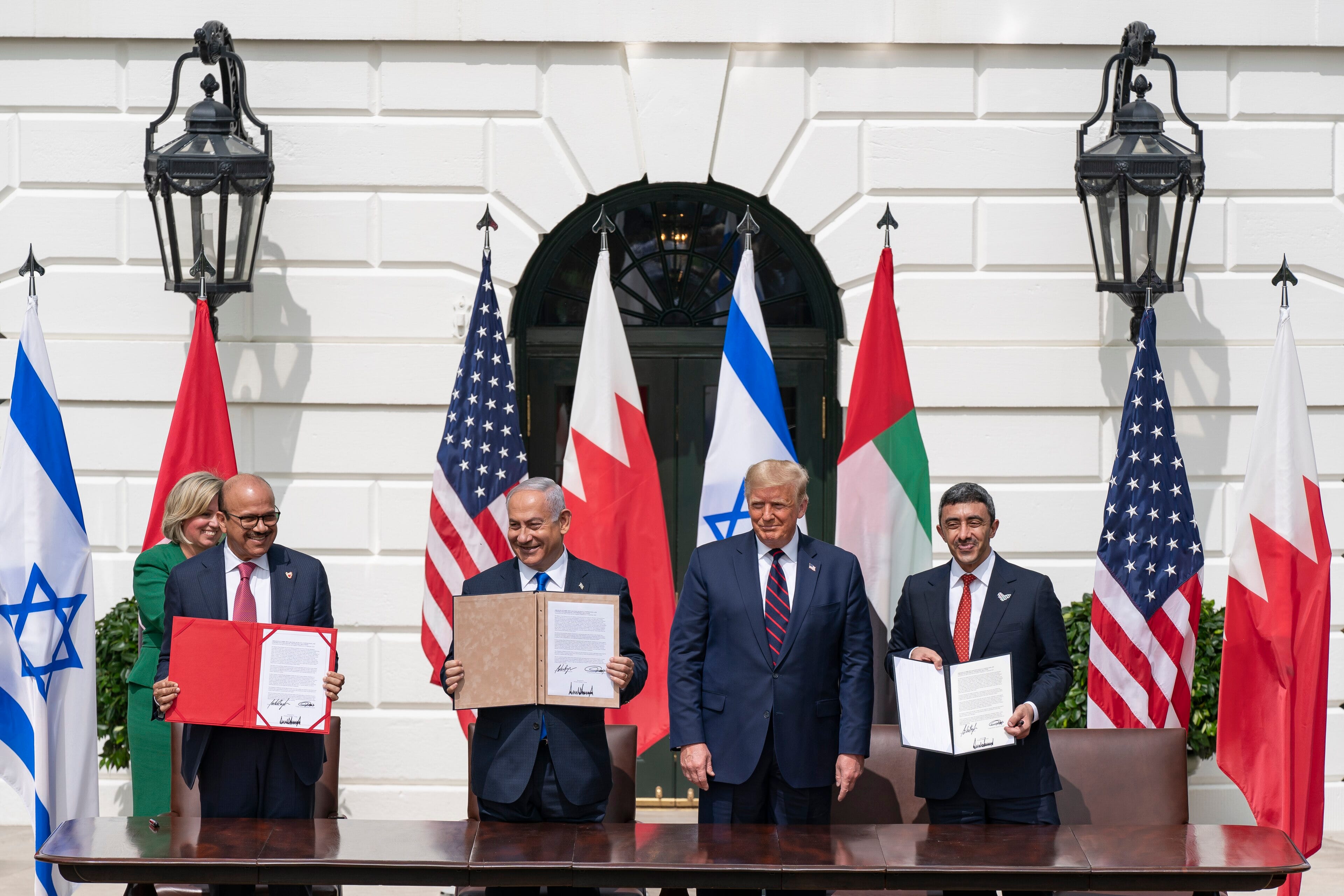
The Abraham Accords shattered that assumption.
Under Netanyahu and Trump, Israel normalized relations with the United Arab Emirates and Bahrain. Morocco subsequently joined the process, while Sudan also agreed to move toward normalization. Embassies opened, direct flights began, trade expanded, and Israelis traveled openly to countries where their presence would previously have been politically unthinkable.
The Abraham Accords did not solve the Palestinian conflict. They did, however, prove that the rest of the Middle East did not need to remain trapped inside it — which was Netanyahu’s great regional disruption. He separated peace with the Arab world from Palestinian rejectionism.
For Arab governments, this created both opportunity and danger. The opportunity was obvious: Cooperation with Israel offered access to technology, intelligence, water innovation, trade, tourism, American favor, and shared defenses against Iran. The danger was that normalization exposed the distance between what some Arab governments said publicly and what they wanted privately.
Publicly, Israel remained the region’s great offender. Privately, Israel was becoming an increasingly valuable partner. And Netanyahu forced that contradiction into the open. He demonstrated that Arab governments could recognize Israel not as an act of charity toward the Jewish state, but because doing so served their own national interests.
The Abraham Accords were not peace created through Israeli weakness. They were peace produced by the recognition that Israel was permanent, powerful, and useful. That model threatens anyone still invested in the belief that Israel must first be weakened, isolated, or pressured into fundamental concessions before it can be accepted by its neighbors.
For generations, hostility toward Israel served purposes that had little to do with Israel: It allowed governments to redirect public anger outward. Economic stagnation, corruption, repression, sectarianism, and political failure could be placed beneath the larger banner of the Arab-Israeli struggle.
In other words, Israel or “The Jews” or “Zionists” became the region’s permanent explanation. This did not require Arab leaders to want an actual war with Israel. Most understood the devastating consequences such a war could bring.
What they needed was something subtler: Israel as a permanent political adversary. Close enough to condemn, but not always close enough to fight. Useful as a private security partner, but still available as a public scapegoat. Open peace makes that arrangement more difficult.
Once Israeli tourists walk through Dubai, Israeli businesses trade with Arab companies, and Israeli officials meet openly with Arab leaders, the mythology begins to weaken. Israel becomes a country rather than a symbol. Its people become visible. Its permanence becomes undeniable.
A genuinely integrated regional order would eventually require Arab governments to explain their own societies without blaming everything on Zionism. It would require educators, clerics, journalists, and political leaders to prepare their populations for coexistence rather than perpetual grievance.
Netanyahu’s regional strategy threatens the old narrative because it does not ask the Arab world to love Israel. It asks Arab leaders to choose their own interests over their inherited hostility. Several have already done so.
Netanyahu’s critics often treat military power and diplomacy as opposites, but they are not.
Diplomacy becomes meaningful when agreements have consequences. A ceasefire that allows a terrorist organization to rearm is not a peace agreement. It is an intermission. A border arrangement that leaves an armed militia more powerful than the national government responsible for the border is not sovereignty. It is a fiction.
Israel and Lebanon are currently engaged in U.S.-mediated discussions over a framework that would pair Israeli withdrawal from southern Lebanon with the disarmament of Hezbollah and potentially lead toward a broader agreement between the countries. Obviously, Hezbollah has opposed the talks and said it does not intend to disarm.
That dispute reveals the real question: Is Israel threatening peace by refusing to withdraw while Hezbollah remains armed? Or is Hezbollah threatening peace by insisting on remaining an independent Iranian-backed army inside Lebanon?
Those who call Netanyahu the obstacle often begin their analysis at the moment Israel uses force. They ignore the years during which Israel’s enemies prepared that force, imported weapons, dug infrastructure, and violated previous agreements.
Israeli action becomes the disruption, and the machinery that made Israeli action necessary becomes background noise. This is how aggressors become part of the regional landscape while those confronting them are accused of destabilizing it.
The uncomfortable truth is that many Arab governments want Israel to be involved in the region, but not powerful.
They want Israel strong enough to constrain Iran, weaken Hezbollah, strike terrorist infrastructure, and provide intelligence against shared enemies — but they do not necessarily want Israel strong enough to dictate the region’s strategic future.
They want Israel integrated enough to provide technology, trade, and security cooperation — but perhaps not integrated enough that the Palestinian issue loses its power as a diplomatic instrument.
They want Israel to fight the forces threatening them all, but they also want Israel to stop fighting before the regional balance changes too dramatically.
In other words, they want Israel to perform the dangerous work of weakening the region’s aggressors while allowing Arab governments to determine when that work has gone far enough.
Netanyahu threatens that arrangement.
He is difficult to control. He does not always accept the regional consensus. He is willing to absorb international condemnation when he believes Israel’s security is at stake. He often views temporary calm not as an achievement but as an opportunity Israel’s enemies will exploit.
Sometimes he is wrong. Sometimes (like most every politician) his decisions are shaped by politics, pride, or an exaggerated belief in his own historical importance. But sometimes he sees something other leaders would rather avoid: A Middle East built around armed militias, revolutionary regimes and periodic massacres is not peaceful merely because the hotels are full and the oil is flowing.
The threats to regional peace are regimes that export violence beyond their borders. They are terrorist organizations that place their military infrastructure inside civilian societies. They are governments that want the benefits of cooperation with Israel without publicly challenging the hatred of Israel. They are diplomatic processes that demand irreversible Israeli concessions in exchange for reversible promises. They are ceasefires that leave every cause of the next war intact.
Netanyahu did not invent the Iranian regime’s ambitions. He did not place Hezbollah above the Lebanese state. He did not make Hamas build its political identity around the destruction of Israel. He did not create the regional habit of treating Israeli vulnerability as stability and Israeli strength as escalation.
What Netanyahu threatens is the assumption that these realities must be permanently accommodated. He is not a threat to regional peace, but he is a threat to regional comfort and strategic ambiguity. He is a threat to governments that want Iran weakened but not defeated, Hezbollah contained but not disarmed, and Israel accepted but never fully empowered.
Most of all, he is a threat to a Middle East that has confused the temporary absence of war with peace.
Is Netanyahu a threat to peace?
No.
Absolutely not.
His views are those which will ensure the security of Israel.
Am Yisrael Chai
what it means is that they see Bibi as a threat to being able to genocide the Jewish state. Bibi just wont play the dhimmi.