


Please consider supporting our mission to help everyone better understand and become smarter about the Jewish world. A gift of any amount helps keep our platform free of advertising and accessible to all.
This is a guest essay by Vanessa Berg, who writes about Judaism and Israel.
You can also listen to the podcast version of this essay on Apple Podcasts, YouTube Music, YouTube, and Spotify.
In a country of more than 340 million people, spanning 50 states, thousands of communities, and countless religions, cultures, ethnicities, and economic interests, Americans are effectively given two political choices: Democrats or Republicans.
That’s it.
You can be a liberal who believes in free markets, a conservative who supports abortion rights, a socialist who opposes illegal immigration, a religious voter who supports universal healthcare, or a libertarian who wants nothing to do with either political establishment.
But when Election Day arrives, the overwhelming majority of Americans face the same dilemma: red or blue. And if neither party represents your beliefs particularly well? Too bad. Pick the one you dislike less.
Americans call this democracy. But there’s a significant difference between having the freedom to vote and having meaningful choices about whom to vote for.
Last week’s U.S. midterm elections exposed that difference rather spectacularly. On Tuesday, November 3rd, Democrats swept back into power in Congress, riding a wave of dissatisfaction with President Donald Trump and/or the Republican Party. But underneath the headlines about the Democratic Party victory was a much more interesting story about what actually motivated Americans to vote.
Many weren’t voting for Democrats so much as they were voting against Donald Trump. According to a Marist poll from September, 80 percent of Democratic Party voters described their congressional vote as a vote against Trump. And exit polling from Tuesday’s election found that one in five voters who supported Democratic Party candidates actually had an unfavorable opinion of the Democratic Party itself.
Millions of Americans went to the polls and supported a political party they didn’t necessarily admire, agree with, or even appreciate. Their primary motivation was stopping the other side. That’s not exactly an inspiring advertisement for representative democracy. And it raises an uncomfortable question: What is the point of having the right to vote if the political system makes it nearly impossible to vote for what you actually believe?
The inconvenient truth about America’s two-party system is that it gradually transforms political participation from an expression of conviction into an exercise in fear. Instead of asking, “Which political party best represents my values?” Americans increasingly ask, “Which political party poses the greatest threat to my values?”
Those are two very different questions. One encourages citizens to think about the future they want to build. The other encourages them to think about the future they want to prevent. And once politics becomes primarily about prevention, political parties no longer need to earn voters’ loyalty through compelling ideas or effective governance. They just need to convince voters that the alternative is worse.
For Democrats, that alternative is Donald Trump and the Republican Party. For Republicans, it is a Democratic Party they portray as increasingly radical, socialist, or detached from traditional American values. Both sides have a powerful incentive to make the other appear as frightening as possible. The more terrified voters become of the opposition, the less accountable their preferred party has to be.
A Democrat who believes their party has abandoned them on immigration, taxation, foreign policy, or cultural issues may nevertheless vote Democrat because they cannot stomach Trump. A Republican who disagrees with Trump’s tariffs, economic interventionism, or approach to America’s allies may nevertheless vote Republican because they fear what Democrats would do in power. In both cases, the voter is effectively trapped.
And being trapped can lead people to vote against their own interests. Think about the liberal women who voted for Abdul El-Sayed in Michigan’s Senate election. El-Sayed is a devout Muslim whose wife wears a hijab — both of which run completely contrary to liberal values. But many liberal women supported him primarily because he was the Democrat running against a Republican.
That’s the danger of a two-party system: Political identity can become more important than scrutinizing the actual candidate. When defeating the other party becomes the overriding priority, voters may stop asking whether the person they’re electing genuinely represents their values.
A system that repeatedly forces people to sacrifice one set of convictions to defend another has a serious representation problem.
Under the American system, voters are constantly told they must compromise their principles to avoid something worse. Eventually, that compromise stops being an unfortunate necessity and becomes the entire basis of political participation.
Other democracies have similarly entrenched two-party systems, but none comes close to matching the United States in global influence, economic power, or geopolitical significance. I am talking about Malta, Jamaica, and Ghana. Yet even these countries have other legally recognized political parties. That is an important distinction. America doesn’t legally prohibit third parties, either. The problem is that its electoral system makes it extraordinarily difficult for them to become viable.
In fact, political scientists have described the United States as exceptionally unusual among democracies using winner-take-all elections because the same two parties dominate competition so thoroughly, across nearly every region and level of national government.
Countries such as Britain and Canada also have two dominant parties, but smaller parties regularly win seats in their national legislatures. Germany, the Netherlands, and many other European democracies take multi-party representation even further.
The American system is particularly unforgiving because most congressional elections are decided in individual districts, where only the candidate with the most votes wins. Imagine a political party that receives 15 percent of the vote in every congressional district across America. That’s a substantial number of people. Tens of millions of citizens could potentially support its platform.
And yet, that party could finish Election Day with exactly zero seats in Congress. Its voters would have participated in democracy without gaining a single representative from the party they preferred.
Political scientists associate this tendency with Duverger’s Law, named after French political scientist Maurice Duverger, who observed that winner-take-all electoral systems tend to produce two dominant parties. Voters quickly recognize that supporting smaller parties may be futile, or worse, might help elect the major party they oppose most.
So they abandon their preferred candidates and vote strategically. And the two-party system becomes a self-fulfilling prophecy.
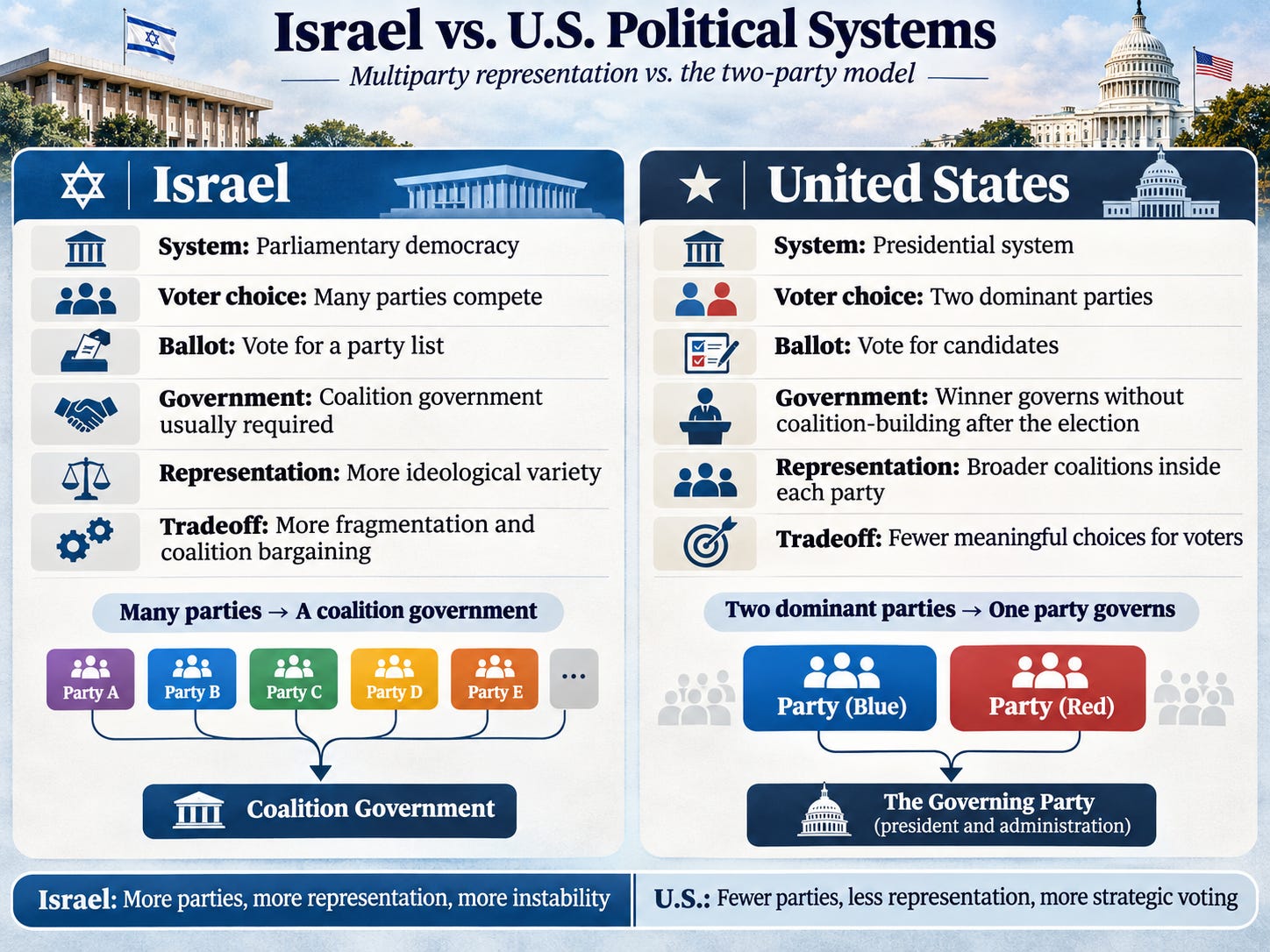
Then there is Israel, where 38 political parties competed in the last election. Thirty-eight. Eleven of them won parliamentary representation in the election two weeks ago, since parties must obtain at least 3.25 percent of the valid vote to qualify for seats. Some of those 11 lists themselves represent alliances between multiple parties.
Still, compare that to the United States. In a country with a fraction of America’s population, Israelis can choose between parties representing dramatically different political and ideological visions. There are secular parties, religious parties, ultra-Orthodox parties, Arab-led parties, nationalist parties, centrist parties, social-democratic parties, and parties that position themselves somewhere between these categories.
An Israeli who supports strong national security policies but opposes religious influence over the state has options. An Israeli who wants a more economically liberal government but also values traditional Jewish institutions has options. So does an Arab Israeli who wants greater integration into Israeli society, or one who prefers a more confrontational political approach.
These differences are not academic. They are reflected in actual political parties competing for actual parliamentary representation. The result is that Israeli voters can often find a party considerably closer to their worldview than the two enormous ideological coalitions presented to Americans.
Of course, Israelis also vote strategically. Parties below the electoral threshold win no seats, so voters may abandon their first choice to avoid wasting their vote. But there is still a fundamental difference between a system that pressures voters to choose between two giant political camps and one that gives them meaningful choices within and across those camps.
In America, a liberal who dislikes the Democratic Party may have little practical alternative to voting Democratic. In Israel, a Left-wing voter unhappy with one political party may have other parties available that represent their beliefs more closely. A conservative Israeli who dislikes Benjamin Netanyahu doesn’t necessarily have to abandon the political Right to vote against him, either.
In Israel, you can reject a politician without necessarily rejecting your entire political identity. In America, that is far more difficult.
There is a legitimate argument that Israel has too many political parties. The country’s multiparty system can produce political instability, coalition gridlock, and governments dependent on relatively small factions that wield disproportionate influence.
Between 2019 and 2022, Israel held five national elections in less than four years. Political negotiations became an exhausting national ritual, and even minor political disagreements could threaten entire governments.
Smaller parties sometimes receive ministerial positions or policy concessions that appear disproportionate to their electoral support because larger parties need their votes to form a parliamentary majority.
And Israel’s most recent election has demonstrated the challenges of political fragmentation again. The largest party, Likud, won just 27 of the 120 seats in the Knesset (the Israeli parliament). No major bloc emerged with an outright majority, leaving the country’s political future dependent on negotiations among parties with considerable ideological differences.
The drawbacks are obvious, but consider the alternative. In Israel, political parties must frequently negotiate their differences openly after an election to build a governing coalition. In America, much of that coalition-building happens inside the Democratic and Republican parties before voters ever reach the ballot box.
The Democratic Party has to accommodate everyone from democratic socialists to business-friendly centrists. The Republican Party must somehow reconcile traditional conservatives, libertarians, religious voters, populists, and an increasingly powerful nationalist wing. These are not coherent political movements. They are collections of competing movements forced to operate under two labels because the electoral system rewards consolidation, which creates its own dysfunction.
A voter who supports a Democratic Party candidate may be helping empower a broader political coalition containing factions they strongly oppose. The same is true for a Republican voter. In Israel, those internal disagreements are more likely to be represented by separate parties that must negotiate with each other. In America, voters frequently don’t know which faction of their own party will prevail until after they have helped elect it.
One system produces complicated coalition negotiations between parties. The other produces complicated power struggles within parties. Neither eliminates political bargaining. Israel simply makes more of the bargaining visible.
The irony is that Americans frequently mock Israel’s coalition politics as chaotic while accepting a political system in which an enormous ideological range of citizens is squeezed into two political organizations that increasingly struggle to coexist internally.
Is Israeli politics messy? Absolutely. But why should the appearance of simplicity be considered more important than the substance of representation?
There is another consequence that deserves considerably more attention: accountability. Imagine you are a lifelong Democrat who believes your party has become too extreme on certain issues. You don’t support the Republicans, but you are frustrated with Democratic leadership, policies, and priorities. What exactly are you supposed to do?
You can vote Republican, which may contradict even more of your beliefs. You can vote for a third party, knowing that candidate has virtually no chance of winning. Or you can stay home, effectively surrendering whatever influence your vote might have had. The most likely outcome? You vote for the Democratic Party candidate(s) again. And the Democratic Party learns that it can count on your support even when you are unhappy.
Now reverse the parties. A lifelong Republican can be deeply dissatisfied with Republican leadership, the party’s relationship with Trump, its approach to federal spending, or its foreign-policy direction. But if that voter considers the Democratic Party alternative unacceptable, the Republican Party can still reasonably expect their vote. This is an extraordinary political advantage.
Imagine operating a business where customers had only two realistic choices, switching to your competitor was emotionally and financially costly, and your customers believed the competitor posed an existential threat to their future. How much pressure would you feel to improve your product?
Certainly, political competition is not identical to commercial competition, but the underlying incentive problem is real: When voters feel they cannot leave, political parties become less responsive to their dissatisfaction.
A multiparty system creates an additional mechanism for accountability. If a political party repeatedly disappoints its voters, those voters can shift to a competing party that represents similar broad values but offers different leadership, policies, or priorities. In Israel, that possibility is not theoretical. Parties rise, decline, merge, split, and disappear. New political movements emerge to represent constituencies dissatisfied with the existing options.
That instability can be frustrating, but it also reflects something healthy: Political parties do not have an automatic entitlement to their voters. And no political party should.
Perhaps the most corrosive consequence of America’s two-party system is what it does to political culture. When only two parties can realistically govern, nearly every disagreement becomes a contest between two opposing tribes. Political opinions that should be independent judgments get bundled together into identities.
Your views on immigration somehow become associated with your views on climate change. Your position on abortion supposedly predicts your position on corporate taxation. Your opinion of Donald Trump becomes a proxy for what you believe about everything from international trade to America’s relationship with Israel.
But human beings do not think in two neat ideological categories. A person can support capitalism and stronger environmental protections. A person can believe in traditional family values and support gay marriage. A person can favor strict immigration enforcement and comprehensive healthcare reform. A person can support Israel and oppose Trump. A person can support Trump and disagree with his foreign policy.
There is nothing inherently contradictory about holding opinions that cross conventional partisan boundaries.
Yet America’s political structure encourages voters to treat these combinations as anomalies that must somehow be explained or justified. And because political identity has become so closely tied to party identity, disagreement over one political issue can be interpreted as betrayal of an entire community. This is especially destructive when politics becomes centered on personalities rather than policies.
Trump is a particularly powerful example. His presence dominates American political discourse to such an extraordinary extent that millions of voters organize their political identities around supporting or opposing him.
Last week’s elections demonstrated that dynamic again. ABC News voter polling found that 43 percent of Americans who voted in the House of Representatives races described their vote as an expression of opposition to Trump, compared with 16 percent who described it as an expression of support for him.
Think about what is missing from this equation: healthcare, housing, education, taxation, infrastructure, energy, foreign policy, economic mobility. All these issues matter enormously to people’s lives. And yet, the organizing principle for a huge portion of the electorate was a single individual who wasn’t even on the ballot.
That is not entirely the fault of the two-party system. Trump himself is an unconventional political figure. But the two-party system magnifies this dynamic by turning every election, including thousands of contests for offices with distinct responsibilities, into another opportunity to vote for or against the same national political identity.
Instead of producing more political diversity, American democracy increasingly produces more intense political uniformity.
Two parties may be easier to understand. They may produce clearer governing majorities. They may even make certain aspects of government more stable. But convenience is not the highest purpose of democracy; representation is.
And if the price of having more meaningful political representation is occasionally having to endure complicated coalition negotiations, that seems like a price worth paying.

Shared; especially with Israelis who wish it was as “simple” as they think the US races are, and for the American who is mystified by the Prime Minister/Knesset/President arrangement and sure that Israel's system is systemically inferior.
You write:
"Think about what is missing from this equation: healthcare, housing, education, taxation, infrastructure, energy, foreign policy, economic mobility. All these issues matter enormously to people’s lives. And yet, the organizing principle for a huge portion of the electorate was a single individual who wasn’t even on the ballot."
In Israel, I don't remember any of the above topics discussed by the 38 parties running for elections, apart from maybe one party.
All the rest were propagating for or against Netanyahu. At least those on the right were propagating security.
When the elections were over, and the results were indecisive, the Left wing parties decided to flip flop their past propaganda and deny their past election promises so that they can entice the Orthodox parties to join forces with them to topple Netanyahu.
They openly admit that their propaganda is now irrelevant. The mission is to oust Netanyahu.
How can people ever trust such liers and deceivers?