


Please consider supporting our mission to help everyone better understand and become smarter about the Jewish world. A gift of any amount helps keep our platform free of advertising and accessible to all.
You can also listen to the podcast version of this essay on Apple Podcasts, YouTube Music, YouTube, and Spotify.
When Ed Sheeran finally broke his silence on September 19th over the controversy surrounding Macklemore’s removal from his tour, he described the Israeli-Palestinian conflict as “the most complex political issue on the planet.”
The most complex political issue on the planet. Really?
More complex than every other geopolitical dispute, civil war, ethnic conflict, nuclear standoff, or centuries-old struggle over sovereignty unfolding across the world? By what measurement? How does one even begin to rank the complexity of political conflicts? Is there an international complexity index that the rest of us have somehow missed?
The Israeli-Palestinian conflict is certainly complicated. It involves competing historical narratives, territorial claims, security concerns, refugees, religion, and generations of trauma. But describing it as the single most complex issue on Earth is not an explanation. It is a superlative masquerading as one.
And perhaps the most frustrating thing about describing the conflict as impossibly complex is that much of its basic history is not particularly difficult to understand. It requires some reading, a willingness to distinguish historical facts from political tribalism and propaganda, and perhaps a little less confidence from celebrities who have apparently discovered the Middle East through their Instagram feeds.
Let’s begin with something remarkably simple. Jews are from Judea. The English word Jew derives from the Hebrew Yehudi, associated with Judah and the ancient Jewish homeland. The Jewish People developed our national, religious, and cultural identity in the Land of Israel thousands of years ago.
Jerusalem was the center of ancient Jewish political and religious life long before it became a holy city to Christianity or Islam. Hebrew was and still is our language. Our temples stood in Jerusalem. Our religious calendar, festivals, literature, and traditions developed around this land. These are not modern Zionist inventions. They are matters of documented history.
Nor did the Jewish connection to the land suddenly disappear when the Romans destroyed the Second Temple in 70 CE or following the Bar Kokhba revolt in the second century. Although wars, expulsions, and successive foreign rulers devastated Jewish communities and contributed to the growth of the diaspora, Jews continued living in the land.
Jewish life persisted through the Roman, Byzantine, Islamic, Crusader, Mamluk, and Ottoman periods, although individual communities experienced destruction, displacement, and renewal. Generations of Jews abroad continued to orient their prayers toward Jerusalem, mourn the destruction of the Temple, and express their longing to return.
And this is where a little linguistic history becomes useful. Jews are from Judea. Arabs originated in the Arabian Peninsula, and Arab identity subsequently spread far beyond it.
The Arab-Muslim conquests of the seventh century brought the region under new rule, followed by centuries of Arabization and Islamization. Some Arabs migrated into the region, while many existing inhabitants adopted Arabic language and culture or converted to Islam. Modern Palestinian Arabs consequently have varied ancestry.
But the notion that Jews appeared in “Palestine” as a foreign people with no prior connection to the territory is incompatible with the historical record. The modern State of Israel was established in 1948; the Jewish People’s connection to the land preceded it by millennia.
That brings us to another historical distinction that is too often lost: Modern Zionism did not begin with the Holocaust.
What emerged in the 19th century was a modern political movement that transformed an ancient religious and national aspiration into an organized project of Jewish self-determination. One of the principal forces behind that transformation was antisemitism.
Consider what was happening in Europe. In the 19th century, Jews were increasingly promised emancipation, citizenship, and equality. Yet even as legal barriers began falling, antisemitism found new political and racial expressions.
Following the assassination of Tsar Alexander II in 1881, pogroms swept through parts of the Russian Empire. Jewish homes and businesses were destroyed, communities terrorized, and civilians assaulted and murdered. These were not abstract disagreements about foreign policy. They were violent attacks on Jews because they were Jews.
In response, Jewish movements such as Hovevei Zion (the Lovers of Zion) began organizing immigration to Ottoman-controlled “Palestine.” Beginning in 1882, the wave known as the First Aliyah brought approximately 35,000 Jews, primarily from Eastern Europe, alongside immigrants from Yemen. They joined Jewish communities already living in the land and established agricultural settlements, including Rishon LeZion, Rosh Pina, and Zikhron Ya’akov.
Some came fleeing persecution; others were motivated by religion, nationalism, or the desire to rebuild Jewish life in their ancestral homeland. Their motivations were varied, but their historical connection to the land was not invented upon arrival.
Then came the Dreyfus Affair. In 1894, Alfred Dreyfus, a Jewish officer serving in the French army, was wrongfully convicted of treason. His case unleashed a wave of antisemitism in a country that celebrated liberty and equality. For Theodor Herzl, who reported on the affair, it helped demonstrate a disturbing reality: even Jews who assimilated, served their countries, and embraced European society could still be treated as permanent outsiders.
In 1896, Herzl published “Der Judenstaat” (“The Jewish State”), and in 1897 he convened the First Zionist Congress in Basel. The proposition was that Jews needed political self-determination rather than having their security depend entirely on the goodwill of others.
And history did not become kinder. In 1903, a pogrom in Kishinev left 49 Jews dead, hundreds injured, and more than a thousand Jewish homes destroyed. The violence followed the circulation of antisemitic accusations, including a false allegation that Jews had murdered a Christian child. The same old blood libels, the same dehumanizing stereotypes, and the same willingness to turn Jewish neighbors into legitimate targets.
Then came the rise of Nazism and, eventually, the Holocaust. But by the time Hitler came to power, the modern Zionist movement had already been building institutions, reviving Hebrew as an everyday language, and encouraging Jewish immigration for decades.
After the Holocaust, many survivors who could not or would not return to Europe sought refuge in British-controlled “Palestine,” where immigration restrictions remained in force. Israel was not conceived simply as compensation for six million murdered Jews. Its establishment followed a much longer history of Jewish nationalism, migration, institution-building, and the search for security.
Nor was the Jewish search for self-determination exclusively a European story. Long before Israel became a state, Jewish communities stretching from Morocco to Iraq and Yemen had maintained their own traditions, languages, institutions, and connections to the Land of Israel for centuries, and in some cases millennia.
Consider Iraq. The Jewish community there traced its origins to the Babylonian exile in the sixth century BCE, roughly 1,200 years before the arrival of Islam. For centuries, Babylonia was one of the great centers of Jewish civilization. The Babylonian Talmud, one of Judaism’s most important texts, emerged from the scholarship of its rabbinic academies. In the 20th century, Iraqi Jews were deeply involved in commerce, culture, and public life. They were not recent arrivals from Europe. Iraq was their home.
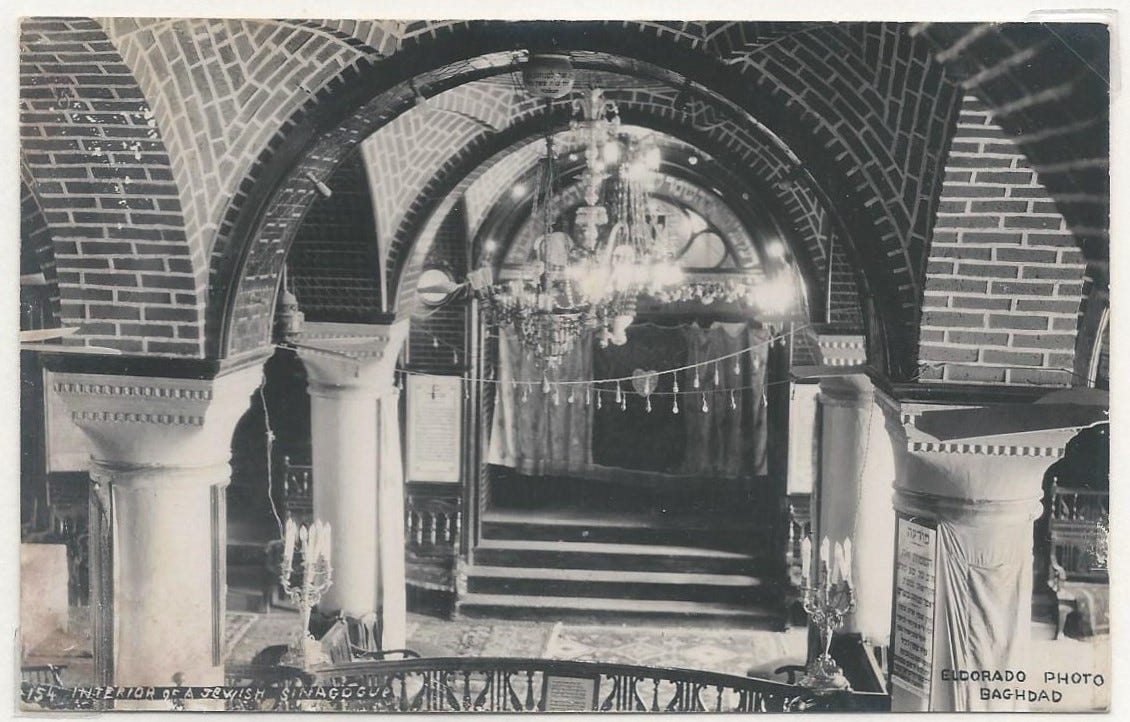
Similar histories existed across the region. Jewish communities in Yemen developed distinctive religious and cultural traditions over many centuries. Moroccan Jews helped shape the country’s commercial, intellectual, and cultural life. Jewish communities in Egypt, Syria, Libya, and Tunisia maintained institutions and traditions of their own.
These were not merely isolated religious minorities waiting for modern Europe to invent a national identity for them. They were part of a Jewish civilization whose connection to Israel long predated the 19th-century Zionist movement.
And their history under Muslim rule deserves to be understood in its entirety.
It included periods of coexistence, cultural flourishing, and important Jewish contributions to surrounding societies. But it also included legal inequality, forced conversions, expulsions, and massacres. Under various Islamic governments, Jews were classified as dhimmis, protected non-Muslim subjects who could generally practice their religion but occupied a subordinate legal position, paid a special tax, and faced restrictions that varied considerably across time and place. Protection was not the same thing as equality.
In the 12th century, the Almohad dynasty imposed forced conversion on Jewish and Christian communities in territories it controlled across North Africa and Muslim Spain, prompting many to flee. In Yemen, in 1679, Jewish communities were expelled to the harsh region of Mawza. The exile became one of the defining catastrophes of Yemenite Jewish history, remembered for its terrible mortality and devastation. Neither episode had anything to do with the modern State of Israel, which would not exist for centuries.
Then came the Farhud. In June 1941, during the Jewish holiday of Shavuot, mobs descended on Baghdad’s Jewish neighborhoods following the collapse of Iraq’s pro-Nazi government. Between 150 and 180 Jews were murdered, hundreds were injured, women were raped, and approximately 1,500 Jewish homes and businesses were looted. This was seven years before Israel declared independence, and its victims belonged to a Jewish community that had existed in Iraq for roughly 2,500 years.
This history does not resolve every question about the creation of the modern State of Israel, but it is available to anyone prepared to study it. We should not need a celebrity to declare the entire subject incomprehensibly complicated before we are permitted to explain it.
And it is worth asking why this particular conflict so often attracts such extraordinary language.
When Jews enter the conversation, the vocabulary frequently moves toward hyperbole: genocide, apartheid, open-air prison, the world’s most complicated conflict. The strongest possible accusations and the grandest possible descriptions become part of the ordinary language of debate.
Genocide is a specific crime involving an intent to destroy a protected group, in whole or in part. Apartheid has a distinct legal meaning. Neither is simply a synonym for a terrible war, an unjust policy, or a government someone despises. Turning crimes against humanity into interchangeable expressions of outrage makes it harder to distinguish a substantiated finding from a slogan.
The danger is that language begins to do the work that evidence and argument are supposed to do. Once a label has been applied, the audience is invited to believe that the case has already been proved. Anyone who questions the label risks being treated as someone who denies the suffering behind it.
And when the subject is the Jewish state, that rhetorical escalation raises another question: At what point does criticism of a government become a justification for hostility toward Jews?
Criticism crosses a different boundary when Jewish people become stand-ins for the Israeli government, when ancient stereotypes about Jewish power are repackaged as political analysis, or when violence against Jews is rationalized through events thousands of kilometers away.
If Israel is portrayed as an embodiment of absolute evil rather than a state that was dragged into war on October 7th, it becomes easier for some people to extend their hostility from the state to the people they associate with it.
The Macklemore controversy illustrates why these distinctions deserve more attention.
In 2014, the rapper performed in a dark wig, beard, and large prosthetic nose that drew criticism for resembling an antisemitic Jewish caricature. The exaggerated Jewish nose and other physical caricatures belong to a tradition of antisemitic representation that long predates the modern State of Israel. Such imagery helped portray Jews as alien, sinister, and fundamentally different from their neighbors.

The Kishinev pogrom provides an especially grim reminder of how conspiratorial accusations against Jews could contribute to violence. Macklemore’s costume was not equivalent to a pogrom, but understanding that history explains why many Jewish audiences recognized the imagery and found it offensive.
Antisemitism did not begin with Zionism, and it cannot be explained exclusively through contemporary Israeli government policy. The stereotypes, conspiracy theories, and violence that helped motivate the Zionist movement existed long before the State of Israel.
And that brings us back to Ed Sheeran. In his Philadelphia statement, Sheeran described the October 7th attacks and the devastation in Gaza in consecutive sentences. He characterized October 7th as horrific and an event that compounded centuries of Jewish pain, before calling the situation in Gaza catastrophic, unjustifiable, and disproportionate.
There is nothing wrong with grieving Israeli and Palestinian lives in the same speech. Empathy is not a finite resource. The problem arises when expressions of grief become a substitute for distinguishing between different actions, actors, and responsibilities.
October 7th was not merely another tragedy that happened to the Jewish People. It was a coordinated attack led by Hamas in which civilians were deliberately targeted and people were abducted into Gaza. Israel’s subsequent military campaign was a response to those attacks. It was not the same event.
That is why a serious discussion cannot end with the assertion that both sides have suffered, or that both sides have engaged in unjustifiable actions.
The questions must be more exacting. Who initiated a particular act of violence? What was its objective? Who was targeted? Who bears responsibility? And what distinguishes the right to respond to an armed attack?
Those questions are harder to answer than simply declaring that everyone is wrong.
Perhaps this is what makes Sheeran’s description so unsatisfying. He invokes extraordinary complexity but offers little explanation of what that complexity actually consists of. He appeals to humanity, but leaves his audience with a series of conclusions rather than the reasoning behind them. His words acknowledge suffering without adequately distinguishing the particular acts that caused it.
There is a strange contradiction in declaring an issue impossibly complex while discussing it almost entirely in absolutes. If the conflict really is as complicated as Sheeran says, then surely it deserves something more rigorous than a few emotionally charged adjectives delivered before a stadium concert. Complexity should be an invitation to investigate, not an excuse to stop thinking.
The historical record offers a starting point. Jews did not invent their connection to Israel in 1948. Zionism did not begin with the Holocaust. Antisemitism did not begin with the establishment of the Jewish state. These are distinct historical facts that can be acknowledged.
It's actually one of the least complex. One side wants to live in peace. The other is death cult committed to wanton slaughter. Why the world fails to see the reality of this is the question of the century.
And for sure…performing in that costume was something he totally understood and is like performing in Black face. It’s just pure bigotry. Apology not accepted.
And what to make of poor Ed Sheeran. Should have just invited Gene Simmons to open for him and let him sing HaTikvah.