


Please consider supporting our mission to help everyone better understand and become smarter about the Jewish world. A gift of any amount helps keep our platform free of advertising and accessible to all.
You can also listen to the podcast version of this essay on Apple Podcasts, YouTube Music, YouTube, and Spotify.
For most countries, an airplane is a routine form of transportation.
For Israel, almost from the beginning, it became something else as well: a potential extension of the battlefield.
There is a reason that flying on an Israeli airline has never felt quite like flying anywhere else — the questions before check-in, the security personnel who seem less interested in your shampoo bottle than in your story, the layers of security that begin before a passenger reaches an airplane and continue after the doors close, the presence of Israeli security at airports thousands of kilometers from Israel, the extraordinary attention paid not merely to what a passenger is carrying, but to who packed it, where it came from, and whether the story makes sense.
None of this emerged from theory. It was learned, incident by incident, hijacking by hijacking, over nearly six decades in which terrorists repeatedly discovered a new vulnerability in international aviation, and Israel repeatedly tried to make sure they could not exploit the same vulnerability twice.
The story begins on a night in July 1968.
EL AL Flight 426 had departed Rome for Tel Aviv when three members of the Popular Front for the Liberation of Palestine seized the Boeing 707 and forced it to Algiers. There were 38 passengers and 10 crew members aboard. The confrontation became something larger than a single airplane: the first successful hijacking of an EL AL jet and the beginning of a new strategy in which Palestinian organizations deliberately transformed international aviation into another arena of the Arab-Israeli conflict. The passengers and crew were ultimately released after more than a month of negotiations.
The importance of Flight 426 is difficult to overstate. Terrorists had discovered that an airplane could be more valuable than a bomb. It was a flying collection of hostages, international headlines, and diplomatic leverage. A relatively small group could seize an aircraft in Europe and suddenly force governments across several continents into negotiations.
Israel’s response was characteristically practical: If terrorists had discovered that the airplane itself was vulnerable, then the airplane would have to become harder to seize.
In the period after the Algiers hijacking, EL AL introduced or expanded measures that were extraordinary for their time: armed security officers aboard flights, stricter passenger screening, and locked and reinforced cockpit doors. By 1970, EL AL had measures that much of the international aviation industry would not broadly adopt until decades later.
The next hijacking demonstrated why those measures mattered.
On August 29, 1969, Popular Front for the Liberation of Palestine operatives hijacked TWA Flight 840 while it was traveling from Rome toward Tel Aviv. The aircraft was diverted to Damascus. Most passengers were eventually released, but two Israeli passengers were detained by Syria for months. Israel was concerned from the beginning that Jewish and Israeli passengers might be separated from everyone else; the United States specifically urged that passengers not be treated differently according to nationality or religion. The two remaining Israelis were finally released on December 5th.
Something important was changing: The target was no longer necessarily an airplane painted with a blue Star of David. An ordinary foreign aircraft could become part of the conflict simply because it was flying to Israel or carrying Israelis.
Then came September 1970.
The Popular Front for the Liberation of Palestine attempted one of the most audacious coordinated hijacking operations in aviation history, the attacks remembered as the Dawson’s Field hijackings. Several international aircraft were targeted almost simultaneously. Among them was EL AL Flight 219, flying from Amsterdam to New York.
The hijackers assigned to the EL AL aircraft were Leila Khaled and Patrick Argüello. But they encountered an airline that had changed since 1968.
When the attempted takeover began, the cockpit remained protected. The captain maneuvered the aircraft, passengers and crew fought back, and an armed Israeli security officer confronted the hijackers. Argüello was shot and Khaled was subdued. The aircraft landed safely at Heathrow. While other aircraft seized during the broader operation ended up in the hands of the Popular Front for the Liberation of Palestine, the attempt against EL AL failed.
The measures adopted after 1968 had been tested in the real world only two years later. They worked.
But Dawson’s Field contained another warning: Accounts from hostages describe hijackers questioning passengers about their religion and retaining some Jewish passengers while others were released. Terrorism against Israeli aviation was beginning to blur into terrorism against Jews aboard international aviation. The passport was not always the defining characteristic anymore. Jewish identity itself could matter.
Two years later, Israel faced perhaps the most extraordinary hijacking crisis ever brought physically onto Israeli soil.
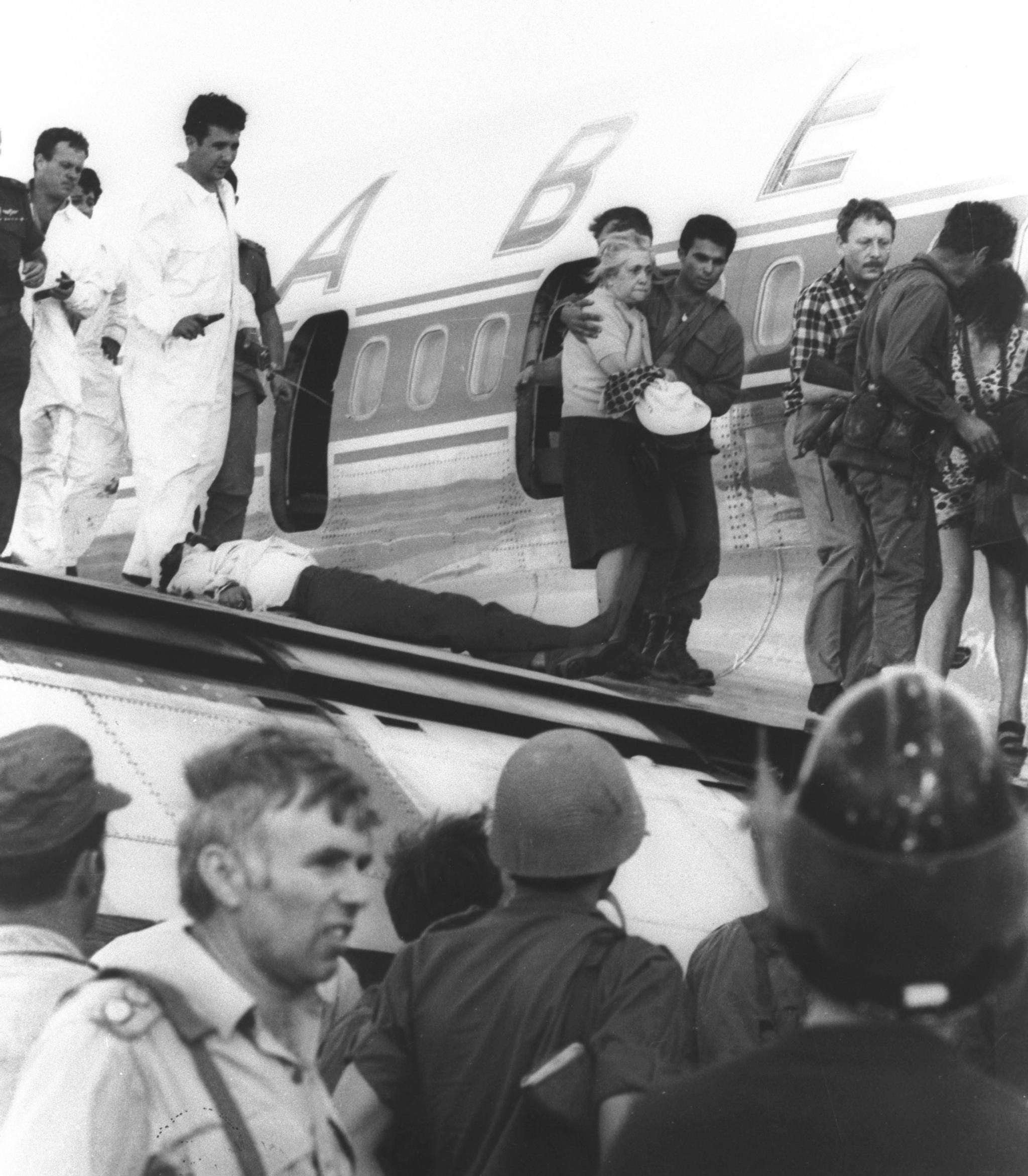
On May 8, 1972, four members of “Black September” hijacked Sabena Flight 571 after it left Vienna for Tel Aviv. They demanded the release of hundreds of Palestinian prisoners and forced the aircraft to land at Lod Airport, today known as Ben Gurion Airport, between Jerusalem and Tel Aviv. This time Israel did not have to send a rescue force across a continent. The hostage crisis was sitting on an Israeli runway.
The following day, Israeli commandos launched Operation Isotope. Members of Sayeret Matkal (one of the IDF’s elite special operations and intelligence-gathering units) approached the aircraft disguised as technicians, stormed the plane, and ended the hijacking. Among the commandos were men who would later become some of Israel’s most recognizable military and political figures.
Sabena produced a different lesson from Flight 426. Prevention was essential, but prevention could fail. So Israel also needed the ability to act after an aircraft had already been taken. That meant intelligence; negotiation as a means of buying time; specialized counterterrorism forces; detailed knowledge of aircraft; coordination between political leaders, security services, and military commanders; and, when necessary, the willingness to attempt a rescue that conventional thinking might consider impossible.
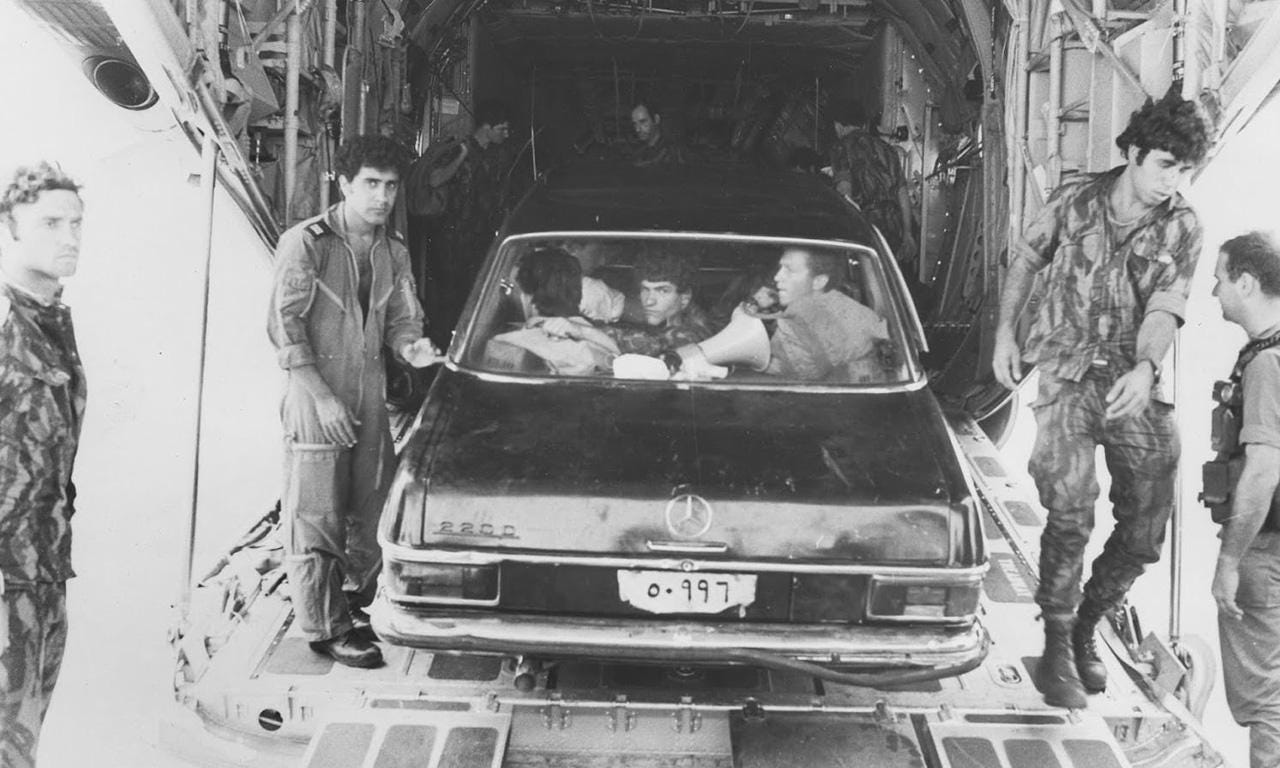
Four years later, that doctrine would be tested 4,000 kilometers from Israel. On June 27, 1976, Air France Flight 139 departed Tel Aviv for Paris via Athens. Hijackers boarded during the Athens stop and seized the aircraft, ultimately forcing it to Entebbe, Uganda, where they received assistance from the regime of Idi Amin.
Then came the moment that made Entebbe fundamentally different from an ordinary hostage crisis. The passengers were separated. Non-Israeli and non-Jewish passengers were released while Israelis and Jews remained hostages, along with the Air France crew members who chose to stay. The airplane had begun as an Air France flight. The hostage crisis had become explicitly about Jews.
On July 4th, Israeli commandos flew thousands of kilometers into Uganda and stormed the terminal at Entebbe Airport. The hostages were rescued and flown home. Yonatan Netanyahu, brother of Benjamin Netanyahu and commander of the assault force, was killed in the operation.
Entebbe became famous because of the rescue, but its deeper lesson was about geography. Israel could secure Ben Gurion Airport. It could secure an EL AL plane. It could put guards aboard its aircraft. None of that guaranteed the safety of Israelis who flew on somebody else’s airline from somebody else’s airport.
That realization helped produce one of the most distinctive characteristics of Israeli aviation security: Israel stopped thinking of aviation security as something that occurred only inside Israel. The security perimeter effectively followed Israeli aviation around the world. That philosophy was vindicated dramatically at Heathrow Airport in 1986.
The Hindawi affair was not a hijacking, but it belongs in this history because it explains why Israeli airport questioning can seem so different from ordinary airport screening. On April 17, 1986, a pregnant Irish woman named Anne-Marie Murphy arrived at Heathrow to board EL AL Flight 016 to Tel Aviv. Unknown to her, her boyfriend, Nezar Hindawi, had placed explosives in her luggage. She had already passed ordinary airport security. Then she encountered EL AL’s security system.
Suspicious inconsistencies emerged during questioning. Her luggage was examined more closely and the bomb was discovered before she boarded. British authorities later concluded that the device was capable of destroying the aircraft. Nearly 400 people had been preparing to fly.
The lesson could hardly have been clearer: A metal detector can discover metal, and an X-ray machine can discover objects, but neither necessarily discovers a lie. Israel therefore developed a security philosophy that combines technology with human judgment. The objective is not simply to discover a prohibited item. It is to understand how the passenger, the luggage, the ticket, the itinerary, and the explanation fit together.
That philosophy remains visible today. At Ben Gurion Airport, every departing passenger undergoes a security process that includes identity verification and security questioning. Checked baggage is subject to automated technological screening, and airport security extends across multiple layers, including baggage screening, terminal security, and protection of the airport’s wider perimeter.
The remarkable thing is that no single layer is supposed to carry the entire burden — probably Israel’s most important aviation-security lesson of all. Do not build a perfect checkpoint; build a system in which the failure of one checkpoint does not automatically produce catastrophe.
The passenger is examined. The luggage is examined. The terminal is protected. The airplane is protected. The cockpit is protected. Personnel are trained. Intelligence is incorporated. Israeli aviation abroad receives its own security attention. Government bodies oversee foreign flights entering Israeli airspace as well as Israeli carriers operating overseas. And there are three separate arenas: aviation departing Israel, Israeli aviation operating abroad, and foreign civilian aircraft entering Israel.
Israeli aviation security abroad is particularly significant. The Israel Security Agency has responsibility for directing security arrangements for Israeli state interests operating both inside Israel and overseas, including Israeli airlines, while EL AL has long maintained security operations at its foreign stations. In effect, an EL AL check-in counter in Melbourne, Paris, or New York is not treated simply as another airline desk. It is part of an Israeli security system operating on foreign soil in cooperation with the host country.
The concept has continued to evolve because the threats continued to evolve. After attackers fired shoulder-launched missiles at an Arkia aircraft leaving Mombasa in 2002, Israel began developing and deploying defensive technology intended to protect civilian aircraft from missile attack. That attack was not a hijacking, but it demonstrated the same recurring phenomenon: Once one route of attack becomes difficult, terrorists look for another.
The same logic explains why reinforced cockpits became so important. Israel had begun hardening cockpit access decades before September 11, 2001. After 9/11, much of the world adopted the principle that terrorists in the cabin must never be allowed to seize the flight deck. EL AL had reached essentially the same conclusion after its own experience with hijacking three decades earlier.
But history has an unpleasant habit of finding the weakness created by yesterday’s solution. That is what makes the events of this past Wednesday so disturbing.
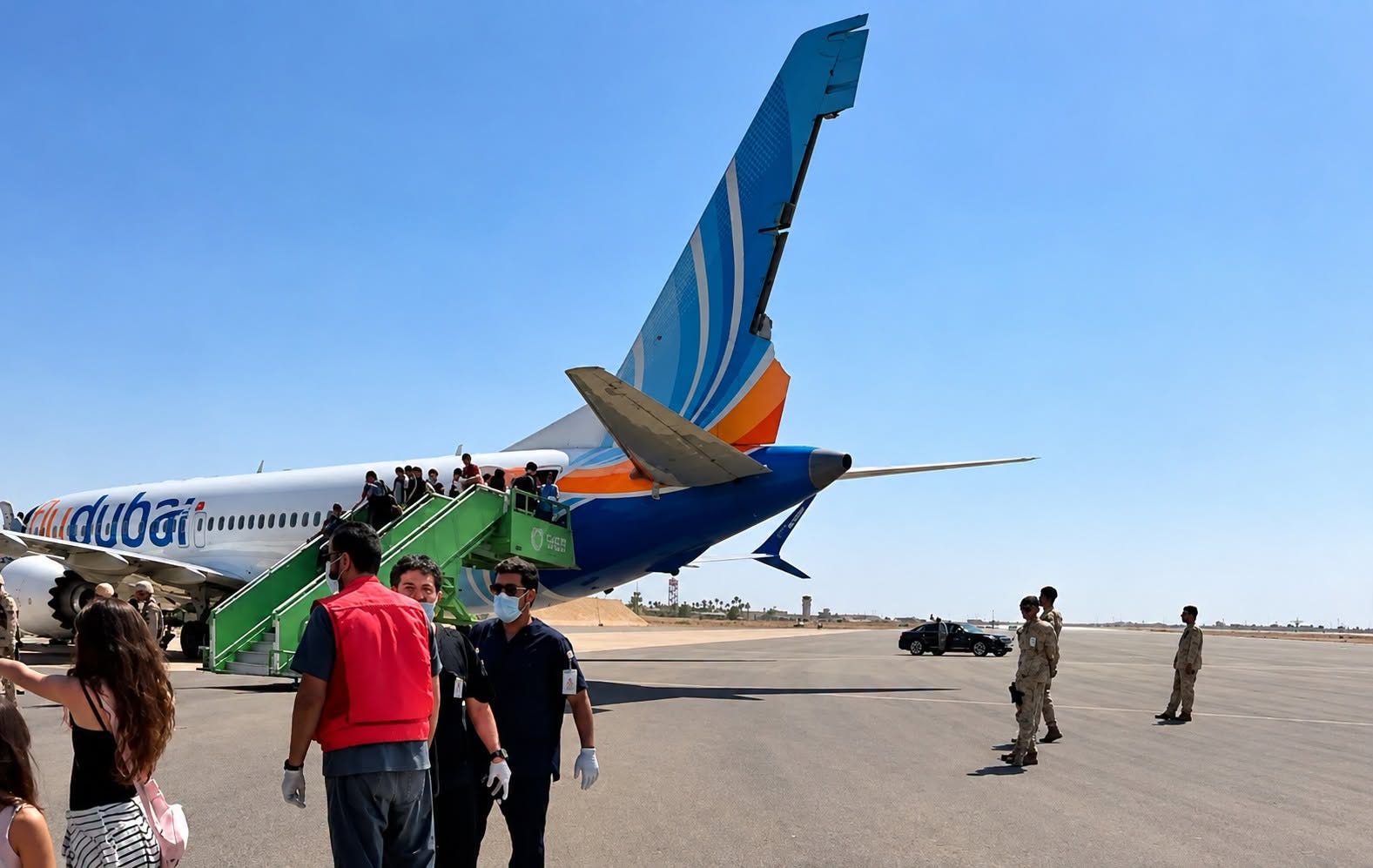
Flydubai Flight 1073 was traveling from Dubai to Tel Aviv carrying more than 170 people, most of them Israelis, when its co-pilot attacked the captain and the aircraft plunged 16,000 feet in just over 30 seconds. Passengers intervened, the attacker was subdued, and off-duty pilots aboard helped bring the aircraft safely to Tabuk, Saudi Arabia.
While facts surrounding this act of terrorism are still being collected, the security problem it exposes is already obvious: For decades, aviation security assumed that the fundamental danger was somebody trying to enter the cockpit, but what happens when the threat is already inside it?
Reinforced cockpit doors solved one problem extraordinarily well. An insider threat raises an entirely different one. In the aftermath of the flydubai incident, aviation experts and Israeli officials have already begun focusing more intensely on crew vetting and the security standards applied to foreign carriers flying into Israel.
And so the history comes full circle. In 1968, Israel learned that it could not assume an airplane was safe merely because everyone had boarded. In 1969, it learned that an Israeli did not have to be flying EL AL to become a hostage. In 1970, it learned that reinforced cockpits and armed security could stop a hijacking already underway. In 1972, it learned that when prevention failed, it needed the ability to retake an aircraft.
In 1976, it learned that Jews could be separated from other passengers thousands of kilometers from Israel and that protecting Israelis sometimes meant projecting power far beyond Israel’s borders. In 1986, it learned (or rather proved) that a conversation with a passenger could discover something that conventional airport screening had missed. In 2002, it learned that the threat did not even have to enter the airport.
And in 2026, Israel may be confronting the next question: How do you protect an Israel-bound aircraft when the potential threat is not the passenger walking toward the cockpit, but someone who was authorized to be there from the beginning?
There is a temptation to look at Israeli aviation security and see paranoia. History suggests something considerably less mysterious: It is institutional memory. Nearly every unusual layer exists because somebody, somewhere, once found the absence of that layer.
Israel did not invent the danger of modern aviation terrorism. It was simply forced to encounter much of it earlier than most of the world. And that produced a security philosophy remarkably consistent with the broader Israeli experience: Never assume that yesterday’s defense will stop tomorrow’s attack.
The history of attacks on Israeli aviation is ultimately a history of adaptation. Terrorists changed methods; Israel changed defenses. The attackers moved from aircraft seizures to hidden explosives, from armed hijackers to missiles, and perhaps now toward insider threats.
Each generation discovered a different vulnerability. Israel’s answer has been to remember every single one of them.
Learning is iterative but should be more than reactive. It should anticipate. Inside jobs are not new. As brave as many of the Israeli passages were it would likely been for nought if not for the pilot who open the door with mortal wounds