


Please consider supporting our mission to help everyone better understand and become smarter about the Jewish world. A gift of any amount helps keep our platform free of advertising and accessible to all.
This is a guest essay by Vanessa Berg, who writes about Judaism and Israel.
You can also listen to the podcast version of this essay on Apple Podcasts, YouTube Music, YouTube, and Spotify.
On Wednesday, the Israeli Air Force chief circulated an update to commanders and soldiers regarding Israel’s war against the Iranian regime, known as Operation Roaring Lion.
“The troops of the air force’s special units,” he wrote, “are currently carrying out extraordinary missions that can spark one’s imagination.”
Major General Tomer Bar did not provide additional details. Yet with each passing day, more information surfaces about Israel’s remarkable, and in many respects unprecedented, operational achievements against the Islamic Republic of Iran and its network of terror proxies throughout the Middle East.
The past two and a half years have been extraordinarily challenging for Israel. During that period, roughly 50,000 projectiles and aerial threats of various kinds (such as drones, rockets, cruise missiles, and UAVs) have been launched toward the country from Gaza Strip, Lebanon, Syria, Iraq, Iran, and Yemen. At the same time, this relentless pressure has dramatically accelerated the integration of emerging technologies — such as artificial intelligence, robotics, and intelligent interception systems — into the Israel Defense Forces.
One example illustrates the scale of this transformation. The operational knowledge accumulated by Israel’s current air defense commanders — combined with the ability to translate that experience into machine learning models — is enabling new systems that dramatically improve threat detection, interception decisions, and battlefield response times.
Policies governing when to intercept, how to respond, and how many interceptors to deploy are increasingly being converted into data sets that artificial intelligence can analyze and refine. This type of operational experience cannot simply be purchased; it can only be gained under the pressure of real-world conflict. Israel’s interception accuracy has already climbed to approximately 94 percent, and the expectation is that it will continue to rise.
Artificial intelligence is also playing a role in highly sensitive targeted operations. One notable case involved the killing of Ismail Haniyeh, a senior leader of Hamas, during his visit to Tehran in 2024. Haniyeh was staying in a heavily secured guesthouse in the Iranian capital. Israeli operatives reportedly planted an explosive device in his preferred room roughly two months before his arrival. Achieving the precision required for the operation demanded months of surveillance, extensive planning, and the use of advanced AI tools to model timing, movement, and blast effects.
Earlier this week, the Financial Times reported another striking example of Israel’s technological reach. According to the report, Israeli intelligence succeeded in infiltrating large portions of Tehran’s municipal traffic camera network. The cameras’ video feeds were encrypted and transmitted in real time to servers in Israel, providing intelligence support during operations that culminated in the assassination of Ali Khamenei, Iran’s Supreme Leader, last Saturday.
Advanced algorithms processed the incoming footage and other intelligence streams, building detailed behavioral profiles of security personnel and mapping patterns of movement. Israel relied heavily on network analysis, a mathematical approach capable of processing billions of data points in order to identify connections and vulnerabilities within complex systems. In recent years, algorithm-driven intelligence collection has automated much of this analytical work. After the successful assassination, Israel released a Persian-language video message from Prime Minister Benjamin Netanyahu, created and distributed using sophisticated AI-generated media tools.
If the IDF’s campaign against Hamas in Gaza served as a testing ground, then Operation Roaring Lion may ultimately be remembered as the first large-scale war in which artificial intelligence played a central operational role. Until recently, AI primarily functioned as a tool for analyzing data. In this conflict, it has begun to move much closer to the center of decision-making. Both militaries are employing the technology across numerous domains: planning large-scale strikes against Iranian targets, coordinating the simultaneous deployment of hundreds of aircraft, determining optimal responses to incoming ballistic missiles, and much more.
The Guardian reported this week that the astonishing speed with which targets are generated, approved, and executed during the war is “faster than the speed of thought.” The shift represents a profound transformation in military doctrine, making operations more precise, more efficient, and potentially more lethal. Meanwhile, The Times of London noted that identifying targets during the 2003 U.S. invasion of Iraq required an intelligence unit of roughly 2,000 personnel. In the current campaign against Iran, a similar task can be accomplished by a team of approximately 20.
During the war against Hamas in Gaza, the IDF began using two artificial intelligence systems known as Habsora (“The Gospel”) and Lavender to assist in identifying and prioritizing targets. Habsora automatically generates recommendations for strikes on buildings and infrastructure, including nuclear facilities, military infrastructure, and headquarters belonging to the Islamic Revolutionary Guard Corps. The system analyzes satellite imagery, communications intercepts, and human intelligence gathered from thousands of sources in order to determine which locations are being used for militant activity.
Lavender focuses on identifying individuals rather than infrastructure. It functions as an AI-driven database that processes vast quantities of surveillance information (such as social networks, communications patterns, and location histories) to flag potential militant operatives. Each individual receives a score between one and 100. When the score surpasses a predetermined threshold, the system designates that person as a potential military target.
Another system known as “Where’s Daddy?” completes the targeting cycle by monitoring those flagged individuals and notifying operators when they enter particular residential buildings.
Artificial intelligence is also central to Israel’s air defense operations. When multiple types of missiles are launched toward Israel from different locations, AI rapidly performs what engineers call “sensor fusion.” In simple terms, the system collects information from radar and sensor networks located at sea, in the air, and on the ground, including both Israeli and American systems, and within milliseconds determines which interceptor should be launched against which threat in order to maximize the likelihood of a successful interception.
At the same time, a separate automated system produces precise targeting intelligence that enables forces to strike Iranian missile launchers almost immediately after they are detected.
What is unfolding is not simply an evolution in military capability. It represents the emergence of an entirely new defense technology ecosystem.
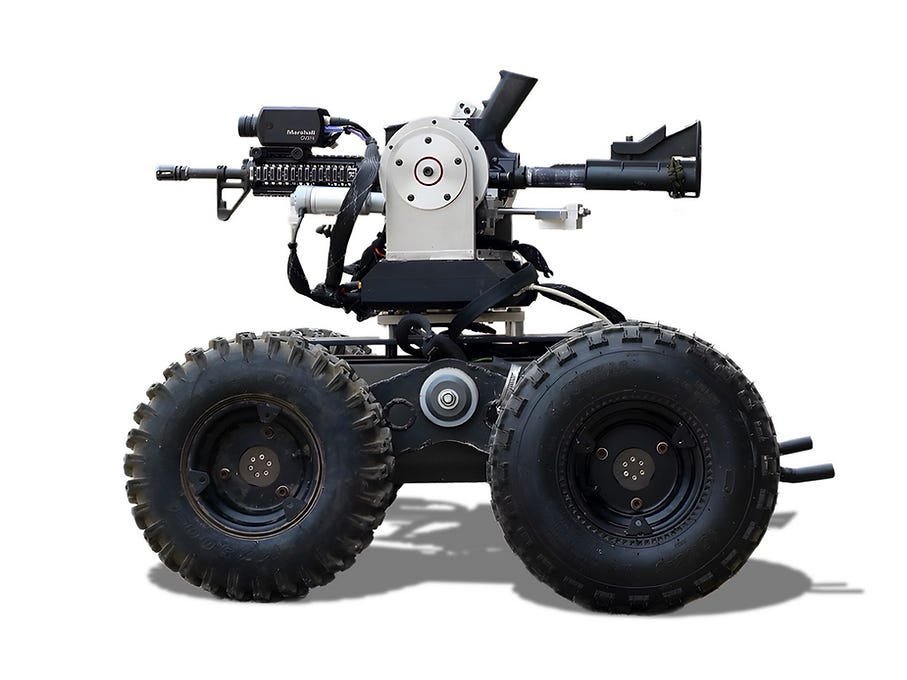
One Israeli company, for example, has developed a targeting system that combines advanced sensors with artificial intelligence to scan an area and lock onto potential threats with extraordinary accuracy. The technology can be mounted on a rifle carried by an infantry soldier or integrated into heavy weapons systems installed on vehicles or robotic platforms. Using AI-based image recognition and tracking, the system follows a target and releases a round only at the precise moment when a hit is virtually guaranteed. The objective is not merely lethality but precision — minimizing the risk to civilians while enabling accurate engagement of ground, aerial, stationary, or moving targets.
Other companies have undergone dramatic pivots since the Hamas-led massacre of October 7th. One example is Macushla, an Israeli robotics company founded in 2018. Originally focused on developing medical technology, the company shifted its priorities after the attacks and began building ground-based robotic platforms and remotely operated firing systems. Its modular robotic system can be configured for a wide range of battlefield roles: navigating tunnels, towing missiles, clearing debris, or breaching doors. The overarching goal is straightforward: replacing soldiers in dangerous routine missions whenever possible.
This transformation is spreading throughout Israel’s broader technology sector. Venture capital is increasingly flowing into areas that were once regarded as niche or even controversial for civilian investors. Since October 7th, the industry has moved from an initial phase of emergency adaptation into what many observers now describe as a sustained “gold rush” in defense technology.
The economic impact is already visible. Israeli defense exports reached a record $14.8 billion in 2024, and early projections suggest that the figure for 2025 could match or even exceed that level. According to the Israel Innovation Authority, cutting-edge technologies now account for roughly 17 percent of Israel’s GDP, 11.5 percent of its workforce, and 57 percent of its exports.
Within Israel itself, more than 300 emerging companies are currently collaborating with the research and development division of the Israel Ministry of Defense. Of those, over 130 have already participated directly in operational activities during the recent wars. The urgency of the situation has pushed the ministry to deploy technologies that may not yet be fully finalized or thoroughly tested, particularly those developed by startups.
Another key institution in this ecosystem is the Directorate of Defense Research & Development, known by its Hebrew acronym MAFAT. For decades, MAFAT has been the driving force behind many of Israel’s most innovative military technologies — from the Iron Dome missile defense system to advanced artificial intelligence platforms and autonomous systems. The directorate functions as a strategic hub for Israel’s defense innovation efforts and is increasingly tasked with anticipating new forms of warfare while integrating emerging technologies into the country’s military capabilities.
In 2024 alone, Israel signed 21 government-to-government defense agreements worth billions of shekels, with major Israeli defense companies securing significant contracts across Europe, Asia, and North America. The Defense Ministry also invested approximately 1.2 billion shekels in startup companies, while small and medium-sized firms concluded contracts valued at hundreds of millions of shekels each.
“For years, Israel was known worldwide as a cyber nation,” said Defense Ministry Director General Amir Baram. “Today, we have evolved into a true defense-tech nation. Tel Aviv now ranks as the world’s third leading defense-tech hub.”1
One of the most pressing problems these organizations are working to solve is the challenge of asymmetric warfare — particularly the growing threat posed by inexpensive drones targeting costly infrastructure. A drone that costs only a few hundred dollars can force defenders to deploy interception systems worth tens of thousands.
Israeli engineers are racing to correct that imbalance. One company has developed acoustic sensors capable of identifying the distinctive sound signatures produced by inexpensive drones approaching sensitive facilities. By recognizing the acoustic fingerprint of a drone’s propellers, these systems can detect threats long before they reach their intended targets.
In parallel, other companies are developing “digital twin” technologies — highly detailed physics-based simulations that replicate real-world battle environments. These simulations allow military planners to rehearse operations with remarkable accuracy and conduct post-mission analysis that significantly improves future performance. Additional technologies focus on electromagnetic systems designed to neutralize remotely triggered improvised explosive devices and identify drone communication signals.
Medical innovation has also been reshaped by the urgency of war. Israeli engineers have developed what is believed to be the world’s first automatic tourniquet — a device designed to immediately respond to life-threatening bleeding during mass casualty incidents such as those witnessed on October 7th. Other newly developed systems include compact kits capable of rapidly identifying dozens of narcotics and explosive compounds.
The transformation extends to the skies as well. According to Muni Katz, deputy CEO of Israel Aerospace Industries, the future of aerial warfare may look dramatically different from today. “If we look 30 years ahead,” he predicted, “military air forces will already be pilotless.”2 In other words, autonomous aircraft and AI-assisted systems could soon dominate aerial combat.
At the same time, Israel is deploying technologies that once seemed like pure science fiction. The country has begun fielding laser-based air defense systems capable of destroying incoming projectiles using concentrated beams of energy. Israel has been working on such systems for years. In 2022, then–Prime Minister Naftali Bennett announced that Israel had successfully completed a series of tests for a new laser-based defense platform. “This may sound like science fiction,” Bennett said at the time, “but it’s real.”
Developed by Rafael Advanced Defense Systems, the system known as Iron Beam is designed to complement the existing Iron Dome network by providing a faster and significantly cheaper interception option. Different variants of the technology include Lite Beam, a 10-kilowatt laser, and Iron Beam-M, a 50-kilowatt mobile laser system capable of being mounted on military vehicles.
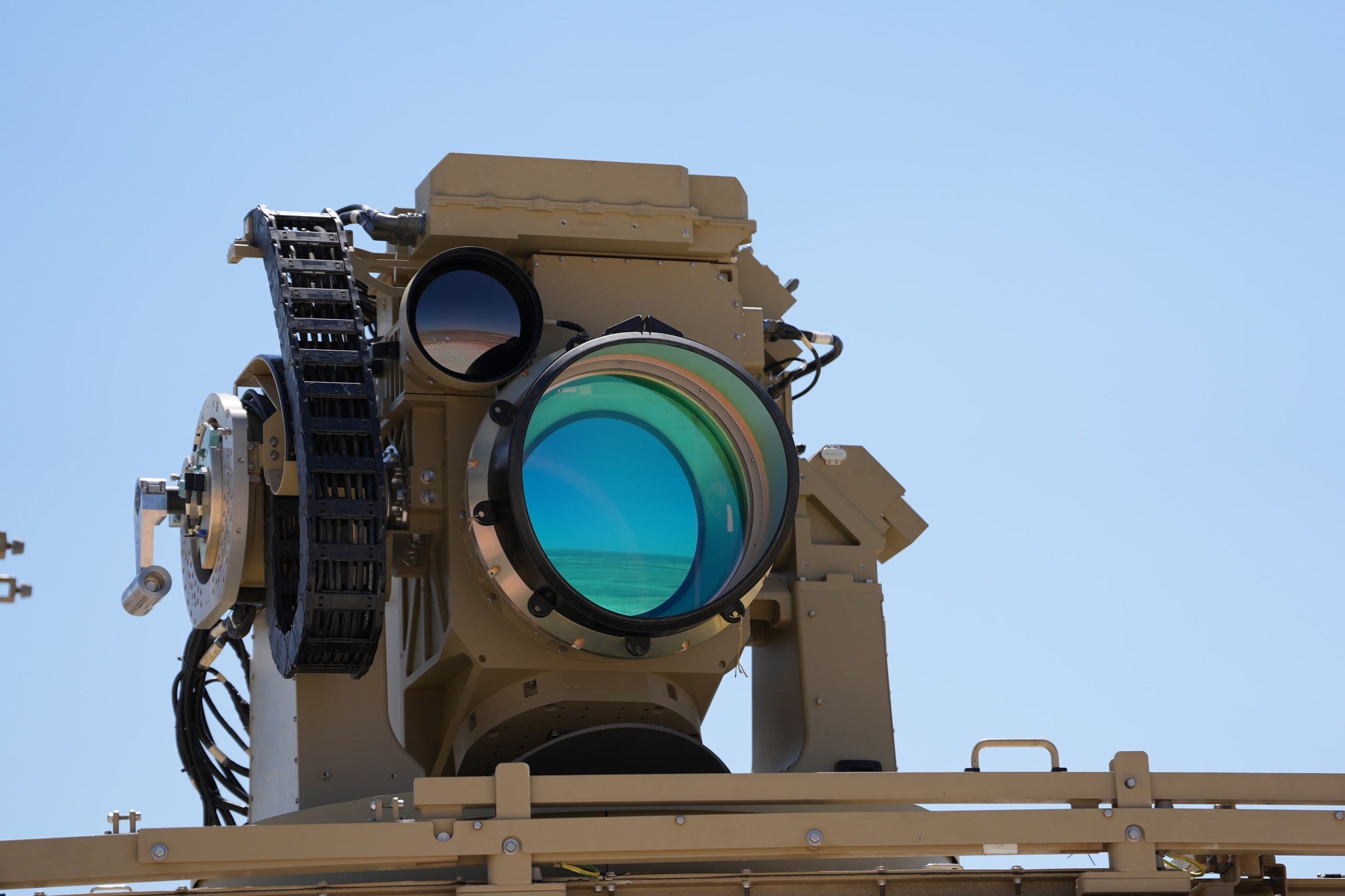
Yet the most profound change may be economic. Traditional interceptor missiles can cost tens of thousands of dollars each, creating a severe imbalance when defending against inexpensive rockets or drones. Laser systems fundamentally alter that equation. Each interception costs only a few dollars’ worth of electricity, and as long as power remains available, the system can continue firing indefinitely. For a country facing thousands of incoming threats, the difference between missile interceptors and beams of light could redefine the financial logic of modern air defense.
A similar transformation is unfolding in cyberspace. Israel has long been recognized as one of the world’s leading cyber powers, but the doctrine guiding cyber warfare is evolving. For many years, Western governments hesitated to launch aggressive cyber counterattacks out of concern that retaliation might trigger uncontrollable escalation. However, the persistent cyber operations carried out by actors linked to Russia, China, Iran, and North Korea are pushing governments toward a new strategy — deterrence through disproportionate response.
Artificial intelligence is also reshaping the nature of cyber conflict. In the past, investigators sometimes identified foreign hackers through linguistic mistakes — for example, Russian attackers who accidentally revealed themselves through awkward Hebrew phrasing in their communications. Today, AI-powered language systems can generate nearly flawless foreign-language text, making attribution far more difficult.
One of the lesser-known components of the Abraham Accords is the extensive cyber cooperation taking place between Israel and multiple regional partners, including countries that are not formally part of the agreements. Much of this collaboration occurs quietly, outside the spotlight of public diplomacy.
According to Yossi Karadi, head of the Israel National Cyber Directorate, the explanation is simple: expertise. “When it comes to cyber,” he said, “it’s not dependent on headlines. Every country wants to work with Israel.”3
When asked how Israel demonstrates that economic activity and technological development continue despite two and a half years of war, Avi Balashnikov, the Israel Export Institute Chairman, said:
“Israeli high-tech is the spearhead of modern Zionism. We will continue to build, create, and proudly lead the global economy — because the eternity of Israel will not die, and the people of Israel live.”4
“How Israel’s defense-tech ecosystem reshapes the battlefield - and the Start-Up Nation.” The Jerusalem Post.
“AI תחת אש: האם האלגוריתם היה מונע את ה-7 באוקטובר?” Ynet News.
“How Israel’s cyber chief is navigating through the dystopian cyber-AI period - exclusive.” The Jerusalem Post.
“Israel showcases tech at Mobile World Congress despite war.” Ynet News.
They cannot stop us, no matter what they do to us. Brilliant and yes—brings tears.
All the trauma of thousands of years , together with the strengthening of survival capacities and the Jewish genius become crystallised in the ancient promise - or demand- to be a light. Today, it's the fight against evil for a new world, a better one. It's our turn.