


Please consider supporting our mission to help everyone better understand and become smarter about the Jewish world. A gift of any amount helps keep our platform free of advertising and accessible to all.
This is a guest essay by Matt Field, who writes the newsletter, “That Jew.”
You can also listen to the podcast version of this essay on Apple Podcasts, YouTube Music, YouTube, and Spotify.
There is a moment in Judaism’s conversion process that startles almost everyone who encounters it for the first time.
A person comes to a rabbi and says he wishes to become a Jew, and the rabbi’s job, fixed by centuries of law and custom, is to turn him away.
Not gently redirect him. Turn him away.
The tradition instructs the rabbi to discourage the seeker, to remind him that he is taking on a heavy yoke and binding himself to a people the world has rarely treated kindly, and to send him off to reconsider. Only if he returns, and returns again, does the door begin to open.
The seriousness is the point. So is the reluctance.
No other major faith behaves this way. Christianity was built to grow. Its founding command is to go into all the world and make disciples of every nation. Islam carries a comparable mandate, the obligation to call humanity to submission and to extend the house of belief across the earth.
These are not distortions of either faith. They are central to what each understands itself to be.
A religion that seeks the whole world is doing exactly what it was designed to do. Judaism was designed to do the opposite. It does not seek you. It would, on the whole, prefer that you remain what you are and live a decent life in that condition.
Hold that fact in mind, because the world has lately decided to call the Jews something that cannot be reconciled with it: “colonialism.”
Israel is described as a “colonial implant,” Zionism as a “settler movement,” the Jewish return as the seizure of someone else’s land by a foreign people.
The word arrives with enormous moral weight, because colonialism is one of the few sins the modern conscience treats as close to absolute. To name a people colonial is to place them outside the circle of legitimate existence. And it is being said, with growing confidence, about the one people on earth whose entire religious posture is a refusal to absorb anyone.
So the accusation deserves to be taken seriously enough to define its terms, which is more than its loudest users have done.
What is colonialism, actually?
Beneath the rhetoric it has always run on two engines. The first is land. A power sends its people to seize and hold territory that is not theirs, displacing those already there. The second is souls. The conqueror does not only take the country; he takes the inner life of its people, replacing their gods and their language with his own.
These two engines ran together for most of recorded history. The ship that carried the soldier carried the priest. Spain did not only claim the Americas; it baptized them, and within a few generations two continents that had never heard the name of Christ were overwhelmingly Christian.
The Arab conquests did the same in the opposite direction, carrying Islam from the Arabian Peninsula across all of North Africa and into Persia across the following century, until lands that had been Christian or Zoroastrian for hundreds of years prayed toward Mecca.
None of this is an insult to either religion. It is simply what happened, the recorded scale of how faiths and empires grew when growth was the goal. Conversion was not incidental to conquest. Conversion was the meaning of it.
Now set Judaism against the first engine, the one made of souls. There is no Jewish mission. There is no campaign, no mandate to spread, no theology that makes the rest of humanity into a field to be harvested. The tradition’s view of the non-Jew is not that he is a soul awaiting capture, but that he is already fine where he stands.
The rabbinic framework holds that the righteous of all nations have a share in the world to come, and that a gentile is bound only by a short list of basic moral commitments, not by the vast architecture of Jewish law. The covenant at Sinai was never understood as a universal claim on all people. It was understood as the particular obligation of one people. A Jew who keeps the law and a gentile who lives decently are both, in the tradition’s eyes, doing exactly what is required of them.
There is nothing to convert anyone to, because the tradition never held salvation hostage to conversion. A religion cannot colonize souls when its own theology declares the other man’s soul already safe.
Honesty requires naming the exception, because there is one, and burying it would be the kind of omission this entire argument is built to expose. In the second and first centuries before the common era, the Hasmonean dynasty, the same Maccabean line whose earlier heroism the festival of Chanukah commemorates, conquered neighboring territories and forced their populations to convert.
The Jewish high priest John Hyrcanus subjugated the Idumeans and compelled them to accept circumcision and Jewish law, the first recorded instance of forced conversion in Jewish history. His successor Alexander Jannaeus extended the same policy to the Itureans of the Galilee. The tradition’s own historian, Josephus, is the one who records both.
That phrase is worth sitting with: the first instance. It is identified as a beginning because there was nothing before it, and it is rightly remembered with discomfort rather than pride. It was the policy of a conquering dynasty wielding state power, not a commandment of the faith, and it ended when that dynasty ended. The 2,000 years that followed moved decisively in the other direction, toward a people that closed the door and learned to guard it.
The contrast with the others is not that Jews proved incapable of conquest. It is that Judaism encountered the expansionist impulse, recorded it as a transgression, and turned away, while the great missionary faiths encountered the same impulse and built their entire understanding of themselves around it.
One could object at this point that Judaism makes a universal claim after all, since the notion that all righteous people share in the world to come is plainly a statement about all of humanity. This is true, and it is the heart of the matter. Judaism does make a universal claim. But it is a universalism of a kind the colonial mind has never been able to recognize, because it includes the other person without requiring him to become anything. It says the stranger is already whole.
The missionary universalism and the colonial universalism include by absorption, by folding the other into the self until the other disappears. Jewish universalism includes by leaving alone. It grants the gentile his full moral standing and then asks nothing further of him, claims nothing of his soul, dispatches no missionary to his threshold.
The turning away has always carried this purpose. The door that does not open is not contempt. It is the institutional expression of a theology that decided, long before the word colonialism existed, that the other man’s soul was never yours to claim.
This is the shared grammar beneath both charges. Colonialism and the missionary project rest on a single buried assumption: that a people’s legitimacy is measured by its reach, that existence without outward expansion is somehow incomplete or suspect. Judaism has refused that assumption at the level of souls for 2,000 years.
The land argument will show that the refusal runs just as deep at the level of territory, because it is the same refusal. The accusation fails on both fronts not by coincidence, but because both fronts are expressions of a single identity the tradition has always declined to inhabit.
This is the ground the accusers most want to fight on, so it is worth meeting them there directly. The modern charge does not usually rest on the old colonial model of a mother country planting a distant outpost for profit. It rests on a newer theory, the framework of settler colonialism, which was specifically constructed so that it would not require a metropole at all.
The argument that Israel has no imperial sponsor, no London or Madrid extracting wealth from a colony, is therefore true but beside the point. The “settler colonial” framework was built to survive that objection, and it rests its weight somewhere else, on a single distinction that does all the moral work. That distinction is between the foreign settler and the native population. The settler is the one who comes from outside. The native is the one who belongs.
Every charge the framework levels depends entirely on that line holding.
This is the assumption that does not survive the Jewish case, and its failure is total. The framework requires that the Jew be foreign to the land. He is not. A people called Israel is named, as a people already living in this territory, on the Merneptah Stele, a stone victory inscription carved by an Egyptian pharaoh more than 3,000 years ago, 12 centuries before Islam existed and more than three millennia before anyone spoke of colonialism.
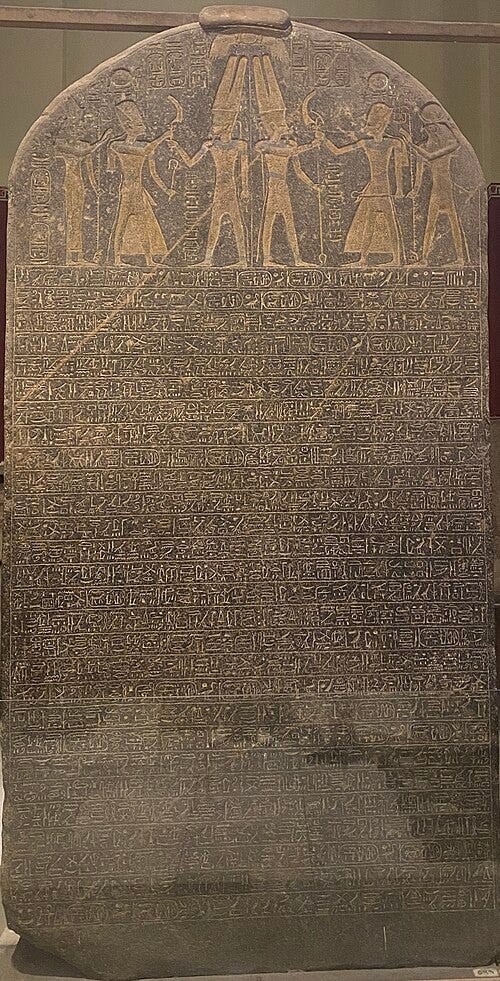
The land is called Judea, the land of the Judeans (today “the Jews” or “the Jewish People”), whose name in nearly every language on earth descends from the name of that place. And for 2,000 years of exile, in Poland and Yemen and Morocco, the prayers of that scattered people faced a single city in that same land, three times a day, without interruption.
When the framework calls this people foreign and the later arrivals native, it is not making a contestable historical claim that happens to cut against the Jews. It is inverting the meaning of its own central terms. The settler it points to is the indigenous one. The colonizer it names is the very people who gave the country its name.
A framework can survive being wrong about a detail. It cannot survive having its central distinction reverse on contact with the very case its champions most want to judge.
And this is where the two engines, souls and land, finally meet, because the failure on both axes is too complete and too symmetrical to be an accident of sloppy reasoning.
A charge that describes the precise opposite of the thing it names is not a mistaken description. It is a projection. The question worth asking is no longer whether the accusation is true, since it manifestly is not, but why it is made at all, and made specifically against this people.
The door explains everything. The colonial mind, the missionary mind, the mind built on universal claims, operates on a single buried assumption, that every people is fundamentally like itself, reaching outward, seeking to absorb, wanting the world to become a version of what it already is. From inside that assumption a people that wants only to exist as itself, in one small place, asking nothing of anyone else’s soul or land, is not merely unusual.
It is illegible. It cannot be read, because it does not fit the only template the framework carries. And the mind that cannot read a thing reaches for the nearest category it already owns.
Unable to comprehend a people that does not seek to absorb, it concludes that this people must be the absorber, doing in secret the very thing the framework assumes everyone is always doing. The accusation is the sound of a universalizing worldview colliding with a particularity it has no language for, and resolving its confusion by assigning that particularity its own face.
This is why the charge does not weaken when the facts contradict it, and why no amount of historical correction has dislodged it. It was never built on facts. It was built on the inability of one kind of mind to accept the existence of the other.
The colonial instinct did not die when the empires fell. It changed its vocabulary and kept its grammar.
It now speaks the language of “liberation,” and in that language it performs the one act it claims to despise, demanding that a particular people surrender its particularity and dissolve into a universal story written by someone else. The least colonial people on earth has been called colonial by a movement that is itself making the oldest colonial demand in history: Abandon what you are and disappear into someone else’s story.
I have spent my life inside a people that never once asked anyone to join it. That refusal to recruit and the refusal to vanish are the same refusal, and the world has always found both intolerable. The one people who never asked you to become them now stand accused of trying to erase you, by a world that cannot forgive their insistence on remaining themselves.
Great article. Vast misinformation has become "the truth" for much of the world. Part of the problem is the ignorance of how many Jews there are in the world. I love asking people, "How many Jews are there in the entire world?" I have asked people all ages, college graduates, non-college graduates, Jew haters, Jew lovers--and the answers I get back almost ALWAYS range from 100 million to a billion. When I tell them, "only 15 million Jews," they almost always shake their heads and say, "that can't be right," and then they take out their phones and Google it. Then they stare at their phones and murmur again, "that can't be right." (Even Joe Rogan had that reaction live on his show after he "guessed" 500 million Jews in the world and was told the truth). Oh, and show them a map of the Middle East with all the land violently colonized by what is now two BILLION Muslims and the teensy strip of land that is Israel, and you get the same reaction because it doesn't fit with the narrative of Israel being the "colonizing land-grabbers."
Isn't it cute for any spaniard to accuse Israel or jews of colonialism? Talk about a reparations bill that has never been paid.