


Please consider supporting our mission to help everyone better understand and become smarter about the Jewish world. A gift of any amount helps keep our platform free of advertising and accessible to all.
This is a guest essay by Ido Singer, the child of a Holocaust survivor who writes the newsletter “When I Should Have Died.”
You can also listen to the podcast version of this essay on Apple Podcasts, YouTube Music, YouTube, and Spotify.
Every time Jews in the diaspora face violence, the same question surfaces: “Why don’t you just leave?”
It’s asked sincerely, sometimes sympathetically, by people who think they’re being practical. Just leave, go somewhere safe, start over somewhere else.
It sounds reasonable — until you realize Jews have been hearing it for 2,000 years, and that every people on earth, except Jews, is assumed to have somewhere they belong.
When Ukrainians fled Russian missiles in 2022, the world didn’t ask why they didn’t just leave Ukraine. The world asked how to help them get back. When Tibetans were displaced by China, the conversation wasn’t about finding them a new country. It was about their right to return to the one they came from. When the Irish were driven out by famine and British policy in the 1840s, nobody suggested they simply find somewhere new to be Irish. Their descendants carry that homeland in their bones a century and a half later, and nobody questions whether it still belongs to them.
Every people climbs toward belonging. History moves against them, and the world’s response is to help them climb back. Jews have been climbing the same ladder for 2,000 years. And every time we near the top, somebody kicks the ladder from underneath our feet.
Spain, 1492: Leave or convert. Germany, 1933: Leave before it gets worse. Poland, 1939: Just get out. Morocco, 1948: Leave while you still can. Not once has the world’s response been: How do we help them stay?
On January 30, 1933, Adolf Hitler became Germany’s Chancellor. German Jews had a choice: Leave now or wait and see. Many left immediately, sold everything, took their families, emigrated to Palestine, America, England. They were called alarmists, paranoid, overreacting — because Germany was civilized, Germany had laws, Germany was the land of Goethe, Beethoven, Kant. “It will pass,” they said. Except it didn’t.
In 1935, Nuremberg Laws stripped Jews of citizenship. In 1938, Kristallnacht (“The Night of Broken Glass”) — synagogues burned, businesses destroyed, Jews beaten in the streets. In 1939, emigration became nearly impossible; borders were closed; quotas were filled. By the time it was obvious that leaving was necessary, leaving was no longer possible. The ones who left between 1933 and 1935 survived. The ones who stayed, who believed in German civility, who thought it would blow over, who didn’t want to abandon their homes, died.
Six million didn’t die because they were stubborn. They died because “just leave” requires three things: somewhere to go, resources to get there, and the ability to see the future. Most didn’t have all three.
And here’s what people forget. The world didn’t want Jewish refugees. At the Evian Conference in 1938, 32 countries met to discuss the Jewish refugee problem. Almost all refused to take them. America had quotas. Britain restricted immigration to Palestine. Canada said, “None is too many.” “Just leave” only works if somewhere will take you. Nobody asked the Germans to just leave Germany.
My father, Edward, was 5 years old when Germany invaded Poland. His father Olek had already watched his world contract for years. Jews in Krakow in the late 1930s felt the atmosphere changing the way you feel a storm before the rain starts — not sudden, grinding, daily.
Vladislava, a Polish woman who had been helping care for the children after their mother Berta had left, understood what was coming before most did. “They look Polish,” she told Olek. “I could take them back to Lancut. My brothers live there. We’d be safe.”
Olek knew what it meant.
“They just lost their mother,” he whispered. “Now they’re going to lose their father.”
“We can stay and hope,” Vladislava said. “But hope didn’t save anyone in Austria.”
She was right. He knew it, so he made the impossible choice: Send them away.
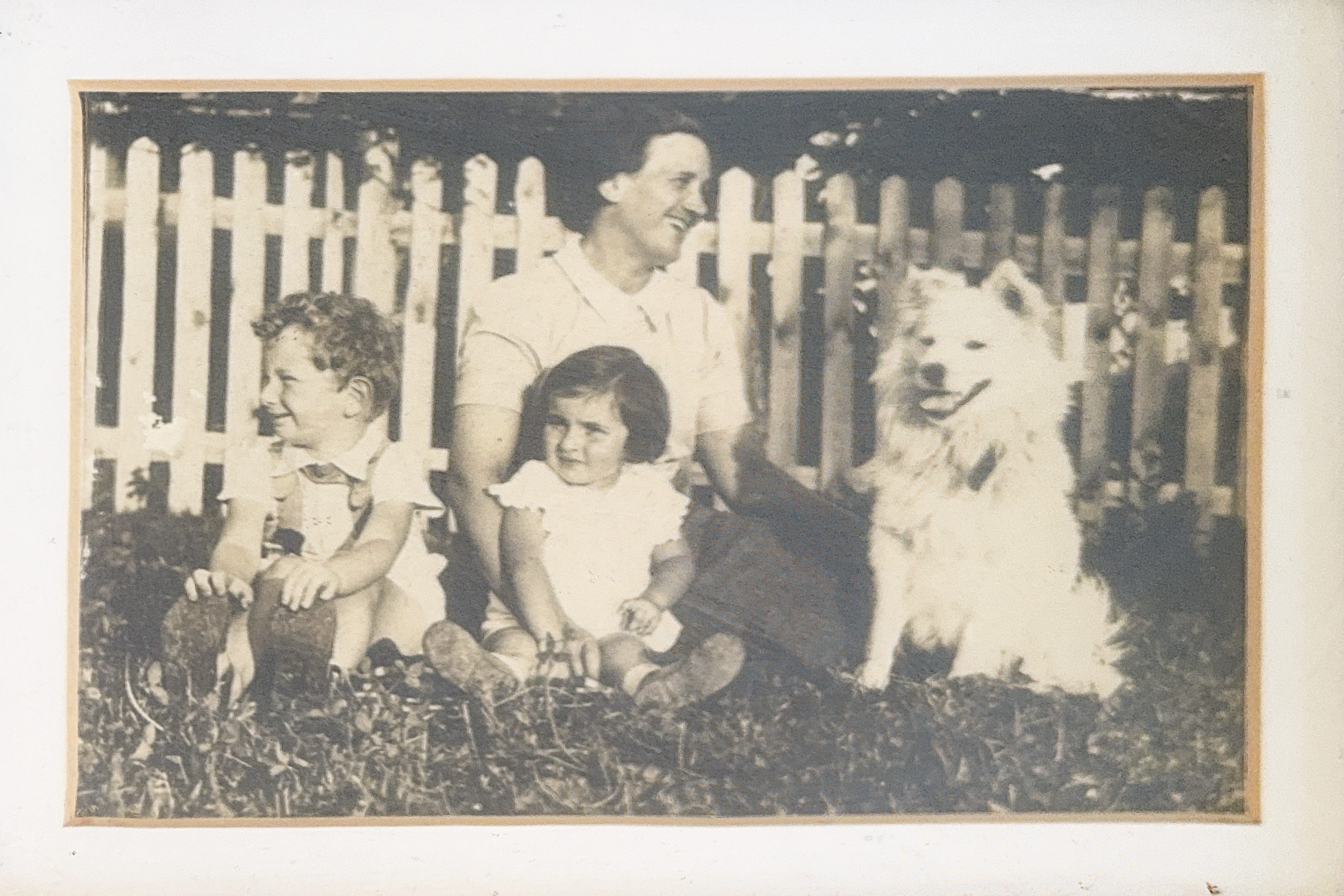
Edward and Giza went to Lancut. Vladislava taught them to answer late, to keep their hands quiet, to make themselves smaller than the room they were in — not hiding, disappearing in plain sight, while standing right there.
They survived.
Olek survived, barely, through forced labor, multiple camps, and death marches, including near-death more than once. The families who stayed together? The ones who said we’ll hide here, or it can’t last long, or we can’t split up? Most didn’t make it.
The skill Vladislava taught Edward in Lancut never left him. By the time I knew my father, the danger was long gone. But the training stayed. It just changed shape. Meanwhile, nobody asked the Poles to just leave Poland.
My grandparents lived in Guelmim, a small city in southern Morocco, often called the Gateway to the Desert. They had known each other since childhood. When the time came, the whole town turned out to celebrate Yitzhak and Zohra. The scent of cumin and orange blossom filled the air. Drums echoed through the narrow streets. Women ululated from rooftops as the couple danced beneath strings of lanterns.
They were not Zionists. They did not dream of Israel. Guelmim was home. Their parents were there. Their community was there.
They didn’t leave because of one explosion. They left because of a slow, grinding erosion. After the modern State of Israel’s creation in 1948, tensions flared. Neighbors turned cold, whispers turned to threats, and the message became legible even without being spoken: You’re not safe here anymore.
Their parents didn’t leave with them, unwilling or unable to believe that home could turn against them. They had stayed.
For years after arriving in Israel, my grandparents sent letters south through neighbors, merchants, and anyone traveling that direction. None ever returned. News from Guelmim came in fragments: rumors of burned houses, of disappearances, of silence thick enough to swallow names. They never heard from their parents again.
After t10n weeks of walking, riding donkeys, sleeping in the backs of trucks, and sailing on a rusted, crowded boat, they finally reached the port at Haifa. They had left Morocco as a family of four. They arrived as five. My mother was born somewhere between Guelmim and freedom — into the space between one life and another, born into exodus, never fully belonging to either side of it.
Of course, nobody asked the Moroccans to just leave Morocco.
Some 850,000 Jews were expelled from Arab countries between 1948 and 1970. There were no United Nations resolutions, no “right of return,” no international conferences on the Jewish refugee problem. They went to Israel and rebuilt. Their great-grandchildren are Israelis.
The 700,000 Palestinians who left Israel in 1948 are still, officially, refugees. Their great-grandchildren are still refugees. The international community maintains that status, funds it, and calls it a “right.” One group rebuilt, the other is kept in a constant state of coddling. The asymmetry isn’t an accident. It’s the architecture.
Here is what nobody asks when they say, “Why don’t Jews just leave?” Leave to where? For 2,000 years, Jews have been told to leave every place we’ve lived. And every time, we had to find somewhere that would take us.
But here is the thing the question always skips over: Israel is not a refuge we settled for. It is where Jews are from. The land, the language, the archaeology, the liturgy praying toward Jerusalem for two millennia. Exile was what happened to us. Return home was always the direction.
When Ukrainians go home to Ukraine, nobody calls it a political project. When the Irish call Ireland home, nobody questions whether they have the right. When Jews returned to the one place that was always theirs, the one place where a Jewish presence survived ancient Egyptians, Philistines, Assyrians, Babylonians, Persians, Greeks, Romans, Ottomans, and Crusaders, the world invented a new category of illegitimacy just for that. That is not a policy disagreement. That is the ladder being kicked away again.
I have children. They go to school in North Carolina. They come home. Nobody asks them to calculate how many seconds they have before impact. But driving home from a Hanukkah event with a giant menorah on the roof of the car last year, I had to explain to my youngest that being visibly Jewish carries a risk, that there are people who want to hurt us because we’re Jewish, that he needed to listen to me if something happened.
And sitting in that car, I thought about Olek whispering to Vladislava, about my grandparents sending letters to Morocco that never came back, about my father learning to make himself smaller than the room he was in. Every generation has its version of the same conversation. Every generation has to explain to its children that the world has not yet decided we belong.
My father, Edward, was 5 years old when Olek sent him to Lancut to survive. He came back. In 1950, Olek brought Edward and Giza to Israel. Edward served, built a life, and had children in the country Jews were always from, because everywhere else had already answered the question.
My father was a plastics engineer. He went to work, came home, raised a family.mI served in the Israeli Air Force and came home. Three generations of ordinary lives, in the one place ordinary Jewish life wasn’t supposed to be allowed or possible. That is not heroism. That is what staying looks like.
Jews have heard “just leave” before. We left Spain, Germany, Poland, Morocco, Iraq, Iran, Yemen, Libya, Syria, and many other places. We left when we saw it coming. We left when we didn’t. We left and survived. We stayed and died.
And every time we left, we had to find somewhere that would take us — somewhere that wouldn’t eventually ask us to leave again. There is one place that has never asked us to leave — because it was ours before the question existed. And we are done answering it.
So I was standing in the waves on a Tel Aviv beach early Shabbat morning on a visit this september and it came to me - after 50 years of dreaming and 10 years of dismay over what is happening in my country, "Vote with your feet, make a safe place for the kids", and so I decided - I'm making Aliya in June, this is the time, for exactly this reason.
When Muslim countries lost the war to Israel , they decided to expel Jews from their countries.
But Israel didn’t kick out their Muslim citizens. If they had , they wouldn’t be facing problems now.