


Please consider supporting our mission to help everyone better understand and become smarter about the Jewish world. A gift of any amount helps keep our platform free of advertising and accessible to all.
This is a guest essay by Andres Spokoiny, President and CEO of the Jewish Funders Network.
You can also listen to the podcast version of this essay on Apple Podcasts, YouTube Music, YouTube, and Spotify.
One of the keys to understanding Western attitudes toward the Israeli–Palestinian conflict is to distinguish between Palestinians and Palestinianism.
Palestinianism is something else entirely. It is not a movement for Palestinian rights. It is a Western ideological framework that transforms “Palestine” from a particular conflict into the central moral lens through which every other issue is interpreted.
The extent to which Palestinianism has colonized public life is difficult to exaggerate.
Climate movements suspend campaigns against global warming to organize demonstrations for Gaza. Pride marches become platforms for “Palestinian liberation.” Labor unions issue declarations about Israel. Literary festivals, immigration protests, museum openings, academic conferences, municipal elections, even mining festivals in Scotland suddenly discover that their central concern is “Palestine.”
At the 2025 Durham Miners’ Gala — a celebration of Britain’s mining heritage — speakers insisted that defending British workers required “freeing Palestine.”
The underlying assumption is breathtaking in its ambition: “Palestine” is no longer one conflict among many, but the hidden key to all of them. Solve “Palestine” (or, more accurately, eliminate the Jewish state) and capitalism, colonialism, racism, patriarchy, climate change, and every other great evil suddenly disappear.
I’m not exaggerating. Irish author Sally Rooney recently declared that “the struggle for Palestine is also and has always been a struggle for human liberation and for our future on this earth.” American political activist Angela Davis described “Palestine” as “the center of the world.” The Climate Justice Alliance proclaimed that “the path to ecological justice runs through a free Palestine.”
None of these statements merely express solidarity with Palestinians or promote a realistic solution for their plight. They assign “Palestine” a unique symbolic role among the world’s foremost injustices.
Of course, people are free to express solidarity with causes they consider just. Nothing is objectionable about that. But solidarity alone cannot explain why a conflict involving a tiny strip of land has acquired a symbolic centrality unmatched by wars that have killed vastly more people, displaced vastly more civilians, or reshaped the international order far more profoundly.
What we are witnessing is not solidarity but something else: The global Palestinianism movement has become so culturally powerful that “Palestine” functions less as a concrete cause than as a universal symbolic language. The result is paradoxical: The more “Palestine” comes to stand for everything, the less attention is paid to the concrete conditions, institutions, compromises, and policies that might actually improve Palestinian lives.
The political theories of Ernesto Laclau and Chantal Mouffe help explain how this transformation occurs. Laclau argued that successful political movements are not built simply by accumulating protests, but by weaving disparate grievances into a common narrative. Political entrepreneurs present seemingly unrelated issues as different manifestations of the same underlying structure of oppression. Laclau called this a “chain of equivalence.”
At the center of that chain stands what he called an empty signifier: a symbol broad enough to absorb multiple, often unrelated aspirations. Concepts such as “the people,” “justice,” or “democracy” acquire enormous political power precisely because they remain undefined. Different constituencies can project onto them their own hopes, fears, and grievances.
Chantal Mouffe later emphasized that such symbols can become the master signifier, the symbolic center that gives emotional coherence to an otherwise heterogeneous coalition. If the central symbol derives its power from being “empty,” then the same must eventually become true of its antagonist; in other words, the enemy no longer matters for what it actually does but for what it comes to represent.
Once emptied of their concrete reality, “Palestine” and Israel become infinitely useful. Palestinians cease to be a people and become the “Every Victim.” Israel ceases to be a country and becomes the “Ultimate Evil” itself. The less either resembles reality, the more valuable they become as symbols.
Once this happens, the conflict itself becomes strangely irrelevant. There is little reason to study its history, understand its competing narratives, grapple with its moral ambiguities, or search for workable compromises. Accepting the complexity of this conflict threatens the very symbolic architecture that gives it power.
Indeed, peace itself becomes almost subversive. A negotiated settlement would collapse the ideological structure that Palestinianism has painstakingly constructed. Once “Palestine” becomes one territorial dispute among many — messy, compromised, tragic, and painfully ordinary — it can no longer function as the master metaphor of “global oppression.”
None of this means that Palestinians have not suffered. They have suffered. Precisely because Palestinians deserve to be treated as a real people rather than as ideological raw material, they deserve something better than being endlessly recruited into Western culture wars. They deserve to be discussed as a nation with political choices, competing visions, institutions to build, leaders to hold accountable, and a future to secure.
This raises an obvious question: Why Palestine? Why did this conflict, and not another, become the master signifier of our age?
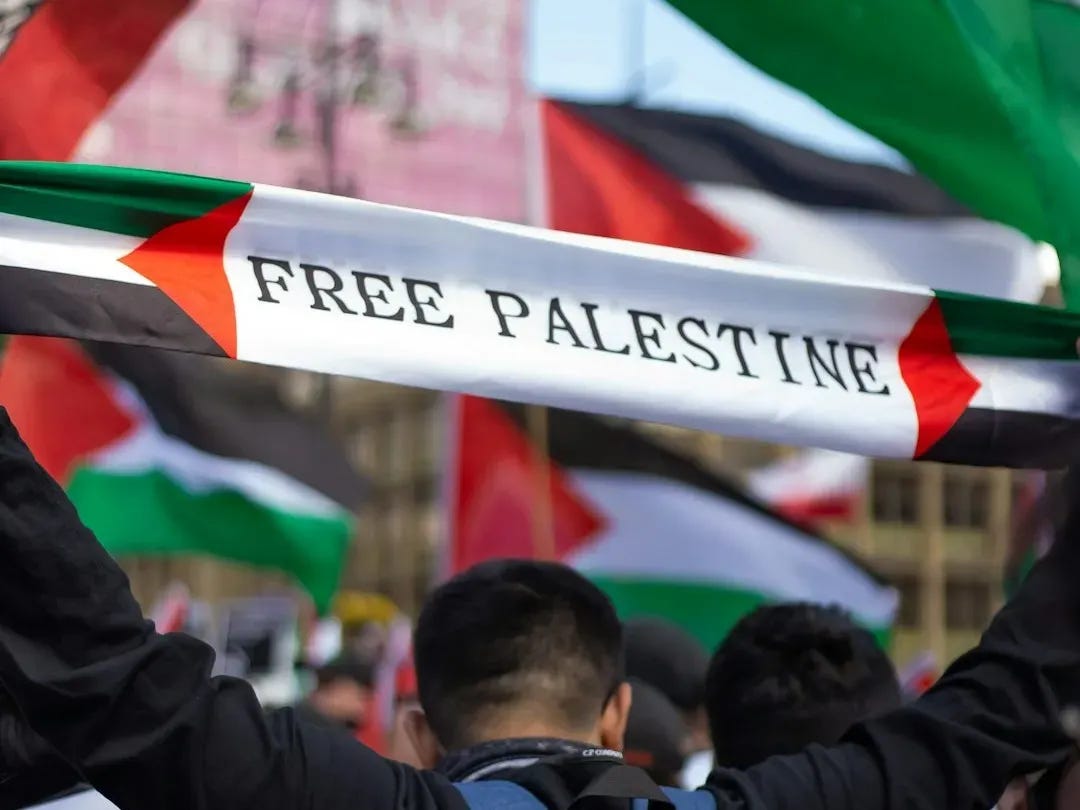
Some explanations are straightforward.
Modern politics rewards moral simplicity. “Palestine” appears to offer a perfectly symmetrical drama: oppressed versus oppressor; colonized versus colonizer; victim versus power. It is a story that can be understood instantly, compressed into a slogan, and exported to almost any political context. That simplicity, though false, is politically useful.
“Palestine” offers a common banner under which movements that otherwise have little in common can march together. Islamists who would imprison homosexuals suddenly become allies of LGBTQ activists. Radical feminists overlook movements whose treatment of women fundamentally contradicts their own principles. Anti-racist activists who rightly denounce ethnic massacres elsewhere suspend those concerns when the perpetrators happen to fit the preferred revolutionary narrative.
“Palestine” allows mutually incompatible ideologies to postpone their contradictions in favor of a common enemy.
“Palestine” also functions less as a foreign-policy position than as a marker of moral identity. Supporting “Palestine” increasingly signals membership in a broader moral community. It tells others not simply what one thinks about the Middle East, but what kind of person one is. That is why “Palestine” appears, often incongruously, in municipal elections, school board meetings, labor disputes, academic hiring committees, and cultural institutions that possess no conceivable influence over events between the Jordan River and the Mediterranean Sea.
Then there is social media. Algorithms reward emotionally powerful symbols, visual narratives, and moral certainty. “Palestine” plays on those three dimensions. Images circulate instantly, stripped of context and embedded within stories that users already wish to tell about capitalism, colonialism, racism, or empire. The conflict is not merely reported; it is optimized for virality. Other tragedies — equally horrific but less photogenic, less familiar, or less useful — simply disappear beneath the algorithmic horizon.
Yet none of these explanations fully accounts for Palestinianism’s extraordinary success.
The comparison with the Uyghurs is especially revealing. Since 2017, the Chinese government has subjected the Uyghurs and other predominantly Muslim minorities in Xinjiang to one of the most extensive campaigns of repression in the contemporary world.
Credible investigations have documented the mass arbitrary detention of hundreds of thousands (and possibly millions) of people in internment camps; pervasive digital surveillance through facial recognition, biometric data collection, and electronic monitoring; torture, sexual violence, and other forms of abuse in detention; forced labor programs; severe restrictions on religious practice, language, and cultural expression; the destruction of mosques, shrines, and cemeteries; the separation of children from their families into state-run boarding schools; and coercive birth-control measures, including forced sterilizations and IUD insertions.
If one were searching for a contemporary example of colonial domination, cultural destruction, mass incarceration, religious persecution, and technological authoritarianism, Xinjiang would appear to satisfy every criterion.
Yet, the Uyghur cause has not colonized the Western imagination. It does not appear compulsorily at climate marches, literary festivals, Pride celebrations, labor conferences, museum openings, or municipal elections. There are no demands that every movement first declare its position on Xinjiang before discussing its own agenda.
There are, to be sure, legitimate reasons for the difference. Some Western governments are more deeply entangled with Israel than with China. “Palestine” has enjoyed decades of well-funded organized international solidarity. China has been extraordinarily successful at restricting access to Xinjiang while suppressing images and testimony.
But that still fails to explain the extraordinary symbolic value attached to Israel — the ease with which one small conflict comes to represent colonialism, capitalism, racism, militarism, policing, borders, environmental destruction, and the entire system of “Western domination.” To understand that, one must examine not only the victim but also the antagonist.
What probably explains why Uyghurism is not a thing while Palestinianism has colonized the political imagination is that Palestinianism derives much of its symbolic power from the identity of its enemy: the Jews.
Antisemitism has never treated Jews as merely another disliked minority. It has consistently transformed them into explanatory figures. Across radically different societies and ideologies, Jews have been imagined as the embodiment of money, capitalism, communism, cosmopolitanism, nationalism, rootlessness, modernity, decadence, secrecy, manipulation, finance, media, and invisible power.
Whatever a civilization most feared or hated, Jews somehow came to personify. Long before Ernesto Laclau described empty signifiers, Jews had already served as one for nearly 2,000 years. They became the receptacle into which societies poured their anxieties, contradictions, and failures.
Israel allows this ancient symbolic structure to be translated into the moral vocabulary of the 21st century. The Jew is no longer imagined merely as the hidden power behind the curtains. In the figure of Israel, Jewish power becomes visible, sovereign, armed, technologically sophisticated, and therefore capable of personifying not merely one country but an entire system.
This means that Palestinianism has inherited a sort of moral structure that places “the Jew” as the embodiment of evil. Sometimes that inheritance is unconscious, sometimes it is adopted and used deliberately. Either way, Israel becomes the state whose wrongdoings acquire a different dimension. Russia, China, Syria, and Iran may commit crimes, but those crimes remain Russian, Chinese, Syrian or Iranian crimes; they are not made to explain the world.

The Uyghur cause is “boring” because it merely directs attention toward the Uyghurs. Palestinianism directs attention toward a theory of the world — and the historical availability of Jews as universal explanatory figures helps explain why. China may oppress a people, but Jews can still be made to explain the universe.
And that has consequences.
It hurts Israelis, certainly. It fuels a political culture in which the Jewish state is judged not by the standards applied to other nations, but by standards reserved for metaphysical evil. It also hurts Jews around the world. Once Israel becomes the symbolic embodiment of global injustice, Jews inevitably become its local representatives. The oldest habit of antisemitism reasserts itself in contemporary language: Jews once again become responsible not merely for what they do, but for what they supposedly represent.
Above all, Palestinianism hurts Palestinians because the actual flesh-and-blood Palestinians disappear into a symbol. They cease to be a people who need functioning institutions, accountable leadership, economic opportunity, personal security, and rule of law. Instead, they become the indispensable protagonists of a universal morality play, valued less for who they are than for what they signify.
Their suffering is transformed into political currency used to explain capitalism, colonialism, racism, climate change, patriarchy, and the failures of the West. But symbols cannot negotiate borders, build schools, reform governments, create jobs, attract investment, fight corruption, or make the painful compromises on which every durable peace depends.
Indeed, Palestinianism creates a perverse incentive structure. The movement rewards theatrical maximalism over attainable improvement. It elevates slogans over institutions, symbolism over governance, permanent resistance over political responsibility. Every concession becomes betrayal. Every compromise becomes collaboration. Every practical success threatens the ideological purity of the cause.
That is why Palestinianism shows little curiosity about Palestinian political failures. Hamas’ absolute authoritarianism, the Palestinian Authority’s rampant corruption, the absence of formidable institutions, the suppression of dissent, the failures of governance, the fragmentation of Palestinian society — these are all awkward facts because they restore agency to Palestinians, and agency complicates the allegory.
That also explains why Palestinianism appears strangely indifferent to outcomes. If the goal were primarily to improve Palestinian lives, one would expect an obsessive interest in economic development, institutional reform, educational achievement, anti-corruption measures, diplomatic breakthroughs, and the difficult work of preparing a society for statehood.
Instead, the movement overwhelmingly rewards symbolic confrontation. The greatest prestige accrues not to those who improve Palestinian lives, but to those who most effectively dramatize Palestinian victimhood.
Consider Greta Thunberg. She has become one of the world’s most recognizable faces of the Palestinian cause. Yet it is difficult to identify a single concrete improvement in the daily lives of Palestinians that resulted from her activism. Her flotilla generated headlines, photographs, and social-media engagement, but it did not open a border crossing, build a school, create a job, reform a Palestinian institution, or bring the parties any closer to peace.
That is a feature and not a bug. Palestinianism produces political capital for the activists, and virtually nothing for the Palestinians.
The result is that Palestinians become indispensable to the movement precisely insofar as they remain unresolved. A “Palestine” at peace with Israel would matter profoundly to Palestinians, but it would be catastrophic for Palestinianism.
Brilliant. This is why I say we are all Israelis now, whether we like it or not.
There is no ‘Palestine’ to begin with. They are Arabs. And the cult of Palestinianism which is the mind virus of the 21st century infecting the West was created by the KGB and Arafat in 1964. This con exists to erase and destroy the Jewish people and our connection to our ancient homeland. By continuing to engage in this nonsense instead of fighting it gives a fake and illegitimate people legitimacy.