


Please consider supporting our mission to help everyone better understand and become smarter about the Jewish world. A gift of any amount helps keep our platform free of advertising and accessible to all.
This is a guest essay by Nachum Kaplan, a longtime journalist and commentator who writes the newsletter, “Moral Clarity.”
You can also listen to the podcast version of this essay on Apple Podcasts, YouTube Music, YouTube, and Spotify.
Much has been written about what surging antisemitism in America means for Jews. More troubling is what it says about America itself.
It says the country is losing the moral architecture that made it stable, prosperous, and trustworthy. It says the America that the world depended upon — and Americans themselves took for granted — is in ideological decay.
Antisemitism is not just a Jewish problem. It is a warning that a society is going wrong. Historically, when civilizations lose confidence in their values, Jews are among the first to discover it. The pattern is depressingly consistent. The U.S. is now following other Western societies down this path.
What America is losing is the moral framework that once gave the country coherence: the belief that individuals should be judged as individuals, that rights are universal, that laws should apply equally, and that some things are unacceptable regardless of political fashion.
For most of American history, those assumptions formed the nation’s cultural operating system. Imperfectly applied? Certainly. Hypocritically violated at times? Of course. But they existed. Americans broadly understood the rules, even when they failed to live up to them.
One of those rules was that antisemitism was shameful. Today, that clarity is dissolving.
America has increasingly replaced universalism with a caste system. People are no longer viewed primarily as citizens or individuals but sorted like laundry into categories of power and victimhood: oppressor, oppressed, privileged, marginalized, innocent before conduct, guilty before speech.
Identity has become destiny.
In this framework, moral worth is no longer attached to behavior but to group classification. Some groups are granted presumptive virtue while others are treated as morally suspect by default. A language of hierarchy has replaced the language of rights.
This is the American problem.
Once a society accepts that people should be treated differently based on identity, equality becomes negotiable, fairness conditional, and standards selective. Rules stop functioning as rules and become weapons applied unevenly depending on political convenience.
Antisemitism thrives in such environments when values collapse.
Jews have now been repositioned within the American moral imagination. For decades, Jews were understood as a vulnerable minority deserving protection. Increasingly, however, they are recast as symbols of power, privilege, whiteness, capitalism, colonialism, or institutional dominance.
History is littered with ideological movements that transformed Jews from vulnerable minorities into embodiments of societal evil. What is new is how mainstream this has become in America, particularly among elite institutions that once prided themselves on liberal values.
The rationalization is the mechanism itself. Modern antisemitism arrives with a graduate degree, speaking the language of “social justice.” It explains itself at length. It moralizes, pathologizes, and performs compassion while excusing cruelty. That rationalization allows people to indulge hostility toward Jews while maintaining a “morally righteous” self-image.
It is what permits students at elite universities to scream at Jewish classmates while believing they are advancing “justice.” It is what allows professors to explain away Hamas atrocities as “context.” It is what enables crowds to chant “Globalize the intifada!” while insisting they oppose antisemitism. It is what allows Ivy League presidents to suddenly develop philosophical uncertainty when asked whether calling for genocide violates campus rules.
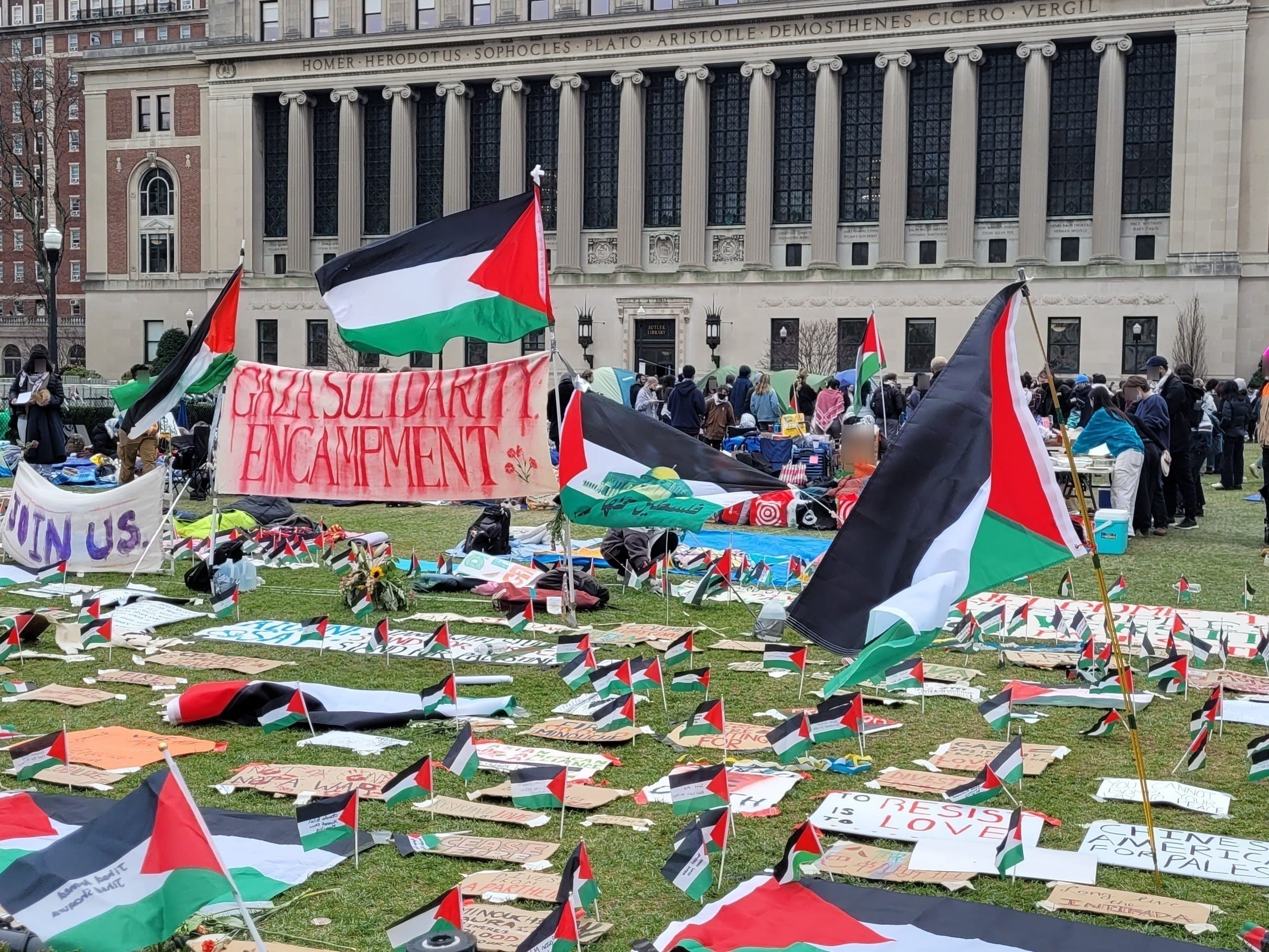
Healthy societies do not require interpretive dance before condemning Jew-hatred. They recognize it instinctively, the way a functioning nervous system recognizes pain. Morally disoriented societies do something different: They debate, contextualize, qualify, and hold panels. If a civilization has started arguing over whether certain forms of antisemitism are acceptable, the decay is already advanced.
That is where America now finds itself.
The country’s enormous military and economic power obscures the deeper problem. America was never exceptional only because it possessed aircraft carriers and nuclear weapons. Plenty of powerful nations have existed throughout history. What distinguished the U.S. was the belief — however imperfectly realized — that ideals and laws mattered more than tribes.
That belief created stability and a served as model. It made America predictable to allies and relatively trustworthy to its own citizens. Beneath the noise of elections and polarization remained a sense that certain principles were durable and non-negotiable.
Today, that confidence is evaporating.
Institutions increasingly behave according to pressure rather than principle. Standards are applied inconsistently. Moral judgments fluctuate depending on which coalition is loudest, angriest, or most fashionable. Citizens notice this immediately. So do allies.
When people stop believing rules are consistent and anchored, behavior changes rapidly. Transgression costs decline, boundaries weaken, and individuals test limits. Things once considered socially radioactive suddenly become acceptable. Synagogues require armed guards. Jewish students hide their Star of David. Protesters glorify terrorist movements in major Western cities while journalists explain why public outrage may be “problematic.”
A society does not reach this stage accidentally. The American elite spent years teaching citizens to interpret every human interaction through race, power, oppression, and grievance. They encouraged tribal consciousness while expecting social cohesion to remain intact, and the damage extends far beyond Jews.
Once a society’s values disappear, the impact spreads into every area of civic life. If Jews can be targeted because they are deemed “privileged,” eventually other groups can be targeted using similarly fashionable rationalizations. This is why antisemitism matters beyond the Jewish community.
Jew-hatred is often the first major symptom of civilizational confusion because it flourishes where societies abandon moral clarity for ideological tribalism. Jews become repositories for displaced aggression. They are transformed into symbols onto which anxieties about capitalism, globalization, power, modernity, and inequality can be projected. Psychologically, this is seductive because it allows people to feel virtuous while indulging hostility.
The modern ideological activist often experiences politics less as civic responsibility and more as moral theater. Outrage becomes a status symbol, compassion performative, and hatred permissible so long as it is directed toward sufficiently unfashionable targets. Jews increasingly qualify.
That is why otherwise educated people can engage in conduct that would have horrified liberals 20 years ago, while still perceiving themselves as “enlightened humanitarians.” The ideology provides moral licensing; it converts prejudice into activism.
Once that conversion takes hold, standards collapse quickly. Facts matter less than narrative, conduct less than identity, and every conflict becomes a competition over victimhood status. Public discourse turns into a permanent struggle to determine who possesses moral immunity and who deserves condemnation.
The result is fragmentation.
Citizens retreat into ideological tribes where their preferred version of reality is continuously affirmed. Shared standards weaken, social trust deteriorates, and national cohesion declines. The country stops functioning as a unified society and increasingly resembles rival moral communities occupying the same territory. Jews are experiencing this acutely, yet they are hardly the only people endangered by such instability.

The broader danger is that broken norms are extraordinarily difficult to restore once lost. Institutional cowardice compounds over time. Every equivocation weakens boundaries further. Every selective application of standards teaches that principles are negotiable.
This is why the current moment feels qualitatively different from previous waves of antisemitism in America. It is not simply that incidents are increasing. It is that institutional responses are weaker, slower, and more compromised. Universities that once advertised themselves as guardians of tolerance suddenly discover free speech absolutism when Jews are threatened. Political leaders who once spoke clearly now hedge their language like nervous corporate lawyers avoiding liability.
The signal is unmistakable: The rules are no longer stable or fixed.
That is the deeper meaning of surging antisemitism in America. It reflects a country losing confidence in its civilizational principles, replacing clarity with ideological fashion, and subordinating judgment to tribal narratives. For Jews, this requires abandoning comforting assumptions.
The belief that America is somehow permanently immune from the patterns that consumed other societies has to die. History does not grant eternal exemptions. Civilizations do not become morally disoriented only elsewhere. For Americans more broadly, the implications are even larger.
A society that cannot maintain universal standards eventually loses the ability to mediate conflict fairly. A society that treats principles as conditional eventually discovers they disappear altogether. Institutions that fail to protect one group today will struggle to protect others tomorrow. Reversal is still possible, yet it must not begin with slogans, public relations campaigns, or another pointless diversity initiative.
Instead it begins with moral confidence. It must start with a reassertion that individuals matter more than categories, that rights are universal, and that standards must apply consistently. Hatred must not be deemed enlightened because it adopts academic vocabulary. That intimidation of Jews is unacceptable regardless of which ideological faction performs it.
These should be utterly uncontroversial statements. The fact that they increasingly sound controversial is itself evidence of how far the decay has advanced.
Restoring those standards will require confronting ideas deeply embedded within elite culture. It will require acknowledging that some movements celebrated as moral progress have instead accelerated tribalism, institutional cowardice, and social fragmentation. That will be uncomfortable; necessary things often are.
Societies do not collapse all at once. They rot morally before they fracture politically. They lose the ability to distinguish principles from slogans, justice from tribal indulgence, and universalism from ideological favoritism.
Antisemitism is one of the clearest warning flares in that process because Jew-hatred has historically flourished wherever moral systems decay and civilizations lose confidence in themselves. America is not there yet, but it is moving in that direction with alarming speed.
That is the American story embedded within the rise of antisemitism — a warning not just to Jews, but to anyone who still believes a civilization requires consistent standards to thrive.
Wow. Very very scary and a massive warning to every sane person
Bottom line is no stereotyping. Whether on the basis of race, religion, other ethnicity and yes political viewpoints. This means no more teaching using critical race theory ( and other ridiculous critical theories that are based in stereotypes and historical labeling. And it means no more intersectionality which reared its head 10-15 years ago and mandates viewing the groups not in favor as deserving of derision, disrespect and cancelation. This became crystal clear when women's march leaders Mallory and Sarsour mandated no zionists and few among the intersectionalists objected. One might argue that what we have seen on college campuses began with those exclusionary mandates. Finally, in the year 2026, the avowed Anti zionist pays no price whatsoever for their jew hatred but the racist will likely be fired or marginalized etc ( AS THEY SHOULD ). Different rules depending upon who is doing the hating and who is the target of the hate. Yes there are exceptions to the foregoing statement but we all know that this is how our society operates today.