


Please consider supporting our mission to help everyone better understand and become smarter about the Jewish world. A gift of any amount helps keep our platform free of advertising and accessible to all.
This is a guest essay by Matthew Nouriel, an Iranian and Jewish writer and activist.
You can also listen to the podcast version of this essay on Apple Podcasts, YouTube Music, YouTube, and Spotify.
Something beautiful is happening between Jews and Persians right now, and it has far less to do with modern politics than most people realize.
People who might not know any better may describe this as a new alliance — as though Persians and Jews suddenly discovered each other through the headlines of the past year.
That framing misses what’s actually happening.
What we are witnessing is the reemergence of something ancient: two peoples whose histories have been intertwined for more than 2,500 years, recognizing each other again after centuries of ideological distortion.
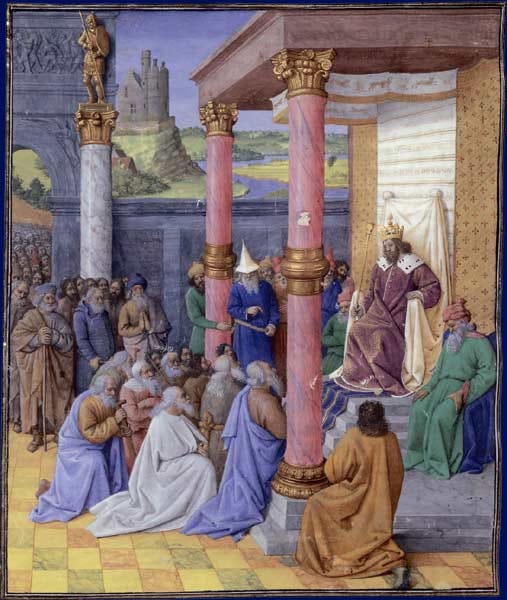
One of the defining moments in Jewish history came through Persia in the 6th century BCE. Cyrus the Great, the founder of the Persian Empire, allowed the Jews exiled in Babylon to return to Jerusalem and rebuild the Temple. In my view, Cyrus was one of history’s first Zionists. Long before the word existed, he understood the principle at the heart of Zionism: that the Jewish People belonged in their ancestral homeland and had the right to return, rebuild, and restore national life there.
That is why, in Jewish tradition, Cyrus holds a unique place. He is the only non-Jew referred to as God’s anointed (His messiah) in the Book of Isaiah (Isaiah 45:1). That title reflects the role he played in making Jewish return to Zion possible. Jewish history remembers him as central to one of the most important acts of national restoration in our story.
Zionism today is constantly misrepresented as though it were some colonial invention of the 20th century, detached from Jewish memory and Middle Eastern history. The history itself says otherwise. Jewish longing for Zion is ancient, woven into Jewish civilization itself, and Persia played a defining role in one of the earliest returns to Zion.
This is why Reza Pahlavi, former Crown Prince of the Pahlavi dynasty of Iran currently living in the U.S. in exile, is right when he says that Iranians and Jews are the only two nations still alive today with a biblical bond. That is not a poetic exaggeration; it is history.
Of course, history was never perfect. Antisemitism existed in Iran, and it would be dishonest to pretend otherwise.
After the 7th-century Arab conquest of Persia, Jews (like other non-Muslims) were classified as dhimmis, a protected but subordinate status under Islamic rule. Like across much of the Muslim world, conditions varied depending on the rulers; there were periods of relative stability alongside periods of restriction and upheaval.
Under the Safavid dynasty between the 16th and 18th centuries), when Shi’a Islam was established as the state religion, restrictions hardened and Jewish communities became even more vulnerable. These attitudes were embedded into Persian society through long-standing Islamic conceptions of Jews as subordinate and ritually impure. European travelers who visited Persia documented these conditions.
In the late 17th century, the French traveler Jean Chardin wrote that “the Jews are obliged to live in separate quarters … they are treated with great contempt … and are exposed to insults and injuries from the populace.”
Other observers described the same system — beliefs shaping daily life, from social interaction to participation in markets and public space. This belief system structured how Jews lived and how they were treated.
In 1839, the Jews of Mashhad (a city in northeast Iran) experienced a pogrom known as the Allahdad, characterized by the mass-killing and forced conversion of these Jews to Islam. In 1910, a blood libel in Shiraz led to a violent pogrom against the Jewish community there. Antisemitism in Iran did not begin with the Islamic Republic of Iran (established in 1979), and the way the regime uses it today is a continuation — taking older religious frameworks and turning them into explicit political doctrine.
Even during the Pahlavi era (1925 to 1979), which Iranian Jews refer to as the golden era of Jewish life in Iran — with greater freedom, visibility, opportunity, and full equal rights — antisemitism still existed. In major cities like Tehran it was often less visible, and many Jews and non-Jews lived, worked, and socialized together without issue.
But it didn’t disappear. Like anywhere else in the world, there were still instances of antisemitism — and in Iran, those attitudes were rooted in the same older Islamic frameworks. You can’t undo something embedded over centuries in the span of a few decades.
I grew up hearing stories that reflected this reality. My mother was a finalist in the National Miss Teen Iran contest in the early 1970s (she came in second place) and within our family, and more broadly within the Jewish community, it was often said that she didn’t win because her last name was Israel, and because she was visibly Jewish. Whether or not that was the deciding factor, the fact that it was believed (and repeated) says something about how people understood the boundaries of acceptance at the time.
The 1906 constitutional reforms in Iran formally expanded rights for minorities, including Jews, but like most legal reforms, they took time to show up in everyday life. It was really under Mohammad Reza Pahlavi, the last Shah (King) of Iran from 1941 to 1979, that those changes became more visible. Even then, older attitudes didn’t just disappear.
Under the Pahlavis, those prejudices were not the defining principle of the state. After 1979, under the Islamic Republic in Iran, they became doctrine. Anti-Zionism and, by extension, antisemitism, were elevated into a central pillar of the regime’s ideology, and hostility toward Israel (and Jews who didn’t fall into place) became something to reinforce, teach, and export. Hostility toward Israel became part of the regime’s core ideological identity, reinforced through propaganda, education, media, and violence.
Hatred was moralized. Anti-Zionism became a revolutionary virtue.
For decades, the regime worked to sever Iranians from their own deeper history and replace it with an identity built around political Islam, permanent grievance, and hostility toward Israel. It taught generations that anti-Zionism was a moral obligation and that Israel — and non-compliant, insubordinate Jews — were a civilizational enemy.
Now many Iranians are confronting what Islamism has done to their country. They are looking at the corruption, repression, humiliation, and theft of national identity and asking harder questions — not only about the regime, but about the ideological framework that justified it. This is not simply anti-regime sentiment, which has existed for a long time. What is growing is anti-Islamist consciousness: a deeper recognition that political Islam itself has been one of the great destroyers of Iranian civilization.
As many Iranians reject Islamism, they are also beginning to reexamine the inherited hostility attached to it, including hostility toward Jews and Zionism. That does not mean every anti-regime Iranian is becoming pro-Israel or pro-Zionist. What it does mean is that a visible and growing number of Iranians are beginning to see Jews and Israel outside the mythology imposed by the regime. For some, Jewish self-determination no longer looks like the villain they were taught to hate.
Ironically, it looks familiar.
After October 7th, Jews everywhere watched outsiders appoint themselves the authorities on Jewish identity. People with no stake in Jewish survival decided what Zionism meant, whether Jewish grief was legitimate, whether Jewish self-defense was acceptable, and whether Jewish sovereignty itself was morally permissible.
Many Iranians in the diaspora are now experiencing that same kind of ideological domination. The same political culture that tries to flatten Jewish identity is trying to flatten Iranian identity. The same people who oppose Jewish sovereignty often oppose genuine Iranian sovereignty as well.
They romanticize the forces that destroyed Iran. They treat anti-Islamism as a moral flaw rather than the rational response of people who have lived under Islamist rule. They decide what acceptable Iranian liberation should look like. If an Iranian dissident rejects Islamism too clearly, expresses solidarity with Israelis and/or Jews, or refuses to perform the right kind of political victimhood, they are treated as suspect.
There is also a smaller group of diaspora Iranian activists in the West who are still choosing to ignore a very obvious contradiction. They speak out against the regime in Iran, but continue to align themselves with the same anti-Israel, anti-Zionist narratives via, for example, claims of “genocide,” “apartheid,” and other accusations that are not only false, but are heavily propagated by the very regime they claim oppose, along with the groups it funds, like Hamas and Hezbollah.
Instead of confronting that inconsistency, many fall back on a kind of false equivalency: positioning themselves as both anti-regime and anti-Israel, as though those positions exist in isolation from each other. In reality, it often feels less like principle and more like preservation — holding onto a political identity and social standing that was built within circles where anti-Zionism is treated as a moral baseline.
It’s not that they don’t have access to the truth. It’s that acknowledging it would force a break with a worldview, with a community, and with a version of themselves they’re not ready to let go of. And when those same narratives begin to echo messaging that many Iranians have long criticized in groups like the National Iranian American Council, it raises real questions about judgment, consistency, and motive.
Many Jews and many Iranians are beginning to recognize each other through a shared experience of exile, propaganda, historical erasure, and the constant demand to justify their own existence. If this sounds abstract, it isn’t. You can see it at rallies where Iranians wave Israeli flags, in chants thanking Israeli leadership, and in artists and activists speaking openly about a connection that remains unthinkable to the virtue-signaling Left.
Zionism is the national liberation movement of the Jewish People. For many Iranians fighting to reclaim their country from Islamist tyranny, the idea of Jewish self-determination becomes clear because they are fighting for their own version of national dignity — something that, in its own way, begins to resemble Zionism itself.
The Jewish People lived through close to five decades of exile before Cyrus the Great made their return possible. Today, Iranians have lived through close to five decades under a regime that has severed them from their own history and culture. The symmetry isn’t just in the timeline; it’s in the relationship. Persians made Jewish return possible then. Today, many Israelis and Jews want to see the people of Iran free from the regime that has taken their country hostage. If history ever allows that circle to close, it would be a profound echo of an ancient act.
The Islamic Republic of Iran tried to turn Iranians against Israel. It tried to turn Iranians against Jews. It tried to bury a shared history under ideology. Instead, it is forcing more and more Iranians to question everything they’ve been told. When a regime lies relentlessly about one thing, people start asking what else it’s lying about. The more it insisted that Israel and the Jews were enemies, the more many Iranians look closer and see something else: kinship.
Tremendous writing. Thank you!
Freedom for Persia / Iran.
Down with the Ayatollahs and Mullahs.
Very well written 👏