


Please consider supporting our mission to help everyone better understand and become smarter about the Jewish world. A gift of any amount helps keep our platform free of advertising and accessible to all.
You can also listen to the podcast version of this essay on Apple Podcasts, YouTube Music, YouTube, and Spotify.
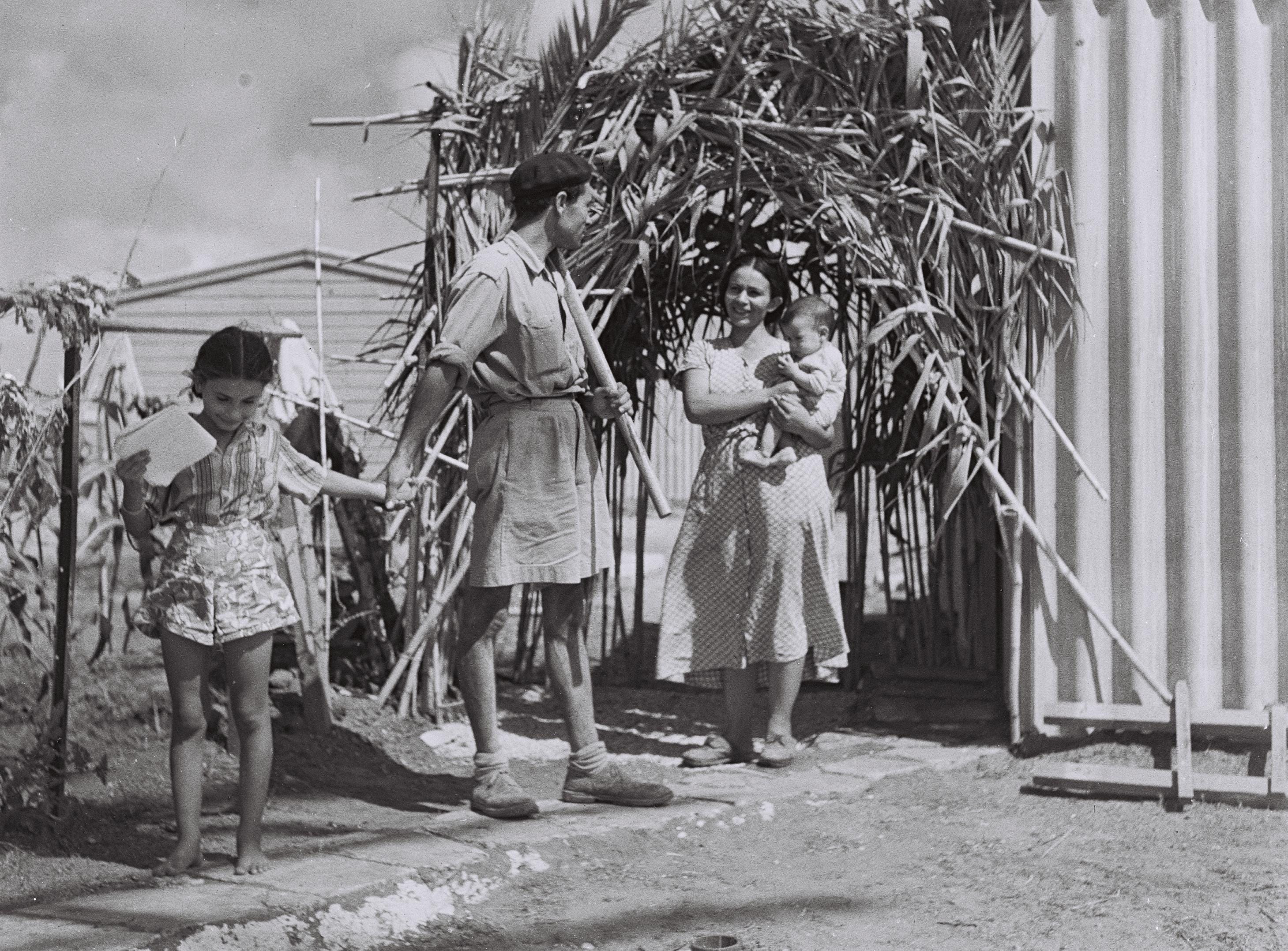
Most religions build monuments to permanence. Judaism, at the height of the harvest season, tells us to move into a hut.
That alone should tell us that Sukkot is stranger and more radical than we usually make it sound.
We spend the year building walls, acquiring things, strengthening institutions, accumulating money, protecting our families, defending communities, and trying to create some small island of certainty in a profoundly uncertain world. Then Judaism interrupts us and says: Go outside. Leave the solid roof. Sit beneath branches. Eat there. Celebrate there. Invite people in. Look through the gaps toward the sky.
And then, as if the hut were not strange enough, Judaism tells us to pick up a palm branch, a citrus fruit, myrtle, and willow, bind them together, and wave them toward every direction of creation.
It can look primitive from the outside. but it may actually be one of Judaism’s most sophisticated statements about what it means to be a Jew, and the Jewish theory of civilization.
The sukkah begins with a brutal proposition: Nothing we build can save us completely. Not the house, not the bank account, not the career, not the institution, not the political system, not even the country. This does not mean those things are unimportant. Judaism is not a religion of withdrawal from the physical world, but Sukkot insists that we distinguish between building something and worshipping it.
There is a moment in every successful society, and every successful human life, when achievement begins to disguise itself as permanence. We start believing that because something has stood for a long time, it cannot fall. Because we have accumulated enough, we are protected. Because our institutions are old, they are indestructible. Because our walls are high, nothing can get through them.
Jewish history has cured us of that fantasy more times than we would ever have wished. And so every year, Judaism stages a peaceful demolition of our illusions. We leave the permanent house for the temporary one.
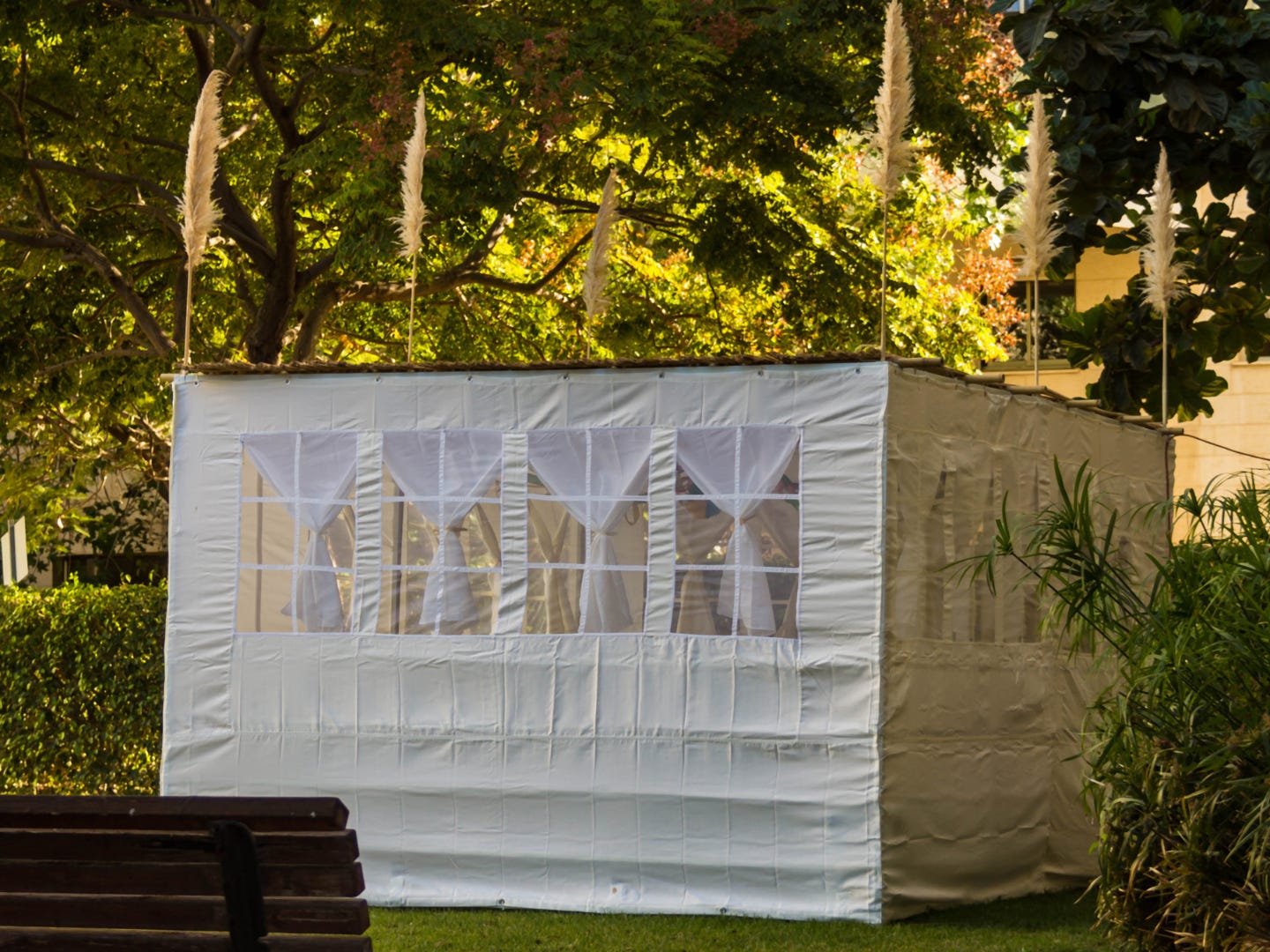
But notice something extraordinary: The sukkah is not a bunker. It is not built to keep the world out. Its entire sacredness comes from the fact that it remains exposed to the world. Wind enters it. Heat enters it. Cold enters it. Sounds from the street enter it. Through the roof there are openings to something larger than ourselves. The structure is sufficient to be called a dwelling, but insufficient to create the illusion that we control everything around us.
That may be one of the most Jewish ideas imaginable. Jewish survival has never depended upon making ourselves invulnerable. We have never been invulnerable. Jewish survival has depended upon learning how to remain Jewish while vulnerable. An invulnerable people needs perfect walls; a resilient people knows who it is even when the walls disappear.
That is why the material placed over the sukkah is such a remarkable symbol. The schach (raw, detached plant material) comes from things that grew from the earth but have been cut away from where they originally grew. Branches, reeds, vegetation — once rooted, now detached, they become the covering over a Jewish home. It is difficult not to see the Jewish story in that. We are perhaps history’s most famous uprooted people.
Jews were repeatedly separated from places where generations had lived. Communities moved from Judea to Babylon, across North Africa, through Spain, Poland, Iraq, Yemen, Persia, Russia, Germany, Morocco, America, and countless other places. Languages, clothing, music changed, recipes, and the architecture around us changed. And somehow the Jewish home kept reappearing.
That may be the deeper meaning of Jewish rootedness. A Jew can be uprooted geographically without becoming rootless spiritually. The branch is cut from the ground, and somehow it still becomes shelter.
This is also what makes Israel so emotionally significant to the Jewish People. After centuries in which Jewish life became extraordinarily skilled at portability, Jews again built a national home in the land at the center of Jewish memory.
Yet Sukkot offers an important warning even here: A home should give us belonging, responsibility, and strength, but no home can eliminate uncertainty from human existence. The Jewish answer to insecurity has therefore never been simply to build stronger walls. It has also been to build stronger Jews.
And then we arrive at the four species. The lulav, etrog, myrtle, and willow could hardly look more different from one another. One is tall and rigid. One is fragrant. One is a fruit unlike anything else on the ritual calendar. One grows close to water and can wither quickly without it. Judaism does not tell us to choose the finest symbol among them. It tells us to hold them together.
There is an old Jewish tendency, and a very modern Jewish temptation, to decide which Jews are the “real” Jews. Religious Jews look suspiciously at secular Jews. Secular Jews roll their eyes at religious Jews. Israelis criticize diaspora Jews for not understanding the Israeli experience. Diaspora Jews criticize Israelis for not being more Western. Ashkenazis, Sephardics, Mizrahis, Persians, Yemenites, Russians, Ethiopians, Americans — all of us have inherited different expressions of the same civilization.
Sukkot gives a simple response: Pick them up together. The mitzvah is not fulfilled by admiring the etrog while discarding the willow. Jewish unity does not require Jewish sameness. In fact, the image created by the four species suggests precisely the opposite. Jewish peoplehood works because different things can remain recognizably different while still belonging to the same bundle.
That lesson feels increasingly urgent. A healthy Jewish future cannot be built only by Jews who pray the same way, vote the same way, dress the same way, speak the same language, or relate to tradition in the same fashion. Jewish civilization has survived precisely because it developed multiple forms without surrendering the idea that underneath those forms existed a shared people, shared memory and shared destiny.
The four species are therefore not merely symbols of Jewish unity. They are symbols of a more demanding idea: Jewish unity must be strong enough to contain Jewish difference.
Then we wave them outward in every direction. The gesture refuses to allow holiness to remain confined to a synagogue, a Torah scroll, or a moment of prayer. East. West. North. South. Above. Below. The sacred is not somewhere else. It surrounds us.
That is an especially important Jewish message because Judaism has never been particularly interested in separating the spiritual world from ordinary life. We bless bread. We sanctify wine. We turn meals into rituals, doorposts into reminders, calendars into memory, marriage into covenant, and agricultural produce into religious obligation. Sukkot goes even further. Take the physical world in your hands and then recognize that it belongs to something larger than you.
This may also explain why Sukkot arrives precisely at the harvest. The harvest is the dangerous moment, not because there is too little, but because there is enough. Scarcity naturally produces humility. Abundance can produce amnesia. When the barn is full, the harvest successful and the year productive, a person can begin to believe the oldest lie in civilization: I did this entirely by myself.
Sukkot arrives at that exact moment and orders the successful farmer to leave the farmhouse. Your harvest matters. Your work matters. Your success matters. But none of it makes you God.
For Jews, this idea has significance far beyond agriculture. We have built extraordinary things wherever history has permitted us to build: businesses, universities, charities, synagogues, cultural institutions, scientific achievements, neighborhoods, and eventually a modern sovereign Jewish society. Sukkot does not tell us to apologize for building. It tells us not to confuse achievement with immortality.
That may be why Sukkot is called zman simchateinu — the season of our joy. The timing seems absurd. Joy should belong inside the palace, yet Judaism places it inside the hut. Perhaps because there are two kinds of happiness. There is the happiness that says everything is finally under control. And there is the deeper Jewish happiness that says everything has never been under control, and still we are here.
We are still singing, still eating together, still welcoming guests, still telling the story, still holding the lulav, still teaching children words their ancestors spoke thousands of years ago. We are still blessing, still building, still returning and, yes, still arguing. This is not naïve happiness. Jewish history would make naïveté impossible. It is defiant happiness.
Sukkot asks us to celebrate not because the world has become safe, but because life remains sacred even when it is not safe. Therein contains the secret of Jewish endurance. The Jewish People survived because catastrophe was never allowed to become our entire identity.
We mourned, and then we married. We buried, and then we planted. We remembered destruction, and then we built another house. We told stories about exile while teaching our children how to live. And once a year, we deliberately construct something we already know we will dismantle.
There is profound philosophy of life contained in that act. The fact that something ends does not make it worthless. A meal ends. Childhood ends. Generations pass. Civilizations change. Jewish life has never required permanence in order to produce meaning.
We build anyway. We decorate anyway. We invite people inside anyway. We say the blessing anyway. And then, when the time comes, we take the sukkah apart and begin another year. Maybe that is what all the symbols of Sukkot are trying to tell us.
For thousands of years, Jews have carried that knowledge from generation to generation. Build the house, but remember the hut. Plant roots, but learn how to carry them. Protect the Jewish People, but do not let fear become Jewish identity. Create a strong Israel, but remember that strength alone has never defined us. Hold tightly to who you are, but leave enough room in the bundle for the Jew who looks nothing like you.
And when history once again reminds us that the roof above our heads is thinner than we imagined, look upward through the branches. Then do what Jews have always done: Make a blessing, invite someone inside, and keep building.
Very nice. Very very nice. Kol hakavod.
As thoughtful and beautifully written a discussion of Succos as we need and the holiday deserves.