


Please consider supporting our mission to help everyone better understand and become smarter about the Jewish world. A gift of any amount helps keep our platform free of advertising and accessible to all.
You can also listen to the podcast version of this essay on Apple Podcasts, YouTube Music, YouTube, and Spotify.
As Democrats celebrated their sweeping victories across America this week, one word kept appearing in the speeches, statements, and celebrations of some of the party’s most energized candidates and supporters.
That word is Palestine — some make-believe place thousands of miles away, whose conflict with Israel (i.e., the Jews) has somehow become one of the defining political causes of America’s emerging Left.
In Michigan, chants of “Free Palestine” erupted as Abdul El-Sayed celebrated becoming the first Muslim elected to the United States Senate. He denounced American support for Israel, attacked AIPAC, and declared that Michigan’s tax dollars should be spent on domestic priorities rather than what he called “apartheid or genocide or war.”
In New York, Brad Lander, the Jewish Democrat elected to represent the state’s 10th Congressional District, promised to become “the Jewish member of Congress who is boldest in support of Palestinian freedom.”
Another New York winner, Darializa Avila Chevalier, demanded a complete arms embargo against Israel and the Palestinian “right of return.” During her June primary victory celebration, supporters had erupted into chants of “Free Palestine.” She was a Columbia University protest organizer before becoming a congressional candidate, and opposition to Israel is central to her political identity.
And these were hardly isolated figures.
Claire Valdez, another newly elected New York congresswoman, declared after winning her Democratic primary in June that she would continue calling for Palestinian liberation. She connected that commitment directly to domestic spending, arguing that Americans should use their money to improve lives at home rather than destroy them abroad.
In Colorado, Melat Kiros, another victorious democratic socialist, had similarly promised during her primary victory speech to stop what she called the “genocide in Palestine.” Following her November victory, she again called for accountability over what she described as American complicity in the conflict.
The same political movement helped propel Chris Rabb in Pennsylvania and Donavan McKinney in Michigan to congressional victories. Palestinian-American organizer Aber Kawas also won a New York State Senate seat after explicitly making Palestinian advocacy part of her challenge to the Democratic Party establishment.
These victories represent a meaningful political development, even if they do not mean that every Democrat, or even most of their voters, shares the same views. But here is what Americans need to understand: “Palestine” is not really about Palestinians. It has become a political symbol, an organizing principle, and an exceptionally useful instrument for a much broader anti-American ideological project.
That project is about who holds power in American society, who controls its wealth, which institutions deserve legitimacy, how history should be understood, and whether the political and economic order that made the modern West possible should be preserved or fundamentally transformed.
In fact, “Palestine” has become something of a password within this movement. Say it loudly enough, and you immediately communicate where you stand on a whole range of issues that have absolutely nothing to do with Palestinians.
You are against billionaires, corporations, capitalism, Immigration and Customs Enforcement (ICE), American imperialism, and just about every established institution that supposedly perpetuates inequality and oppression. You support redistributing wealth, fundamentally restructuring American society, and replacing existing power structures with something entirely different.
And you can communicate all of that with just two words: Free Palestine. It is not simply a foreign-policy position, but an all-encompassing political identity.
The easiest way to understand this phenomenon is to examine what the Democratic Socialists of America, the organization behind several of these politicians, actually believes. Alongside demands to “Free Palestine,” they advocate aggressive wealth taxes, public ownership of major corporations and essential industries, abolishing ICE, and dramatically restructuring American political institutions.
They are not interested in reasonable reforms and continuous improvements, but in burning many of the existing systems down to the ground. Their ambitions extend well beyond ordinary changes. They propose abolishing the United States Senate, replacing the president and Supreme Court with institutions subordinate to Congress, and creating an entirely different political and economic system.
What does any of this have to do with the Israeli-Palestinian conflict? What does nationalizing major industries have to do with Palestinian self-determination? What does restructuring the American judiciary have to do with Gaza?
Nothing inherently, yet they have been packaged together as parts of one unified moral and political struggle. To support one increasingly means being expected to support the others. “Palestine” has become the gateway through which a much broader ideological revolution is being sold to American voters.
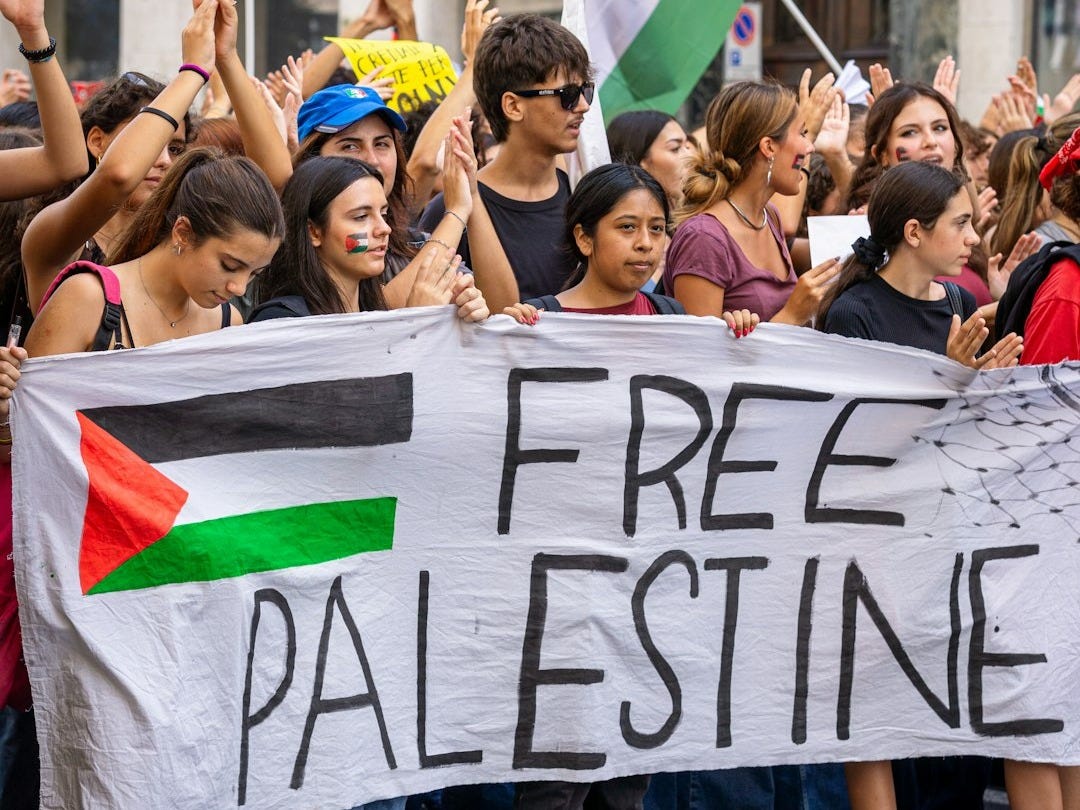
And there is another dimension to this phenomenon that deserves considerably more attention: the Left’s remarkable ability to reinvent itself around whichever cause happens to dominate the cultural conversation.
A few years ago, Black Lives Matter was omnipresent. Politicians took knees, corporations issued statements, celebrities posted black squares on Instagram, and Americans were encouraged to demonstrate their moral virtue by publicly embracing the movement.
Before and alongside that, climate change became the defining moral emergency for an entire generation of activists. Greta Thunberg became an international celebrity. Politicians warned that civilization was running out of time. Young people marched in the streets and demanded that governments fundamentally restructure the global economy.
Climate change did not disappear. Racial issues did not disappear. What changed was the intensity of the cultural attention. The political spotlight moved on to October 7, 2023, Israel’s subsequent war against Hamas in Gaza, and the flood of images, videos, protests, and online campaigns that followed. Suddenly, “Palestine” became the defining moral cause of the moment. The slogans changed. The flags changed. The hashtags changed. But the underlying political psychology remained remarkably familiar.
Here was another opportunity to identify an “oppressed” population, accuse established institutions of perpetuating “injustice,” and demand that society reorganize itself around a moral emergency.
For activists who had previously built their public identities around other causes, “Palestine” offered a fresh opportunity to demonstrate their righteousness. It was the latest cause around which to rally, the latest opportunity to feel morally superior, and the latest way to distinguish the enlightened from the supposedly ignorant, indifferent, or evil.
This is the politics of feeling good about being good. And it is much easier than the politics of actually governing.
The great advantage of declaring yourself an ally to an “oppressed” people is that you do not necessarily have to explain how you intend to solve their problems. You can simply announce that you stand with them, identify their supposed “oppressors,” and demand that everyone else do the same. The political applause is immediate. The political responsibility can be postponed indefinitely.
And a politician who declares that they stand “against genocide” can instantly claim a kind of moral authority that politicians discussing healthcare financing, housing construction, or infrastructure spending cannot. Who wants to argue about the details of an insurance reimbursement system when someone else is claiming to “fight genocide”?
Show me the emerging American Left’s detailed policy proposals. I cannot recall one. Having a list of sweeping demands is not the same thing as having serious, workable governing strategies. “Free Palestine” is not governance. The same applies to many of the movement’s domestic ambitions like “abolish ICE,” “tax the rich,” “Medicare for All,” and “end capitalism.”
Announcing an outcome does not resolve the difficult questions of cost, implementation, incentives, public support, or unintended consequences.
It is easy to promise affordable housing. It is considerably harder to explain how to construct enough homes, reform zoning, lower building costs, and overcome local opposition.
It is easy to promise that billionaires will pay for everything. It is considerably harder to demonstrate precisely how much revenue a proposed tax will generate, how businesses and investors will respond, and whether the resulting system can sustainably finance the promises being made.
It is easy to condemn war. It is considerably harder to explain how a democracy should respond when a terrorist organization massacres its citizens, takes hostages, and promises to repeat the attack.
That is the difference between political performance and political competence.
It is also why the movement increasingly resembles what political theorists call Third Worldism: a worldview that interprets global affairs principally through the struggle between an exploitative Western world and supposedly “oppressed” peoples fighting for “liberation.”
Just look at the “rising stars” of the Democratic Party. Ilhan Omar was born in Somalia. El-Sayed’s parents are Egyptian. Mamdani was born in Uganda. Rashida Tlaib’s parents are from the West Bank. These politicians and others have literally imported Third Worldism into the Democratic Party.

Under this worldview, national conflicts are rarely examined on their own historical terms. Instead, they are inserted into a larger story about colonialism, capitalism, racial hierarchy, and Western domination. Israel is reduced to an outpost of Western imperialism, and “Palestine” becomes the symbolic representative of everyone supposedly “oppressed” by the system.
And once one accepts this framework abroad, it becomes remarkably easy to apply it at home.
If Israel represents settler colonialism, America can be condemned through the same lens. If Israeli soldiers represent occupation, American police and immigration agents can be portrayed as instruments of an analogous system. If wealth is understood principally as the product of exploitation, redistribution becomes a moral obligation rather than an economic proposition to be evaluated on its merits. And if established institutions are inherently “oppressive,” replacing the people who control them becomes an act of “liberation.”
This is how an argument ostensibly about “Palestine” can become an argument about who should control America’s wealth, institutions, and government. It is also how “Palestine” becomes a weapon in the Democratic Party’s internal struggle for power. Defeating a “pro-Israel” (really, a pro-Western) Democratic incumbent can therefore be presented as simultaneously defeating the donor class, confronting American imperialism, and advancing social justice. One electoral victory becomes a triumph over multiple supposed systems of “oppression.”
There is no need to persuade voters that a longstanding incumbent has failed on housing, healthcare, or education if that incumbent can instead be portrayed as “supporting Israel genocide.” It is a shortcut to moral disqualification. Nobody has explained the underlying strategy more clearly than Aber Kawas, the newly elected Palestinian-American state senator from New York.
After winning her Democratic primary in June, Kawas openly discussed how “Palestine” was being used to redefine progressive regressive politics. She argued that politicians who champion affordability or oppose immigration enforcement must also speak out about “Palestine” to demonstrate ideological consistency. A politician can support universal healthcare, higher taxes on wealthy Americans, workers’ rights, affordable housing, and virtually every other major liberal policy.
But if that politician supports Israel’s existence as a Jewish state and rejects the movement’s characterization of Israel as inherently “oppressive,” their liberal credentials can suddenly become suspect. That is not ordinary foreign-policy debate. It is an attempt to redefine the ideological boundaries of an American political movement. And once those boundaries are established, enforcing them becomes a powerful instrument of political control.
This is how relatively small but highly organized ideological factions can transform much larger political parties. They need not immediately convince every voter. They need only establish the rules by which politicians, donors, activists, and institutions are judged.
This is why Americans should be careful not to confuse the popularity of a political cause with the seriousness of the movement advocating it. For all their grandstanding about Palestinian “liberation,” what are these politicians actually doing to improve Palestinians’ lives?
Sanctioning Israel, demanding arms embargoes, berating AIPAC, threatening to arrest Benjamin Netanyahu, and calling for an end to American military aid might generate applause at campaign rallies, but none of it constitutes a serious plan for Palestinian prosperity, security, or self-government.
You know what would actually make a difference? Removing Hamas from power in Gaza, holding Mahmoud Abbas and his inner circle accountable for corruption and self-enrichment, building functioning Palestinian institutions, and creating an economy that offers Palestinians something more promising than perpetual conflict.
And even then, why has this particular issue become such an obsession within the Democratic Party? The U.S. faces enormous challenges involving the strength of the dollar, global supply chains, access to critical minerals and rare earths, economic competitiveness, and the rise of China. Those issues have far greater implications for America’s long-term prosperity and global influence than the Israeli-Palestinian conflict.
Yet you would never know it from listening to the “Free Palestine” crowd, whose political priorities seem to revolve around condemning America’s allies, attacking its institutions, and championing causes thousands of miles from home. For all their talk about “liberation,” one question remains conspicuously unanswered: What, exactly, is their vision for making America better?
A serious movement should welcome those questions. A movement built around political performance prefers to condemn the people asking them.
“I support the Palestinians” and “Free Palestine” have never had anything to do with the Palestinians. They are code phrases, or terms of art, meaning “I want the Jews to suffer and die.”
You are right Joshua.
Every word is true.
But now tell us what to do about it, as we see the world we knew and took for granted crumbling under our eyes.