
The Ethnic Cleansing No One Mentions When Talking About Israel
One cannot make the argument that Israel is "colonial" in good faith. It can only be made by deciding, in advance, that certain people — namely Jews — do not count.


Please consider supporting our mission to help everyone better understand and become smarter about the Jewish world. A gift of any amount helps keep our platform free of advertising and accessible to all.
This is a guest essay by Matt Field, who writes the newsletter, “That Jew.”
You can also listen to the podcast version of this essay on Apple Podcasts, YouTube Music, YouTube, and Spotify.
The German ambassador to Egypt works out of a house that used to belong to a Jewish family. So does the Swiss ambassador. So does the American one. The homes were confiscated in 1956, when the Egyptian government declared, in a proclamation read aloud from the minarets of Cairo and Alexandria, that all Jews were Zionists and enemies of the state.
The families were given one suitcase. They signed documents “donating” everything else to the government. Then they left. The houses are still there; the families are not.
This is where the argument about Israel begins — not in Europe, but here.
There is a story told about Israel with remarkable confidence in universities, at the United Nations, in the opinion sections of newspapers that should know better. The story goes like this: European Jews, traumatized by European persecution, arrived in a land populated by indigenous Arabs and established, by force, a settler state. European guilt. European migration. European power. Colonialism wearing a Star of David.
The story requires you to ignore the majority of Israelis.
Mizrahi Jews (those whose ancestry traces to Iraq, Iran, Yemen, Egypt, Morocco, Libya, Syria, Tunisia, Algeria, and Lebanon) constitute the largest demographic bloc in Israel’s Jewish population, somewhere between 45 and 61 percent depending on how intermarriage and self-identification are counted. No serious demographer disputes the basic fact.
They are not European, but descendants of communities that lived in the Middle East and North Africa for over 2,000 years before the word “Europe” carried any political meaning. Many trace their origins to the Babylonian exile of 586 BCE. Their families were in Baghdad before Rome was a city. They were in Sana’a and Cairo and Tripoli while the ancestors of today’s loudest “anti-Zionists” were still pagans in northern forests.
By every definition that the language of indigenous rights claims to honor, they are indigenous people of the Middle East.
The colonial thesis does not complicate this fact; it requires its erasure.
These communities did not arrive in Iraq and Yemen and Egypt from Europe or from nowhere. They arrived from Eretz Yisrael (the Land of Israel), carried there by the conquests and expulsions that defined the ancient world.
The Babylonian exile of 586 BCE brought Jews to Mesopotamia when Nebuchadnezzar destroyed the First Temple and deported the population of Judea. Later waves followed the Assyrian conquest, the Roman destruction of the Second Temple in 70 CE, and the subsequent dispersions that scattered Jewish communities across the region.
The Jews of Baghdad, of Sana’a, of Cairo, of Tripoli were not immigrants to the Middle East from somewhere else; they were the exiled children of the Land of Israel, living in the lands to which conquest had driven them, maintaining their language, their texts, and their memory of home across 2,000 years. When they came to Israel in the 20th century, they were not arriving as colonizers; they were returning.
To understand what was lost, you have to know what existed.
The Jews of Iraq were among the oldest continuous Jewish communities on earth. Their roots in Babylonia stretch to the destruction of the First Temple. They did not merely survive in Iraq; they built there. The Talmud, the central text of Jewish law and life that has governed Jewish practice for 15 centuries, was composed in Babylon, in the academies of Sura and Pumbedita, on the soil of what is now modern Iraq.
By the early 20th century, Jews made up roughly a third of Baghdad’s population. They were merchants, musicians, government officials, doctors, and bankers. They spoke Judeo-Arabic and prayed in Hebrew and had done both, without interruption, for two and a half millennia.
The Jews of Yemen maintained a liturgical tradition so ancient and so isolated from the rest of the Jewish world that scholars of Hebrew phonetics study it today to understand how the language was originally pronounced. They had been in the Arabian Peninsula since before the rise of Islam. Their piyyutim, their sacred poetry, carried melodies that the rest of the Jewish world had forgotten.
The Jews of Morocco and Algeria predated the Arab conquest of North Africa. The Persian Jewish community traced its origins to the era of Cyrus the Great, who is named in the book of Isaiah as the instrument of Jewish liberation. The Jews of Egypt and the Jews of Syria were ancient. These were not transplanted peoples, but rooted ones with sacred texts, living languages, and unbroken communal memory reaching back to the earliest chapters of Jewish history.
In 1948, there were 135,000 Jews in Iraq, 265,000 in Morocco, 140,000 in Algeria, 105,000 in Tunisia, 100,000 in Egypt, 60,000 in Yemen, 38,000 in Libya, and 30,000 in Syria. Today, there are fewer than 10 Jews in Iraq, fewer than 10 in Yemen, and fewer than 10 in Libya. The end of each community had its own texture, but the pattern was the same everywhere.
In Baghdad, the unraveling began on the Jewish holiday of Shavuot1 in June 1941. Nazi influence had reached Iraq through the German ambassador Fritz Grobba, who funded antisemitic newspapers, bankrolled a youth movement modeled on the Hitler Youth, and cultivated a pro-Axis officer class. When a short-lived pro-Nazi government collapsed and British forces moved toward the city, mobs took to the streets.
Over two days, roughly 180 Jews were killed, hundreds were wounded and raped, and 1,500 homes and businesses were looted and destroyed. The pogrom is called the Farhud, an Arabic term often translated as “violent dispossession” or “pogrom.” It is not taught in schools.
A decade later, Iraq criminalized Zionism, seized Jewish property, stripped Jews of their citizenship, and arranged the conditions under which 120,000 Jews boarded planes to Israel in Operation Ezra and Nehemiah, leaving behind the land where the Talmud was written.
In Egypt, President Gamal Abdel Nasser’s government waited until the Suez Crisis of 1956. Then the proclamation went out from the mosques: Zionists, enemies of the state, one suitcase, sign the form, leave. Between 1948 and the late 1960s, more than 80 percent of Egypt’s Jews fled, most to Israel, some to France and the Americas, all to a life rebuilt from nothing.
In Yemen, anti-Jewish riots erupted in late November 1947, triggered by protests against the United Nations Partition Plan. Over three days, more than 80 Jews were killed, over 100 Jewish-owned businesses looted, synagogues burned. In 1949 and 1950, in an operation the Israeli government called On Wings of Eagles, nearly 49,000 Yemenite Jews were airlifted to Israel. Many had walked for days through the desert to reach the airstrip. They arrived carrying almost nothing. They brought their Torah scrolls.
In Libya, the Jews had been present for over 2,000 years, their roots in the region traceable to before the destruction of the Second Temple. In 1945, Arab nationalist riots killed more than 140 of them and destroyed hundreds of their homes. Another pogrom followed in 1948 — more dead, more homes burned. When Prime Minister Muammar Gaddafi came to power in 1969, he confiscated all remaining Jewish property by law. By 1970, the government declared Libya Judenrein (German meaning “free of Jews”) — 2,000 years of Jewish presence, ended by decree.
The same pattern completed itself across Morocco, Algeria, Tunisia, Syria, Lebanon, and Iran — sometimes through mob violence, sometimes through bureaucratic suffocation. Property laws required Muslim business partners, passports were withheld, citizenship was stripped, and bank accounts were frozen.
The Jewish communities of the Arab world were liquidated across three decades through a combination of persecution, pauperization, and periodic slaughter, until more than 99 percent were gone. The land confiscated from those who fled amounts to 40,000 square miles, five times the size of Israel in 1948. The property losses, documented across 22 archives and submitted to the United Nations Human Rights Council, are valued at $263 billion in current terms.
There is no UN agency for these refugees, no annual day of mourning recognized by the UN General Assembly, no special rapporteur, no international fund, no permanent refugee population maintained across generations as a political instrument.
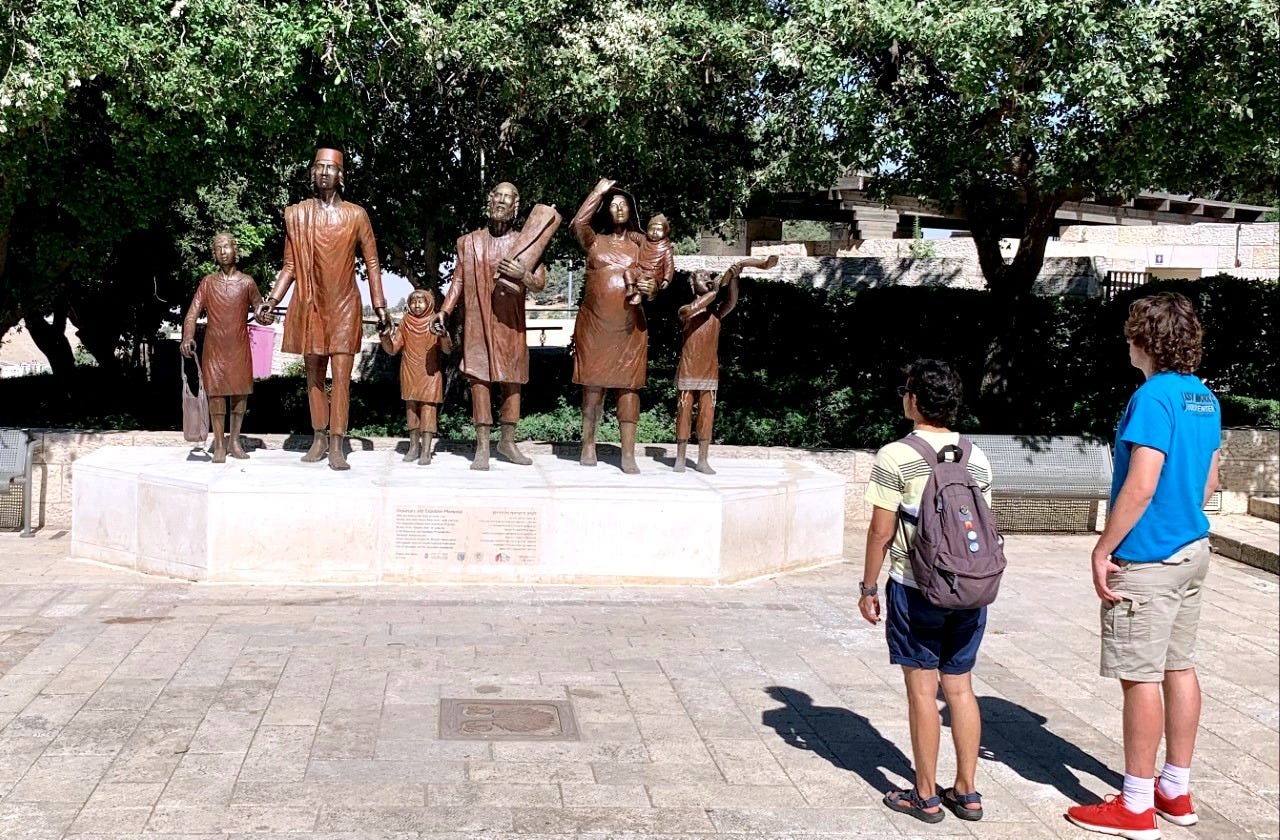
The word Nakba — meaning “catastrophe” in Arabic and referring to the 1948 displacement and dispossession of over 700,000 Palestinians during the First Arab-Israeli war — is not applied to them, though by every measurable standard, what happened to nearly one million Jews across the Arab world was a larger, more total, and more deliberately engineered displacement than the Palestinian exodus to which that word is exclusively applied.
The silence is not an oversight. Oversights get corrected when you point them out. This is where the argument has to be named precisely.
The people who advance the colonial thesis about the modern State of Israel are not, in general, ignorant of Mizrahi Jews. They are educated people. They read. They know that Israel is not a monoculture. The problem is not that they lack information; the problem is that the information does not serve the argument, so the information is not used.
The colonial framing is load-bearing. Remove it and the entire ideological structure collapses. Acknowledge that the majority of Israelis descend from communities expelled from Arab lands, and you must also acknowledge that Arab states conducted ethnic cleansing against their Jewish populations. Acknowledge that, and you cannot sustain the clean binary of indigenous Arabs against colonial Europeans. Acknowledge that, and the people demanding the dismantling of Israel as an act of decolonization are demanding that the refugees of Arab ethnic cleansing surrender the one place that took them in.
The Mizrahi Jews do not complicate this argument; they end it — so they are disappeared, not through a conspiracy, but through a habit of selective attention so consistent and so convenient that it functions as policy. They are the people the argument needs not to exist. And for the most part, in the discourse that shapes how much of the world talks about Israel, they don’t.
The erasure is not ignorance; it is maintenance.
Israel is a country whose majority population descended from Jews expelled from the Arab world. Those Jews came from communities that predated Islam, that built the Talmud on Babylonian soil, that maintained ancient Hebrew liturgy in Yemeni mountains, that had been part of the fabric of Cairo and Baghdad and Tripoli for longer than most modern nations have existed. They were dispossessed by Arab nationalism, stripped of citizenship and property, forced onto planes and into transit camps and into a new country that was the only country that would have them. They are not colonizers of the Middle East; they are its expelled children, returned.
And those Arab states bear direct responsibility for the demographic reality they then spent decades condemning. Nearly 900,000 Jews left Iraq, Yemen, Egypt, Libya, Morocco, Algeria, Tunisia, and Syria, driven by persecution, pogrom, and state-sponsored dispossession. Some left under direct expulsion order. Others left because staying had been made impossible. The distinction matters less than the result: They are gone, their property was taken, and not one Arab state has ever offered to keep them, protect them, or compensate them for what was taken.
Some 650,000 went to Israel, because Israel was the only country that would receive them without conditions. The rest went to France and the Americas. They expelled the Jews, closed every door behind them, and then condemned where those Jews ended up. The population that the colonial thesis calls a European imposition was built, in its majority, by refugees the Arab world itself created. The indictment and its cause are the same people.
The conflict has competing claims; they deserve honest accounting; and that accounting cannot begin until all the people are on the table.
The people who built the colonial thesis around Israel knew, or should have known, all of this. They constructed the argument anyway. They invoked “indigenous rights” while erasing the most indigenous Jews on earth. They demanded “historical accountability” while granting total immunity to the Arab states that liquidated their Jewish populations and kept the stolen property. They called Israel a “European project” while ignoring the Yemeni Jews who walked through the desert carrying Torah scrolls to reach a plane to Israel.
You cannot make that argument in good faith. You can only make it by deciding, in advance, that certain people do not count.
The Mizrahi Jews count. They were there when the argument was being built against them. They were there when the world decided not to notice. They are there now, the majority of the people in the Jewish state, the expelled children of the Arab world, home. No thesis survives that — only the decision to keep pretending it doesn’t exist.
Shavuot is a major Jewish holiday marking the 50th day after Passover and commemorating the giving of the Torah at Mount Sinai.
Jews predated Islam. Close to a million Jews were expelled from MENA where they lived for centuries, Israel absorbed most. Diarna, Our Homes is a digital library of Jewish history and culture. Since 2010 some 3 thousand sites have been identified so far. Today, you cannot find Jews in this vast area, Iraq, Libya, Yemen, Algeria, Egypt, Lebanon, Syria and the other nations. The forced removal of Jews from the Arab and Muslim world is the true Apartheid.
An excellent article Matt that is well-written and well-argued using historical evidence! This is the story of the OTHER Nakba, the one that almost no one talks about. The idea Israel is white settler colony is downright absurd. First off, the Jewish people are the indigenous people of the land of Eretz-Israel. They are no different from the Native Americans, Native Hawaiians, Inuits, Aboriginal Australians, Torres Straight Islanders, Māoris, Ainu, Aleuts, and Saami. Second, Ashkenazi Jews are NOT white Europeans! Jews were never accepted by Europeans as part of their society. They were always seen as an alien other who could never really be part of mainstream European society. Furthermore, Ashkenazi Jews are descended from the Ancient Hebrews. Plus, there were 300,000 Jews still living in Israel when the first Arab settlers arrived.
Ashkenazi Jews are NOT white either! Some are light-skinned enough they can pass as white but they are technically not. This argument also ignores the majority of Israel’s population, Mizrahi Jews. Jews from the Middle East and North Africa. Don’t call them Arab Jews. That would be lumping them in with their colonizers. The Jews were colonial subjects of the Arabs NOT the other way around! Mizrahi Jews faced discrimination, persecution, pogroms, expulsions, and the theft of their property and assets. Many did not have the money or resources to go to America or Europe, so Israel was their only choice. Ashkenazi history is pretty well known. Mizrahi history is very much not. Did you know that Iraq was the second most important place in the Jewish faith behind Israel?
Did you Iraq’s Jewish population was there before the Arabs came? Did you know Jews and Arabs once lived together in Middle Eastern countries in relative peace at one time? Vibrant Jewish communities some dating back to ancient times, existed throughout the Arab and Islamic worlds in Egypt, Syria, Iraq, Lebanon, Libya, Tunisia, Algeria, Morocco, Iran, and Yemen. But they were expelled or pressured into leaving by the government of their countries in the 1940s, 1950s and 1960s. Did you also know that the Holocaust wasn’t just in Europe, it also extended into North Africa? Many Arabs gladly assisted the Afrika Korps and their SS and Italian allies in rounding up North African Jews and sending them to concentration camps. There was also the Free Arabian Legion of the Wehrmacht which consisted of Arab and black African volunteers who joined up because they saw the Nazis as anti-colonial liberators and shared their hatred for the Jews.
The Farhud in 1941 when Arabs rampaged through the Jewish community bringing death and destruction with them wherever they went, is also an important historical event that has been forgotten from Mizrahi history. This is the ethnic cleansing that no one tells you about. The Palestinians on the other hand, were not real victims of ethnic cleansing. Why did Palestinians flee their villages in 1948? For three main reasons. 1) They wanted to get themselves and their families out of the crossfire and to safety. 2) The Arab governments or Arab military commanders told them leave. 3) They were expelled by the IDF or fled in fear of living under Jewish rule after the Deir Yassin Massacre. On the third point, let’s explore that further. The IDF usually would allow any Arabs who remained in the area to stay as long as they put up no resistance or gave aid to the invading Arab armies.
It was only in situations where the local population put up resistance or helped the Arab forces that they were expelled. This by the way, was not ethnic cleansing, but a population exchange. Ethnic cleansing is when the partial or full destruction of a people is sought. A population exchange is when you separate two populations because they can’t coexist peacefully. This was most certainly the latter NOT the former. After the war, the 250,000 Arabs who remained inside the borders of the new Jewish state became citizens and received the right to vote and representation in the Knesset. The Palestinian refugees who fled during the war could not be allowed back for demographic and national security reasons. On the first point, had they been allowed back the state wouldn’t have been a majority Jewish state and the Jews would’ve been right back where they started before Israel existed, a persecuted minority. Second, they would be taking a massive hostile populace into their borders.
The Arab expulsion of Jews on the other hand, was definitely done because of that community’s religion and ethnicity and a desire to destroy this community. Mizrahi Jews deserve reparations from the countries that ethnically cleansed them. They also deserve an officially apology. The UN should have a special day in order to commemorate the ethnic cleansing of Mizrahi Jews from Arab lands as well. The Arab countries also owe reparations to another party as well, the Palestinians. The Palestinians would never have had to leave their homes and would have a state today if not for the bigotry of their own leaders and the actions of the Arab countries in invading Israel. Israel doesn’t owe the Palestinians a dime. But Egypt, Syria, Iraq, Iran, Algeria, Tunisia, Morocco, and Yemen owe millions to Mizrahi Jews.