

Please consider supporting our mission to help everyone better understand and become smarter about the Jewish world. A gift of any amount helps keep our platform free of advertising and accessible to all.
This is a guest essay by Martin L. Yarmush, a professor at Rutgers University.
You can also listen to the podcast version of this essay on Apple Podcasts, YouTube Music, YouTube, and Spotify.
One of the most frustrating aspects of the current Gaza war is that nearly everyone is talking about it, yet very few people seem capable of explaining what is actually happening on the ground.
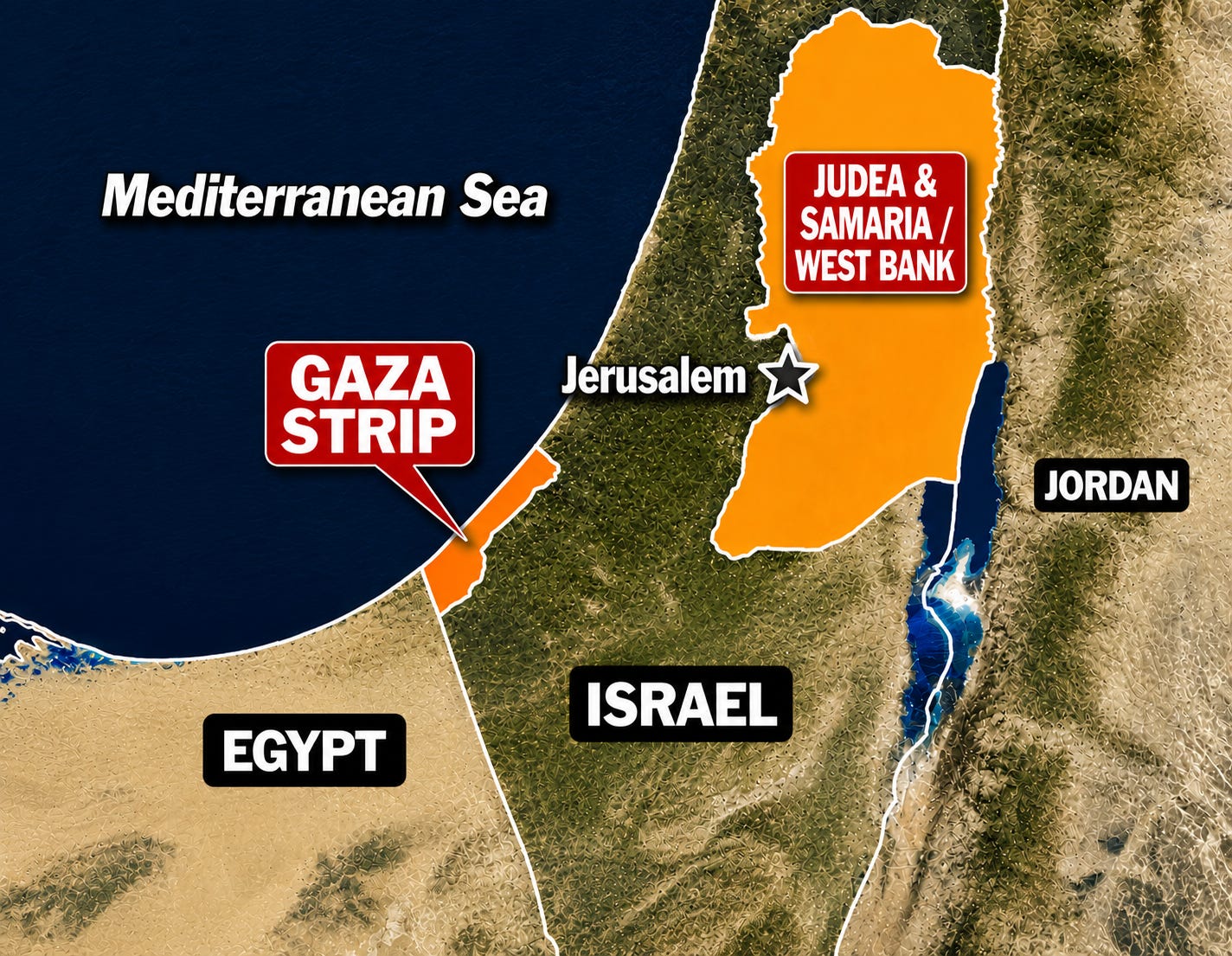
Recent headlines announced that Israeli Prime Minister Benjamin Netanyahu has directed the Israeli military to expand its control over approximately 70 percent of the Gaza Strip.
Critics immediately denounce the policy as “occupation.” Supporters celebrate it as a necessary security measure. International commentators invoke words such as “annexation,” “ethnic cleansing,” “resistance,” “liberation,” “genocide,” and deterrence.
Yet beneath the slogans lies a far more complicated reality, one that cannot be understood through political talking points alone.
The first misconception that must be discarded is the idea that Gaza has somehow been neatly divided into an Israeli-controlled 70 percent and a Palestinian-controlled 30 percent. That is not the reality. Gaza today is a shattered and fragmented landscape consisting of military zones, buffer zones, partially destroyed urban centers, evacuation corridors, humanitarian distribution areas, Hamas tunnel networks, and pockets of civilian concentration.
The lines drawn on military maps do not correspond neatly to where people actually live. In practice, the overwhelming majority of Gaza’s civilian population has become concentrated into a relatively small portion of the territory, while large sections of the Strip have been depopulated through evacuation orders, military operations, destruction of Hamas-infested infrastructure, or simple fear of remaining in active combat zones.
This distinction is critical because many people hear “70 percent control” and imagine that 70 percent of Gaza’s people are somehow under Israeli administration. while 30 percent remain under Hamas. Nothing could be further from the truth.
Most of Gaza’s roughly two million residents are concentrated in increasingly crowded areas, particularly around Gaza City and portions of central and southern Gaza. Some Palestinians still remain within areas that Israel considers under its operational control, but these areas are generally not functioning civilian communities in any normal sense. They are areas subject to military operations, movement restrictions, security sweeps, and continuing instability.
Thus, when discussing territorial control, one must distinguish between land and population. Israel may control a substantial percentage of the land, while the overwhelming majority of civilians occupy a much smaller percentage of the territory.
To understand why Netanyahu is pursuing this strategy, one must understand how profoundly October 7th altered Israeli strategic thinking.
Before October 7th, a large segment of the Israeli security establishment believed Hamas could be contained. Periodic military operations would degrade its capabilities. Intelligence monitoring would provide warning of major attacks. International diplomacy would maintain relative stability.
The horrifying events of October 7th shattered those assumptions.
For many Israelis, the lesson was not merely that Hamas remained dangerous. The lesson was that allowing Hamas to govern territory adjacent to Israeli communities created an unacceptable long-term security risk. As a result, the debate within Israel shifted from deterrence to denial. The question was no longer how to deter Hamas from attacking. The question became how to deny Hamas the physical space necessary to rebuild.
Military organizations think geographically — in terms of depth, distance, maneuver space, logistics, staging areas, and defensive buffers. From that perspective, every kilometer placed under Israeli control represents one less kilometer available for tunnel construction, weapons storage, training facilities, command centers, rocket launch sites, and infiltration routes.
Whether one agrees with this logic or not, it explains why territorial control has become such a central objective. Netanyahu and much of the Israeli security establishment increasingly view land itself as a strategic asset. The goal is not simply to kill Hamas terrorists. The goal is to create a military environment in which Hamas cannot easily regenerate.
Yet here we encounter the central paradox of the entire war: Hamas has lost enormous amounts of territory, infrastructure, leadership personnel, and military equipment, yet Hamas continues to exist. This reveals something many outside observers fail to understand. Hamas is no longer functioning primarily as a conventional governing authority. It increasingly resembles an insurgent movement.
Throughout modern history, insurgencies have repeatedly demonstrated an extraordinary ability to survive territorial losses. The Viet Cong survived despite overwhelming American firepower. The Taliban survived despite losing control of Afghanistan. Iraqi insurgents survived after the fall of Saddam Hussein.
Territory matters, but it is not everything. Underground networks, ideological commitment, decentralized command structures, local support systems, and clandestine operations can allow insurgencies to persist long after they lose formal control of territory.
This means that Hamas is not necessarily confined to the remaining 30 percent of Gaza. Fighters can move. Tunnel systems can extend beneath military lines. Weapons can be hidden. Small cells can operate covertly. Even extensive territorial control does not automatically eliminate insurgent activity.
It explains why the war has become so difficult to conclude. Israel insists that Hamas must disarm. Hamas insists that it will not disarm. These positions are fundamentally irreconcilable. As long as both sides maintain them, the war cannot truly end regardless of how many military victories either side claims.
The humanitarian consequences of this dynamic are profound. As civilian populations become concentrated into shrinking geographic areas, the stresses on daily life become increasingly difficult. Housing shortages intensify. Water systems become overloaded. Medical facilities operate under pressure. Sanitation systems struggle to keep pace with population density. Schools become shelters. Temporary accommodations become semi-permanent communities. Even when food enters Gaza, distribution remains difficult.
Humanitarian crises are rarely caused by a single factor. They emerge from the interaction of multiple pressures simultaneously. Population density, damaged infrastructure, economic collapse, displacement, insecurity, disease risk, and psychological trauma all reinforce one another.
The debate over humanitarian aid has become almost as politicized as the war itself. Critics often portray Israel as deliberately starving Gaza. Supporters point out that enormous quantities of aid continue to enter the territory through organized channels.
The truth is more complicated than either narrative.
Significant quantities of aid are entering Gaza. Food, medicine, fuel, and other supplies continue to flow through various mechanisms. Yet the scale of the challenge is staggering. Feeding, housing, and medically supporting roughly two million people in the middle of an active conflict is among the most difficult logistical tasks imaginable. Aid deliveries can alleviate suffering. They cannot restore normal economic life. Humanitarian assistance can prevent catastrophe. It cannot rebuild a functioning society.
This reality brings us to one of the most recently heavily publicized aspects of the conflict: the “activist” flotillas attempting to reach Gaza. These missions generate enormous media attention. Photographs of activists confronting Israeli naval forces spread rapidly across social media. Politicians issue statements. Television panels erupt into debate.
Yet, when viewed through the lens of practical humanitarian logistics, the significance of these flotillas becomes far less impressive. A handful of boats carrying symbolic quantities of supplies cannot meaningfully address the needs of millions of people. The actual humanitarian challenge requires thousands of truckloads, complex distribution networks, warehousing systems, fuel supplies, water treatment infrastructure, medical logistics, and sustained international coordination.
The flotillas therefore function primarily as political theater. Their purpose is not logistical. Their purpose is symbolic. Supporters see them as acts of conscience intended to draw attention to Palestinian suffering. Critics see them as publicity campaigns designed to create dramatic confrontations while contributing little materially to the humanitarian situation.
Whatever one’s political sympathies, it is difficult to argue that a few vessels carrying limited cargo represent a serious solution to Gaza’s humanitarian needs. The cameras may focus on the flotillas, but the real story remains the daily movement of food, fuel, medicine, and supplies through far less glamorous channels that the Israelis maintain.
The deeper problem is that neither side appears to possess a credible vision of what comes after the war.
Israel has articulated a military objective but has struggled to articulate a convincing political endpoint. Hamas continues to reject disarmament while offering little evidence that it can govern Gaza successfully after the devastation of the conflict. International actors propose various formulas involving multinational administration, Palestinian Authority involvement, Arab peacekeeping forces, or international trusteeship arrangements, yet none of these proposals has generated sufficient political support among the parties that matter most.
Consequently, Gaza remains trapped in a strategic vacuum.
History teaches that wars often end not when one side achieves complete victory, but when both sides conclude that continued fighting no longer serves their interests. Unfortunately, there is little evidence that such a moment has arrived. Israel continues to believe that security requires further military pressure. Hamas continues to believe that survival itself constitutes victory. The civilian population remains caught between these competing visions.
The tragedy is that everyone can identify the problems — while almost no one can identify a workable solution. Israelis understandably refuse to accept a return to the conditions that enabled October 7th. Palestinians reject a future defined by permanent military control and displacement. Hamas refuses to surrender because surrender would require abandoning the very annihilationist ideology that defines it. The organization was founded not to build a prosperous Palestinian state alongside Israel, but to replace Israel altogether.
After years of war, devastation, and suffering, Hamas has shown little indication that it has abandoned that objective. As long as a movement dedicated to the elimination of the Jewish state retains influence, Israelis will continue to view its disarmament not as a political preference, but as a basic requirement for national survival. Israel obviously refuses to tolerate an armed Hamas. International institutions issue statements but possess limited leverage. Humanitarian organizations try to operate, but they cannot solve fundamentally political problems.
As a result, the debate over 70 percent of Gaza ultimately misses the larger issue. The real question is not whether Israel controls 70 percent, 60 percent, or 80 percent of the territory. The real question is what political reality can emerge that simultaneously provides security for Israelis, dignity for Palestinians, and a sustainable framework for peace.
I posit the only sane solution is to destroy Hamas.
Until a viable solution is generated and executed, every map remains temporary. Every military gain remains provisional. Every humanitarian intervention remains incomplete.
The shrinking geography of Gaza is therefore not merely a military development. It is a visual representation of a conflict that has reached a point where tactical decisions are increasingly substituting for strategic solutions.
Land is being controlled. Battles are being fought. Aid is being distributed. Statements are being issued. Yet the fundamental question remains unanswered: What exactly is the endgame?
Until someone can answer that question convincingly, Gaza will remain trapped between war and peace, between military occupation and sovereignty, between survival and reconstruction, and between the competing narratives that have defined this conflict for generations.
There has been one and the same possible solution since Golda Meir said this decades ago:
"Peace will come when the Arabs will love their children more than they hate us."
Sadly, we're as close to that day today as we were back then. The Palestinians have to be masters of their own fate and not rely on the UN or on Israeli apologies and concessions, they have to want to join the civilized world and build a healthy society, not one rooted in Jew hate.
Until then we'll just keep recycling through wars, terrorist attacks and plans that evaporate on first contact with reality.
"The flotillas therefore function primarily as political theater. Their purpose is not logistical. Their purpose is symbolic."
Not quite symbolic. Agitprop more accurately defines the theatrics of it.
"Palestinians reject a future defined by permanent military control and displacement. "
A slight oversimplification. Palestinians were always very clear on their ultimate goal. It is clearly articulated in their charters, the statements of their representatives, in their media, and by the Arab street: it is the complete obliteration of Israel and the elimination of the Jews per religious dictates but not to establish a "Palestinian state. That already exists to the East of Israel. Their goal is to create a Caliphate. Thus "Hamas has shown [not little but no] indication that it has abandoned that objective" clarifies the enduring situation.
" International institutions issue statements but possess limited leverage."
Lurking under international institutions positions on the issue may - demonstrably may - be colluding interests to see Israel gone, especially considering that no country in the world would allow the establishment of a terror state on its borders dedicated to its annihilation. For no trivial reason were "Palestinians" ejected from Jordan, Syria, Iraq, and Lebanon. For no trivial reason has Egypt built a higher wall between Gaza and Sinai that has Israel. Whatever country they have gone to, these people have been a destabilizing force. And today we are witnessing this phenomenon in Europe, the Americas, and Australia.
"dignity for Palestinians"
This may be a bit of Western ethnocentrism where we presume to define for them what they see as their "dignity." Judging from their own statements, they will only have recovered their dignity when they reverse the nakba, that is, the defeat of the five Arab armies that attacked Israel the day after it became a state under their rallying cry "Drive the Jews into the sea."No
"Gaza will remain trapped between war and peace, between military occupation and sovereignty, between survival and reconstruction, and between the competing narratives that have defined this conflict for generations."
Some internal contradictions in the above statemen,t such as the idea of Gaza being trapped between war and peace. The only time there has ever been peace in that territory was when Israel controlled it. Sovereignty brought Hamas. "Competing narratives" echoes Critical Race Theory that one narrative is a valid as another. There is history, archeological evidence, facts, law, and legal precedent that indicate the accuracy of a narrative and separate willful propaganda from verifiable account. Tragically, what we are dealing with here are inconvenient truths to be summarily dismissed both by the local Arabs and the West. And how is that going for them?
As if this witches brew were not toxic enough, from the Arab point of view this conflict is fundamentally and demonstrably a religious war. And the role of religion and ethnicity in this struggle is something the West cannot allow itself to entertain for a moment. And so the cycle continues greased by blood with no end in sight mostly because one party refuses to (yet again) bare its neck on the chopping block while its sworn adversaries aided and abetted by their allies declare that the party of the first part must submit to the will of the party of the second part. :)