


Please consider supporting our mission to help everyone better understand and become smarter about the Jewish world. A gift of any amount helps keep our platform free of advertising and accessible to all.
This is a guest essay by Melissa Brodsky, a writer specializing in media literacy, modern antisemitism, and history.
You can also listen to the podcast version of this essay on Apple Podcasts, YouTube Music, YouTube, and Spotify.
It was the year 1945. The laundry permeated the air, heavy with bleach and steam and the exhaustion of machines running too hard for too long.
Two massive industrial washing machines dominated the room, churning and shaking the floorboards with enough noise to rattle your back teeth. A young woman stood behind the counter, pleasant and efficient, taking in uniforms and smiling at the officers who dropped them off.
The British soldiers who came through liked the joint. It had reasonable prices, reliable service, and friendly staff. If Yelp had been around, it would have scored a 10 out of 10.
None of them ever wondered why two washing machines needed to run 14 hours a day. And not one of them ever looked at the floor beneath their boots.
Twenty-five feet below those boots, a factory was running around the clock.
By 1945, the Haganah (a Jewish underground paramilitary organization founded in June 1920 in British Mandate Palestine) understood with absolute clarity what was coming. The British Mandate would end. When it did, five Arab armies would not wait to see what happened next. The question of Jewish survival in the land was going to be settled by force, and the Haganah intended to be ready.
Getting weapons was hard but manageable. Smuggling rifles, pistols, and Sten submachine guns through a British blockade required nerve and patience, and the Haganah had both. The Sten gun (a simple, cheap British submachine gun produced in enormous quantities during World War II) was available in surplus and relatively easy to acquire. The bullets were another matter entirely.
A bullet press is not a piece of equipment you can hide behind a curtain. The machines that stamp nine-millimeter cartridges are heavy, industrial, and loud, producing a distinctive metallic shrieking that carries through walls and across open ground. The smell of brass and gunpowder is immediate and unmistakable. And the British, who knew perfectly well that the Haganah was building up its arsenal, had informants across the British Mandate watching for exactly this kind of operation.
Yosef Avidar, the Haganah officer tasked with solving the ammunition shortage, had actually purchased bullet presses in Poland back in 1938. They made it as far as Beirut before the situation in Europe made moving them further impossible. They sat in storage in Lebanon for years, waiting.
When Avidar finally got them moving again, he faced the same problem he always faced: Running industrial bullet presses in a territory controlled by an occupying army with a network of informants and a habit of surprise inspections required a cover so complete that a British officer could stand directly above the operation and see nothing but a pleasant agricultural community going about its daily business.
In 1945, a group of young pioneers, most of them teenagers recruited from the Hatzofim (scouts) youth movement, settled on a bare patch of land on Kibbutz Hill in Rehovot, directly adjacent to a British military camp. They put up buildings. They planted crops. They built a dining hall and living quarters and gave every appearance of doing exactly what hundreds of other groups of Jewish pioneers were doing across British Mandate Palestine: establishing a new agricultural community from scratch.
It was all a stage set.
Working in absolute secrecy over 22 days, the group excavated a chamber eight meters (26 feet) beneath the ground. The walls and ceiling were poured concrete, nearly two feet thick, designed to muffle sound and withstand weight. The finished space was roughly the size of a tennis court, 250 square meters (2,690 square feet) of underground factory, lit by electric light, ventilated through a shaft disguised as the chimney of the bakery operating directly above it.
The machinery went in through an opening concealed beneath a 10-ton industrial baking oven, mounted on a pivot so it could swing out to allow access to the shaft below and swing back to cover it completely. The entrance the workers used daily was hidden beneath one of the industrial washing machines in the laundry above, which swung out on heavy hinges to reveal a metal ladder descending into the earth.
When the machine swung back, the entrance disappeared.
Then came the problem of electricity. Running 30 bullet presses around the clock consumes an enormous amount of power. A sudden spike in electricity consumption at an agricultural kibbutz would raise questions immediately. So the Haganah tapped directly into the British military’s own power supply. The British Army was unknowingly powering the bullet factory being built to fight them.
They built the laundry because they needed the noise. Industrial washing machines running at full capacity produce enough mechanical roar to mask the shrieking of bullet presses below. They offered the service commercially, at rates low enough to attract customers, and built a clientele that gave them an ironclad excuse to run the machines from morning to night.
Bullet casings are made of copper. Importing large quantities of copper into British Mandate Palestine would attract exactly the kind of attention the operation could not afford. British customs officials asked why they needed so much of it. The Haganah told them it was for manufacturing lipstick containers. To make the story airtight, they backed it up with gifts of lipstick to British officers’ wives. The British officers’ wives were delighted. The copper kept coming.
The 45 workers lived on the kibbutz above and descended into the factory in rotating shifts. Each shift lasted roughly 10 hours. Down in the bunker, under artificial light, in the heat and the noise and the smell of brass and machine oil, they stamped nine-millimeter bullets at a rate of up to 40,000 a day.
Each bullet was marked with the letters EA — E for Eretz (as in Eretz Yisrael, the Land of Israel) and A for Ayalon (the name of the factory, the Ayalon Institute) — a small, invisible declaration of identity pressed into every cartridge that came off the line.
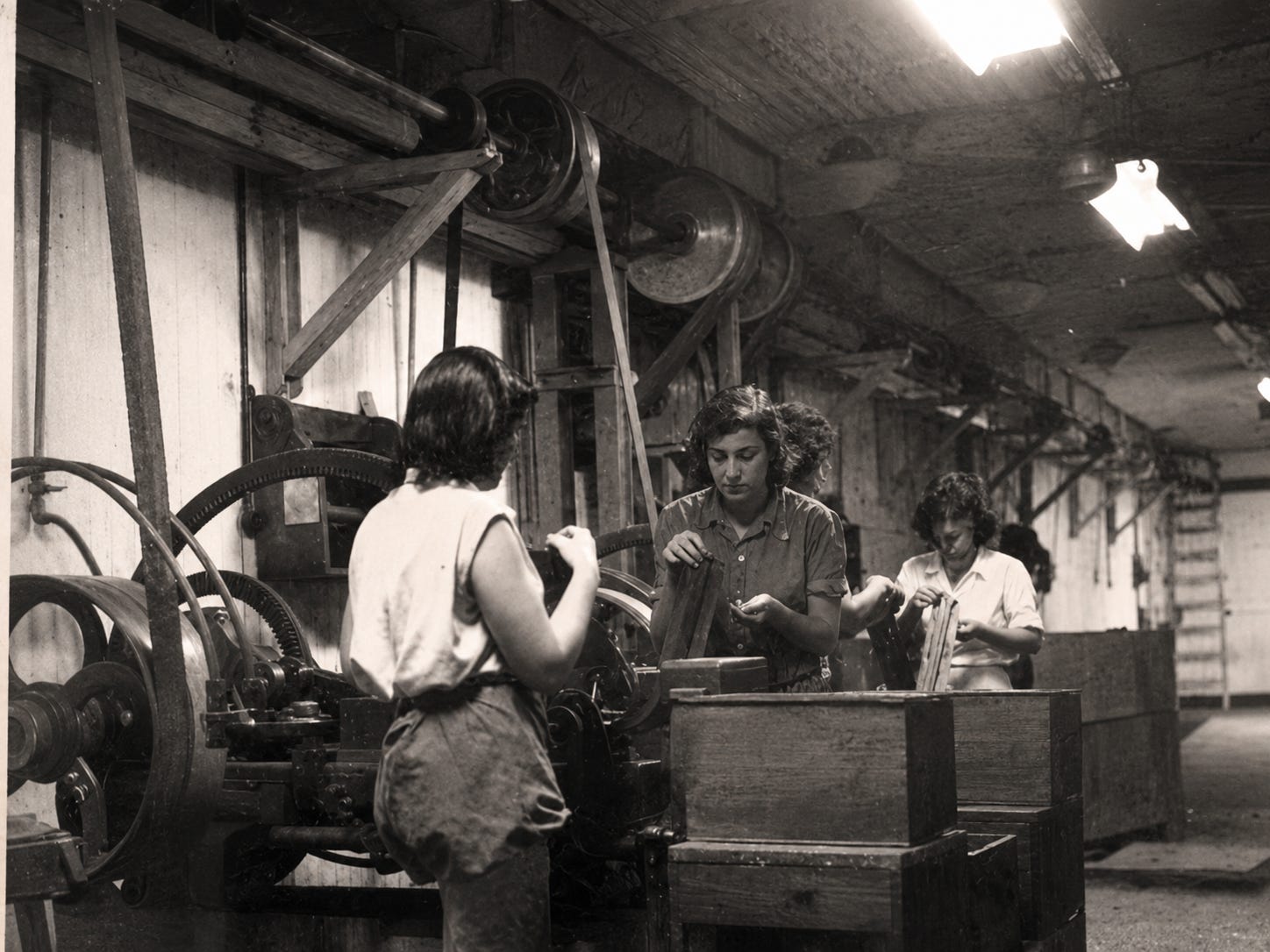
The work left marks. Underground workers got pale. The kibbutz was supposed to be populated by sunburned, weather-beaten agricultural pioneers. Workers also emerged from their shifts smelling of machine oil and gunpowder.
To explain the smell, carpentry and metal workshops were built around the laundry above, giving anyone who noticed the scent a plausible explanation. To explain the pallor, the operation’s director appealed to the Haganah’s chief doctor, Dr. Yosef Kot, who came down into the bunker personally.
The workers suffered chronic headaches, eye problems, general weakness from 10-hour shifts underground with no sunlight or fresh air. The doctor’s prescription was a quartz lamp. They hauled it down into the bunker. After their shifts, the workers stripped down and stood under it, treating their medical symptoms and maintaining the tan that their actual working conditions made impossible. When they emerged above ground, they looked appropriately weathered.
The kibbutz kept uninvited visitors away through a separate scheme. The gate always had a notice posted. Today it might be foot and mouth disease. Tomorrow, a bird plague. The next day, an infant illness requiring quarantine. Nobody came to check, not even family. Workers had to turn their own relatives away at the gate, cutting visits short, refusing to explain why. The families understood they should not ask.
When the finished bullets needed to leave the compound, they went out in milk cans with false bottoms and later in hidden compartments of fuel trucks, a particularly audacious choice given that they were stashing gunpowder-filled ammunition inside vehicles designed to carry flammable liquid. The cans looked like dairy deliveries. They were carrying the ammunition that would determine whether a Jewish state survived its first weeks of existence.
In February 1948, the Jewish underground blew up a section of British railway. The British, furious and suspicious, launched a sweep of the surrounding area that brought soldiers directly to Kibbutz Hill.
The workers had minutes of warning. They descended into the factory, shut down the machines, and climbed back out. Then, in a move of extraordinary improvisation, they organized themselves into a medical relief team and went to assist casualties from the railway explosion. When British soldiers arrived at the kibbutz gates, they found a community apparently engaged entirely in humanitarian work.
The inspection found nothing. The machines went back on the next day.
By the time the British Mandate ended in May 1948 and the State of Israel declared independence, the Ayalon Institute had produced more than 2.25 million nine-millimeter cartridges. When five Arab armies invaded simultaneously in the hours after independence was declared, those bullets were already distributed and waiting.
It has been said, by the people who were there, that the ammunition from the Ayalon Institute was the only supply that was never in shortage during the 1948 war. Every other category of weapon and equipment ran low at some point during those desperate first weeks. The bullets from the factory beneath the laundry did not.
Yehudit Adler, a 19-year-old worker at the Ayalon Institute, put it simply when asked about those years: “It was not frightening. It’s very difficult for me to reconstruct the feeling because we were so dedicated and we wanted it to succeed. And we knew the dangers, of course. One little lapse and the British would hang us.”
The operation shut down in June 1948, once the immediate threat to central Israel had passed and the British had departed. The machines were moved to other locations, and the bunker went quiet.
After independence, the 45 workers did not go their separate ways. They had spent three years living as a community above a secret, sustaining each other through isolation, illness, and the daily weight of knowing what failure would cost. When the war ended and the factory closed, they decided to do what they had always said they were doing: They founded a real kibbutz.
Kibbutz Ma’agan Micha’el opened in 1949 on the Mediterranean coast near Zikhron Ya’akov, 93 kilometers (58 miles) north of the Ayalon Institute. The community they had pretended to be finally actually became.
Their secret, kept so completely that not a single word leaked during three years of operation, stayed kept for another 25 years after that. The public did not learn about the underground factory until 1973. Twenty-five years of silence, maintained by 45 people who had decided that some things were worth protecting long after the danger had passed.
After the State of Israel was established, Yehudit Adler changed her name. She became Yehudit Ayalon, taking the name of the factory as her own, carrying it forward into the rest of her life the way she had carried everything else about that place: without fanfare, without explanation, and without apology.
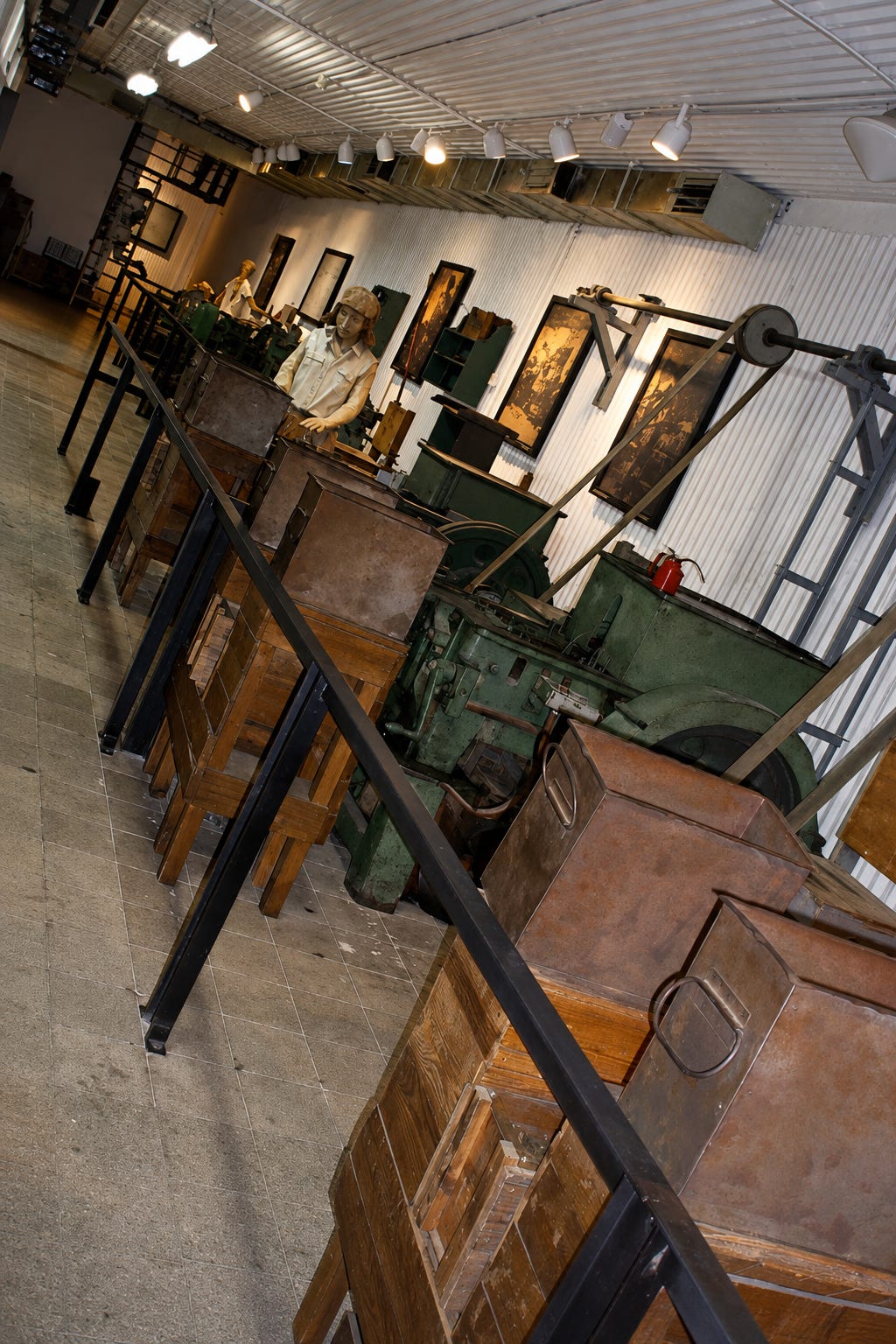
In 1987, after a restoration project, the site opened as a museum. Visitors today can stand in the laundry above, watch the washing machine swing out on its pivot, and descend the same metal ladder those 45 teenagers climbed every day for three years. The bullet presses are still there. The UV lamp is still there. The concrete walls, two feet thick, built in 22 days, are still there. The factory that saved a country is still exactly where they left it.
There is a version of this story that frames it as a caper, a clever trick pulled off by resourceful underdogs, and that framing is not wrong. The fake quarantine signs, the lipstick cover story, the sunlamp tans, the British officers dropping off their laundry above a bullet factory powered by the British Army’s own electricity — all of it has a quality that belongs in a heist film.
But underneath the cleverness is something more serious: These were mostly teenagers, children from a youth movement who were told that the survival of their people depended on what they did underground, in the dark, in the heat, for 10 hours a day.
They stamped their initials onto every bullet they made, EA, Eretz Ayalon, a signature nobody would ever see but them, pressed into the brass of cartridges that would be fired by soldiers in a war for a country which did not exist yet.
A wonderful country built on the shoulders of giants. I visited Ayalon museum while on tour with Sar-El. It gave extra meaning and context to our tiny contribution.
An amazing and moving story, I am in tears. Thank you.