

Please consider supporting our mission to help everyone better understand and become smarter about the Jewish world. A gift of any amount helps keep our platform free of advertising and accessible to all.
This is a guest essay by Mitch Schneider, who writes from Israel.
You can also listen to the podcast version of this essay on Apple Podcasts, YouTube Music, YouTube, and Spotify.
“From the river to the sea, Palestine will be free!”
You’ve seen the videos. Someone walks up to a protester, chanting along with the crowd, and asks a simple question: Which river? Which sea?
The blank stare that follows is more honest than anything else in that crowd. Because it tells you exactly what this is. Not a political position. Not a historical claim. A feeling, borrowed from a chant, carried through a megaphone, aimed at a people whose home it describes, by someone who couldn’t find that home on a map.
So let’s answer the question they couldn’t.
The river is the Jordan. The sea is the Mediterranean. Nine miles at its narrowest. Between them, nearly 8 million Jews.
Ask anyone chanting “From the river to the sea, Palestine will be free!” what they mean by free. They’ll say occupation. They’ll say apartheid. But the land between the river and the sea isn’t occupied territory. It’s Israel. The nearly 8 million Jews who live there aren’t an occupying force. They’re the population. So when the chant says free, and the geography says Israel, and the population says Jews, the sentence completes itself.
They know how it sounds.
Some will tell you this started in 1967, when the Israelis captured the West Bank and Gaza in a war launched against Israel. Others will say 1948, when the modern State of Israel was born and the first war began.
Both are wrong.
Not because the dates are incorrect, but because the violence, the sustained effort to ensure there would be no Jewish state in this land, predates both of them by decades. It predates the state. It predates the war. It predates, in fact, the very grievance that is now offered as its cause.
Next time someone tells you this started in 1967 or 1948, ask them about April 4, 1920. On this date, a crowd gathered outside the Jaffa Gate during the Nebi Musa festival in Jerusalem. The speeches began, the chants followed: “Palestine is our land and the Jews are our dogs!” Jewish homes and synagogues were attacked. Jews were beaten and murdered in the streets. Local British forces, as part of British Mandate Palestine, largely stood aside.
There was no Israeli state. No army. No occupation. No settlements. Not a single one. Just Jews living in the land their ancestors had never entirely left, and people who had decided that their presence was the problem.
A year later, on May 1, 1921, Arab rioters attacked the Jews of Jaffa. 47 Jews were killed. The attacks spread to Petah Tikvah, Rehovot, and Hadera. Same pattern: no Jewish state, no Israeli army, no occupation, just Jews.
Then came August 24, 1929, a Saturday morning in Hebron. The Grand Mufti of Jerusalem, Haj Amin al-Husseini, had spent weeks telling Muslims that Jews were planning to seize the Al-Aqsa Mosque — the same lie, told the same way, for the same purpose. Hundreds of men with swords and axes went house to house through the Jewish quarter. In two hours, 67 Jews were dead, including infants killed in their mothers’ arms. The British police commander walked the main street, where it was quiet, and didn’t go to where the killing was.
The Jewish community of Hebron had lived in that city since biblical times. They weren’t “Zionists,” and they weren’t “settlers.” They were a community with roots reaching back further than anyone now chanting about “Palestine.” They were evacuated by the British. They didn’t return for 38 years.
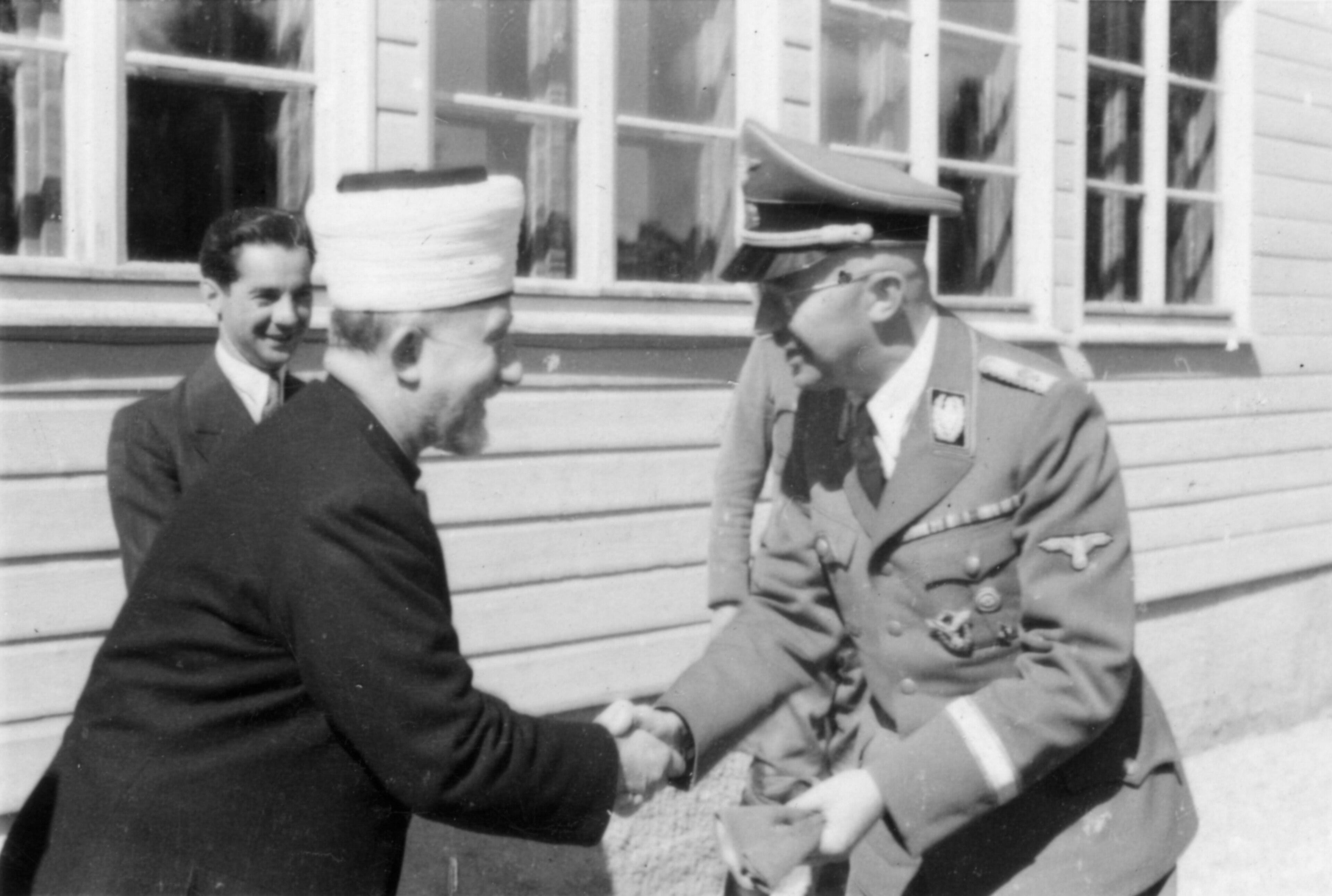
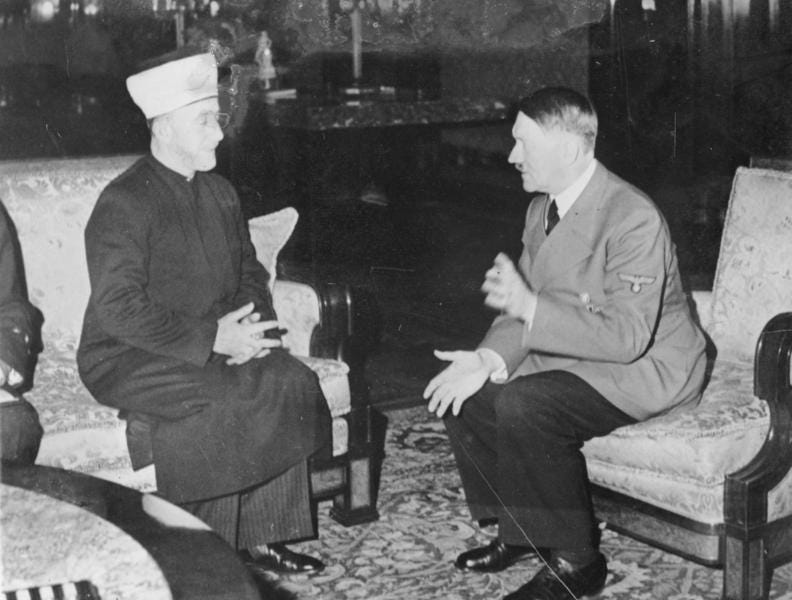
The Grand Mufti who incited that massacre spent World War II in Berlin. He met with Hitler. He recruited Bosnian Muslims for the Waffen-SS (the combat branch of the Nazi Party’s SS paramilitary organization during World War II). He broadcast Nazi propaganda in Arabic across the Middle East. He was wanted for war crimes after the war but escaped to Egypt, where he continued his work. He died in 1974, never tried by a court of law, never convicted. A founding father, by some accounts.
The Palestine Liberation Organization was founded in Cairo in 1964 — not in Jerusalem, not in Hebron, not in Gaza City, but in Cairo, at an Arab League summit convened at the initiative of Egypt’s president. Its first chairman, Ahmad al-Shukeiri, was born in Lebanon to a Turkish mother and had most recently served as Saudi Arabia’s ambassador to the United Nations. The organization created to speak for the Palestinian people was built in Egypt, by the Arab League, chaired by a man who was Lebanese by birth and Saudi by employment.
That was three years before the West Bank was even under Israeli administration, and three years before the grievance that’s now offered as the movement’s reason for being.
The Palestine Liberation Organization’s own founding charter, Article 24, stated explicitly that the organization made no territorial claim over the West Bank (which was then under Jordanian control) or Gaza (which was under Egyptian control). The territories the movement now claims to be liberating were not part of its original demand. The point, stated plainly in the same charter, was the elimination of Israel. All of it, from the river to the sea. Article 9 named the method: Armed struggle was the only way to liberate “Palestine” — not negotiation, not coexistence, armed struggle.
Then, in 1969, Yasser Arafat became chairman of the Palestine Liberation Organization. Born in Cairo. Educated in Cairo. A lieutenant in the Egyptian army. His family had moved to Cairo in 1927, 21 years before 1948, and two years before the Hebron massacre. They didn’t leave because of Israel. They left far before the State of Israel was born.
In 1967, Israel won the Six-Day War, started by a coalition of Arab states, primarily Egypt, Syria, and Jordan. The West Bank, previously occupied by Jordan since 1948, came under Israeli administration. Gaza, previously held by Egypt, did the same. The charter was revised: The West Bank and Gaza were added to the claim. The goal didn’t change. Only the justification did. Convenient timing, right?
The next time someone tells you this is about land, “occupation,” or 1967, remember what happened the day after Israel declared independence in 1948: Five Arab armies invaded (Egypt, Jordan, Syria, Iraq, and Lebanon). The Arab League’s secretary general, Azzam Pasha, had declared the previous October, in an interview published in the Egyptian newspaper Akhbar al-Yom, that the coming war would be “a war of extermination and momentous massacre which will be spoken of like the Tartar massacre or the Crusader wars.”
They lost.
Their own leaders told them to leave — not forever, just for a few days, a few weeks at most, while the armies finished the job. Cars with megaphones drove through Jaffa encouraging people leave so the fighting can succeed. The Arab Salvation Army told villages: We’re here to exterminate the Zionists. Leave your houses. You’ll return safely in a few days.
One refugee, speaking decades later on Palestinian Authority television, said he left with only the clothes on his back. “We were supposed to return in two hours,” he said. “Why carry anything? We’re still waiting for those two hours.”
Mahmoud Abbas wrote it himself, in the official Palestine Liberation Organization journal, in 1976: Arab armies “abandoned them, forced them to emigrate and to leave their homeland.”
The Jordanian daily Falastin had already said the same thing in February 1949. The Arab states had encouraged Palestinians to leave temporarily “in order to be out of the way of the Arab invasion armies” and had “failed to keep their promise.”
Their own words, in 1949 and 1976, before anyone else could have planted them.
By May 1967, Egyptian President Gamal Abdel Nasser had massed troops on Israel’s border, expelled United Nations peacekeepers from the Sinai, and blockaded the Straits of Tiran. On May 27th, he said it plainly: “Our basic objective will be the destruction of Israel.” Israel struck preemptively and won in six days. The West Bank came from Jordan. Gaza came from Egypt. No Palestinian state had existed in either territory. Nobody called it occupation when Jordan held the West Bank. The word arrived with Israel, and only with Israel.
In 1973, Egypt and Syria attacked on Yom Kippur, the one day when Israel’s soldiers would be fasting and in synagogue. Israel survived. Every war has been launched at Israel to answer the chant. Every war lost. But the same demand arrives each time: Call the outcome “occupation,” start again.
In 1937, the Peel Commission offered the Arabs a state. They rejected it and launched the Arab Revolt. In 1947, the UN voted to partition the land into two states. The Arab League rejected that and sent five armies. The pattern was established long before Camp David.
In July 2000, at Camp David, Israeli Prime Minister Ehud Barak offered the Palestinians a state on approximately 95 percent of the West Bank (plus equivalent land swaps), a Palestinian capital in East Jerusalem, and sovereignty over the Temple Mount. According to Dennis Ross, who led the American negotiating team, Yasser Arafat said no and walked away without making a counteroffer.
In 2008, Ehud Olmert went further still: 94 percent of the West Bank plus land swaps, East Jerusalem as the Palestinian capital, and international administration of the Old City of Jerusalem — the most generous offer any Israeli prime minister had ever put on the table.
The Palestinian leadership rejected that too.
Two states offered twice in a generation, on top of two offers rejected in the previous generation — not because the terms were impossible, but because the goal was never a state alongside Israel.
Then, in 1967, after winning a war that five Arab armies launched against them, Israel offered to return the Sinai and the Golan Heights in exchange for peace. The Arab League met in Khartoum and issued its answer: no peace with Israel, no recognition of Israel, no negotiations with Israel — what became known as “the three no’s” — after losing a war they started. That’s the receipt nobody frames and hangs on the wall.
The chant didn’t stop in 1967; it found new sponsors. The Grand Mufti incited from Jerusalem and then from Berlin. Today Qatar hosts Hamas’ political leadership in Doha and Iran funds Hamas, Hezbollah, Palestinian Islamic Jihad, and the Houthis from Beirut to Sanaa. The missile and the protest sign have the same return address. The goal hasn’t changed since 1920. Only the budget has.
Next time someone tells you “Palestine” is an ancient nation with a prior claim to this land, ask them one question, just one: Name the country. Not the people, not the land, not the cause. The country, the sovereign state with a government and a currency and a prime minister and borders recognized by other nations.
Name the president of “Palestine” before 1948. Name the currency. And I’m not talking about the Palestinian pound, which was the British Mandate currency, administered by Britain, bearing the image of the British crown. Name a Palestinian currency. Name the capital city, not a city someone claims should be a capital, but the actual seat of government where a Palestinian parliament met and passed laws.
Name the year “Palestine” declared independence. Name the prime minister who signed the declaration.
The silence that follows these questions isn’t ignorance; it’s the answer. There was no sovereign Arab state called “Palestine” — not for a year, not for a month, not for a day. The land between the river and the sea has been governed by Judean kings, Hasmonean rulers, Roman emperors, Byzantine basileis, Arab caliphs, Crusader lords, Mamluk sultans, Ottoman pashas, and British high commissioners.
Never once by a sovereign Arab state called “Palestine.” The Palestine Liberation Organization was founded in 1964 to “liberate” a country that had never existed from a people who had held sovereignty here twice in recorded history.
Nobody is demanding America give the land back to the Cherokee. Nobody is organizing boycotts of Canada over the Cree. Every country on earth sits on land that was won in a war somebody lost, and the world has made its peace with that.
Except, somehow, here in Israel.
Here, the losing side gets to demand that the winning side justify its existence in perpetuity, backed by founding documents that still call for its elimination, and the international community nods along and calls it a “peace process.”
And when that argument runs dry, there’s one more thing worth saying: The Babylonians destroyed Jerusalem and exiled the Judean leadership in 586 BCE. The Babylonians are gone. The Romans destroyed the Temple, renamed the land, banned Jews from their own capital on pain of death. The Roman Empire is a ruin you can visit on a package holiday.
The Spanish Inquisition expelled every Jew from Spain in 1492. Spain spent the following century in decline. And then the Nazis, who brought the full industrial capacity of a modern European state to bear on the question, with meticulous paperwork and industrial efficiency.
The Third Reich lasted 12 years. The Jews have been around for 3,500.
Every empire that made the elimination of the Jewish People a central project is now either gone or a cautionary tale. And the Jewish state, the one the Grand Mufti tried to prevent in 1920, that five Arab armies tried to destroy in 1948, that Nasser promised to finish in 1967, is 78 years young. The people are 3,500 years old, the language older still, the coins in the ground 2,000 years old.
The modern state is the newest chapter of the oldest story on earth. It has Arab judges on its Supreme Court, a philharmonic, more patents per capita than almost any country on earth, and a habit of flying lost tribes home from places the world forgot they existed.
Every empire that tried to end this story is now a chapter in a history book. This one is still being written.
From the river to the sea.
They’ve been trying since before there was a river or a sea to chant about.
Jews, go back where you came from.
We did. It’s called Israel. And we’re not going anywhere.
Yet Jews all over the world stand side by side with those chanting "from the river to the sea” with their famous “Jews for” signs: not a single one of them ever holding up a sign “Jews for Jews.” For every Jew that gets it there are two Bernie Sanders.
The world will never accept Israel or a Jewish state as long as they can stand with Jews who say they shouldn't.
The Jews have been victims for 3,000 years and no gang of facts is ever going to change that as long as Jews remain the only people that eat their own. The warped defeatist mind set of the perpetual victim refuses to see things as they are. There will only be peace through strength and there will only be strength when Jews are united in that cause.
A wonderful summary of history; however, your basic premise, that this information can used with positive effect on those who refuse to hear, leaves much to be desired. Those who attend the protests and chant their b.s. understand simple chants. If you want a simple, catchy, snappy little chant that can be used as a counter-argument, feel free to use this one. "From the river to the sea, the IDF shall keep us free."