


Please consider supporting our mission to help everyone better understand and become smarter about the Jewish world. A gift of any amount helps keep our platform free of advertising and accessible to all.
This is a guest essay by David Schechter, a sports medicine physician based in Los Angeles, and Joshua Hoffman, the founder of “Future of Jewish.”
You can also listen to the podcast version of this essay on Apple Podcasts, YouTube Music, YouTube, and Spotify.
Boy George is probably not the first person you would expect to hear about in an essay about the Jewish future.
The eyeliner, the hats, the unmistakable soundtrack of the 1980s — none of it immediately suggests a lesson in Jewish peoplehood.
Yet this year, the British pop star released a song called “We Will Dance Again,” invoking the young people murdered at the Nova music festival on October 7, 2023. His declaration was simple: “I stand with the Jews.”
There is something both moving and deeply unsettling about how much those words mean to us. Moving because solidarity, when it comes without an asterisk, can feel like oxygen. Unsettling because a non-Jewish musician affirming that Jewish people deserve his support should hardly be a remarkable event. It should not require an explanation, much less an act of professional or social courage. Yet here we are, grateful for a sentence that ought to be ordinary.
Perhaps that is one of the harder things to absorb about the years since October 7th: discovering how many relationships came with conditions we had never understood. We thought certain friendships, institutions, and communities would know what to say when Jews were massacred. We assumed that people who spoke eloquently about the humanity of strangers would recognize ours. For many Jews, the shock of the attack was followed by another, more intimate shock: realizing whom we could no longer count on.
We discovered that some people could discuss Jewish suffering only after placing it inside a political argument. Before acknowledging a murdered family, they needed to establish their credentials, announce their positions, and explain the context. There is always room for serious discussion about history, war, and the responsibilities of governments. But when every expression of sympathy for a Jewish victim requires a preliminary negotiation, something has gone badly wrong.
That experience can become consuming. We keep track of who said something, who said nothing, who signed which letter, and who quietly disappeared. We celebrate the unexpected ally and spend hours arguing with the predictable enemy. We find ourselves mentally revising the guest list of people we once considered friends. Some of that attention is necessary. Trust should respond to evidence. But there is a danger in allowing the Jewish future to become a referendum conducted by everybody else.
An entire people cannot spend its life refreshing the screen to find out whether it has been granted permission to exist. Nor can we allow our sense of possibility to rise and fall with the opinions of actors, professors, musicians, or people whose principal achievement is having a large social media following. Their choices can matter. They do not relieve us of making our own.
At some point, the question has to move beyond who is standing with us. We have to ask what we are prepared to do with our own solidarity.
The promise of dancing again offers a place to begin. At Nova, people had gathered for something wonderfully unremarkable: music, friendship, the pleasure of being young and alive. They were not assembled to make a geopolitical argument. They did not owe the world an explanation for being there. The horror of their murder includes the destruction of that ordinary freedom — the ability to inhabit a moment without imagining that someone might kill you for it.
Dancing requires a certain trust in the world. You stop monitoring yourself so closely. You surrender a little control. You assume that the stranger beside you is there for roughly the same reason you are: to enjoy the music, to feel connected, to have a good night. Terror attacks that trust as surely as it attacks the body. It tries to make every future gathering feel like a risk, every celebration feel irresponsible, every moment of happiness feel like something that can be punished.
To envision Jews dancing again is therefore to envision something larger than survival. Survival can mean merely reaching tomorrow. Dancing suggests that tomorrow might contain something worth anticipating. A wedding. A celebration. An evening when a parent does not spend every minute checking the phone. A future in which Jewish life has room for more than defending its right to continue.
None of this means that grieving people owe anyone a display of resilience. Those who have suffered do not have to turn their pain into an uplifting lesson for the rest of us. Some losses remain losses. Some empty chairs will always be visible to the people who know who should be sitting in them. The responsibility belongs to the wider community: to help create a world in which the bereaved can live without being asked either to forget or to remain forever inside the worst day of their lives.
That future requires practical work. A country needs functioning institutions, an economy, businesses willing to expand, and people willing to commit resources before the outcome is certain. Communities need teachers, gathering places, and families who believe that what they are building will endure. A damaged life may need years of support after the public has moved on to another story. Hope becomes consequential when someone accepts responsibility for making it possible.
This is where the word “bond” becomes particularly useful. We speak about the bonds of family, faith, and peoplehood as though they exist independently of our choices. We assume that because we feel connected, the connection is secure. But anyone who has maintained a friendship, a marriage, or a relationship across continents knows that a bond can be sincerely felt and still poorly tended. Affection does not automatically become attention. Concern does not automatically become help.
The bond between Jews in Los Angeles and Jews in Jerusalem cannot consist entirely of shared anxiety whenever the news becomes unbearable. If we belong to the same people, that relationship has to include some investment in one another’s ordinary lives and long-term prospects. Otherwise, we become relatives who call only when someone is in the hospital: genuinely concerned, perhaps, but largely absent from everything that makes a life.
An Israel bond gives that relationship a concrete form. It is a loan to the State of Israel, with repayment and interest governed by the terms of the particular bond. The program began in 1951, and Israel Bonds reports an uninterrupted record of on-time principal and interest payments. That history matters, even as any investment still requires attention to its terms and risks.
There is something compelling about the structure itself. A donation responds to a need; a loan also anticipates a future relationship. It establishes a date beyond the present crisis. It assumes that there will be years ahead in which obligations are met and life continues. In the Jewish experience, where so much energy has gone into surviving the immediate threat, committing resources to a future date carries an emotional significance that a financial statement cannot fully capture.
A bond has a maturity date. Hatred would like us to believe that the Jewish story has an expiration date. Choosing to invest is one practical way of refusing to organize our lives around that expectation. We are making plans beyond the emergency. We are entering into an agreement with a future we intend to help sustain.
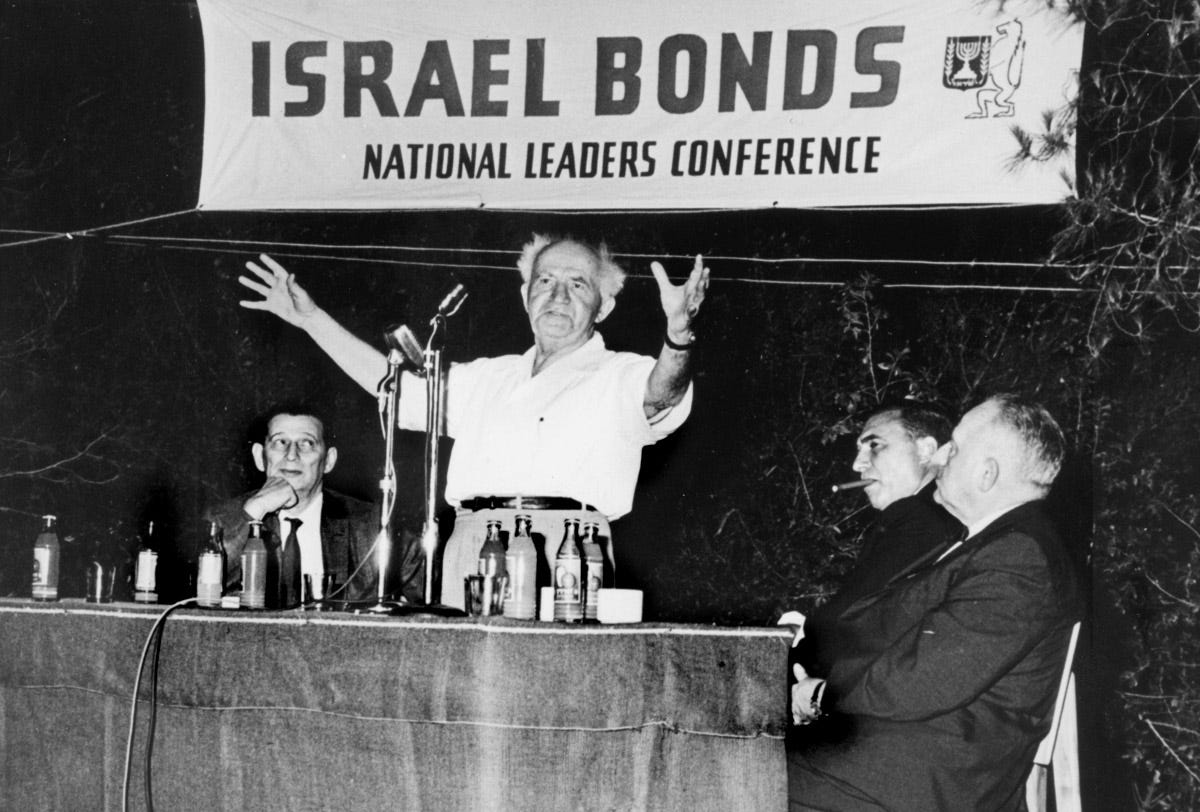
This is especially meaningful because the news trains us to experience Israel almost entirely in the present tense. The latest attack, the latest political dispute, the latest diplomatic confrontation. Everything is urgent; everything demands a reaction. An investment asks us to widen the frame. What do we expect to exist in five years? What do we want to be stronger in ten? What are we doing now that will still matter when today’s arguments have been replaced by tomorrow’s?
Of course, an investment cannot settle every argument about Israel, nor should it be expected to. Jews disagree about governments, military decisions, religion, economics, and almost everything else. Supporting Israel’s future does not require pretending that every decision made by its leaders is wise. It requires recognizing that the lives and prospects of millions of people cannot be reduced to our opinion of whichever politicians currently hold office.
There is an immaturity in treating a country as though it were a person who must earn our friendship by agreeing with us. Countries contain children, elderly people, political opponents, exhausted parents, ambitious students, and citizens who are themselves furious with their government. To withdraw all concern for their future because we dislike a leader is to make those people disappear behind the very politics we claim to take seriously.
For Jews, the relationship also reaches beyond the politics of the moment. Israel is part of our language, our calendar, our prayers, our family histories, and our understanding of where we come from. That does not dictate a position on every policy. It does explain why the connection cannot be switched on and off like a subscription. A serious relationship can withstand disagreement. It should also generate responsibilities that survive disagreement.
Nor should Israel’s right to a future depend on assembling a sufficiently impressive list of its contributions to the world. Its medical advances, scientific research, and technological achievements deserve recognition. They reveal a society doing far more than the narrow image of perpetual conflict allows outsiders to see. But Israelis should not have to cure a disease or invent a device to establish that their children deserve safety.
Sometimes, in our eagerness to defend Israel, we accept a degrading premise without realizing it: that Jewish existence must continually demonstrate its usefulness to everyone else. We present our accomplishments as though arguing against our own eviction. Pride in achievement is healthy. The suggestion that our rights depend on achievement is not. The Israeli who has never invented anything has exactly the same claim to a peaceful life as the scientist whose work benefits millions.
The deeper case for investing is about participation. Those of us living outside Israel can easily become spectators, even intensely emotional ones. We follow developments, defend positions, and experience every crisis through a screen. We may finish a day feeling depleted by something to which we have contributed very little beyond our attention. The exhaustion is real. So is the gap between feeling involved and being useful.
An investment is one way to close that gap. Supporting an Israeli business, sustaining a Jewish institution, educating our children, and showing up for our communities are others. The point is not to establish a single financial test of Jewish loyalty. People have different means and different responsibilities. The point is to ask whether our concern produces anything that can outlast the feeling — whether someone, somewhere, is stronger because we cared.
This also changes the meaning of solidarity. We often speak of it as a public declaration, something announced loudly enough that other people can hear. But much of the solidarity that sustains a people is quiet and repetitive. It is a standing commitment, a renewed membership, a purchase, a lesson taught, a relationship maintained. It rarely generates the emotional satisfaction of winning an argument. Its value is that something exists afterward that otherwise might not.
That is what makes an Israel bond a meaningful gift for a wedding, a bar or bat mitzvah, or a new baby. Such occasions already express confidence in continuity. We gather around a child because we expect that child to grow. We celebrate a marriage because two people have decided to build something together. A gift connected to Israel’s future places that personal milestone within a larger story: Your life is your own, and you also belong to a people whose next chapter you will help write.
Imagine what that gift communicates when it is explained properly. Years from now, when this bond matures, you will be older. You will know things you do not know today. Your life will have changed in ways none of us can predict. And at this moment, while celebrating who you are becoming, someone chose to connect your future to the future of your people. The financial value matters. So does the act of expectation.
Jewish history is often taught as a succession of catastrophes, interrupted by brief periods of relief. Yet catastrophe alone cannot explain why we are still here. Persecution explains what threatened Jewish continuity. It does not explain what sustained it. For that, we have to look at the people who kept teaching children, establishing households, building communities, and making commitments whose rewards they might never personally see.
They carried grief, but they also prepared for celebrations. They preserved the names of the dead and chose names for newborn children. They remembered destroyed communities and took responsibility for living ones. They gave the next generation more than a record of what had been done to us. They passed on something to belong to, something to practice, something to love.
That is the responsibility we have inherited. We cannot allow Jewish identity to become an elaborate system for monitoring antisemitism. Our children deserve to know why Jewish life is worth living before they are asked to understand why others resent it. They deserve songs that are sung for pleasure, gatherings that are not responses to tragedy, and a connection to Israel that includes curiosity and affection alongside concern.
Boy George’s solidarity deserves our gratitude. It should also prompt us to examine our own. We cannot control how many people stand beside the Jewish People, but we can decide how firmly we stand beside one another. We can give that commitment a place in our calendars, our communities, and, where appropriate, our investments. We can make decisions that assume the Jewish future is something we are responsible for building.
The next Jewish wedding will need musicians. The next generation will need schools. The next Israeli startup will need someone willing to believe in it before it succeeds. Somewhere, a child who has not yet been born will grow up to celebrate beneath a chuppah, surrounded by people who made that future possible without ever knowing their name.
If we want a future filled with dancing, we have work to do before the music starts.
Jewish National Fund-USA!