


Please consider supporting our mission to help everyone better understand and become smarter about the Jewish world. A gift of any amount helps keep our platform free of advertising and accessible to all.
This is a guest essay by Bob Goldberg, who writes the newsletter, “The New Zionist Times.”
You can also listen to the podcast version of this essay on Apple Podcasts, YouTube Music, YouTube, and Spotify.
Michigan’s U.S. Senator-elect Abdul El-Sayed says he has no ties to the Muslim Brotherhood, and he has disavowed it sort of and after the fact.
Very well.
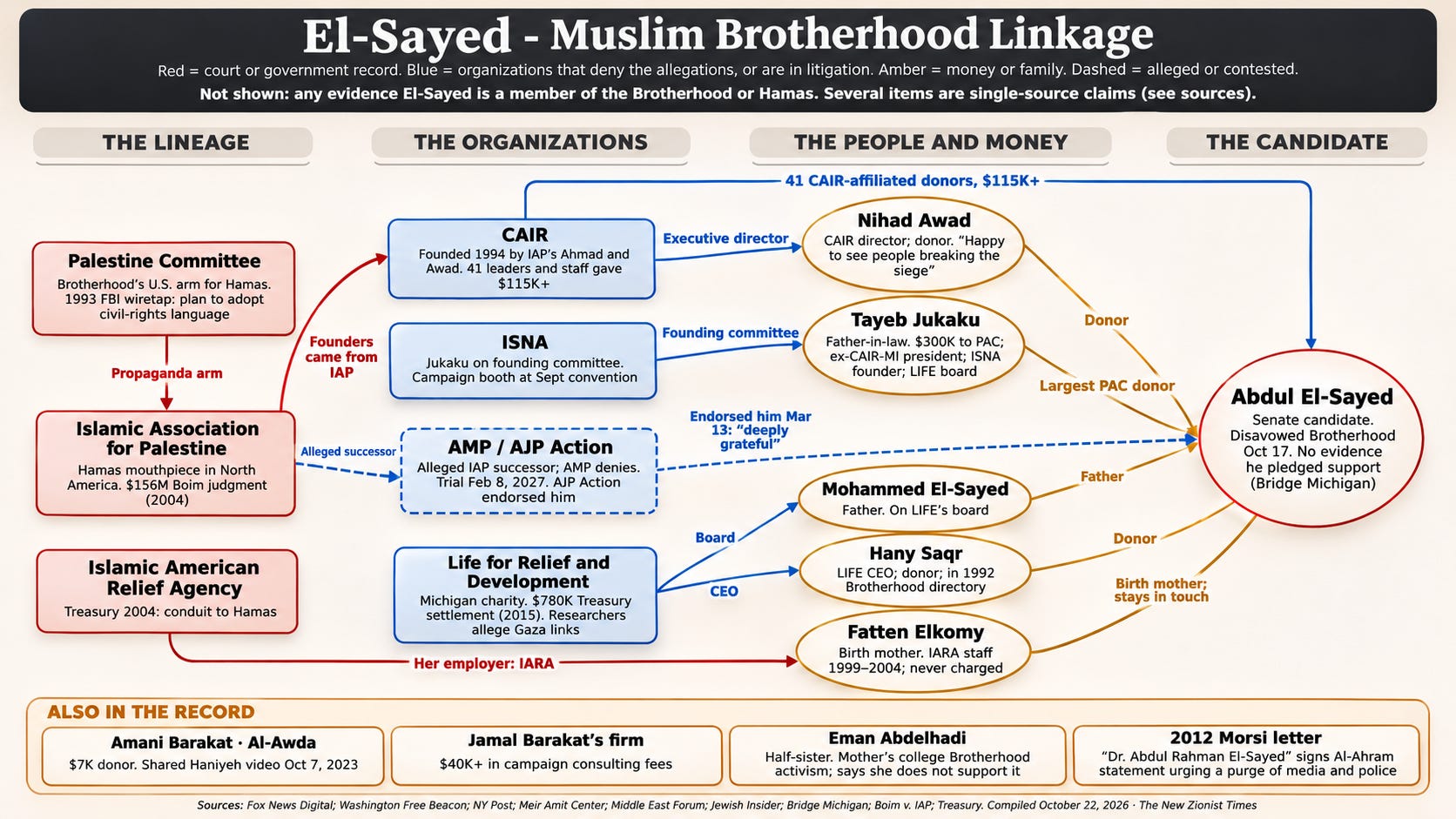
Set the words aside and look at who writes the checks, who hosts the speeches, and who endorsed his campaign. The answer is a three-decade institutional project, and it did not begin with modern “progressive” activism.
It began in October 1993, in a Philadelphia Courtyard Marriott. The FBI had the room wired. Gathered there were senior members of the Muslim Brotherhood’s “Palestine Committee,” and they faced a problem: The Oslo Accords1 threatened to marginalize Hamas. Their solution was not to abandon the mission but to sanitize it. According to the transcripts, the organizers discussed, with striking candor, how to conceal their allegiance, adopt the vocabulary of American civil rights, and build new public-advocacy fronts that could pass in the American mainstream.
The people in that room understood perfectly well that a message carried by a respectable messenger travels farther than one carried by a known one.
At the center of that ecosystem stood the Islamic Association for Palestine. A future Hamas political bureau chief, Khaled Meshal, directed it, and Mousa Abu Marzook financed it. Through the 1980s and early 1990s, it served as Hamas’ mouthpiece in North America: distributing its communiqués, promoting its charter, circulating tapes celebrating suicide bombings.
Then came the rebranding. Within months of the Philadelphia meeting, the Islamic Association for Palestine’s president, Omar Ahmad, and its public relations director, Nihad Awad, helped found the Council on American-Islamic Relations. A decade later, a federal court entered a $156 million judgment against the Islamic Association for Palestine for its civil liability in the Hamas murder of an American teenager, David Boim.
The Islamic Association for Palestine closed its doors. The Boim family’s lawyers allege that it did not go out of business so much as change its name, and that the old organization’s people, conferences, and messaging reappeared as American Muslims for Palestine, which denies it. A jury will decide in February.
Now fast-forward to the present. That network has mobilized behind a viable candidate for the United States Senate.
Follow the money, as the saying goes. A Fox News Digital review of campaign-finance records found that El-Sayed’s campaign took in more than $115,000 from at least 41 current or former employees and leaders of the Council on American–Islamic Relations. These were individual contributions, not checks from the Council itself, and that distinction matters legally. Politically, 41 associated donors make a constituency. You do not need a conspiracy board and red string. A spreadsheet will do.
The outside money is larger still. His father-in-law, Tayeb Jukaku, gave $300,000 to Fighting for Michigan PAC, the super political action committee supporting El-Sayed, making him its largest individual donor, according to the Washington Free Beacon. Jukaku once served as president of the Council on American–Islamic Relations’ Michigan branch and sat on the founding committee of the Islamic Society of North America.
When Americans for Justice in Palestine Action, which grew out of the American Muslims for Palestine ecosystem, endorsed El-Sayed, he said he was “deeply grateful.” At the Islamic Society of North America’s September convention in Detroit, his campaign was reportedly given an exhibitor booth to hand out political literature to thousands of attendees.
Then there is Life for Relief and Development, a Michigan charity. El-Sayed’s father, Mohammed El-Sayed, sits on its board, and reporting indicates Jukaku recently did too. Its chief executive, Hany Saqr, and other board members have given to the campaign. In government exhibits from the Holy Land Foundation prosecution (a U.S. terrorism-financing scheme attributed to Hamas)2, Saqr appears in a historical directory of American Muslim Brotherhood figures.
The charity has its own federal record. In 2015, it agreed to pay $780,000 to settle potential civil liability with the Treasury Department for apparent violations of Iraq sanctions. Treasury identified $236,000 in transfers routed through Jordan and called the case egregious, noting that the charity’s president directed the transactions despite prior warnings.
$780,000 is a lot of money to settle a matter the campaign’s defenders consider irrelevant. And two outside researchers go further. A 2019 Meir Amit Center investigation reproduced photographs of Life for Relief and Development-branded supplies distributed in Gaza through a group whose leadership it linked to the Popular Resistance Committees, and a November 2023 Middle East Forum investigation documented Life for Relief and Development funding directed to the Hamas-associated Unlimited Friends Association.
Then there is El-Sayed’s family, which demands precision, so let us be precise.
His birth mother, Fatten Fathy Elkomy, worked for the Missouri-based Islamic American Relief Agency from 1999 to at least 2004. In October 2004, the Treasury designated the Islamic American Relief Agency’s worldwide network for supporting terrorism, alleging it funneled money to Hamas.
Government exhibits show Elkomy handled orphan-support correspondence, including a December 2000 request for $24,607.34 for the Islamic American Relief Agency’s Iraq office. This paper trail proves no criminal wrongdoing, and a transfer to Iraq is not a payment to Hamas. It does, however, place his family within an organization under federal scrutiny.
His half-sister, Eman Abdelhadi, has written about their mother’s activism in the Muslim Brotherhood while in college in Egypt. When asked on the TV show “Meet the Press” whether he or his family had any ties to the Brotherhood, El-Sayed answered flatly, “No.” Later, he told NBC he had never discussed the subject with his mother and that she had not raised him; his parents divorced when he was 3, and his father and stepmother raised him. “I never discussed it with my mother” and “my family has no ties” are two different answers.
A child does not inherit culpability. An adult candidate answers for his own paper trail. On November 25, 2012, three days after Egypt’s Brotherhood president, Mohamed Morsi, issued a constitutional declaration placing his decrees beyond judicial review, the Cairo daily newspaper Al-Ahram published a public statement signed by 46 Egyptian community leaders in the United States. The statement backed Morsi’s power grab and urged him to “purge the media and the police as quickly as possible.” The 33rd signature reads “Dr. Abdul Rahman El-Sayed” of New York, where the future Senator-elect was then at Columbia University.
And there are the allies whose records require no excursion into Egyptian history. Amani Barakat, chair of the anti-Zionist group Al-Awda, gave El-Sayed $7,000. On October 7, 2023, she shared a video of the Hamas leader Ismail Haniyeh justifying the atrocities, while her organization issued statements saluting the “Palestinian resistance.”
El-Sayed’s campaign later directed at least $40,000 in consulting fees to a firm co-founded by her son, Jamal Barakat. And weeks after the massacre, at an American Muslims for Palestine convention, the Council on American-Islamic Relations executive director, Nihad Awad, said he was “happy to see people breaking the siege” on October 7th. Mr. Awad, as it happens, appears among the donors.
Pressed on these matters, El-Sayed has likened the scrutiny to the anti-Catholic prejudice John F. Kennedy faced in 1960. The comparison falls apart under the slightest scrutiny.
Kennedy was not embracing the endorsement of a political arm of an organization accused in federal court of succeeding a Hamas-linked group. He was not paying consulting fees to vendors tied to Hamas apologists, nor raising tens of thousands of dollars from leaders of organizations descended from a group founded under a Hamas leader’s direction. Kennedy was asked whom he would obey. El-Sayed is being asked whom he chooses to keep close.
A candidate for national office should be able to say what conduct disqualifies a person or an organization from his political circle. Celebrating the massacre of October 7th would seem a natural place to begin. The standard need not be demanding: Try not to sound pleased about the day of a massacre. It ought to be manageable.
Every candidate builds a coalition, and every coalition exacts its price. Voters are entitled to examine the network that supplies the checks, the vendors, the institutional endorsements and the surrogate megaphones before they decide whether to send that coalition’s candidate to the United States Senate.
El-Sayed has disavowed the Muslim Brotherhood in words. Words are cheap. Now he must account for the relationships. And so must his supporters, particularly those who are Jewish.
The Oslo Accords, signed by Israel and the Palestine Liberation Organization in 1993 and 1995, established mutual recognition, created a framework for Palestinian self-government in parts of the West Bank and Gaza, and outlined a process for negotiating a permanent Israeli-Palestinian peace agreement.
The Holy Land Foundation prosecution was a landmark U.S. federal terrorism-financing case in which, in 2008, an Islamic charity and five of its leaders were convicted of providing approximately $12.4 million in support to Hamas through Hamas-controlled charitable organizations in the West Bank and Gaza.

Not only are words cheap, Muslims are known to lie to non-believers. It is perfectly acceptable. So don't believe a word he says.
Having a great time this evening to celebrate the FIRST Muslim Senator-elect in our 250 year history!!! A great day for American democracy.
At the time Abdul El-Sayed signed that open letter in November 2012, doing so was not an endorsement of a terrorist organization under the law of either the United States or Egypt.
The legal and political realities of November 2012 establish this fact directly:
• Official Status of Mohamed Morsi: At the time, Mohamed Morsi was the officially recognized, democratically elected head of state of Egypt. The United States maintained formal diplomatic and working relations with his government, and Congress (including El-Sayed’s eventual political opponent, Mike Rogers) voted to maintain annual foreign aid to Egypt under Morsi's administration.
• No Terrorist Designation: In 2012, neither Mohamed Morsi nor the Muslim Brotherhood were designated as terrorist entities by the United States government.
• The Egypt Context: The Egyptian government itself did not classify the Muslim Brotherhood as a terrorist organization until December 2013—months after Morsi was removed from power in a military coup.
The Context of the Letter
The open letter, signed by El-Sayed and 45 other Egyptian-Americans while he was a medical student, urged Morsi to remove holdovers and allies of the previous Hosni Mubarak dictatorship from Egypt's media and police forces. Not go after media and police! The document itself did not pledge allegiance to or endorse the Muslim Brotherhood as an organization. It is a nothing burger. 🍔
All Brotherhood terrorist designations have been pushed through between Jan-Mar 2026…as this rising star took flight. How desperate. El-Sayed for President, and I am a Christian and CAIR is a beautiful organization.
Now let’s talk about who funds (and gets a tax deduction) for funding “settler” terrorists in the next article.