


Please consider supporting our mission to help everyone better understand and become smarter about the Jewish world. A gift of any amount helps keep our platform free of advertising and accessible to all.
This is a guest essay by Naya Lekht, who writes about Jewish history, the history of anti-Jewish movements, and the Arab-Israeli conflict.
You can also listen to the podcast version of this essay on Apple Podcasts, YouTube Music, YouTube, and Spotify.
In 2021, Dara Horn published a book with the arresting title, “People Love Dead Jews.”
Her central claim was that the world finds Jews easiest to mourn when they are powerless, and, well, dead.
On October 7, 2023, that proposition was tested and inverted: Much of the world turned against its living Jews in the immediate aftermath of the deadliest attack on Jewish life since the Holocaust. Anti-Jewish bigotry surged globally. The Anti-Defamation League and American Jewish Committee documented dramatic spikes in antisemitic incidents across Europe, North America, and beyond.
By 2025, the death toll among diaspora Jews had reached its highest point in more than 30 years.1
Something has gone terribly wrong. and the reason is hiding in plain sight: For decades, we have been allowing a lethal worldview to go unnamed and thus unchecked: “anti-Zionism.”
At the center of this worldview sits a specific narrative engine: “the Nakba” (meaning “catastrophe” in Arabic). The argument is not that people have no legitimate grievances or no right to a national narrative. It is that the Nakba narrative, as it has been constructed and weaponized since the 1990s, does not merely tell a story of displacement. It functions as a libel, and understanding what that distinction means is essential to understanding why much of the world reacted to October 7th the way it did.
In the July 2025 issue of Sources Journal, Michael Koplow argued that Jewish educators must take the Palestinian narrative more seriously. He wrote: “It is critically important to know not only that Palestinians view Israel as carrying out a decades-long continuous Nakba, but why they think that.”
Koplow urged educators to examine why Palestinian Arabs continue to describe Israel as an “apartheid” state and dismissed the concern that repeated acknowledgment of such charges normalizes them as a kind of “gateway drug” argument. Acknowledgment, he insisted, is not the same as acceptance.
Koplow is a serious thinker, and the piece deserves a serious response. He is right that understanding is not the same as endorsement. He is right that Jewish educators who refuse to engage Palestinian Arab experiences impoverish their students.
But his argument contains an unexamined premise: that the Nakba narrative, and the “apartheid” charge embedded within it, are political perspectives to be engaged rather than libels to be identified. The distinction matters enormously and collapsing it is precisely how the “anti-Zionist” era has advanced so successfully.
Consider an analogy: If someone were to accuse Jews today of deicide, the ancient charge that Jews killed Christ, we would not treat that claim as a legitimate Christian narrative worth acknowledging. Nor would we engage a racialized claim about Jewish pollution of society as simply an alternative viewpoint with deep historical roots.
In those cases, we recognize the structure for what it is: not a perspective, but a libel. A libel does not merely assert something false. It assigns fixed moral roles, villain, victim, savior, and draws on fragments of truth to sustain itself; critically, it moves from the particular to the universal in order to render a whole group morally indictable. The Nakba narrative does exactly this. And until we name it as such, we will continue debating within its frame rather than examining the frame itself.
So what exactly is the Nakba narrative and how does it function as a main delivery mechanism of demonization?
We can go various routes here. The first is trace the origin story of the Nakba: to show that Yasser Arafat, then the head of the Palestinian Authority, invented “Nakba Day” on May 15, 1998 — on the exact day that the State of Israel celebrated its 50th year of independence.
We can even point to Arab thinkers, namely Constantine K. Zurayk, who coined the term “Nakba” and meant something very different by it: namely that the catastrophe was that the “defeat of the Arabs in Palestine … was one of the harshest of the trials and tribulations with which the Arabs have been afflicted throughout their long history.”
Put differently, the original use of the term placed exclusive blame on the Arab states for allowing themselves to be defeated by the Jews.
Furthermore, we can show that the passing of the “Zionism is Racism” Resolution at the United Nations in 1975 happened in concert with the creation of the United Nations’ Committee on the Exercise of the Inalienable Rights of the Palestinian People, an institution that has worked “to delegitimize the State of Israel by amplifying Palestinian efforts to depict the Jewish state as colonial and [an] apartheid regime.”2
Indeed, despite Resolution 3379 being rescinded in 1991, the UN Committee on the Exercise of the Inalienable Rights of the Palestinian People “continued to carry out its work, promoting the ideas at the heart of the Zionism-is-racism resolution, such as its condemnation of ‘the unholy alliance between South African racism and zionism,’ and its call for ‘the elimination of colonialism and neo- colonialism, foreign occupation, zionism, apartheid and racial discrimination in all its forms.’”
Just two years after the creation of this UN committee, an annual observance of November 29th, the anniversary of the UN vote to partition British Mandate Palestine, became the “International Day of Solidarity with the Palestine People” at the UN, serving as a precursor for “Nakba Day.”
But pointing to the Nakba’s origin story, treating its invention as a fixed date on the calendar, is not unusual. At some point, all peoples seeking a national narrative anchor it by consecrating key events with a specific date. At one point in the Jewish calendar, there was no date to commemorate the Holocaust or the Exodus.
The Greeks anchored their modern national identity in the fall of Constantinople in 1453, a catastrophe so formative it generated an entire mythology: the Marble King, the sleeping emperor who would, one day, return to reclaim the city. The Romans traced their founding grief to the sack of Troy, a catastrophe that paradoxically became the origin story of empire in Virgil’s Aeneid. Aeneas carries his father out of the burning city on his back, and from that loss founds Rome. Jewish tradition has Tisha B’Av, a day of lamentation commemorating the destruction of both Temples.
What distinguishes these crisis narratives from the Nakba as it functions today is not their emotional weight, but their orientation. Each of these traditions simultaneously holds grief and forward motion. The Aeneid moves from catastrophe to civilization-building. The Passover seder ends with the declaration, “Next year in Jerusalem,” a refusal to allow mourning to become a permanent condition.
The Nakba narrative, by contrast, was constructed precisely to foreclose that movement. Its purpose, as we shall see, is not to mourn displacement but to indict a people as inherently illegitimate.
The origins of the Nakba as a political observance are instructive here, not because a fixed date of invention delegitimizes a grievance for all peoples eventually consecrate key events with specific dates, but because the invented date reveals the invented purpose.
Following, what is eclipsed by the Nakba narrative is not simply context but causation. The Arab refugee crisis would not have occurred had the Arab Higher Committee accepted the UN Partition Plan of 1947, which would have created both a Jewish and an Arab state. It would not have occurred had five Arab armies not invaded the fledgling Jewish state the morning after its declaration.
And the departure of many Arab civilians was actively encouraged by Arab leadership. As Khaled al-Azm, who served as Prime Minister of Syria in 1948 and 1949, later wrote with candor: “Since 1948 we have been demanding the return of the refugees to their homes. But we ourselves are the ones who encouraged them to leave.”
Few ask for context unless, of course, if calling for the genocide of the Jews constitutes a form of harassment.
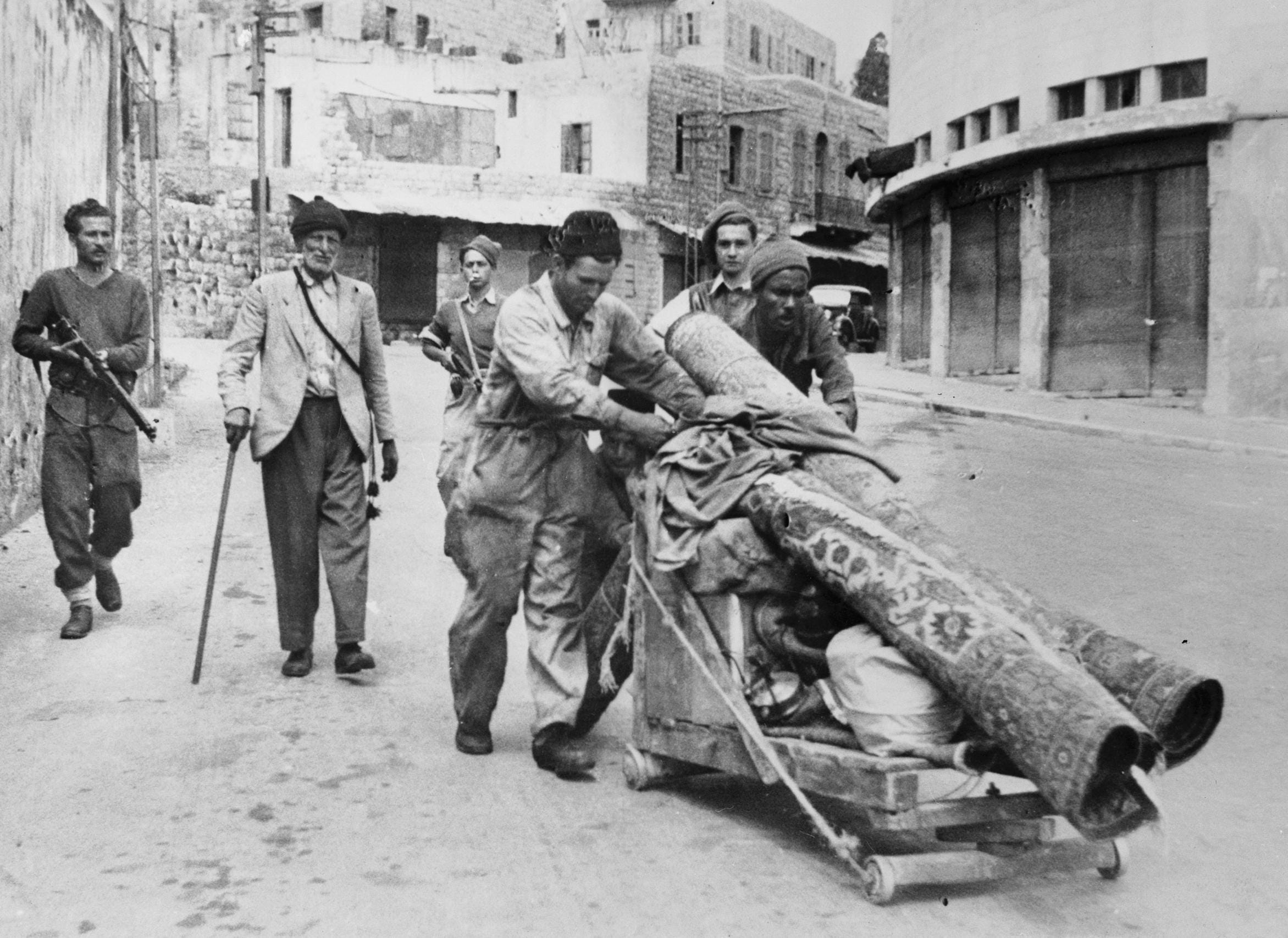
A lie can be corrected. Present the evidence, demonstrate the error, and the lie loses its power. A libel is more durable because it does not depend on falsehood alone; it depends on the transformation of partial truth into totalizing moral indictment. This is what makes the Nakba narrative so effective and so difficult to counter.
The central libel is the claim of ethnic cleansing: that the modern State of Israel was founded through the deliberate, systematic expulsion of an indigenous population.
There is a kernel of fact onto which the libel attaches: The refugees were real. But the libel performs a series of moves that transform that fact into something categorically different. It erases the initiating context (the Arab rejection of partition and the declaration of war). It erases Arab agency in the departure of civilians. It imports the moral vocabulary of “settler colonialism” to describe a movement of Jewish national return.
And it moves from the particular, specific displacements in specific villages, to the universal: Zionism as an inherently eliminationist project, and Zionists, everywhere and always, as legitimate targets of resistance.
This last move is the most consequential. Consider the logic of the deicide charge as an analog. Its historical persistence rested on a kernel of fact: Judas, a Jew, betrayed Jesus. The libel’s power lay in its move from the particular (one man’s act) to the universal (collective Jewish guilt), which then authorized centuries of persecution.
The Nakba narrative performs the same operation: from the particular suffering of 1948 to the universal guilt of every Zionist, everywhere, forever. It is this universalization that explains why the slogan “From the River to the Sea” functions as a statement about all of Israel, not merely its policies, and why Israelis murdered, raped, and kidnapped on October 7th could be celebrated, excused, or simply ignored by people who consider themselves advocates for human rights.
Precisely for this reason, “anti-Zionism” has been able to thrive at the UN, today’s church that is ostensibly charged with safeguarding universal human rights.
By the time October 7th occurred, two decades of campus organizing, UN programming, and cultural production had prepared the ground. Indeed, as early as 2003, an application form for volunteers at San Francisco Women Against Rape asked applicants to participate in “political education discussions” that included “protesting the war and supporting Palestinian liberation and taking a stance against Zionism.” The executive director avowed that “Zionism is racism,” repeating the Soviet “anti-Zionist” formulation word for word.
Much of the world did not turn its back on Israelis murdered, raped, and kidnapped because Palestinian Arab voices were absent from public discourse. They turned their backs precisely because the Palestinian Arab voices that had been carefully amplified and institutionalized had spent two decades establishing that Zionists were cosmic villains, illegitimate, colonial, and unworthy of the ordinary protections of human sympathy.
There is a second dimension of the libel that receives less attention: its consequences for Palestinian Arabs themselves. A national origin story rooted primarily in grievance, resentment, and the permanent vilification of another people does not only demonize its target; it immiserates its own adherents by leaving no conceptual space for forward motion.
Comparative literature illuminates this point. Jewish historical memory is suffused with catastrophe, and Jewish writing is full of expressions of loss and displacement. Consider Psalm 137: “By the rivers of Babylon, there we sat, yea, when we remembered Zion.” Yet even this, one of the most achingly mournful texts in the tradition, is a memory of rupture that implies the possibility of return.
And alongside the lachrymose tradition runs another equally persistent impulse: the drive to build. Wherever Jews settled in exile, they did not only mourn what was lost; they worked to create anew. This ethos is especially pronounced in early Zionist literature. In “How to Break a Heatwave,” a song by Naomi Shemer, the landscape is initially harsh and unyielding, a hill of dust, sun, and thorns, but the pioneers respond not with despair but with ingenuity, draining swamps, laying pipes, planting trees. The catastrophe of exile is real; the response is generative.
One might argue that such optimism was easier to sustain in the context of return to an ancestral land rather than exile from it. But a similar orientation appears elsewhere in Jewish writing.
Isaac Babel offers a still more telling example, because his experience of alienation was not chosen but imposed. A Russian-Jewish writer who lived through violent pogroms, Babel could have constructed his work as an extended indictment of Russian society. He did not.
His early story “At Grandmother’s” (1915) explores the process of seeking acceptance within a culture that is hostile. Rather than reducing Russia to its violence, Babel gestures toward rapprochement, expressed through an enduring attachment to Russian literature and culture. The grandmother’s imperative “Study! Study and you can have everything,” is not a call to defy Russian society but to master its cultural world, to do whatever is necessary to endure and succeed within difficult conditions. This orientation is not naïve; it is a strategic relationship to history that allows for a future.
This orientation is largely absent from the Palestinian Arab literary tradition as it has been institutionalized. Anton Shammas’s “Arabesques” (1986), written in Hebrew, is often celebrated as a gesture toward integration. But Shammas himself clarified that his purpose was something different: “What I’m trying to do is to un-Jew the Hebrew language, to make it more Israeli and less Jewish.”
The distinction is subtle but significant. The act is not one of entering into a shared cultural space, as Babel entered Russian literature, but of attempting to redefine that space by stripping it of its Jewish particularity.
Hebrew, here, is not embraced as the historical language of a people; it is reconfigured as a neutral medium that can be detached from Jewish identity. This reflects a broader pattern in which the point of contest is not Israeli policy or the specific terms of a political settlement, but the legitimacy of Israel as a Jewish state.
And then there is Mahmoud Darwish, designated “the national poet of Palestine,” who wrote “Intifada,” a poem that frames suicide terrorism as martyrdom. How can there be a negotiated future when the canonical literary expression of Palestinian nationhood glorifies violence against civilians as its highest moral act?
This is not a question about whether Palestinian Arabs deserve a state or whether their suffering is real. It is a question about what happens to a people when their national identity is anchored in permanent resistance rather than in the possibility of building something new.
The problem is that we are not living in a moment of critical distance from the “anti-Zionist” era. We are living in it. And inside an ideological moment, “acknowledgment” is never neutral. Every institutional acknowledgment of the Nakba narrative as a legitimate perspective rather than as a libel to be analyzed extends the libel’s reach. It signals to students, to journalists, to policymakers, that the “apartheid” charge and the “ethnic cleansing” claim are starting points for debate rather than the conclusions of a demonization project.
Holocaust remembrance offers a useful contrast. That tradition, even at its most expansive, maintains clear moral distinctions. It condemns the Nazi regime without essentializing the German people as a whole. At Israel’s official memorial for the Holocaust, Yad Vashem, a section established in 1962 titled the “Avenue of the Righteous Among the Nations” honors non-Jews who risked their lives to save Jews, institutionalizing the principle that evil is particular, not collective.
The Nakba narrative, as it functions in “anti-Zionist” discourse, does the opposite: It reduces all Israelis to illegitimate usurpers and all Palestinian Arabs to entirely passive victims, erasing individual agency and making it impossible to imagine a future not wholly defined by the past.
To ask Jewish educators to “acknowledge” the “apartheid” charge without first naming it as a libel is to ask them to participate in their own community’s demonization and delegitimization. It is the equivalent of asking Jewish educators in the 1930s to acknowledge the sincerity of Nazi racial science before critiquing it. The sincerity of a belief does not determine its moral status for libels are often sincerely held.
Much of the world turned its back and will continue to turn its back on the murdered, raped, and kidnapped Israelis of October 7th because decades of institutional, cultural, and educational work had prepared it to do so. The Nakba narrative was the engine of that preparation. It transformed a genuine historical grievance into a libel; it replaced the possibility of coexistence with the imperative of permanent resistance; and it left Palestinian Arabs themselves captive to a worldview that defines them primarily by opposition to another people’s existence.
One can certainly feel compassion for a people held captive by propagandists who weaponize their pain. But there is another people, Israelis and Jews around the world, who are demonized, delegitimized, and, at times, killed in the name of “anti-Zionism.” Individuals like Yaron Lischinsky and Sarah Milgrim, Zvi Kogan, Melvin Cravitz, Adrian Daulby, and Paul Kessler, as well as the 15 Jews gunned down last December on Australia’s Bondi Beach, are targeted by an ideology that reduces them to symbols, symbols of colonialism, “white” supremacy, racism, and “apartheid.”
Naming that ideology clearly, refusing to dignify its central libel as a perspective worth acknowledging on its own terms, is not a failure of empathy. It is the precondition for any honest reckoning with what has happened.
“Antisemitic violence worldwide in 2025 killed highest number of Jews in 30 years, study finds.” CNN.
“50 Years of Anti-Zionist Propaganda: Why the UN’s ‘Committee on the Exercise of the Inalienable Rights of the Palestinian People’ Must Be Dismantled.” Foundation for Defense of Democracies.

The Nakba itself is a lie. The tragedy for the Arabs was that they couldn’t destroy the nascent Jewish state and murder its inhabitants. The reality is that, if the Arabs were victorious in 1948, these “Palestinians” would be perfectly happy being Egyptians or Syrians or Jordanians. The goal, as it has been since 1948, is not to build a country but destroy one. The West doesn’t understand this or care if it does.
And, all those Western countries calling for a Palestinian state are foolish to think such a state will be anything but a theocracy or autocracy just like every other Arab country in the Middle East. A Palestinian state will be aligned with Iran, Turkey, China, Russia and against the U.S. and Europe. The West is demanding the creation of an inherently anti-Western country.
If Israel and her allies learn nothing else from October 7th they should learn to far more aggressively combat the propaganda and gaslighting that is ubiquitous in the Arab world and that has now infiltrated western institutions.