


Please consider supporting our mission to help everyone better understand and become smarter about the Jewish world. A gift of any amount helps keep our platform free of advertising and accessible to all.
This is a guest essay by Vanessa Berg, who writes about Judaism and Israel.
You can also listen to the podcast version of this essay on Apple Podcasts, YouTube Music, YouTube, and Spotify.
There is a lazy explanation that people repeat: Israel just “can’t qualify” for the World Cup.
That’s technically true in the same way saying a fighter “lost because he got knocked out” is true. It describes the outcome, not the system that produced it.
The real story is more uncomfortable — and far more revealing about how international sport actually works when politics enters the pitch. Fittingly, our story starts with Iran.
Iranian football’s rise in the 1950s and 1960s tracked closely with Iran’s broader modernization under the Shah. In the 1950s, the national team was still inconsistent and regionally minor, but its participation in early Asian competitions marked a shift: Sport was becoming part of how Iran presented itself internationally, even before it had the infrastructure or consistency of a footballing power.
By the early 1960s, results improved enough to make football politically visible. Wins and losses against regional rivals like Iraq, India, and Pakistan began attracting attention from top political leadership, including direct criticism when results disappointed. By the mid-1960s, football had overtaken wrestling as Iran’s most popular sport.
Iran–Israel relations at this stage were structurally contradictory. Officially, there were no formal diplomatic ties, and Tehran carefully avoided open recognition. But practically, relations were extensive: intelligence cooperation, oil exports, trade, airline routes, and technical exchanges all continued. Israel maintained a presence in Tehran, while Iran simultaneously aligned itself (at least rhetorically) with Arab positions in international forums, especially at the United Nations.
This dual-track relationship created a political tension that would eventually spill into sport. After the 1967 Six-Day War, public sentiment inside Iran shifted more strongly in favor of Arab and Palestinian positions. Anti-Israel rhetoric increased in the press and public discourse, while the state attempted to balance domestic opinion with its quiet strategic ties to Israel. Football, now a mass national obsession, became one of the few arenas where this contradiction could surface indirectly.
That contradiction became visible in the 1968 Asian Cup in Tehran, where Iran and Israel met in a final that carried meaning far beyond sport. The match unfolded in a climate shaped by post-1967 regional anger, Iranian public sympathy for Arabs, and growing discomfort with the Shah’s perceived closeness to Israel.
Although Iran and Israel still cooperated behind the scenes, the public atmosphere had shifted. The match was accompanied by nationalist and anti-Israel expressions in the stands, and afterward violence targeted parts of Iran’s Jewish community. The key shift wasn’t just the game itself, but the realization that football had become a container for political identity conflict inside Iran—not just a sporting rivalry.
That event also triggered a longer-term effect: growing insecurity among Iranian Jews and the beginning of more visible emigration pressures, even as official Iran–Israel cooperation continued.
In the years that followed, Iranian football entered its “golden age,” winning multiple Asian Cups and failing to qualify for early World Cups. This culminated in Iran’s decision to host the 1974 Asian Games in Tehran, an elaborate showcase designed to project an image of a modern, outward-looking, and increasingly influential state under Shah Mohammad Reza Pahlavi.
As one of the Shah’s key regional partners at the time, Israel was invited to take part in the competition. Four years earlier, the then-22-year-old Jewish state qualified for the World Cup held in Mexico (as part of the Asian Football Confederation), Israel’s first and only participation in the global football event.
But the 1974 Games also exposed how far sport had become politicized in Asia. The Arab–Israeli conflict increasingly shaped sporting participation, and Israel’s presence in Asian sport was already under pressure from boycotts and diplomatic opposition. During the Games, multiple delegations refused to compete against Israeli athletes across different sports, turning the event into a stage for coordinated political protest rather than unified competition.
In football, Israel entered the tournament regarded as one of the stronger teams in contention for the gold medal, a view also held by Iran’s manager Frank O’Farrell. Yet its path to the final was unusual: It advanced in part because both North Korea and Kuwait declined to face it for political reasons. As one Egyptian journalist based in Kuwait put it to his Israeli counterpart:
“I can only drink coffee with you, but playing football — we can’t. We have instructions, there is a government, we took a decision not to appear against Israel. It’s forbidden, it’s forbidden.”1
For Israel, this was a turning point: Even when it was physically present in Asian sport, it was being systematically excluded from competition itself. For Iran, it revealed a contradiction the regime could no longer fully control — hosting Israel in Tehran while simultaneously operating in an Asian sporting environment where boycott politics were becoming the norm.
By the time the football tournament reached its final stage, Iran and Israel again found themselves positioned toward a confrontation that was no longer accidental. Reports and decisions around scheduling, refereeing assignments, and group placements created a perception that Iran’s sporting establishment was not neutral. The symbolism of Iran as host, Israel as participant, and the wider Arab political context made the final feel predetermined in its meaning even before kickoff.
“Iranian Jews extended their hospitality to us, presented us with gifts, and even encouraged us throughout the tournament,” said Shiyeh Feigenboym, who played for the Israeli football national team. “However, prior to the final, they notified us they couldn’t attend. They marked Jewish houses, and consequently, they were absent from the final.”2
The 1974 final thus became the climax of a long escalation: from Iran’s modernization and football’s rise, to Iran–Israel covert cooperation, to post-1967 political polarization, to the 1968 rupture, and finally to the Asian Games where sport itself had become a proxy arena for regional alignment.
Players and journalists described the Iran–Israel final not as a game, but as an environment saturated with political meaning.
“Five minutes into the game, Shalom Schwarz made a break on the left side and passed me the ball about 20 meters from the goal. I took a powerful shot, and the ball hit the crossbar,” Feigenboym recounted. “Ultimately, we lost 1 to 0 due to an own goal by Yitzhak Shum. After the game, the players told me: ‘Listen, if your shot had gone in at the start, they would have lynched us.’ That was the prevailing sentiment.”
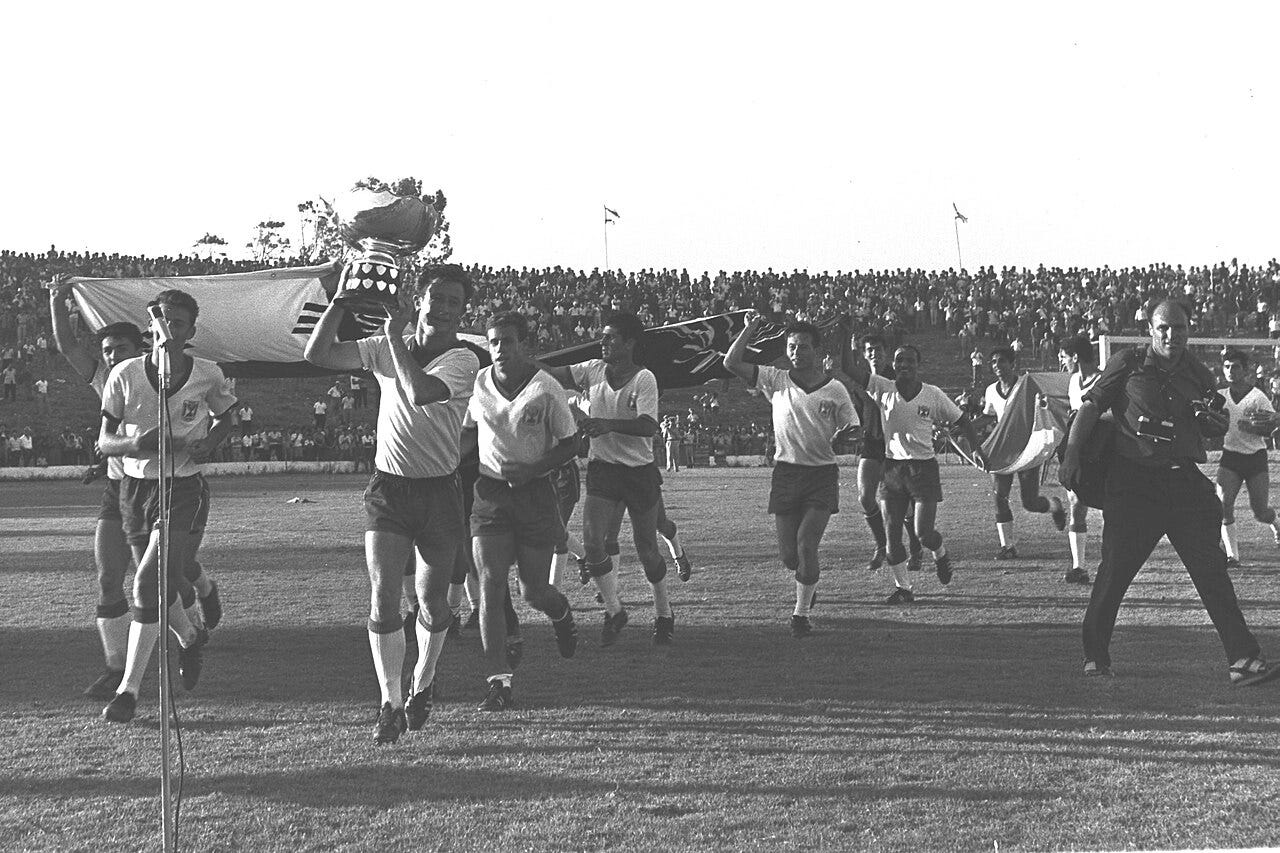
Two weeks later, on September 14, 1974, just as the Asian Games were drawing to a close, the Asian Football Confederation expelled Israeli football. The move barred Israel from participating in official Asian Football Confederation competitions and prevented it from hosting matches under the organization’s framework, including the cancellation of the Asian Nations Cup qualifiers scheduled to be held in Israel in 1975.
This followed a familiar trend for much of the post-1948 period, after Israel humiliated the five attacking Arab armies in its War of Independence that year. Many Arab and Muslim states refused to recognize Israel diplomatically, which set the baseline for its regional isolation. This translated into a broader Arab League boycott that restricted trade and investment ties, including secondary and tertiary pressure on companies doing business with Israel.
In parallel, Israel was largely shut out of regional frameworks — economic, transport, cultural, and academic — because participation in such systems depended on political recognition that most states withheld.
Israel was eventually placed into the Union of European Football Associations (UEFA) in the 1990s. This is often misunderstood as geography. It isn’t. It’s governance. FIFA’s confederations are not continents. They are administrative ecosystems designed to ensure predictable fixtures, functioning qualification cycles, and politically survivable competition structures.
Israel moved not because Europe was “closer,” but because Europe was stable enough to host its participation without constant breakdowns. That solution came with a hidden cost that is almost never stated clearly.
Once Israel entered UEFA, it didn’t just change opponents. It changed probability. In UEFA World Cup qualifying, Israel now competes in the densest concentration of elite national teams on earth: France, Spain, Germany, England, Italy, Portugal, the Netherlands, Croatia, and Belgium. And underneath them, there is a second tier of nations that would be dominant across any other confederation.
In most regions, a team can build a qualification path through lower-ranked opponents, regional balance, and occasional upsets. In Europe, there is no stable “lower tier” to rely on. Every group is a knife fight. A single bad window can end everything.
So when people ask why Israel isn’t in the World Cup, they are often asking the wrong question. The real question is: Why did Israel’s route get placed in the most competitive system in the sport?
International football is built on a contradiction: It treats national identity as fixed (you represent your country), but treats it competition structure as adjustable (you play where governance allows). So outcomes are not just about talent; they are about placement. And placement is history.
Hence why Israeli football is good all things considered (it is the most popular sport in Israel), yet countries like Iraq, Qatar, Jordan, Cabo Verde, Côte d’Ivoire, and Haiti qualify for the World Cup while the Jewish state does not.
Israel moving from the Asian Football Confederation to the Union of European Football Associations solved one problem, but it created another: Israel’s seemingly forever absence in the World Cup.
One could make the argument that this is effectively a boycott without the formal declaration.
Interview with Machnes; Maariv, September 8, 1974.
“When Israel last faced Iran on Soccer field.” Ynet News.
Interesting history. Here we are 56 years later and some nations and athletes still refuse to compete against Israel or Israelis.
Israel should just say fuck you, Donald Trump and go ahead and do everything to destroy. I ran I believe it has the military power and the intelligence to do it so the world will condemn Israel if they do big fucking deal the world already condemned Israel.