


Please consider supporting our mission to help everyone better understand and become smarter about the Jewish world. A gift of any amount helps keep our platform free of advertising and accessible to all.
This is a guest essay by Lieutenant Colonel Ariella Mazor, the IDF’s International Spokesperson.
You can also listen to the podcast version of this essay on Apple Podcasts, YouTube Music, YouTube, and Spotify.
Since Hamas’ brutal massacre of Israeli civilians on October 7, 2023, every new report on Gaza’s humanitarian situation has quickly become a political battleground. Headlines show a single conclusion, governments cite whichever finding supports their narrative, and social media compresses complex data into accusations against Israel. The latest Integrated Food Security Phase Classification report is no exception.
The report, assessing food security in Gaza following the October 2025 ceasefire, presents a more nuanced picture than many of the headlines it generated. It acknowledges that expanded humanitarian assistance has significantly improved food security and nutrition across Gaza while warning that those gains remain fragile, and could quickly be reversed if humanitarian operations are disrupted.
The central disagreement is not over whether Gaza continues to face humanitarian challenges. It is whether the Integrated Food Security Phase Classification’s report accurately explains why those challenges persist and whether it reflects the full body of available evidence.
Israel’s Coordinator of Government Activities in the Territories, the IDF body responsible for coordinating humanitarian assistance into Gaza, recently published its own assessment using data from the United Nations, international organizations, the Civil-Military Coordination Center, and other verified sources. Its findings paint a markedly different picture from the Integrated Food Security Phase Classification report of humanitarian conditions in Gaza since the ceasefire.
Since October 2025, approximately 1.8 million tons of food have entered Gaza — nearly three times the amount the World Food Programme identifies as necessary. The increased volume and variety of food have significantly improved market availability and contributed to an estimated 72 percent decline in food prices.
The humanitarian effort extends well beyond food. More than 70,000 cubic meters of water are supplied to Gaza every day, exceeding international humanitarian standards, while Israel continues to facilitate infrastructure repairs, sanitation projects, waste collection, and other initiatives alongside international organizations.
Healthcare has also expanded considerably. Since the ceasefire, more than 18,000 tons of medicines and medical supplies have entered Gaza, the number of functioning hospitals and medical facilities has increased significantly, and hospital bed capacity has grown by more than 50 percent.
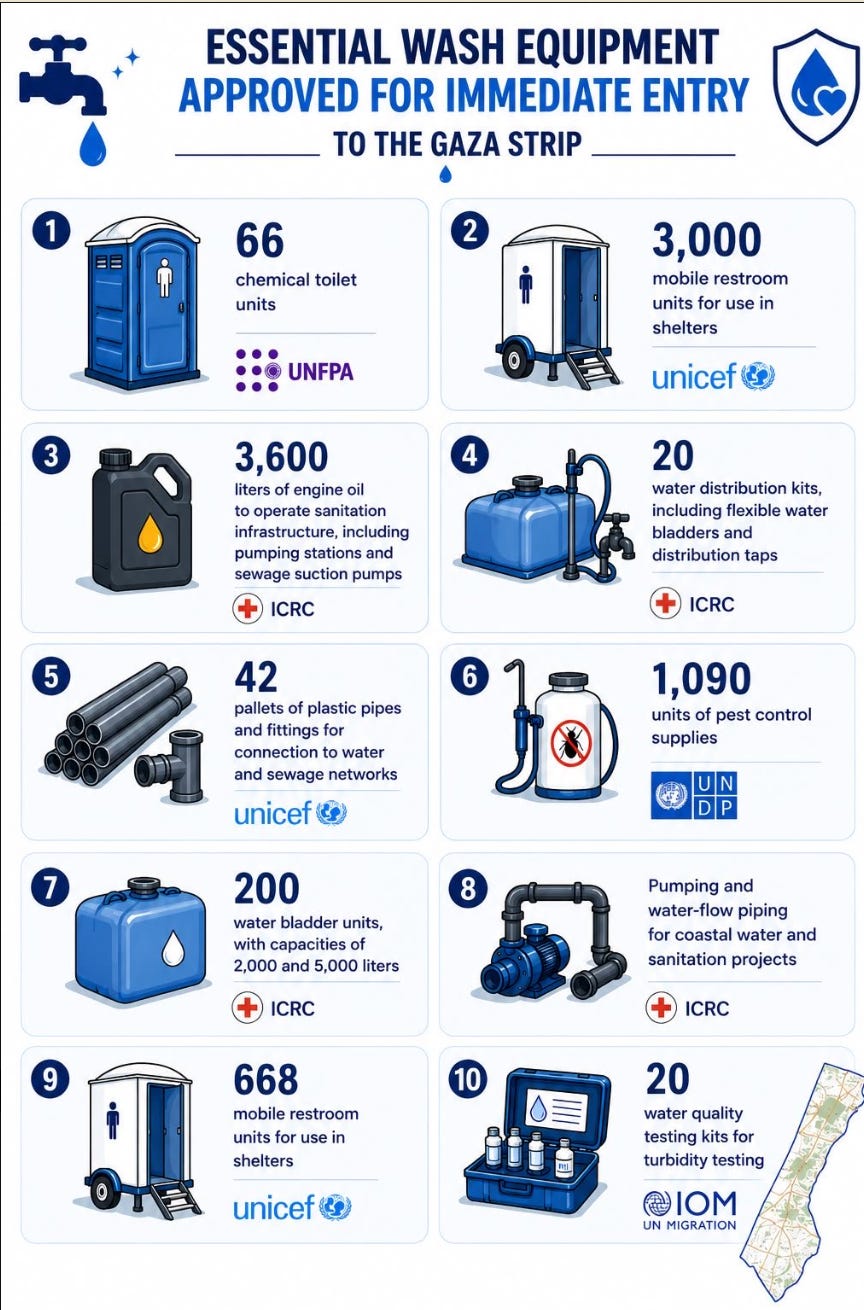
None of these figures suggest Gaza’s humanitarian challenges have disappeared. But the Integrated Food Security Phase Classification report falls short in two important respects.
First, it was completed without consultation with the IDF and Israeli authorities despite our months of coordination over humanitarian operations and despite extensive operational data being made available throughout the assessment process. A comprehensive assessment cannot claim to present the full humanitarian picture while excluding one of the principal bodies responsible for coordinating the humanitarian effort it seeks to evaluate.
Second, and more significantly, the report consistently emphasizes Israeli military operations, humanitarian policies, and safety precautions as reasons for Gaza’s ongoing problems, while giving comparatively little to no analytical weight to Hamas’ own conduct.
Food security depends on far more than the amount of aid crossing the border. It also depends on whether humanitarian organizations can distribute that aid safely, whether warehouses remain secure, whether truck drivers can operate without intimidation, and whether assistance reaches civilians without theft or diversion.
These are not hypothetical concerns. On July 12th, United Nations Deputy Special Coordinator for the Middle East Peace Process Dr. Ramiz Alakbarov condemned the obstruction of humanitarian operations by “Gaza’s de facto authorities (Hamas),” describing armed personnel entering food distribution centers and World Food Programme warehouses, assaulting truck drivers, intimidating humanitarian workers, and creating “an increasingly dangerous pattern of intimidation, violence and obstruction” that disrupted life-saving assistance.
Yet Hamas’ theft of aid, interference with humanitarian distribution, intimidation of aid workers, and continued exploitation of civilian infrastructure receive little attention in the Integrated Food Security Phase Classification’s explanation of why humanitarian conditions remain fragile.
Instead, the report repeatedly identifies Israeli actions as the principal drivers while treating Hamas largely as a background condition rather than an active participant shaping humanitarian outcomes.
No amount of aid can guarantee food security if humanitarian organizations are obstructed, supplies are diverted, or aid workers are threatened. These realities are not peripheral to Gaza’s humanitarian situation; they are central to understanding it.
Humanitarian assessments influence international policy, donor decisions, media coverage, and public opinion. Their conclusions carry enormous weight. That is precisely why they must incorporate all relevant evidence, acknowledge the progress that has been made, and account for every major actor shaping conditions on the ground.
That is where the latest Integrated Food Security Phase Classification report falls short.
The problems stem from the inborn hate for Jews and Israel that have been shown by most all of the media, including CBC, Toronto Star, and most news writers who love to put Israel down as they used Israeli technology to carry our their hateful and erroneous lies. The UN is still respected by some yet this unnecessary organization has done absolutely nothing to improved life on the planets while most of the chairs of the various parts of the UN take home 6 and 7 figure salaries. Money that should be spent on providing better health care, eliminating terrorism, and being decent human beings! Almost every year I get messages asking me to purchase UNICEF Christmas cards, so I play "dumb" and ask the volunteer about this organization. Shortly after Oct. 7, 23, I got the call so I asked which children on the planet would receive anything from the organization, and it was a repeat answer which I have received since 1980's when I was still teaching.
"We provide food, medical care for children in every country on the planet". And when I specifically said "Israel", the person on the end of the phone replied, "I will have to look into that". Well, I never get a return call, and I know the answer. Sorry, UN, International Red Cross, Doctors Without Borders, World Vision, etc., etc., etc. You are all anti-Jewish, Israel, and your ignorance is contagious! If you think Hamas, Hezbollah, IRGC, Qatar are so wonderful, along with Putin's Russia, YOU ARE THE ENEMY! The Israeli Government has fed Gazans for many years, and their only thanks they received was rockets into civilian homes. Those who were attacked, massacred, and taken hostage tried to befriend Gazans and October 7th was the thanks they received. Check out some of the videos taken live in Gaza where the markets are filled with fresh produce, children eating ice cream while Dad is checking out his new smart phone. I suggest Israel stop all truck loads of food and medical supplies, and take care only of their own in the LEGAL STATE OF ISRAEL! Am Yisrael Chai!
Antisemitic Narratives are being controlled by Nazi Elements in the international Humanitarian organisations. These organisations have been well infiltrated by such groups, as has the UN, and some of The Media too. Often they are the same people. Hamas was and is protected and armed by Nazis, often associated with Elements of the Services in The West, and we have monitored just such. Our Reports are with you.