


Please consider supporting our mission to help everyone better understand and become smarter about the Jewish world. A gift of any amount helps keep our platform free of advertising and accessible to all.
This is a guest essay by Rabbi Steven Abraham, the rabbi at Beth El Synagogue in Omaha, Nebraska.
You can also listen to the podcast version of this essay on Apple Podcasts, YouTube Music, YouTube, and Spotify.
Nearly one year ago, the Jewish Federations of North America released findings from its March 2025 survey on American Jewish life and Zionism.
We are now in February 2026, with enough distance from both October 7th and the survey itself to ask not merely what the numbers revealed, but what they have become.
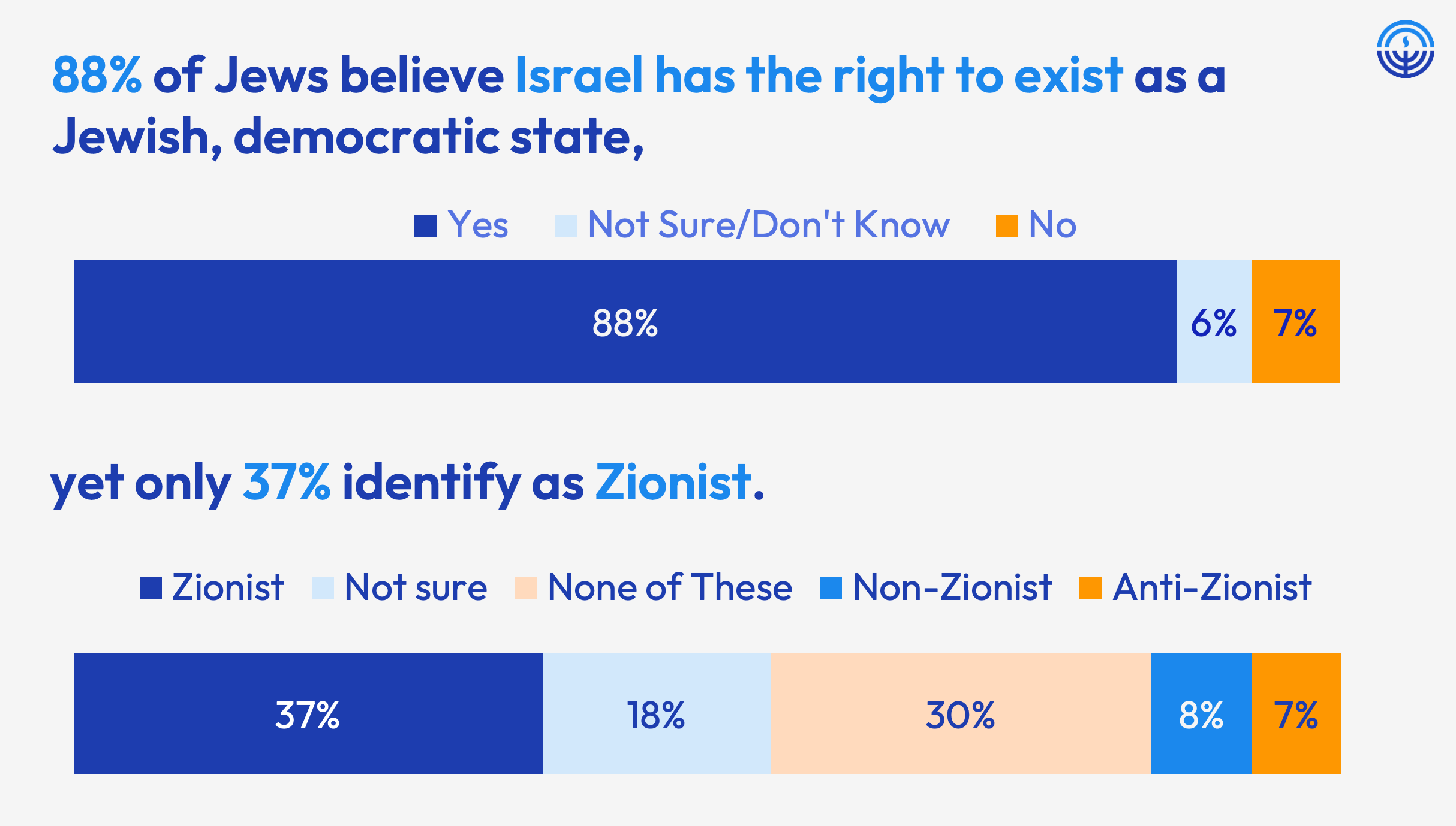
One finding in particular refuses to fade: According to the survey, 88 percent of American Jews believe that Israel has the right to exist as a Jewish, democratic state, yet only 37 percent identify as Zionist.
That gap is not a rounding error. It is not statistical noise. It is a theological fracture.
Nearly nine out of 10 Jews affirm the classical definition of Zionism: the right of the Jewish People to have a Jewish state. And yet barely more than a third are willing to claim the word.
Why?
The fact that this data is now a year old only sharpens the question. If this were a momentary hesitation in the immediate aftermath of October 7th, one might attribute it to shock, confusion, or semantic drift. But 12 months later, the gap appears structural. Something has settled.
What are we witnessing?
Let us begin with what the data makes clear: American Jews overwhelmingly affirm Israel’s legitimacy as a Jewish state. This is not a fringe position. It is a communal baseline.
And yet the label “Zionist” has become unstable.
This is not the first time in Jewish history that Jews have believed something deeply while hesitating to name it. The Torah itself is attentive to the moral power of naming. Avram becomes Avraham. Yaakov becomes Yisrael, which means “to wrestle with God,” after he wrestled with a divine messenger at the Jabbok River, symbolizing his spiritual transformation from a deceiver to one who relies on God.
In Judaism, a name is not a mere descriptor; it is a destiny claim. To accept a name is to accept its implications.
In the modern period, Zionism was originally a descriptive term for a political aspiration: Jewish self-determination in the ancestral homeland. It did not imply agreement with any specific government, policy, or ideology. It did not require messianic maximalism or partisan loyalty. It meant that Jews, like other peoples, had a right to sovereignty.
That 88 percent of American Jews affirm this right suggests that the core idea remains intact. But only 37 percent identifying as Zionist tells us something else: The word itself has become morally contested.
The question is not whether Jews believe in Jewish self-determination. The question is whether they are willing to publicly inhabit the name.
The survey offers a clue: Jews who do not identify as Zionist often associate Zionism with beliefs beyond its classical definition — such as Jewish superiority, unconditional support for whatever actions Israel takes, denial of Palestinian nationhood, or permanent control over disputed territories.
In other words, the term has been redefined in public discourse. If Zionism is presented not as Jewish self-determination but as ethno-supremacy or uncritical nationalism, then distancing from the label becomes morally understandable — even if one continues to affirm Israel’s right to exist.
Language is not neutral. It is a battlefield.
Jewish tradition has long understood this. The Talmud debates not only laws but definitions. Precision in language protects precision in thought. When a term is inflated or distorted, moral clarity erodes.
The data suggests that Zionism, as a word, has drifted from its classical meaning in the American Jewish imagination. Many Jews believe in the substance but hesitate before the symbol. This is not merely semantic. It reflects a deeper discomfort with Jewish particularism in a universalist age.
For decades, American Jewish identity has been framed primarily through universal ethics — justice, inclusion, human rights. These are not alien to Judaism; they are central to it. The prophets thundered against oppression long before modern liberalism gave those instincts institutional form. But prophetic universalism is rooted in covenantal particularism. The prophets speak as members of a people bound to a land, a language, and a shared destiny.
Zionism, at its core, is the modern political expression of that particularism.
If 88 percent of Jews affirm Israel’s right to exist as a Jewish state , then the covenantal intuition remains strong. But the reluctance to claim the word “Zionist” suggests discomfort with overtly embracing Jewish national identity in a cultural environment suspicious of nationalism.
It is easier, perhaps, to believe quietly than identify publicly. But Jewish history teaches that names matter. Yaakov wrestles and emerges as Yisrael — “for you have struggled with God and with men and prevailed.” To be Yisrael is to struggle and still claim the name.
So, what does it mean that a majority of Jews affirm the idea but hesitate to claim the name?
One explanation is sociological: “Zionist” has become socially costly in certain environments, particularly on campuses and in progressive spaces. The survey notes that anti-Zionism is highest among 18–to–34-year-olds. (Fourteen percent identify as anti-Zionist.) Even where anti-Zionism remains a minority position, the cultural pressure to distance oneself from nationalist labels is real.
Naming oneself a Zionist may feel like stepping into controversy, but theologically, this raises a deeper issue. Jewish particularism has always carried social cost: to keep Shabbat in a seven-day economy, to eat differently, to refuse assimilation, to insist that Jewish memory and destiny matter. Zionism is not an innovation in Jewish history. It is an iteration of an ancient pattern: Jews claiming that their collective existence is not accidental. If we affirm that Israel has the right to exist as a Jewish state, then we affirm that Jewish collective existence has political expression.
The reluctance to claim the name may reflect not disagreement with the principle but anxiety about the cultural implications.
The survey also reveals that 48 percent of Jews choose “none of these” or decline to identify with any Zionist label. This is not a radical minority; it is a vast middle. We may be witnessing not ideological extremism but label exhaustion. In an era of polarization, many Jews may resist binary categories. “Zionist” and “anti-Zionist” can feel like totalizing identities, flattening complexity into slogans.
Yet Judaism has always allowed for complexity within commitment. One could be a fierce critic of the monarchy and still affirm Israel’s covenant. One could rebuke kings and still pray for Jerusalem. To identify as Zionist need not mean endorsing every policy of the Israeli government. It means affirming the legitimacy of Jewish self-determination.
Perhaps the task ahead is not to coerce identification but to clarify definition. If 88 percent of Jews believe Israel has the right to exist as a Jewish, democratic state, then the theological foundation of Zionism is widely shared. The gap lies in trust — trust that the word has not been irreversibly corrupted.
Because we are now a year removed from the survey’s publication and nearly two and a half years removed from October 7th, so we must ask whether this identity gap is deepening or stabilizing. October 7th intensified emotional attachment to Israel. Seventy-one percent of Jews reported feeling emotionally attached to Israel, up significantly from prior years. Crisis clarified peoplehood.
But crisis identity is not the same as covenant identity. Crisis produces solidarity through threat. Covenant produces solidarity through meaning. If the reluctance to claim the word “Zionist” persists, it may signal that while Jews feel attachment to Israel, they have not fully integrated a confident theology of Jewish nationhood into their moral self-understanding. That is not a public relations problem. It is an educational and theological one.
The task for rabbis and Jewish educators is not to scold the 63 percent who decline the label. It is to recover its clarity. Zionism, stripped of caricature, is the assertion that Jews are not merely a religion but a people — and that peoples have a right to self-determination. It does not demand policy uniformity. It does not preclude critique. It does not negate geopolitics. It asserts that Jewish sovereignty is morally legitimate.
In a world suspicious of nationalism, this claim feels fraught. But Judaism has never been purely universalist. It binds ethics to a people, law to a land, and memory to geography. The courage to say the word may require disentangling it from maximalism and reclaiming it as covenantal realism. The Torah’s attention to names is instructive: To refuse a name is sometimes prudence, but to reclaim a name is often destiny.
If 88 percent of Jews believe in Israel’s right to exist as a Jewish state, then the core of Zionism is already embraced. The hesitation lies in public articulation. Perhaps the deeper question is not whether Jews are Zionist, but whether they are willing to inhabit Jewish particularism without apology.
In February 2026, with the immediacy of October 7th behind us and the survey’s findings no longer fresh, we can see that this gap is not fleeting. It is reflective of an American Jewish community negotiating its relationship to power, nationalism, and moral identity. The challenge is not to manufacture consensus. It is to cultivate clarity. Belief without naming is unstable. Naming without belief is hollow.
If we believe that the Jewish people have a right to political self-expression in their ancestral homeland, then we owe ourselves an honest conversation about why the word that names that belief feels so heavy. Jewish history has rarely afforded us the luxury of anonymous conviction.
At some point, belief demands a name. And names, in Jewish tradition, shape destiny.

What the author identifies is what another author calls “Semanticide”, the murder of language. Jews, and especially Israel have watched semanticide slaughter terminology to their detriment for ages but most significantly since October 7.
Terms like “genocide” and “famine” have been warped into unrecognizable definitions in order to delegitimize Israel and paint targets on Jews.
That Jews themselves have fallen into this slanderous activity and for reasons suggested above, will not identify as Zionists, should come as no surprise. Jews suffer under the same miseducation as non-Jews and also lack any serious Jewish identity. The internet’s speed and ability to saturate the information highway has accelerated this trend. And face it, we will never out shout our enemies.
We must start reclaiming Jewish souls! A person who knows not of who they are and where they have been is not choosing AGAINST Zionism. A choice requires knowing one’s options. Rather they are riding the misinformation flow of our hateful enemies. Funding Jewish education, supporting Jewish learning at all levels. In essence suturing the wound of assimilation and proactively healing that wound is the only solution. There are working models, e.g. birthright, Chabad, but we must start younger with affordable Jewish day schools. Let’s hope we can stop the bleed soon or the future of US Jewry and the U.S.-Israel bond will face terminal consequences.
I love when I tell a fellow Jew that I’m a Zionist—and typically I get a response in one form or another criticizing the Israeli government/Netanyahu. The ignorance and/or cowardice is remarkable.