


Please consider supporting our mission to help everyone better understand and become smarter about the Jewish world. A gift of any amount helps keep our platform free of advertising and accessible to all.
This is a guest essay by Vanessa Berg, who writes about Judaism and Israel.
You can also listen to the podcast version of this essay on Apple Podcasts, YouTube Music, YouTube, and Spotify.
Last Thursday evening, October 29th, something beautiful happened in Los Angeles.
Omer Adam, one of Israel’s biggest musical stars — who I like to call “the Justin Timberlake of Israel” — performed in front of 18,000 Jews at the Intuit Dome, bringing a distinctly Israeli soundtrack to one of America’s most famous cities.
Thousands of miles from Israel, Hebrew took center stage, accompanied by the unmistakable rhythms and melodies of modern Israeli music. Omer spoke in both Hebrew and English throughout the concert, his thick Israeli accent adding to the charm.
At one point, he asked the crowd, “How many people here don’t speak Hebrew?” The crowd cheered. “And how many people do speak Hebrew?” The cheers grew even louder. “Az lo tzarich lishbor et hashinayim,” he responded. Literally translated, that means, “So I don’t need to break my teeth,” a wonderfully Israeli expression for struggling to speak a foreign language.
There was something both hilarious and heartwarming about the exchange. Here was an Israeli singer, performing in one of America’s premier concert venues, thousands of miles from home, discovering that he didn’t need to change his language, hide his accent, or translate himself for everyone to feel included. For a few hours, Hebrew wasn’t a foreign language in Los Angeles. It was the language of the evening. And whether you understood every word or not, you belonged.
On the surface, it was a concert. But there is something much bigger, and much more moving, about an Israeli singer performing in a major American arena, especially at this moment in Jewish history.
For much of the past three years, being Jewish has often felt like an exercise in endurance. We have mourned, worried, stressed, protested, explained, defended, and tried to make sense of a world that sometimes seems determined to make Jewish identity a source of anxiety. Israel, meanwhile, has been discussed endlessly in the language of war, politics, social issues, and international controversy. It can be exhausting, even for those of us who love the Jewish state with every fiber of our being.
And then, along comes Omer Adam.
He isn’t a politician, or a diplomat, or a military commander, or a religious leader. Just a wildly talented Israeli singer whose music makes people want to dance, fall in love, sing at the top of their lungs, and forget about their troubles for a little while.
Anyone who has spent meaningful time in Israel knows that Omer Adam is practically unavoidable. His songs are everywhere: at weddings, in taxis, at parties, in cafés and restaurants, and on the radio. He is part of the soundtrack of everyday Israeli life, the kind of artist whose songs become attached to memories without anyone necessarily realizing it. You might associate one with a summer evening in Tel Aviv, another with a wedding in Jerusalem, or another with a late-night drive along Israel’s Mediterranean coast.
Music has an extraordinary ability to transport us through time and space. A familiar melody can bring back a person, a place, or a version of ourselves that we thought we had left behind. For Israelis living in Los Angeles, hearing the music of home carries an emotional significance that goes well beyond the songs themselves. It reconnects them with the country they came from, the people they miss, the language they grew up speaking, and the countless ordinary moments that made Israel home.
And for Jews who have never lived in Israel, Israeli music can create a different kind of connection. It offers a glimpse of Jewish life that cannot be found in political speeches, history books, or synagogue services. It introduces them to a Jewish culture that is confident, creative, energetic, occasionally ridiculous, and wonderfully alive.
That is part of what makes Omer Adam so special. His music brings together contemporary pop with Mizrahi and Mediterranean sounds, reflecting the extraordinary cultural mixture that makes Israel, well, Israel. It is music shaped by a society whose people have roots in the Middle East, North Africa, Europe, and beyond. A society that has taken influences from countless places and created something that belongs unmistakably to itself.
It is also a reminder of something we sometimes take for granted: Israel has created an entire modern Jewish civilization.
For centuries, Hebrew connected Jews through prayer, sacred texts, scholarship, and literature, even as most Jews conducted their everyday lives in other languages. Then came one of the most extraordinary cultural transformations in modern history: Hebrew became the everyday language of a modern nation. Children began speaking it to their parents, friends began joking in it, couples began falling in love in it, and musicians began writing songs about everything from heartbreak to national pride.
Today, a Hebrew-language pop star can perform in one of Los Angeles’ premier entertainment venues, with an audience drawn to music that emerged from a small country on the other side of the world. If that is not remarkable, I don’t know what is.
For generations, Jewish communities around the world fought to preserve their languages, customs, traditions, and identities, often under circumstances that made even the most basic expressions of Jewish life difficult. Today, Jewish culture is not merely something being preserved from the past. It is something being created in the present, embraced by new generations, and carried across oceans.
And it is not confined to religion, either. Jewish civilization has produced its own contemporary art, humor, television, cinema, literature, fashion, food, and music. Israeli society argues about all of these things with characteristic intensity, but the very existence of such a rich cultural world is an astonishing achievement. This is why I wish more Jews, particularly those living outside Israel, understood the importance of engaging with Israeli culture, rather than just Israeli politics.
We spend an extraordinary amount of time debating what Israel does. We spend considerably less time celebrating what Israel is.
We follow its elections, scrutinize its governments, argue about its leaders, and react to the latest developments in its conflicts. Those matters are important, of course, but they are not the sum total of Israeli life. Israel is also the family gathering for Shabbat dinner, the children playing soccer after school, the young couple getting married, the crowded café on a Friday morning, and the popular song playing from a car with its windows rolled down.
Israelis do not wake up every morning thinking about the international debates surrounding their country. Like everyone else, they have jobs to get to, children to raise, relationships to navigate, bills to pay, dreams to pursue, and weekends to enjoy. They laugh at bad jokes, complain about traffic, fall in and out of love, and listen to their favorite songs on repeat.
In other words, they live. And that ordinary, beautiful fact deserves far more attention than it gets.
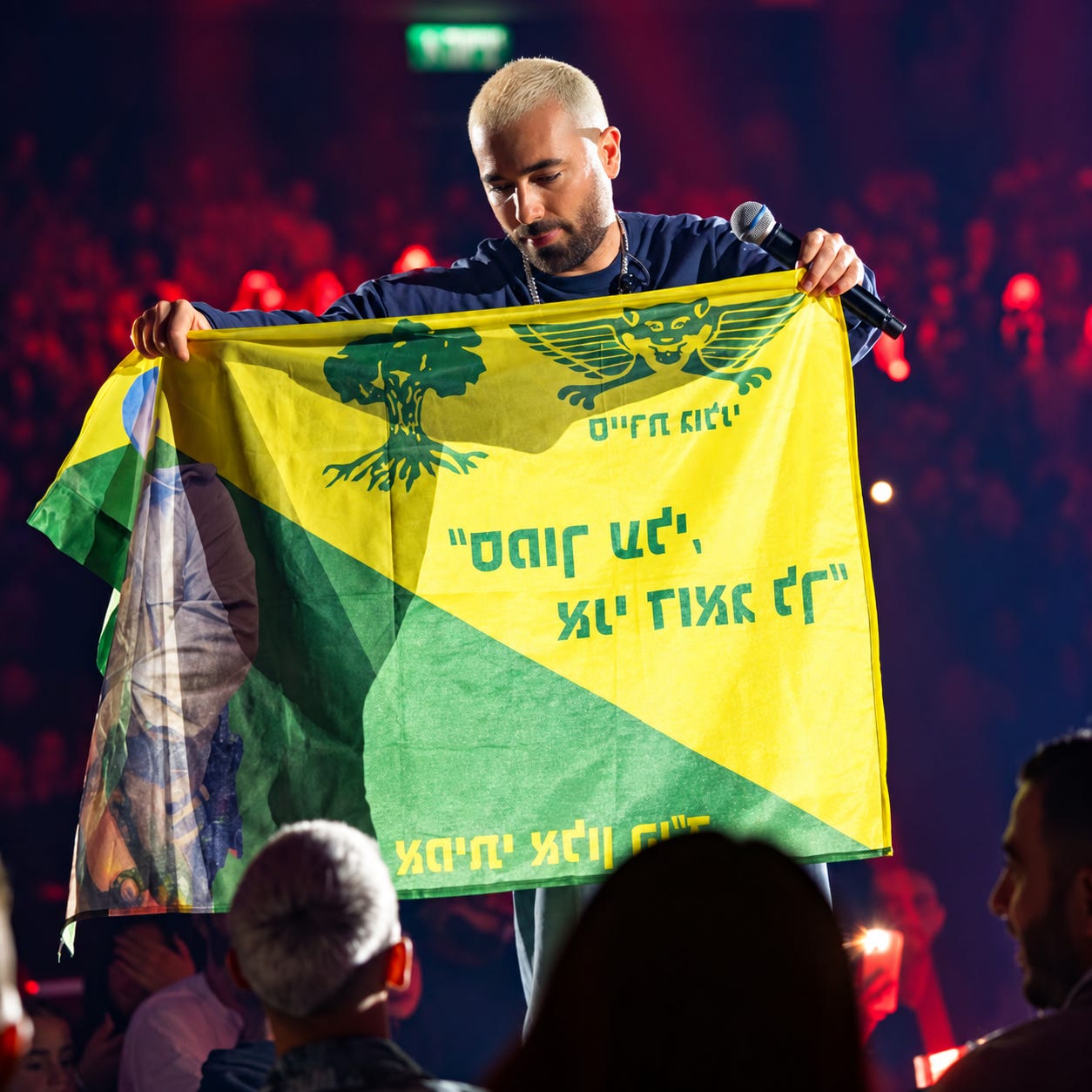
There is also something deeply meaningful about Israeli music connecting Jews across generations and geographies. A young Israeli who moved to Los Angeles last year might hear an Omer Adam song and think of the friends she left behind. An Israeli immigrant who has spent decades building a life in California might feel, for a moment, that home is not quite so far away. An American Jew who understands only a handful of Hebrew words might find herself drawn into a cultural experience that makes Israel feel less abstract and more personal.
They do not all need to relate to Israel in exactly the same way. That is part of the beauty of it. Music allows people with different backgrounds and different relationships to Jewish identity to share something meaningful without having to agree on everything else.
And perhaps that is another lesson worth taking from Thursday evening’s concert: We Jews have become very good at gathering when something terrible happens. We come together for vigils, memorials, rallies, fundraisers, and demonstrations. We know how to organize when our people are threatened, and there is tremendous dignity in that solidarity. But Jewish togetherness should not depend on tragedy. We should be just as eager to gather when there is something wonderful to celebrate.
We need more occasions when Jews come together simply because being Jewish is a source of happiness.
We need more music, more laughter, more dancing, more shared experiences, and more opportunities to enjoy the culture that generations before us worked so hard to sustain. We need to remind our children that Jewish identity is not merely a responsibility they inherit or a burden they must carry. It is also a source of extraordinary beauty, richness, creativity, and joy.
There is a temptation, especially these days, to interpret every expression of Jewish pride as an act of resistance. A Jewish festival becomes a statement against antisemitism. An Israeli cultural event becomes an answer to those who question Israel’s legitimacy. Even a concert can become an opportunity to prove that Jewish people will not be intimidated.
I understand the impulse, but there is something even more powerful about celebrating Jewish life without feeling compelled to justify the celebration to anyone.
Omer Adam does not need to represent a political argument. His music does not need to answer Israel’s critics. The people who enjoy his songs do not need to make a statement about the Middle East. We are allowed to experience something wonderful simply because it is wonderful. In fact, that freedom may be the most meaningful thing of all.
The ultimate achievement of Jewish survival is not merely that Jews are still here. It is that we have built lives worth celebrating. We have created a country, revived a language, developed a thriving culture, and raised generations of people who can experience their Jewishness as something natural and joyful.
And nowhere is that achievement more beautifully expressed than in Israeli music, particularly the way artists like Omer Adam effortlessly weave Judaism into their songs. Take his song Modeh Ani (“I Give Thanks”), inspired by the traditional Jewish morning prayer expressing gratitude to God for another day of life. Or Yom Hashishi (“The Sixth Day”), an upbeat, catchy song about the anticipation of Friday and Shabbat that incorporates biblical verses recited during Kiddush on Friday evening.
“Dad calls me again,” he sings, with a slight chuckle. “Don’t be late to dinner so Mom won’t strangle us.”
In another song, Rak Shelach (“Only Yours”), this one about love, he sings: “I’m keeping Shabbat so I can spend more time with you.”
One moment, Omer is singing about the familiar chaos of family dinners, the next about making time for someone he loves on Shabbat, and the next he’s singing verses from the Book of Genesis that Jews have recited around their Shabbat tables for generations. The ancient and the modern, the sacred and the ordinary, all flow together.
And that is what makes artists like Omer Adam so much more than foreign musicians. They are taking a civilization thousands of years old and making it feel unmistakably young. They are transforming ancient words into contemporary music, introducing Jewish traditions to new generations without making them feel like lessons in Jewish history. They are demonstrating that Jewish continuity does not have to mean clinging desperately to the past. It can also mean creating something beautiful in the present.
Our ancestors could scarcely have imagined an evening like Thursday’s, but I like to think they would have understood exactly what it meant. After everything our people have endured, after every attempt to silence our voices, erase our traditions, and sever our connection to one another, here we are, singing in Hebrew, celebrating our heritage, finding new ways to make an ancient civilization come alive.
And sometimes, to appreciate just how extraordinary that is, all we need to do is listen to the music.
There are some great videos from the concert. Love them.
Thank you for showcasing the extraordinary miracle of Israeli culture and the breadth of the modern Hebrew language