


Please consider supporting our mission to help everyone better understand and become smarter about the Jewish world. A gift of any amount helps keep our platform free of advertising and accessible to all.
You can also listen to the podcast version of this essay on Apple Podcasts, YouTube Music, YouTube, and Spotify.
Yesterday, in Philadelphia, a group of anti-Zionist activists attempted to intimidate Jewish business owners by organizing a boycott of their restaurants. They wanted to make an example of these businesses, encouraging the public to stop patronizing them because of their owners’ support for Israel.
Instead, something extraordinary happened.
Hundreds of Jews, Zionists, and their allies showed up to support the targeted restaurants. They waved Israeli flags, stood proudly in the streets, and formed long lines outside the businesses. What was supposed to be an exercise in intimidation became a remarkable demonstration of Jewish pride, solidarity, and resilience.
And the timing could hardly have been more significant. Today, November 9th, marks the 88th anniversary of Kristallnacht, the Nazi-orchestrated pogrom against Jews in Germany and Austria in 1938.
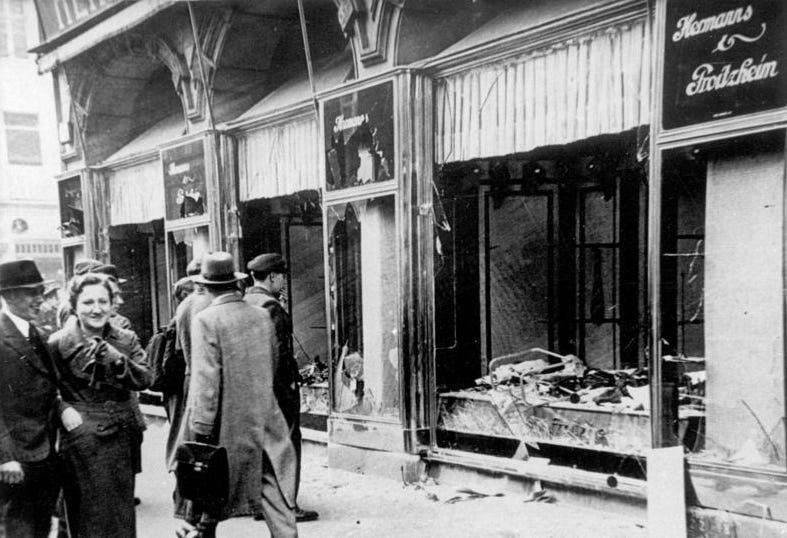
Most people know Kristallnacht as the “Night of Broken Glass,” when Nazi mobs smashed the windows of Jewish businesses, burned synagogues, and terrorized Jewish communities. But there is much more to this story than shattered windows. And some of its lesser-known details offer surprisingly relevant lessons for Jews confronting antisemitism in 2026.
Kristallnacht did not begin with broken glass.
One of the most misunderstood aspects of Kristallnacht is that it was not the beginning of Nazi Germany’s persecution of Jews. Hitler had already been in power for nearly six years. By November 1938, German Jews had endured systematic discrimination, professional exclusion, economic persecution, and the gradual destruction of their civil rights.
In fact, the Nazis had organized a nationwide boycott of Jewish businesses on April 1, 1933, just two months after Hitler became chancellor. Nazi storm troopers stationed themselves outside Jewish-owned shops and professional offices, intimidating potential customers and displaying signs urging Germans not to buy from Jews.
Long before Jews were systematically murdered, Germans were encouraged to stop doing business with them. Ordinary commercial relationships were politicized. Buying something from a Jewish merchant became an expression of disloyalty to the nation. The Jewish shopkeeper was no longer merely a businessman trying to support his family; he was portrayed as a threat to society.
And this is one of the lesser-known details: Some non-Jewish Germans deliberately defied the boycott. They continued shopping at Jewish businesses, sometimes specifically to demonstrate solidarity with their Jewish neighbors. Others ignored the boycott or objected to the intimidation. Their actions did not stop what followed. But they remind us that even in Nazi Germany, individuals had choices about whether to participate in, accommodate, or resist antisemitism.
The Nazis understood something important: If you could convince people that patronizing a Jewish business was morally or politically unacceptable, you could begin removing Jews from public life without initially resorting to mass violence.
By November 1938, years of this propaganda and exclusion had helped prepare the ground for something far more sinister. The Nazis made the Jews pay for the violence committed against them. Kristallnacht itself was presented to the German public as a spontaneous expression of anger over the death of German diplomat Ernst vom Rath, who had been shot in Paris by 17-year-old Herschel Grynszpan. What is frequently left out of the story is why Grynszpan acted.
Just days earlier, Nazi authorities had expelled more than 17,000 Jews with Polish citizenship from Germany. Among them were Grynszpan’s parents and siblings, who had lived in Germany for decades before being forcibly deported toward Poland. After learning what had happened to his family, Grynszpan shot the diplomat. The Nazis seized upon this individual act to justify collective punishment against an entire Jewish population.
But Kristallnacht was not spontaneous. It was coordinated by Nazi leaders, with Joseph Goebbels helping orchestrate the violence. During November 9th and 10th, more than 1,400 synagogues were destroyed, thousands of Jewish businesses were vandalized, and Jewish homes were invaded. Hundreds of Jews died during the violence and its aftermath, while approximately 26,000 Jewish men were imprisoned in concentration camps.
And then came one of the most outrageous parts of the story: On November 12th, the Nazi government announced that Germany’s Jews would have to pay a collective fine of one billion Reichsmarks as punishment for what the regime described as Jewish hostility toward Germany. Yes, you read that correctly. The Nazis attacked Jewish businesses, burned Jewish synagogues, destroyed Jewish property, and then forced the Jewish victims to pay for the damage.
Jewish property owners were also ordered to cover repair costs, while insurance payments that would otherwise have gone to them were confiscated by the German government. The victims were financially punished for being victims. It was a calculated effort to destroy Jewish economic independence, making it increasingly impossible for Jews to remain part of German society.
Within weeks, the Nazis introduced additional restrictions barring Jews from operating retail businesses and attending public schools. The goal was to make Jewish life in Germany untenable. The people who were supposed to protect Jews were ordered not to.
Another lesser-known detail of Kristallnacht concerns the German police and firefighters. As synagogues burned throughout Germany, firefighters often stood nearby, watching the flames consume the buildings. They had been instructed to prevent fires from spreading to neighboring properties, not to save the synagogues themselves. Police officers were likewise directed not to interfere with the anti-Jewish violence, provided that non-Jewish lives and property were not endangered.
Jewish property was not worth protecting. Jewish places of worship were not worth saving. The authorities responsible for maintaining public order were effectively telling the perpetrators that Jews were outside the protection of the law. And ordinary Germans witnessed this. Some participated enthusiastically. Others watched. Some disapproved but did little. A minority intervened or expressed solidarity.
The broader lesson is unmistakable: Antisemitism becomes infinitely more dangerous when institutions stop protecting Jews and society begins treating their mistreatment as normal. That is why Jewish communities today must demand more than sympathetic statements from political leaders, universities, employers, and law enforcement. We must demand action. The world condemned Kristallnacht. That was not enough.
Perhaps the most revealing lesson of Kristallnacht concerns the international response. Contrary to the popular notion that the world simply ignored what happened, the pogrom received enormous international attention. Newspapers across the United States reported extensively on the atrocities. Americans expressed widespread disgust at Nazi persecution of Jews.
A November 1938 public opinion survey found that 94 percent of Americans disapproved of the Nazis’ treatment of Jews. But the same polling revealed something astonishing: When asked whether the United States should allow more Jewish refugees from Germany to enter the country, 71 percent of Americans said no. In other words, Americans overwhelmingly condemned the persecution of Jews while overwhelmingly opposing one of the most meaningful ways to help them escape it.
Sympathy is not the same as solidarity. Condemning antisemitism is not the same as standing up to it. And expressing outrage over Jewish suffering is not necessarily the same as doing something to prevent it. It is relatively easy to say that Jews should not be persecuted. It is considerably harder to inconvenience yourself, confront your own community, risk social disapproval, or take meaningful action on their behalf.
This is why Jewish communities cannot afford to measure their security by how many people express sympathy after something terrible happens. The more important question is how many people are prepared to act before it happens.
What happened in Philadelphia yesterday was the response Jews need. On Sunday, November 8, an anti-Zionist cycling group called “Philly Bike On Your Left” organized a demonstration targeting six Jewish-owned Philadelphia eateries: Goldie, Dizengoff, K’Far Cafe, Huda, Mac Mart, and Schlesinger’s Deli. The group’s promotional material declared: “These Zionist Establishments Must Go! Not in Our City!” Several of the targeted establishments belong to the restaurant group co-owned by celebrated Israeli-American chef Michael Solomonov.
The organizers maintained that the demonstration was motivated by the business owners’ support for Israel, not their Jewish identity. They also denied deliberately scheduling it on the eve of Kristallnacht.
There is something deeply disturbing about organizing a campaign to drive Jewish-owned businesses out of an American neighborhood because their owners support the existence of Israel, raise money for Israeli causes, or express solidarity with fellow Jews.
One of the targeted restaurant owners, Yehuda Sichel of Huda, said he believed his business was singled out partly because he had raised money to help Israeli children traumatized or injured by the October 7th massacre. His grandfather, remarkably, had survived the Holocaust and witnessed Kristallnacht. Imagine being the grandson of a man who lived through the Nazi persecution of Jewish businesses, only to find your own restaurant targeted by a campaign demanding that Zionist establishments disappear from your city.
Of course, Philadelphia in 2026 is not Nazi Germany in 1938. The former involved a protest and boycott campaign in a democracy; the latter was a state-organized campaign of violent persecution. But we should still recognize the disturbing resemblance between the language of economic exclusion then and now. In both cases, Jewish business owners were being portrayed as people whose political identity made them unacceptable participants in ordinary commercial life. And this time, the response was inspiring.
Hundreds of supporters lined up outside the targeted restaurants. Some waved Israeli flags and confronted the boycotters. Others simply bought food, turning an attempted boycott into an extraordinary day of business. Approximately 300 people participated in the anti-Israel demonstration, while about 200 participated in the direct counterprotest. Hundreds more showed their solidarity by patronizing the restaurants.
At Huda and Schlesinger’s Deli, lines stretched around city blocks. Mac Mart, which would ordinarily have been closed on Sunday, opened to welcome the influx of supporters. The restaurant’s owner, Marti Lieberman, described the result beautifully: “Everything turned into a massive pot of positivity.”
That is how Jews should respond to antisemitism — by showing up, standing together, and demonstrating that attempts to isolate Jews will instead produce even greater Jewish solidarity.

And importantly, Jews were not alone. Non-Jewish supporters, faith leaders, ordinary Philadelphia residents, and elected officials joined the effort. Philadelphia Mayor Cherelle Parker condemned the targeting of Jewish-owned businesses, and Pennsylvania Governor Josh Shapiro praised the community’s response. This matters enormously, because defeating antisemitism cannot be the responsibility of Jews alone.
Across the world, antisemitism has reached levels that should alarm every Jewish community. Jews increasingly find themselves pressured to explain their relationship with Israel, defend their Jewish identity, or demonstrate that they are sufficiently distant from Zionism to be accepted in certain social, academic, cultural, or professional environments.
This is a particularly insidious form of antisemitism because it encourages Jews to participate in their own marginalization. The message is often implicit: You are welcome here, provided you are the “right” kind of Jew; provided you do not make people uncomfortable with your connection to Israel; provided your Jewish identity remains private, politically acceptable, and subordinate to whatever ideological expectations the surrounding community imposes.
Jews should reject that bargain. Being Jewish should never require an apology. Supporting Israel should never require an apology. And nobody should have to renounce Zionism as the price of participating in any society.
Every November, Jews around the world commemorate Kristallnacht. We share photographs of burning synagogues, listen to Holocaust survivors, and promise that such horrors must never happen again. These commemorations are important, but remembrance without action is incomplete. Jewish communities should be doing what Philadelphia did yesterday, and much more.
When Jewish businesses are targeted, patronize them. When Jewish students are harassed, mobilize parents, alumni, donors, and legal advocates. When synagogues are threatened, organize security, demand accountability, and make sure their congregations know they are not alone. When antisemitism is normalized by politicians or institutions, make that normalization carry reputational, political, and financial consequences. And when Jews are pressured to hide their identity, respond by making Jewish life more visible.
Most importantly, Jews must stop behaving as though every public expression of Jewish pride needs to be balanced by an apology to people who resent it. There is a difference between being respectful of others and being ashamed of ourselves. And if recent years have taught us anything, it is that making Jewish identity less visible does not make antisemitism disappear. The antisemite does not become more tolerant simply because Jews become more accommodating.
There is one final detail about Kristallnacht that deserves greater attention. The Nazi persecution of Jews did not happen because Jews failed to condemn antisemitism loudly enough. German Jews had built extraordinary cultural, educational, charitable, religious, and professional institutions. Many were deeply patriotic Germans. They had served their country, contributed to its economy, and believed they belonged. None of that protected them when the state turned against them.
But Jews in today’s democracies do have opportunities that German Jews in 1938 increasingly did not.
We can organize openly. We can challenge discrimination in court. We can mobilize political allies. We can defend our institutions. We can use our economic and collective influence. We can celebrate our identity in public. And, of course, we live in a world in which the State of Israel exists.
That last difference is not incidental. In 1938, European Jews had no sovereign Jewish state capable of offering them refuge and defending Jewish national interests. Today, whatever one thinks of its government, Israel exists as the living expression of Jewish self-determination.
It is therefore especially striking that the people who showed up in Philadelphia yesterday did not feel compelled to choose between their American identity and their connection to Israel. They waved Israeli flags on American streets. They supported American businesses owned by Jews. They stood alongside non-Jewish neighbors. They exercised their rights in a free society without surrendering their Jewish pride.
And they demonstrated something that too many Jewish communities seem to have forgotten amid the constant barrage of antisemitism: We do not have to accept intimidation as a permanent condition of Jewish life.
Eighty-eight years ago, the streets of Germany were littered with shattered glass from Jewish businesses while authorities allowed the destruction to continue. Yesterday, the streets of Philadelphia were filled with people determined to keep Jewish businesses open.
The circumstances could hardly be more different. But that difference is precisely the point.
Feeling a great deal of pride reading this article. Thank you!
Its a great example that we all need to stop sticking our heads in the sand. This is not going away. We need to first and foremost fight for ourselves, and then ask allies to fight alongside for decency, humanity, and the future. And for those Jews who prefer to fall on a sword than wield it. They will come for you too, no matter how righteous your arrogance blinds you. Am Yisrael Chai!