


Please consider supporting our mission to help everyone better understand and become smarter about the Jewish world. A gift of any amount helps keep our platform free of advertising and accessible to all.
This is a guest essay by Adam Hummel, a writer from Toronto currently visiting Israel.
You can also listen to the podcast version of this essay on Apple Podcasts, YouTube Music, YouTube, and Spotify.
There are several Thai massage parlours on Ben Yehuda Street in Tel Aviv, and on Saturday morning, they were open.
The bakery next to them was closed.
The bar across from the bakery was full on Friday night.
The bus lane was empty, because the buses do not run on Shabbat, and through that empty lane came a river of electric scooters, weaving, unbothered, carrying young Israelis to wherever young Israelis go when the state has decided that public transportation must rest but private momentum may do as it pleases.
So, I did what any 40-year-old would do on a beautiful day in July in Tel Aviv. I thought: What would Theodor Herzl, the father of political Zionism, make of this? What would David Ben-Gurion, the State of Israel’s founding prime minister, have to say?
The longer I thought, the more I realized the two men would not be surprised by the same things — not even close. And the shape of their respective surprises says something real about Israel.
Herzl got the city right and the world wrong. Ben-Gurion got the world right and the city wrong.
Start with Herzl, because Herzl would be just totally insufferable here. He would walk down Rothschild Boulevard, past the cafes and the cold brew and the startup offices stacked 10 storeys high, and he would say, politely, “Told ya so.”
He did tell us so.
Altneuland, his utopian novel of 1902, imagined a Jewish society on this exact coastline that is technological, cosmopolitan, tolerant, and slightly obsessed with infrastructure. He imagined electric transit. He imagined opera. He imagined a society so normal that its politics were boring. Tel Aviv is Altneuland with better coffee. In fact, when Tel Aviv was founded in 1909, it took its name from the Hebrew version of Altneuland.
Even the Thai massage parlours fit, in their way. So does the fact that this small Mediterranean city has more sushi restaurants per person than almost anywhere outside Japan, and a juice stand on every second corner, and a poke bowl place where the falafel used to be.
Herzl’s whole dream was that Jews would build a country ordinary enough to contain the full inventory of a modern city, the sublime and the seedy alike. A Jewish metropolis with the same storefronts as Vienna or Marseille is not a betrayal of his vision. It is the vision. Not necessarily a Jewish state, but a state of Jews.
Two things would stagger him, though. The first is the Hebrew. Herzl assumed the Jewish state would speak German, or some polyglot European mixture. He famously could not imagine buying a train ticket in Hebrew.
Yet here is a city where the tattoo artists and the venture capitalists and the teenagers arguing at the shawarma counter all conduct their lives in the language of Isaiah, revived from the library shelf by sheer stubbornness. Next to the highway there’s a billboard advertising artificial intelligence technology in the language of the prophets. He got the trains right and the ticket wrong.
The second is the faces. Herzl’s imagined Jew was a Viennese Jew, or a Russian or a Pole or a Croat. He did not picture a country whose majority traces itself to Baghdad and Casablanca and Sana’a, whose supermarket shelves carry amba (a tangy, spicy Middle Eastern condiment made from pickled green mangoes, vinegar, and fenugreek) and whose music charts belong to singers his Vienna would not have recognized as kin.
The state he designed for European Jews — Jews like him — became a state substantially of Middle Eastern ones. The city is his. The people in it are a plot twist.
Then there is Ben-Gurion, who would recognize the world instantly: the soldiers on the train, the IDF reservists’ duffel bags, the news alerts, the bomb shelters, the sense that the siege has changed frequencies but never fully ended. He never believed statehood would dissolve Jewish precarity. He believed it would give precarity an address and an army, and on that he was correct, and he would find the evidence everywhere, and he would not be surprised by any of it.
I think he would be pretty stunned by the city itself. Ben-Gurion wanted pioneers — austere ones, sunburned ones, socialists draining swamps and reading Plato in the evenings. He moved to a hut in the Negev to personally model that very ethic.
And what has his revolution produced?
A line outside a French bakery on Dizengoff, made up of beautiful people waiting 20 minutes for croissants topped with pistachios. Kibbutzim reborn as boutique hotels. A beach where the only sound of national purpose is the ceaseless thwock of matkot (paddle ball) paddles, a game with no points, no winner, and no end (which may be the most honest metaphor the country has ever produced).
Street cats sunning themselves on the hoods of electric cars. A dog population so dense that the man who once did headstands on this very sand would today be photographed by six passersby walking goldendoodles. And in the Carmel Market, between the spice pyramids and the knockoff sunglasses, a vendor selling t-shirts of Ben-Gurion himself doing that headstand, his image now merchandise, his austerity now a souvenir.
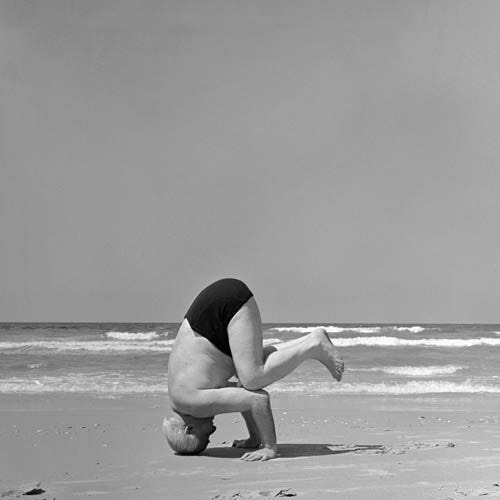
And the deeper miscalculation, the one that governs Israeli politics to this day: Ben-Gurion signed the status quo agreement with the religious parties because he was certain they were a museum piece. Give the old world its exemptions, he thought, and it will fade within a generation.
It did not fade. It grew, and organized, and now holds the balance of power in the state he built to outgrow it. Those Shabbat scooters threading through the empty bus lanes are the physical residue of his bet. Public transit rests because he conceded it would. Everything else moves because the society he predicted never arrived.
The symmetry is not an accident. Each man got wrong the thing he thought he did not need to study.
Herzl was a journalist and playwright before he was a statesman, and cities are stagecraft: sets, boulevards, cafe scenes. Things a man can draw. He drew them, and they got built, which is why Rothschild Boulevard looks the way he said it would.
His mistake was about the audience.
His Zionism, some say, was born in a Paris courtroom, watching a mob howl at Alfred Dreyfus (a 35-year-old Alsatian French artillery officer of Jewish descent, was wrongfully convicted of treason for being Jewish), and he concluded that the problem was that of Europe, not that of the Jews.
True enough.
But he then assumed Europe hated Jews for being strange, and would stop once Jews became normal. Give the Jew a flag, a navy, a parliament, and the reviews would improve. (They did not.) The man who understood the mob at Alfred Dreyfus’ “trial” somehow still believed the mob could be reasoned out of existence by a flag.
Ben-Gurion made the opposite bet. He never expected the world to applaud. The hostility was permanent weather, and he planned for it, which is why he ran home after declaring a state on May 14, 1948, to begin preparations for the war he knew was coming, and also why nothing about the 2026 world would surprise him.
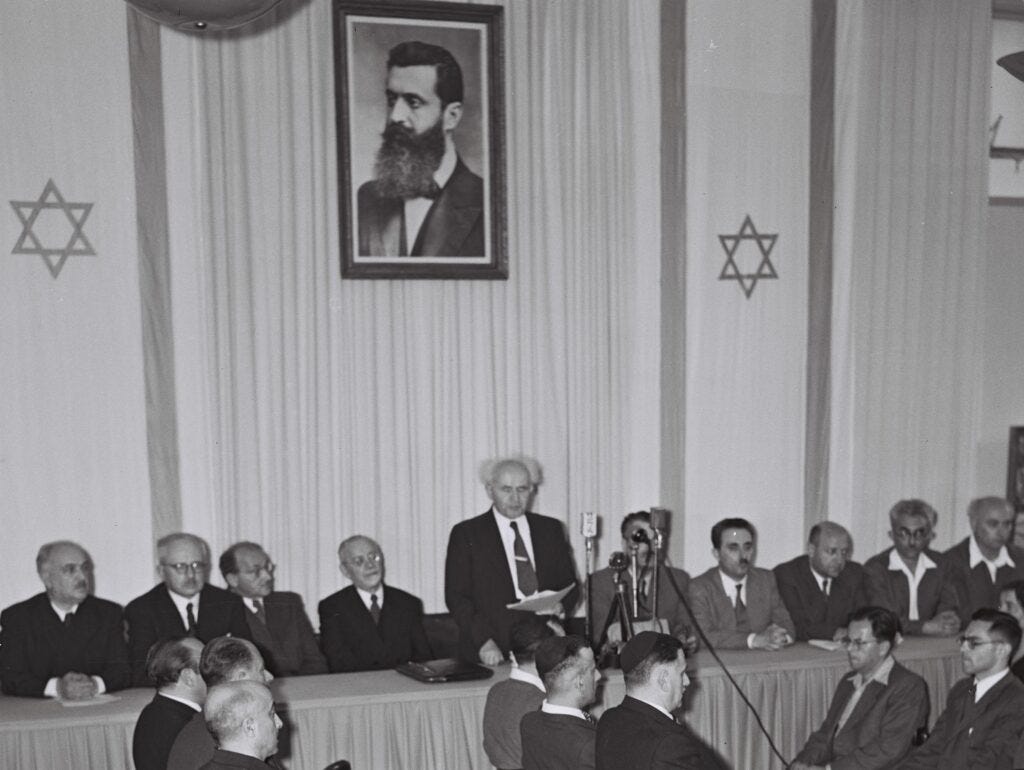
What he tried to redesign was the Jew. The diaspora Jew, he believed, had been deformed by 2,000 years of powerlessness and needed remaking — into a farmer, a soldier, a socialist laborer, austere by conviction. The old Jew of the study house would rust away like old farm equipment.
But you cannot hold a whole people in permanent revolutionary tension, because revolutions are made by people who want their grandchildren to be spared the need for one. The pioneers drained the swamps so that someone, someday, could stand in line for a croissant without shame. The city defied him not by betraying the revolution but by completing it.
Herzl redesigned the city and trusted the world. Ben-Gurion distrusted the world and tried to redesign the Jew. Each was right where he did the work and wrong where he made the assumption.
There is one expectation both men held, and it is the one that failed most completely.
Herzl believed, explicitly, that a Jewish state would end antisemitism. Normalize the Jew, he argued, and the ancient hatred would lose its object. Ben-Gurion was less romantic but shared the premise in his bones: The diaspora was the disease and sovereignty was the cure.
And here we are in 2026. The Jewish state exists. It thrives, in its loud, improbable, croissant-eating way. It has a tech sector and a space program and a beach culture that would make the Baron Rothschild blush. All while us Jews in Toronto are still discussing security protocols at our children’s schools. The flag did not end the hatred. It gave the hatred a new vocabulary.
The failure has a pattern, and once you see it, you see it everywhere. Herzl said the old language would not survive the marketplace. Well, it survived, and conquered the marketplace. Ben-Gurion said the old faith would not survive the state. It survived, and now helps steer the state; there is a mezuzah on the doorpost of the nightclub, and some of the scantily clad men and women kiss it on the way in.
And both men said the old hatred would not survive Jewish normalcy. It survived too, fluent in a new vocabulary within a generation. Everything the founders marked for extinction refused to die. The state was an act of will. The country is an act of inheritance.
Neither man had a plan B for this. Much of their architecture assumed the problem was Jewish homelessness, and that solving the homelessness would solve the rest. The homelessness is solved. The rest is still here. That is not a reason to think they failed. The city and country currently around me is the most persuasive counterargument to despair that the Jewish People has ever constructed.
But it does mean we are living in the chapter they never wrote, working from a blueprint whose final pages are blank.
I finished my walk here in Tel Aviv where I started, outside the massage parlour, which was still open, next to the bakery, which was still closed. Somewhere between those two doors is the whole country.
Made me tearful in both a sad and joyous way. Am Yisrael chai
Meanwhile Rahm Emanuel the US Democrat, failed mayor of Chicago, and Obama's darling is coming to Tel Aviv to denounce Prime Minister Netanyahu for keeping Israel safe. For him the lives of Hamas and Hezbollah Terrorists are being violated while protecting Israeli citizens.