


Please consider supporting our mission to help everyone better understand and become smarter about the Jewish world. A gift of any amount helps keep our platform free of advertising and accessible to all.
This is a guest essay by Nadav Eyal, a columnist for Yediot Aharonot (one of Israel’s largest newspapers), and a Senior Scholar at Columbia University’s School of International and Public Affairs.
You can also listen to the podcast version of this essay on Apple Podcasts, YouTube Music, YouTube, and Spotify.
Ed Halmagyi’s bakery, Avner’s, became world-famous after the Bondi Beach attack two Sundays ago.
This story was widely reported: A day after, Halmagyi decided to close Avner’s. The message he left on the door was quoted everywhere:
“In the wake of the pogrom at Bondi one thing has become clear - it is no longer possible to make outwardly, publicly, proudly Jewish places and events safe in Australia.”
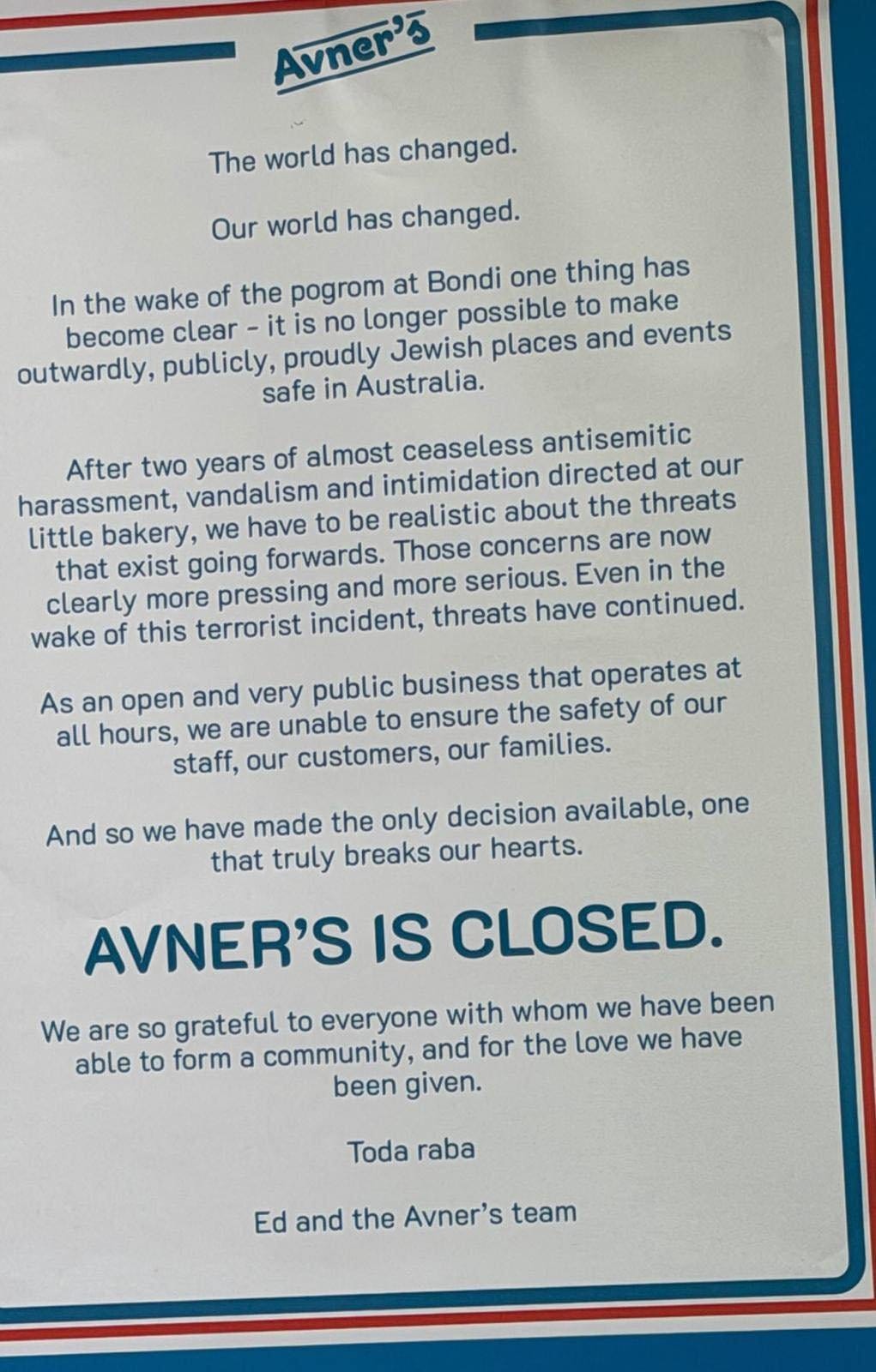
The bakery is in a fashionable Sydney suburb, and Halmagyi is a television personality and a well-known figure in Australia’s food scene. Avner’s was supposed to open in September 2023, but its opening was delayed until October. This week, I spoke with Halmagyi.
“For two years, we were dealing with vandalism, harassment, posters that were anti-Israel, anti-Zionist, or straight-up antisemitic. Graffiti on the windows or around the shop. Basically, that was our reality almost every week — five or six days out of seven — for two years.”
Think about that: five or six days a week. Every week. For two years.
“The bakery is in one of Sydney’s more progressive suburbs. That wasn’t by accident. I wanted to open a business that wasn’t in the shtetl. A place that was both Jewish and Australian. Something that celebrated that identity. But as time went on, more and more people just wouldn’t come on principle because it was a Jewish business. You can’t underestimate how deeply this idea has taken hold: that we, as Jews, as a collective, are responsible for every strategic decision made by the Israeli government and everything that happens in Gaza.”
A typical threat, he told me, would be someone stopping outside the shop and saying: “All Jews are the same. You should all be killed.”
“The threats against me and the business were serious. One person tried to set the place on fire, but used diesel — you need heat in order to ignite diesel — so I managed to stop him. On Sunday, police came to brief us that there was a real, immediate threat against us. After that, someone drove past with a Syrian flag, circling and shouting that he was going to come back and kill the Jews. A few hours later, the massacre happened at Bondi Beach.”
“After Bondi, everything changed forever. The question now isn’t whether someone will show up with six guns and his kid, like at Bondi; it’s whether someone comes with a single gun. Or a knife. Everyone knows something else will happen. The only question is how. There aren’t many high-profile Jewish businesses in Sydney. As one of them, I can’t guarantee anymore the safety of customers, my family, or myself anymore. The world changed.”
He spoke about the dream that ended.
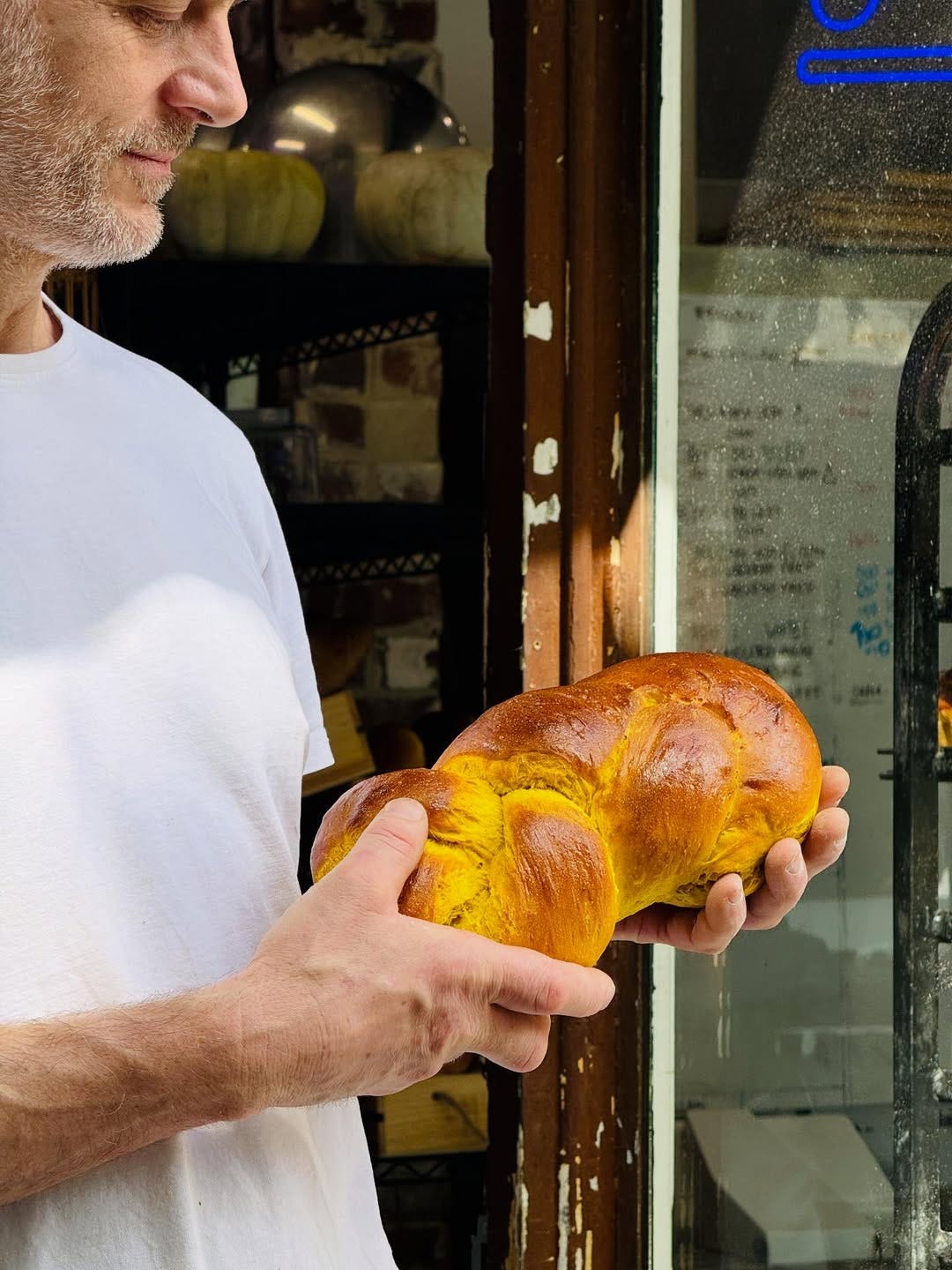
“I wanted to show what it means to be Jewish and Australian. A place that was part of the local community. You wouldn’t find a better bagel anywhere in Australia, maybe only a handful better in the United States. Our challah was exceptional. Our babka was world-class. No one needs honey cake — it isn’t essential — but people buy it because it makes them happy. I wanted to make people happy. Parents came in the morning after dropping their kids at school. In the afternoons, we’d draw with chalk on the pavement with the kids.”
“But everything changed on Sunday after Bondi. The range of what’s possible expanded — and it now includes the possibility of Jews being massacred simply because they can. Jewish schools and institutions have armed guards, fences, walls. You can’t do that for a bakery. It doesn’t make economic sense, and it destroys the openness, connection to the community, the family atmosphere.”
He is impatient with the wave of sympathy now being expressed towards the Jewish Community; it reminds him of American writer and professor Dara Horn’s book, “People Love Dead Jews.”
“Some of the people expressing solidarity now are the same ones who held racist views, or legitimized violence.”
It doesn’t sound like Halmagyi is leaving.
“I love being Jewish. I love being Australian. I love being part of Sydney. But Sydney is going to have to have a very uncomfortable conversation with itself. Certain attitudes spread through this society over two years and made this massacre possible. When you see a bunch of reckless fools wearing Chinese-made keffiyehs chanting ‘Globalize the intifada!’ — this is where it leads. Australia allowed it.”
In one sense, the story Halmagyi tells is about antisemitism, pure and simple. There’s no way to deny that the war in Gaza itself enhanced and empowered hostility toward Israelis and toward Jews identifying with Israel. But there is a difference between criticism — even resentment — and placing collective blame on an entire people.
That angle has been widely discussed. To some extent, though, I think this story is no less about enforcement, or rather the failure to enforce rules and the law in the face of antisemitism. This is not the same thing.
There is a dominant theme out there: The rising tide of anti-Israel antisemitism following the war is serving as an ideal opportunity for age-old hatred. While there is no question animosity is growing, and the constant images coming from Gaza (together with biased interpretations) have fueled it. But the story is larger than that. This is not a flare-up, not (only) a bottom-up grassroots reaction.
Israeli security services believe there is a “power or state-led” campaign that goes beyond encouraging anti-Israeli sentiment. It is now pushing classic antisemitism — globally, and specifically in the West.
Israel does not know with certainty who is behind the operation or operations, but it has become a central concern in Jerusalem. Israeli officials told me the issue requires close examination, not least because it appears to extend beyond any single country or arena. The anti-Israel and anti-Jewish rhetoric — across social media posts, as well as popular opinionators — has surged in recent months, according to those Israeli experts.
While some of this can be understood as fallout from the war’s end and the heavy toll in Gaza, they say they have reached a disturbing conclusion, supported by intelligence: This represents a new, state-led endeavor. It goes well beyond the known phenomena on platforms such as TikTok. One substantive shift has been the move away from Gaza-focused attacks on Israel and Israelis toward more classic, generalized antisemitism.
Within the Israeli government, officials identify a broad, global, and primarily artificial effort — that is, engineered rather than organic — to intensify hostility and hatred toward Israelis and Zionist Jews. The emphasis is on the word artificial. Professional assessments presented to senior figures of Israel’s defense apparatus have concluded that only state actors with large influence operations, backed by intelligence services, or alternatively a number of private influence firms hired by a state, are capable of executing the kind of coordinated and timed actions now appearing worldwide.
Against this backdrop, Israel’s broader relationship with Qatar comes back into focus. A senior, well-informed Israeli official told me: “It seems the Qataris have made a fundamental decision to try to destroy relations between Israel and the Trump Administration at their very foundation. They are in jihad.”
A few weeks ago at the Doha Forum (a large event held annually since 2003 in the capital city of Qatar), Qatar’s prime minister gave an interview to Tucker Carlson. The prime minister spoke of the transfer of funds to Hamas over many years, with the support of Israeli governments, the Mossad and the Shin Bet, as well as administrations in Washington, D.C. Those remarks made headlines in Israel.
But the truly troubling statement was about Gaza’s reconstruction. The Qatari prime minister said: “… we are not the ones who are going to write the check to rebuild what others destroyed,” adding that “our payments will only go to help the Palestinian people if we see that the help coming to them is insufficient.” That is very far from what Qatar promised to do with regard to rebuilding Gaza.
The prime minister also rejected the notion that a ceasefire was already in place in Gaza: “It’s not yet there. What we have just done is a pause. We cannot consider it yet a ceasefire. A ceasefire cannot be completed unless there is a full withdrawal of the Israeli forces, which is not the case today.” Rhetorically, at least, this grants legitimacy to a renewal of Palestinian attacks against IDF forces inside the Gaza Strip.
At another level — rooted in Australia, Bondi Beach, and a small bakery — this is a story about power structures with a legal and moral duty to stop racist lawlessness against Jews, and their abdication of that duty.
If people repeatedly make death threats outside a bakery in Sydney, day after day, one would expect local police to intervene. Australia demonstrated during COVID that it is fully capable of enforcing its rules extremely heavy-handedly. Yet demonstrations with flags of terror groups were seen in Sydney again and again after October 7, 2023. Laws were simply not enforced. The pro-Hamas radical echo chamber received a waiver.
This did not happen only in Australia. Look at U.S. campuses. There are no universities or colleges whose rules allow harassment of students, or demonstrations that openly sabotage study, even for the most just cause. And yet, here too, radicals were given a pass. A specific pass to go after Israel, those who support it, and ultimately Jews who identify as Jewish.
The question, of course, is why.
Why would the Sydney police not treat the constant harassment and intimidation of Avner’s as what it was: a vile racist campaign, deserving resources and manpower to stop it? Why would they not see certain phenomena at demonstrations for what they were: clear and present incitement to violence, and promotion of terror groups?
The answer is that there was a deal here. A dark one.
The deal here is murky, but its logic is not. Different governments and power structures arrived at the same outcome from different motives.
Some genuinely despised Israel, or at least its current government, and saw leniency toward anti-Israeli and anti-Jewish hate as a way to signal that. Others understood, often quite well, the operational realities of fighting Hamas in Gaza, but were constrained by domestic political coalitions they felt compelled to appease. Think of the reflex, especially visible in parts of Democratic Party presidential candidate Kamala Harris’ campaign, to “hear out” every radical accusation directed at Israel, no matter how extreme or detached from reality.
This dynamic was fed by a media frenzy united less by concern for Palestinians than by fixation on the Jewish state. A bargain emerged: no serious policy shift in the Middle East, no real break with Israel, but a permissive atmosphere at home. More demonstrations. More protests. More “expression.” Much of it aimed, directly or indirectly, at local Jewish communities.
And so, in practice, they struck a dark deal. Jews, most of whom were assumed to be pro-Israel anyway and therefore “guilty,” were sacrificed.
That is what happened to a small bakery in Sydney. And then it enabled Bondi Beach.
In remembrance of Sophia and Boris Gorman, may their memory be a blessing, who were murdered together on Bondi Beach while trying to disarm one of the terrorists.

‘The rising tide of anti Israel antisemitism’ .. or put more simply, it’s Jew hate & Israel hate. Propagated by lousy politicians, ineffective police, moronic biased media and ignorant / stupid people, many of whom think it is fashionable.
The UK is no different to Australia .. utterly shameful.
Stop ....the emphasis on Jew hate
This is a world wide Muslim religious war. This is the rise of a new ottoman empire. This is total fear that your supermarket or bus or pizza parlors will be blown up by Muslims so you do not act. Step 1 quit Columbia and get all Jews to leave Columbia University and put it out of business. .number 2 write about how the UK France Spain Belgium Australia Norway Sweden Finland Canada Portugal are all Muslim controlled countries.