


Please consider supporting our mission to help everyone better understand and become smarter about the Jewish world. A gift of any amount helps keep our platform free of advertising and accessible to all.
This is a guest essay by Lucy Tabrizi, who writes about politics, philosophy, religion, ethics, and history.
You can also listen to the podcast version of this essay on Apple Podcasts, YouTube Music, YouTube, and Spotify.
To be clear, this is not an essay about progressive or liberal Jews in general. It is about a specific figure who has become indispensable to the modern anti-Zionist movement: the anti-Zionist Jew — the so-called “good Jew,” who speaks “as a Jew,” not to complicate the mob’s story, but to bless it.
Disagreement with Israeli policy is not what defines this figure. What defines them is a willingness to revise Jewish history, identity, and peoplehood in order to make Jewish existence morally conditional.
They serve as the anti-Zionist movement’s preferred shield against the charge of antisemitism. “How can this be Jew-hatred,” the logic runs, “when Jews themselves are saying it?”
Jewish anti-Zionism is often animated by a tragic belief — that exemption is possible, that denouncing one’s own people loudly and publicly enough will earn safety. History offers no evidence for this belief. A particularly instructive example came in Nazi Germany. In the regime’s early years, a small group of highly assimilated Jews organised openly in support of Adolf Hitler, dismissing reports of persecution as exaggerations and denouncing Zionism as a threat to Jewish integration. Their loyalty did not spare them. By 1935, the Nazis dissolved the organisation and arrested its leader. The regime, it turned out, had no use for distinctions between “good Jews” and the rest.
The function was then simply absorbed directly by the state. In the lead-up to the 1936 Berlin Olympics, international pressure mounted to boycott the Games over Germany’s treatment of Jews. A single Jewish athlete, Helene Mayer, was selected for the German team to signal that Jews were being treated just fine. Mayer won silver and gave the Nazi salute on the podium. The image went global. It worked. The boycott fizzled out.
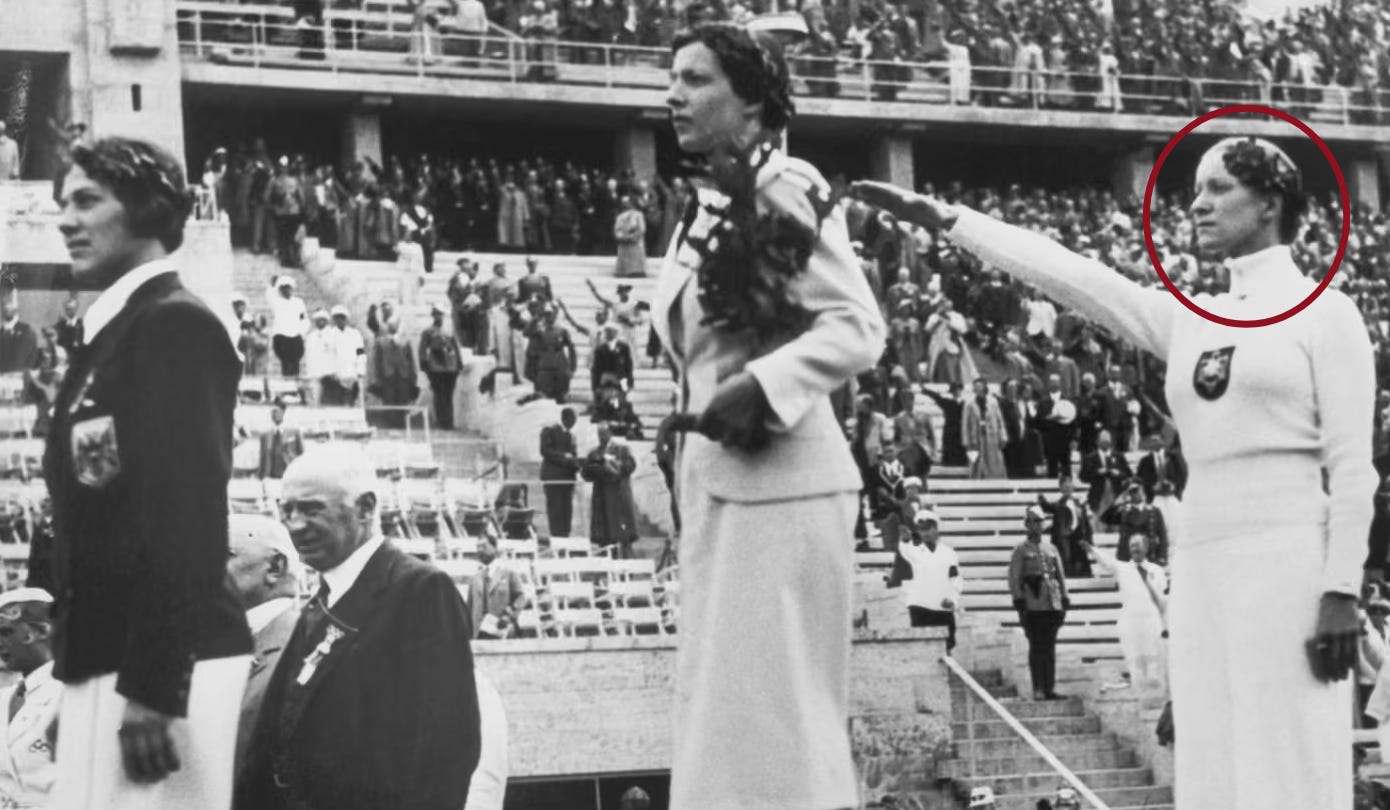
German Jews, meanwhile, continued to be stripped of their rights and livelihoods, before being rounded up, deported, and murdered. The “good Jew” had served her purpose.
The same mechanism operated in the Soviet Union. From the earliest years of the regime, explicitly Jewish communist bodies were created to dismantle Jewish religious, cultural, and communal life from within. Their Jewish identity was essential: The state could not be accused of antisemitism if Jews themselves were shutting down synagogues, abolishing community institutions, and arresting Zionist leaders.
By the early 1950s, the logic reached its endpoint. Under Joseph Stalin, plans were drawn up for the mass deportation of Soviet Jews to prison camps, to be justified by public letters signed by Jews denouncing “Zionism” and urging the state to act against “traitorous” Zionist Jews. The plan was interrupted only by Stalin’s death.
And yet, the pattern was not confined to Nazi Europe or Stalinist Russia. In Egypt under President Gamal Abdel Nasser, Jews were pressured to publicly renounce Zionism as a condition of safety, only to be expelled regardless. In communist Poland, an officially “anti-Zionist” purge targeted Jewish party members and intellectuals alike. In Iraq, one of the country’s most prominent anti-Zionist Jews was hanged after a show trial accusing him of Zionism anyway.
Different ideologies, identical outcome: Jews who believed that loyalty, assimilation, or public rejection of Jewish peoplehood would protect them discovered the same truth. Antisemitism does not reward compliance; it consumes it. The category of the “good Jew” has never survived contact with power.
Many anti-Zionist Jews today believe they are resisting indoctrination, that they have broken free from inherited myths. Perhaps. But being misled once does not confer permanent immunity from being misled again.
What often goes unexamined, however, is the social position from which this confidence emerges. Most anti-Zionist Jews in the diaspora are not acting under threat. They are insulated by liberal democracies, protected by distance, and cushioned by the belief that Jewish vulnerability is a historical artefact rather than a present condition. That insulation makes it possible to treat Jewish peoplehood as optional and Jewish self-defence as negotiable. Cut off from the civilisational memory that Zionism emerged to answer, it becomes easy to mistake comfort for enlightenment. The absence of danger is misread as insight.
Modern anti-Zionism did not emerge organically from moral reflection. It is the inheritance of an ideological campaign that replaced the word Jew with Zionist — while leaving every underlying accusation intact. The language of conspiracy, domination, blood guilt, and moral corruption was simply updated. To oppose Zionism, in this sense, is not to stand outside history. It is to unknowingly step into one of its most well-worn grooves.
A striking feature of Jewish anti-Zionism is the insistence that Jewish identity is merely religious — a faith or ethical tradition — rather than a people or a nation. This requires erasing the foundations of Jewish civilisation itself. Jewish law, language, calendar, prayer, and collective memory are all inseparable from the Land of Israel. Jews have described themselves as a people, a nation, a tribe for millennia.
The attempt to separate Judaism from Zionism is therefore not a recovery of authentic Jewish tradition, but a denial of it. Jewish attachment to the Land of Israel is one of the oldest continuous threads in history, explicit at least since the return from Babylonian exile in 536 BC and woven through every layer of Jewish life thereafter. Jewish anti-Zionists treat Israel as simply a modern political add-on.
Indeed, surveys consistently show that roughly nine in 10 diaspora Jews identify as Zionists in this basic sense: They support the existence of a Jewish state in the Jewish ancestral homeland. That overwhelming consensus is what anti-Zionist movements obscure. After all, it is difficult to claim you are not anti-Jew when what you are opposing is the core political expression of Jewish peoplehood shared by the vast majority of Jews.
And yet anti-Zionist movements continue to elevate anti-Zionist Jews as moral shields against the charge of antisemitism. To do so, they rely on outliers — most conspicuously Neturei Karta1 — and present them as representative moral authorities. This is often described as solidarity, but it is not. It is tokenisation: the elevation of a minority voice not for what it risks or knows, but for the absolution it provides.
Confusion usually arises at this point: How is this any different from amplifying dissidents in Gaza?
The answer lies in risk, representation, and consequence.
Elevating Jewish voices that minimise or excuse antisemitism endangers other Jews. Elevating dissenting voices in Gaza does the opposite. A Jew in New York loses little by denouncing Zionism, except perhaps by shifting the target further into the future. They may be applauded, platformed, even celebrated at rallies where Jewish history is casually rewritten. A Palestinian in Gaza who criticises Hamas risks imprisonment, torture, or death, and does so in defiance of views that are genuinely popular, violently enforced, and backed by armed power.
The same tokenising logic explains the elevation of groups like the Jewish Council of Australia and Jewish Voice for Peace (which might not even be Jewish), which receive outsized media and institutional attention despite occupying a fringe position within Jewish life. Jewish Voice for Peace’s value lies not in its size or credibility, but in its function: providing a “Jewish” brand under which hostility to Jewish self-determination can operate shielded from scrutiny.
That branding is so useful that basic questions about representation, accountability, or even authorship are treated as impolite. Some of Jewish Voice for Peace’s digital infrastructure has been linked to administrators operating outside the United States, including in Lebanon2 — a detail that would provoke immediate outrage were this any other minority group not named “the Jews.”
The group has repeatedly amplified or glorified figures responsible for mass violence against Jewish civilians. Among them is Ghassan Kanafani, who claimed responsibility for the 1972 Lod Airport massacre, in which 26 civilians were murdered. The celebration of terrorism, it seems, is more easily overlooked when it arrives with a Jewish seal of approval.
Likewise, the slogan “Globalize the intifada!” now openly embraced in spaces adjacent to Jewish Voice for Peace, refers not to abstract protest, but to a sustained suicide-bombing campaign that deliberately targeted Israeli civilians in buses, restaurants, schools, markets, and shopping centres. To cheer this while simultaneously condemning gun violence in American schools is moral hypocrisy, plain and simple.
But this is how tokenisation works. By elevating fringe Jewish voices, movements hostile to Jewish lives and self-determination claim Jewish endorsement, while dismissing the views of most Jews as corrupted, brainwashed, or morally illegitimate.
Abuse flows downstream. Dissent is not debated but swarmed, shamed, and silenced. The “good Jew” does not restrain animus; they license it. Hostility toward Jews, recoded as hostility toward “Zionists,” becomes righteous. This is not progressive; it is the oldest pattern in Jewish history. And it rests on a “moral logic” applied to Jews alone. No other Indigenous people are told that prolonged exile voids their connection to their homeland, or that survival itself now constitutes injustice. Only Jews are subjected to this logic, and the anti-Zionist Jew is invited to certify it.
The anti-Zionist Jew often speaks in the language of universalism — anti-colonialism, feminism, anti-racism, human rights — yet these commitments fracture the moment Jews are involved. Colonialism is condemned, except Arab colonialism. Feminism is championed, except when violence is carried out by Islamist forces brutalising women. Anti-fascism is embraced, except when fascist rhetoric is directed at Jews. Land Back is sacred, except when the land is Jewish. These are not minor inconsistencies; they are ideological signs, revealing not a principled moral framework, but a hierarchy of acceptable victims and unacceptable survivors.
“The occupation” occupies a singular psychological role in Jewish anti-Zionist thinking. It is treated not as a consequence of war, but as its original sin. End it, and peace will follow. End it, and moral order will be restored. The belief is comforting because it locates control entirely in Jewish hands. If Jews are at fault, Jews can fix it. If Jewish suffering persists, it must therefore be deserved.
Yet every major attempt to reduce Jewish vulnerability in the region — autonomy, withdrawal, partition, compromise — was met not with reconciliation, but with escalated violence. Occupation did not birth the conflict. It followed it. Accepting this requires confronting a far more unsettling possibility: that hostility toward Jewish presence in the region did not originate with borders or settlements, but with Jewish autonomy itself.
At its core, Jewish anti-Zionism demands something extraordinary — that Jews uniquely surrender not merely a state, but their historical memory, their collective identity, and their right to self-defence, all in exchange for the promise of moral approval from cultures that have never protected them.
Supporting Palestinian human rights does not require the falsification of Jewish history. Moral clarity does not require self-annihilation. And no civilisation survives by teaching its children that their existence is a moral problem.
The anti-Zionist Jew is not a rebel standing against power. They are the latest incarnation of an ancient hope: that if Jews abandon themselves, the world will finally love them.
That hope has always been fatal.
Neturei Karta is a Haredi Jewish anti-Zionist group founded in Jerusalem in 1938. They believe that the establishment of the State of Israel is forbidden by Jewish law because it violates the theological belief that a Jewish state can only be created by the Messiah.
Source: NGO Monitor
It's difficult for me to separate anti-Zionist Jews with political Progressives, which seem to go hand in hand. When Peter Binert, a pro-Palestinian apologist talked about his beliefs regarding the Gaza/Israel conflict, he never failed to include the 'right wing' policies of Netanyahu. He emphasizes that he is an Orthodox Jew who keeps Kosher, as if all of it make his opinions more believable and palatable. Jews like Brad Lander from New York, who was also pro-Palestinian, campaigned with Mamdani thinking he would be rewarded with a position in his cabinet found out he wasn't even considered and it was given to someone else. When will these Jews learn that no matter what they do, they will be last in line, if on line at all?
I have never understood this. Turning against your own never results in what you hope for. It is cowardice pure and simple