


Please consider supporting our mission to help everyone better understand and become smarter about the Jewish world. A gift of any amount helps keep our platform free of advertising and accessible to all.
This is a guest essay by Daniel-Ryan Spaulding, a comedian and writer.
You can also listen to the podcast version of this essay on Apple Podcasts, YouTube Music, YouTube, and Spotify.
February 26 of last year was a day of national mourning in Israel.
I know because I was there.
Hostages Square in Tel Aviv was covered in orange tulips. Yellow ribbons fluttered from signs and lampposts. Families held Israeli flags. Thousands of people stood together in silence, watching the funeral procession of Shiri Bibas and her two young sons, 4-year-old Ariel and 9-month-old Kfir.
Across the country, tens of thousands of Israelis lined the route from Rishon LeZion to southern Israel as the Bibas family was laid to rest. People stood on bridges. They gathered along highways. They filled public squares. Many cried openly.
For Israelis, it was a day of national mourning. For Jews around the world, it felt personal.
The image of Shiri Bibas being taken into Gaza with her two red-haired children in her arms had become one of the defining images of October 7th. For nearly 16 months, people prayed for a different ending. They hoped that somehow, despite everything, the family would return alive.
Instead, they were returned in coffins. Or rather, ransomed and extorted back to Israel after Hamas demanded the release of Palestinian criminals and terrorists in exchange for their remains. Even in death, there was no dignity.
Before the funeral, Hamas staged one final spectacle. As they had done repeatedly throughout the hostage releases, they transformed human suffering into propaganda theater. Coffins were displayed on a stage. Cameras rolled. Crowds gathered. The cold-blooded, brutal murders of a mother and her babies became another opportunity for psychological warfare.
The cruelty did not stop there.
When the remains were initially handed over, it was discovered that the body returned was not even Shiri Bibas. After 16 months of agony, after kidnapping a mother and her children, after murdering them, after turning their deaths into a grotesque public spectacle, Hamas found one final way to inflict psychological torture on a grieving family and an entire nation.
It is difficult to overstate how devastating that moment felt to many around the world.
For months, we had followed every development. We had memorized names and faces. We had watched hostage families plead for help. We had spent countless hours absorbing information that many people understandably could not bear to look at. And then, while Israelis mourned, something revealing happened on American television.
On the American TV show “The View,” Sara Haines, whose husband is Jewish, attempted to acknowledge the tragedy. It should have been one of the least controversial moments imaginable. A mother and her two young children had been kidnapped and murdered. Millions of people were grieving.
Before Sara could even sit with the enormity of what had happened, the show’s co-host Whoopi Goldberg shut the conversation down. Not gently. Not thoughtfully. With the sort of dismissive, curmudgeonly impatience that had become all too familiar throughout the war.
“We should feel bad for everybody,” she snapped. “All the families. All the children.”
Of course we should. Nobody was suggesting otherwise. Nobody was arguing that innocent Palestinians were undeserving of compassion. But that wasn’t what the conversation was about. For one brief moment, the conversation was about a murdered Jewish mother and her children. For one brief moment, the focus was on a family whose suffering had captured the attention of millions of people around the world.
And even that seemed to make Whoopi uncomfortable.
The exchange became even more revealing when the panel discussed the fact that Hamas had initially failed to return Shiri Bibas’s remains.
When the issue was raised, another one of the show’s co-hosts, Sunny Hostin, quickly jumped in to note that Hamas had eventually returned the correct body. Eventually. As though the timing were the issue. As though the psychological torture inflicted upon the Bibas family, upon Israel, and upon Jews around the world was somehow softened because the correct remains arrived later.
Watching the exchange, what struck me most was the body language around the table. Sara Haines went silent. Joy Behar, another show co-host, appeared uncomfortable. Both seemed to understand that this was one of those rare moments when politics should take a back seat to simple human empathy.
But empathy was not what won the day. What won the day was moral equivalence.
The insistence that Jewish grief must immediately be diluted, redirected, qualified, and balanced against something else. That moment captured something many had already begun to understand after October 7th.
We were never really allowed to talk about October 7th. We were never allowed to talk honestly about the atrocities. We were never allowed to talk about the fact that crowds across the Western world celebrated October 7th almost immediately. We were never allowed to ask what it meant that people cheered the murder, kidnapping, torture, and abuse of civilians. Every attempt to have that conversation was met with deflection.
What about Gaza? What about colonialism? What about history? What about everyone else?
The subject changed before the conversation could even begin.
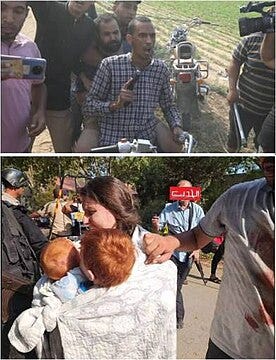
The Bibas family became perhaps the clearest example of this phenomenon. If there was any story capable of breaking through political tribalism, surely it should have been theirs. A mother. Two children. A baby. Yet even then, many people seemed incapable of extending simple human sympathy without immediately qualifying it.
This is where ideology becomes dangerous. Because ideology has a remarkable ability to erase cause and effect. Too many people on the Western Left have come to view the conflict through a simplistic framework of “oppressor” and “oppressed,” “privileged” and “marginalized,” “powerful” and “powerless.” Within that framework, Israelis become symbols rather than people. Jews become avatars of power rather than human beings capable of suffering.
Once that happens, empathy becomes conditional. The murder of Jewish children is no longer viewed first as a human tragedy. It is filtered through a political lens. The victims become representatives of a system rather than individuals. And when that happens, even mourning becomes controversial.
What makes moments like this especially frustrating is that they do not exist in isolation. Whoopi Goldberg has spent years demonstrating a remarkable confidence when speaking about subjects she appears to know very little about. This is the same television personality who once suggested that women living under the Islamic Republic of Iran do not necessarily have it worse than Black Americans. It was one of those comments that revealed not merely ignorance, but a profound inability to grasp the reality of life under an Islamist regime.
Women in Iran are imprisoned for refusing to wear a hijab. They are beaten by morality police. They are tortured. They disappear into prisons and are executed. To compare that reality to life as a multimillionaire celebrity living comfortably in Manhattan is not merely inaccurate. It reflects a worldview insulated from the consequences of the ideas being discussed.
That same confusion was visible in her response to the Bibas family. What struck me was not simply the words themselves. It was the instinct behind them. The inability to allow a moment of grief to exist without immediately reframing it through an ideological lens. The inability to recognize that sometimes the appropriate response is not analysis. It is mourning.
What made this especially painful for many people was the context. For months, hostage families had been sharing details of what happened on October 7th and what their loved ones endured in captivity. Jewish communities and their allies around the world absorbed every update, every testimony, every fragment of information. We watched videos. We read reports. We followed every hostage release. We memorized names and faces because these hostages felt like our family.
And then we carried that information into conversations with friends, audiences, colleagues, and neighbours.
Again and again, we found ourselves explaining horrors that many people simply did not want to hear. Again and again, we were met with denial, deflection, hostility, or accusations that we were exaggerating.
The trauma was not only in learning what happened. The trauma was in trying to communicate what happened. The trauma was in realizing that people who would instinctively sympathize with almost any other victims often seemed unable to extend that same compassion when the terror occurred in Israel.
I am often reminded of the words of Yarden Gonen, whose sister Romi was taken hostage on October 7th. Like so many hostage families, she spent months speaking to international audiences. She was pleading for her sister’s return. But she was also trying to warn people.
Again and again, hostage families described the ideology that produced October 7th. They warned about the terror networks surrounding Israel, about the normalization of extremism, and about the consequences of ignoring movements that openly celebrate violence. Many believed the world needed to understand what had happened not only for Israel’s sake, but for its own.
Yet whenever they spoke, they were often met with denial, minimization, hostility, or indifference. The people carrying the deepest trauma were simultaneously forced to convince others that their trauma was real. As we tried to raise awareness about the hostages, we were told we were spreading propaganda. As families begged for their loved ones to be returned, they were met with slogans, conspiracy theories, and moral equivalencies.
Again and again, people trying to warn others found themselves ignored, dismissed, or mocked.
That compounds the trauma. It deepens the wound. And it is why moments like Whoopi Goldberg’s comments resonate far beyond a single television segment. Because they are not unique. They are representative. They represent the casual cruelty of people protected from the consequences of the world they comment on. People who will never hear a rocket siren. People who will never spend 16 months wondering whether their child is alive or dead. People who will never stand in Hostages Square surrounded by orange tulips and grieving families.
And yet somehow still feel entitled to lecture the victims about how they should process their grief. That is what I remember when I think about Whoopi Goldberg’s comments. Not because they were shocking. By that point, very little shocked me anymore. They stayed with me because they perfectly captured a broader cultural failure.
A Jewish mother and her two children had been murdered. Millions of people were grieving. And yet the instinct of one of the most influential television personalities in America was not to acknowledge that grief, but to immediately dilute it. To universalize it. To make sure nobody focused on it for too long.
That is the casual cruelty. Not open hatred. Something subtler. The inability to allow Jews even a brief moment of mourning without demanding that the spotlight be shifted elsewhere.

“We should feel bad for everybody. All the families. All the children.” Excuse me Whoopi?!?! If that’s not an “All Lives Matter” comment I don’t know what is!!!! Is there no limit to idiotic hypocrisy in this world?!?!? Asking for a friend. 🤦🏽♀️
Bravo. So well expressed.
Whoopi Goldberg is a disgrace. A miserable human. She's not even funny anymore. Or just in her brutish, dehumanised way. She's particularly savage as she is aging badly.
Whitewashing Nazis by making everything the same also shows her basic lack of decency, masked in idiotic self-righteousness.