


Please consider supporting our mission to help everyone better understand and become smarter about the Jewish world. A gift of any amount helps keep our platform free of advertising and accessible to all.
This is a guest essay by Melissa Brodsky, a writer focused on media literacy, modern antisemitism, and history.
You can also listen to the podcast version of this essay on Apple Podcasts, YouTube Music, YouTube, and Spotify.
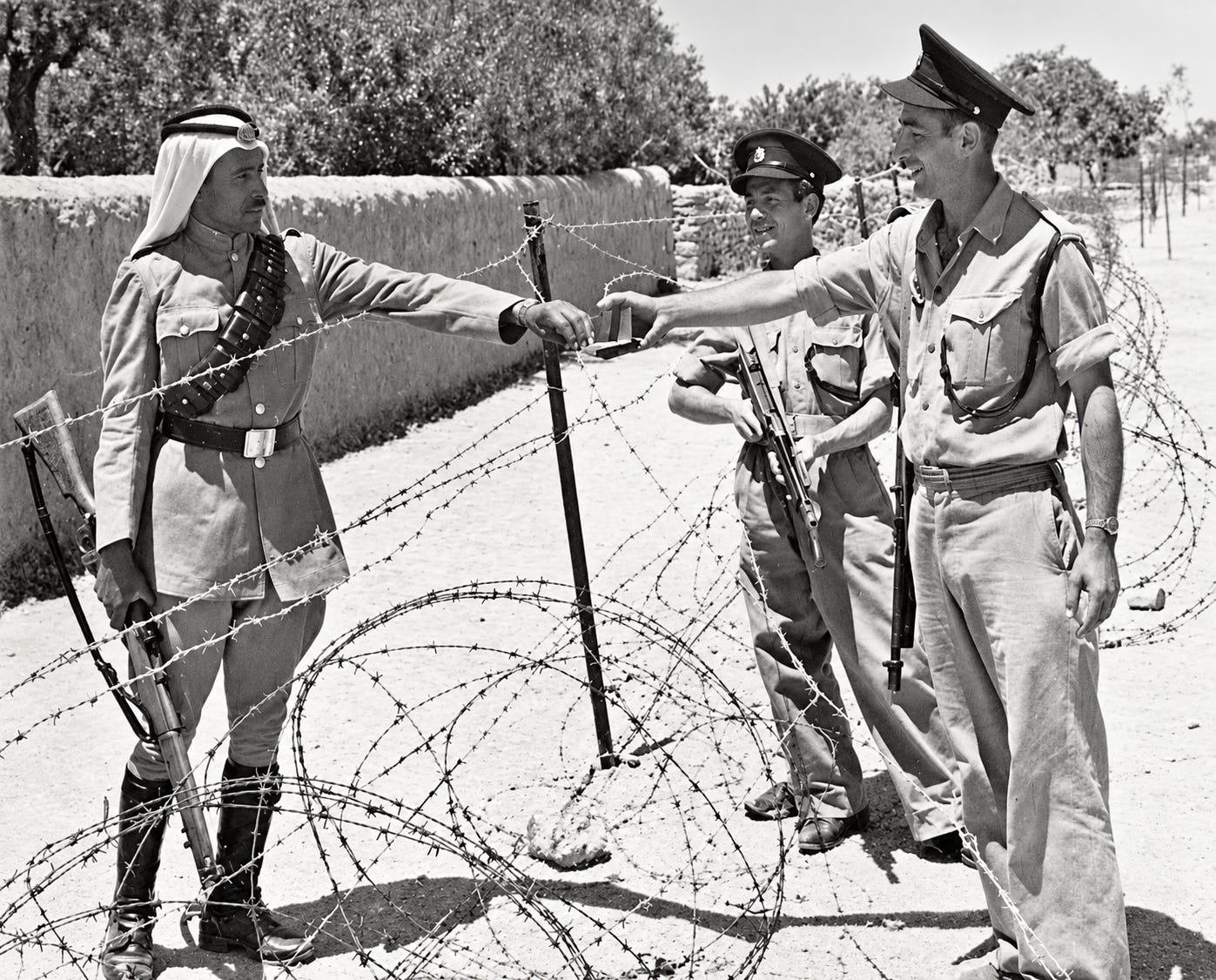
The Green Line (the demarcation line set by the 1949 Armistice Agreements after the 1948 Arab–Israeli War) cut through fields, roads, villages, and neighborhoods, but it also separated people from property they still legally owned.
Jews had homes in Jerusalem’s Old City and in the neighborhoods around Shimon HaTzadik. Jewish families lived north of Jerusalem in Atarot and Neve Yaakov and south of the city in the four communities of Gush Etzion. Jewish-owned parcels were scattered through East Jerusalem, Hebron, Bethlehem, Silwan, Beit Jala, Beit Iksa, Beit Safafa, and other places that ended up under Jordanian control.
Some of the property belonged to individual families. Other parcels belonged to banks, religious trusts, the Jewish National Fund, the Hebrew University of Jerusalem, and Jewish organizations.
There were farms, houses, shops, synagogues, cemeteries, schools, and undeveloped land. When the Arab–Israeli War ended and the armistice line was settled in 1949, thousands of dunams (a unit of land equal to about a quarter acre) belonging to Jews were now on Jordan’s side. Most of the owners were on the other.
The Jewish Quarter of Jerusalem’s Old City surrendered to the Arab Legion on May 28, 1948.
The following morning, the American vice consul in Jerusalem sent Washington the surrender terms. Approximately 2,000 women, children, elderly, and religious residents were to be evacuated to Jewish-held Jerusalem under the supervision of the International Red Cross. About 300 military-age men would be taken as prisoners of war to Amman. Of approximately 150 wounded, the seriously injured would be turned over to the Red Cross while the others became prisoners.
The evacuation continued through Zion Gate into the night. By the following morning, the Jewish civilian population of the quarter was gone. A community that had survived Ottoman rule, the British Mandate, riots, and repeated periods of violence had been emptied.
Its buildings remained. There were houses and shops, courtyards and yeshivas, charitable institutions, and synagogues. The great dome of the Hurva, a historic Orthodox Jewish synagogue, had towered above the quarter for decades, and nearby stood Tiferet Yisrael, another large 19th-century synagogue. Smaller houses of prayer were scattered through streets where Jews had lived for generations.
The destruction began immediately. The Hurva was blown up after the quarter fell. Tiferet Yisrael was destroyed as well. During the 19 years of Jordanian rule, other synagogues were demolished, damaged, stripped, or converted to other uses. Later accounts disagree over the number because they counted synagogues and smaller houses of prayer differently, but when Jews returned in 1967, much of the Jewish Quarter’s former religious landscape was gone.
A few miles north of Jerusalem, Jewish farmers had been building an agricultural community in Atarot (a biblical place mentioned in the Book of Joshua) since the years before World War I. Land around Qalandia was purchased for Jewish settlement beginning in 1912. After the war the community grew around dairy herds, orchards, fields, houses, and a cemetery. Farmers hauled milk and produce into Jerusalem along a road that became increasingly dangerous as attacks on the community mounted.
Atarot had already been badly damaged during the Arab riots of 1929. During the Arab Revolt of 1936 to 1939, five members of the community were killed in attacks on the settlement and its road to Jerusalem. By 1948, Arab forces had increasingly isolated the community and made its connection with Jerusalem dangerous.
Women and children were evacuated in April. On May 14th, the remaining residents were ordered to leave Atarot and reinforce nearby Neve Yaakov, abandoning the farms and houses they had spent decades building. The following day, they watched Atarot burn.
They weren’t safe at Neve Yaakov either. Arab forces attacked there too, and on May 16th its defenders withdrew on foot toward Mount Scopus. In 48 hours, two Jewish communities north of Jerusalem had been emptied.
Atarot’s families spent months moving before eventually settling in the former German Templer village of Wilhelma, which they renamed Bnei Atarot. Their old community was almost completely razed. The airport survived, as did the cemetery.
The families had lost the place where they lived. They had not ceased to own the land.
Estimates of Jewish property that came under Jordanian control sometimes reach about 30,000 dunams, but a more exact accounting survives in the records of the United Nations Conciliation Commission for Palestine. On March 17, 1966, United Nations land specialist Frank Jarvis compiled the Jewish-owned land identified in the commission’s records in Judea and Samaria (also known as the West Bank) under Jordanian control. His total was 16,684.421 dunams.
More than half was in the Jerusalem district. Another 3,031.759 dunams were listed in the Hebron district and 2,928.095 in Bethlehem, with smaller holdings in Nablus, Tulkarm, and Ramallah. Of the total, 6,676 dunams belonged to the four former Jewish communities of Gush Etzion.
The owners included private individuals, the Jewish National Fund, the Palestine Jewish Colonization Association, the Anglo-Palestine Bank, the Hebrew University of Jerusalem, and Jewish religious trusts. The Jewish cemeteries in Hebron and Nablus appeared among the properties as well. Individual Jews held land in East Jerusalem, Silwan, Beit Jala, Beit Iksa, Beit Safafa, Hebron, and elsewhere.
Some of those properties had been purchased under the Ottoman Empire and others during the British Mandate. The Green Line came later. A military armistice did not cancel the deeds.
Jordan inherited a British wartime system for controlling property belonging to enemy nationals and adapted it after 1948. Israel was now the enemy state. Jews who became Israeli citizens could therefore have property they had purchased years or decades earlier placed under Jordan’s Guardian, or Custodian, of Enemy Property.
Someone might have bought a parcel while the Ottoman Empire still existed, retained it through the British Mandate, and still appear in the land registry as its owner. Once that person became an Israeli citizen, Jordan could take control of the property, administer it, lease it, and collect rent from it.
The sequestration orders appeared in Jordan’s official government newspaper. An April 1954 order included property belonging to Yona Bern, Yona Friedman, the Palestine Electric Corporation, Shlomo ben Avraham Abu Jadid acting for the Hayy Olam religious trust, the Jewish National Fund, Pinhas Liebkin, and others. The Jewish cemeteries in Hebron and Nablus were included too.
The Anglo-Palestine Bank’s property was placed under the Guardian in 1963. Jordan was still issuing orders involving Jewish-owned property in Jerusalem in October 1966, less than eight months before Jordanian rule there ended.
Jordanian custodianship did not automatically erase the original owner’s title. The custodian could control and lease the property while the registered ownership remained. One small property in Hebron was rented for five Jordanian dinars a year.
By 1960, Jordan was still trying to identify some of what it controlled. That March, its representative asked the United Nations Conciliation Commission for registration records concerning Jewish-owned immovable property in Shu’fat and Nebi Ya’qub in the Jerusalem district. The UN land expert searched the commission’s files and found that it did not have them.
Eleven years after the armistice, Jordan was still looking for the paperwork of Jews who could no longer reach their land.
Jordan did more than hold Jewish property in government accounts. Buildings got new occupants, parcels were leased, and land was made available for government and refugee projects. Local Arab refugees were housed in parts of the former Jewish Quarter after its Jewish population had been expelled. Elsewhere, Jewish-owned property became available for uses chosen by Jordanian authorities because the owners were no longer there to control it.
At Atarot, the Jordanian custodian allowed the UN agency for Palestinians (UNRWA) to use 68 dunams of Jewish-owned land for the Qalandia Vocational Training Center. American diplomatic records show how valuable that property was becoming. Land estimated at about 200 Jordanian dinars per dunam in 1948 was valued around 1,000 dinars per dunam by 1961.
The arrangement was fairly simple in practice: The Jewish owners were across a border they couldn’t cross. Jordan controlled their land. UNRWA used 68 dunams of it.
Jews had buried their dead on the Mount of Olives for centuries. Generations of Jerusalem families were there, along with rabbis, scholars, community leaders, and Jews who had traveled from abroad to be buried overlooking the Old City. After 1948, the cemetery was under Jordanian control.
Article VIII of the Israel-Jordan Armistice Agreement signed on April 3, 1949, called for arrangements allowing free access to holy places and cultural institutions and the use of the Jewish cemetery on the Mount of Olives. Jews in Israel did not regain ordinary access to the cemetery during Jordan’s nineteen years in East Jerusalem.
The cemetery was also physically desecrated. After 1967, thousands of gravestones were found missing, broken, or removed from their original locations. Israeli investigators documented stones incorporated into roads, paving, military installations, latrines, and other construction. Israel later told the UN Security Council that 38,000 of approximately 50,000 stones had been torn up. The total came from an Israeli government count, but the removal and reuse of gravestones are documented in photographs and post-1967 investigations.
Families in West Jerusalem could live within sight of the mountain where their parents and grandparents were buried and still be unable to visit them. The armistice agreement had promised access. Jordan never provided normal access during its nineteen years of control.
Hebron’s Jewish property predated both Israel and the British Mandate. Jews had lived in the city for centuries and owned homes, shops, religious property, and land there.
On August 24, 1929, Arab rioters murdered 67 Jews in Hebron. Homes and synagogues were attacked and looted, and British authorities evacuated the surviving Jewish population. A small number of Jews returned in 1931, but British authorities removed the remaining community again during the Arab Revolt in 1936.
By 1948, there was no Jewish community left in Hebron. But, there was still Jewish property. Jordan’s enemy-property records included Jewish holdings in the Hebron district, including the cemetery. The UN’s 1966 accounting identified more than 3,000 dunams of Jewish-owned land in the district. Some belonged to institutions and some to private owners whose connection to Hebron reached back well before anyone had drawn a Green Line.
The Jews had been driven out. Their names remained on the property records.
South of Jerusalem were the four Jewish communities of Gush Etzion: Kfar Etzion, Massuot Yitzhak, Ein Tzurim, and Revadim. They had endured months of siege and attacks before Kfar Etzion fell on May 13, 1948, one day before Israel declared independence.
The fall ended in a massacre. After the defenders surrendered, Arab Legion soldiers and local Arab irregulars killed a large number of the surviving Jewish defenders and residents. Estimates vary, but more than 100 Jews were killed at Kfar Etzion that day. The remaining three settlements surrendered to the Arab Legion the following day, and their surviving residents were taken prisoner. The four communities were subsequently destroyed.
The land was substantial. The 1966 UN accounting attributed 6,676 dunams of Jewish-owned property to the four former settlements, making Gush Etzion one of the largest concentrations of Jewish land under Jordanian control.
For 19 years, the communities existed elsewhere. Survivors rebuilt their lives inside Israel while the sites of their former homes remained across the Green Line. Their property was still being counted as Jewish-owned in a United Nations land report in 1966.
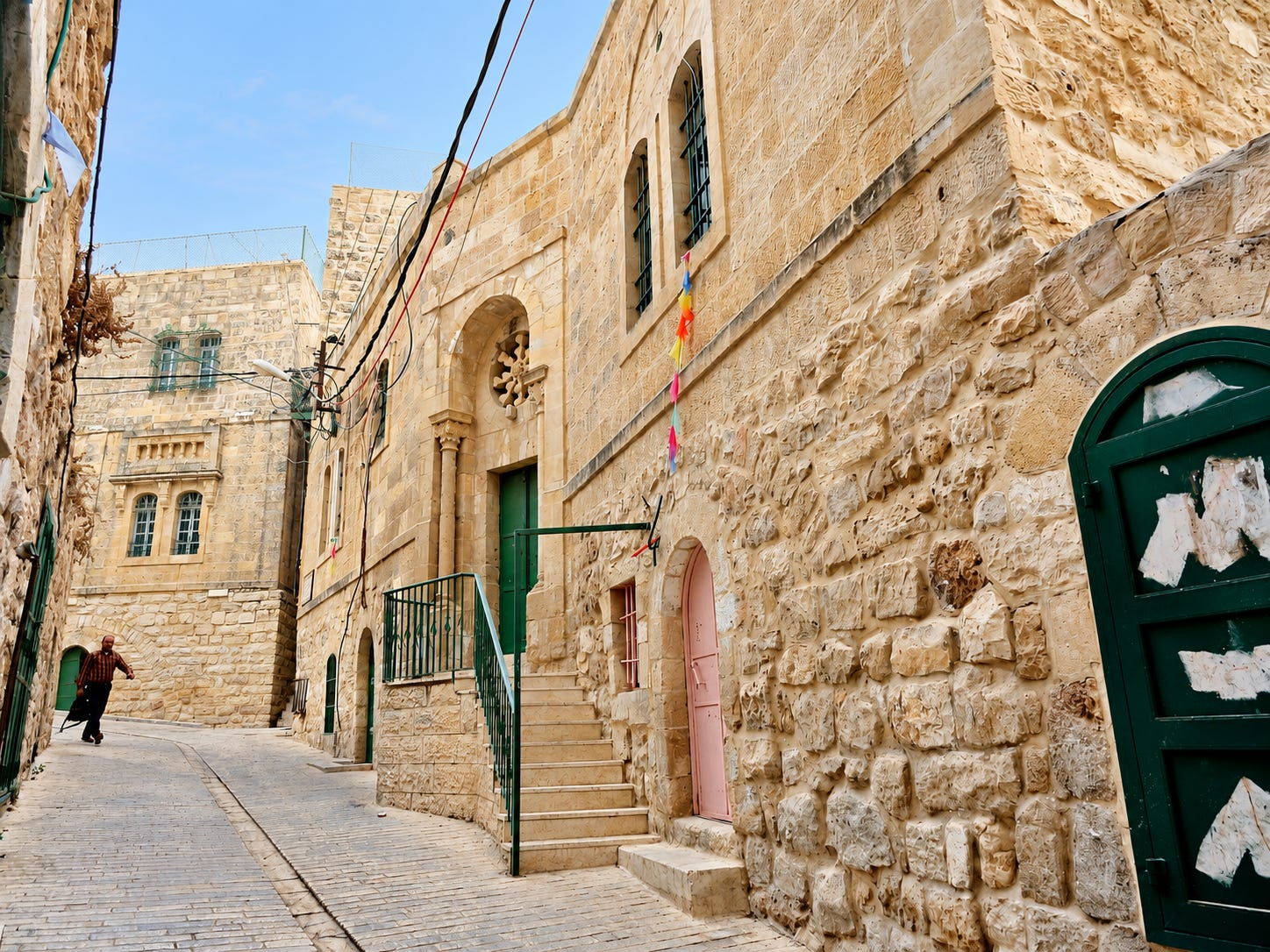
Sheikh Jarrah’s property history began long before the court cases that eventually made the neighborhood internationally famous. In 1876, Jewish communal trusts purchased land near the traditional tomb of Shimon HaTzadik (Simon the Just). Jewish families later settled around the tomb and in neighboring Nahalat Shimon, forming communities outside the Old City walls decades before the British Mandate.
Violence in 1948 forced the Jewish residents out. Their property came under Jordan’s Custodian of Enemy Property. On August 25, 1954, the custodian leased the land to Jordan’s Minister of Housing and Construction for 33 years at a rent of one Jordanian dinar a year. The ministry was allowed to build houses there and rent them to refugees.
Jordan and UNRWA entered another agreement on November 16, 1954. UNRWA provided $55,636 to construct homes for 28 Palestinian refugee families, and its annual report recorded the project while it was underway. The agreement described the construction site as formerly Jewish property.
The 28 families had been displaced during the 1948 war from places that became part of Israel. Under the Jordanian arrangement, they would leave UNRWA’s relief rolls and pay nominal rent for the houses. In September 1956, Jordan’s housing minister entered individual agreements with the residents that contemplated eventual ownership under certain conditions.
Jordan never completed those transfers in the land registry before losing East Jerusalem in 1967.
That failure eventually became central to decades of litigation. Jordan later produced documents supporting the local Arab residents’ claims, while Israeli courts concluded that title had never legally passed to them. The courts also recognized tenancy rights created during Jordanian rule.
The Sheikh Jarrah dispute therefore did not begin with Israelis arriving in an Arab neighborhood in the 2000s. Jewish ownership predated the British Mandate. Jews were driven from the property in 1948. Jordan seized control of it as enemy property, leased it to its housing ministry, and placed Palestinian refugee families there. The promised transfer of ownership to those families was never completed.
That history does not settle every later legal question, but leaving it out changes the story completely.
After the 1967 Six-Day War, Israel captured East Jerusalem and the West Bank in June 1967, ending 19 years of Jordanian rule. Jewish property that had been under Jordan’s enemy-property custodian now came under Israeli control, creating questions about whether it should be returned and what should happen when other people had been living on it for years.
Local Arabs (known as “Palestinians”) had also lost property during the 1948 war, including homes and land inside the State of Israel. The Israelis administered much of that property through its Custodian of Absentee Property under the 1950 Absentees’ Property Law. This becomes relevant here because the two property systems developed differently after 1967.
Israel’s 1970 Legal and Administrative Matters Law created a mechanism for certain Jewish property in East Jerusalem that remained under Jordanian custodial control to be released to former owners or their successors. Palestinians generally did not receive an equivalent mechanism to reclaim property lost inside Israel in 1948. That difference remains one of the Palestinian arguments against the East Jerusalem restitution system.
Israeli legal arguments focus on what the 1970 law actually covered: property that had remained under the Jordanian custodian when Israel took East Jerusalem. Property Jordan had legally transferred to someone else presented a different question. Sheikh Jarrah became difficult because Jordan had promised eventual ownership to the refugee families but, according to the later Israeli court record, had never completed the conveyance.
The legal fight came almost two decades later.
Between 1948 and 1967, Jewish property remained scattered across territory from which its owners had been expelled or otherwise separated. Homes acquired new occupants. Land was leased. Synagogues were destroyed. Cemeteries were placed under enemy-property control. Gravestones were torn out of the Mount of Olives. Atarot and Neve Yaakov disappeared. The Jewish Quarter was emptied. Gush Etzion was destroyed after a battle that ended with the killing of more than 100 Jews at Kfar Etzion.
The owners didn’t disappear from the paperwork.
In March 1966, UN land specialist Frank Jarvis could still add up the Jewish-owned property his records identified on Jordan’s side of the Green Line.
16,684.421 dunams.
Years after the armistice, the deeds still had their names.
I always found it weird how some Westerners see 99.84% of the Middle East ruled by Muslims, but they want it to be closer to 100%. For Muslims who feel this way, it's pure greed. For non-Muslims, it's incomprehensible.
In all the talk, the accusations, the claims that the Palestinians were kicked out when the Jews created Israel, none of those people have been able explain why Jerusalem has a Jewish name, had that name for over 2,000 years.