


Please consider supporting our mission to help everyone better understand and become smarter about the Jewish world. A gift of any amount helps keep our platform free of advertising and accessible to all.
This is a guest essay by Vanessa Berg, who writes about Judaism and Israel.
You can also listen to the podcast version of this essay on Apple Podcasts, YouTube Music, YouTube, and Spotify.
If you have ever seen a Palestinian leader appear in public, you may have noticed something peculiar: Oftentimes, they are holding a child in their arms.
Why?
A child can make an Israeli assassination attempt far more difficult.
But you don’t have to be a Palestinian leader to understand the power of putting a child between yourself and someone who opposes you. In the West, there is a particularly effective way to win an argument without ever having to make one: Bring up the children.
The principle is remarkably similar. When you put a child between yourself and your opponent, suddenly your opponent is put in a difficult position.
It doesn’t matter what the argument is about — war, politics, immigration, education, religion, public safety, or virtually anything else. Simply invoke the suffering of children, frame yourself as the person who cares about them, and the implication does the rest: Anyone who disagrees with you must not care about children.
Now, the conversation is no longer about the issue itself. It’s about whether you’re a decent human being. And who wants to be on the side that’s supposedly against children?
Consider a statement that has circulated in countless variations throughout the Israel-Hamas war: “Wanting kids to live isn’t antisemitic.” So says “Ms. Rachel,” a famous YouTuber who somehow thinks that having a take on Gaza is related to her original songs and classic children’s music videos.
Of course, “wanting kids to live” is not antisemitic.” That’s precisely what makes the statement so manipulative. It takes something virtually everyone agrees with, presents it as though it were a controversial position, and insinuates that the people on the other side of the debate must believe the opposite.
The implication is obvious: I want children to live. You disagree with me. Therefore, you must not want children to live. It’s a clever rhetorical trick, and an intellectually dishonest one.
Nobody needs to be persuaded that children deserve to live. Nobody needs to be convinced that children should not suffer. These are among the most universally shared moral convictions in human civilization.
But agreeing that children should live tells us virtually nothing about how to resolve a war, defeat a terrorist organization, negotiate a peace agreement, protect civilians, or respond to an armed attack. Those are the actual questions. And they are considerably harder than declaring that children shouldn’t die.
The problem with invoking children this way is that their suffering is being used to avoid the very conversations necessary to address it. For example, when someone raises concerns about Hamas, the October 7th massacre, Israeli hostages, or Israel’s security, another person might respond by asking, “What about the children in Gaza?” It’s a way to shut down the original conversation. Instead of addressing the argument about Hamas or Israeli security, the person redirects the discussion toward something emotionally devastating and morally indisputable.
If you continue discussing Hamas, you’re accused of ignoring dead children. If you discuss Israel’s security concerns, you’re accused of valuing Israeli lives over Palestinian ones. If you point out the complexity of urban warfare, you’re told that nothing could possibly justify the death of a child.
And just like that, the original argument disappears. It’s replaced by a moral loyalty test. The person invoking the children gets to occupy the moral high ground without having to explain what they actually believe should happen next.
Should Israel have responded militarily to October 7th? If so, how? What should happen to Hamas? What arrangements could prevent another massacre? How can civilians be protected while armed groups operate in densely populated areas? What obligations does Israel have when civilian casualties are foreseeable? What responsibilities do Palestinian armed groups bear toward the people living around them?
These questions matter. Some are deeply uncomfortable. Some have no easy answers. But they cannot be resolved by repeating, “Children are dying.” That statement describes an awful reality. It does not, by itself, establish a policy.
And yet, in modern political discourse, describing an awful reality is increasingly treated as a substitute for thinking about what to do about it. This phenomenon extends far beyond Gaza. Imagine a politician arguing that a particular immigration policy needs to be enforced. Rather than debate whether the policy is fair, effective, or necessary, an opponent responds, “How can you do this to innocent children?”
Perhaps there are children who would be harmed by the policy. That deserves serious consideration. But their existence does not automatically answer every question about immigration law.
Or think about education. A parent raises concerns about what is being taught in a classroom, and someone responds, “Why do you want to hurt vulnerable children?” Again, the conversation shifts. The original question was about educational content, parental rights, and the responsibilities of schools. Now the parent is defending themselves against an accusation of cruelty.
The same tactic appears in arguments about criminal justice, public spending, healthcare, and national security. Somewhere in the discussion, somebody discovers that invoking children is easier than defending a position. And the reason is simple: Children are the closest thing society has to an unquestionable moral trump card. They are innocent and vulnerable, and they depend on adults for protection. Their suffering evokes an instinctive emotional response that transcends social and political beliefs, nationality, and religion.
Precisely because of that, they are extraordinarily useful to people who want to manipulate an argument.
Nobody wants to be accused of not caring about children. So when someone frames a disagreement around that accusation, the other person is immediately placed on the defensive. Instead of explaining why a particular policy might be necessary, they must first establish that they are not a monster. This is not a fair debate. It’s emotional blackmail disguised as compassion.
And here’s something else worth considering: The people who invoke children most aggressively are not necessarily the people who care about them most. Compassion is not measured by how frequently someone mentions children. Nor is it measured by how dramatically someone expresses outrage at their suffering. It is measured, at least in part, by whether someone is willing to think seriously about how that suffering can actually be prevented.
That requires more than slogans. It requires examining causes and consequences. It requires distinguishing between intentions and outcomes. It requires acknowledging that policies designed to protect people can sometimes produce unintended harm, and that refusing to act can also have devastating consequences.
In the case of Gaza, it requires taking Palestinian children’s suffering seriously without pretending that Hamas, Israeli security, hostages, civilian protection, and the future of Gaza are irrelevant distractions.
There is another uncomfortable truth that gets lost whenever children are invoked to end an argument: Children have parents, and parents have responsibilities.
For example, let’s say a parent enters a country illegally with their children, or enters illegally and subsequently has children there. When the government attempts to enforce its immigration laws, critics sometimes point to the children and ask how anyone could be so heartless as to disrupt their lives. But who made the original decision?
The children did not choose to cross a border illegally. They did not choose where to live or what laws their parents would follow. Those decisions were made by adults. And while the children should not be blamed for their parents’ decisions, other parents cannot be held responsible for the decisions of another child’s parents.
And the same distinction matters when we talk about Gaza. Israeli parents cannot be asked to spare their own children at the expense of Palestinian children. This becomes all the more true when we understand the stark differences in Israeli and Palestinian cultures, and how they view their own children.
In much of mainstream Palestinian culture, sacrificing one’s life for a greater cause (martyrdom) is presented as an extraordinary honor. Children grow up hearing stories that celebrate those who died for Islam and “Palestine.” They are taught that killing Jews is virtuous. This makes up significant parts of school curricula, media, and political discourse.
When Hamas glorifies martyrdom, celebrates armed struggle, or exposes civilian populations to the dangers of warfare, we should not automatically assume that its leaders share the same priorities or moral framework as the people criticizing Israel from comfortable homes in the United States or Europe. And, sadly, there are no universal standards regarding the protection of children.
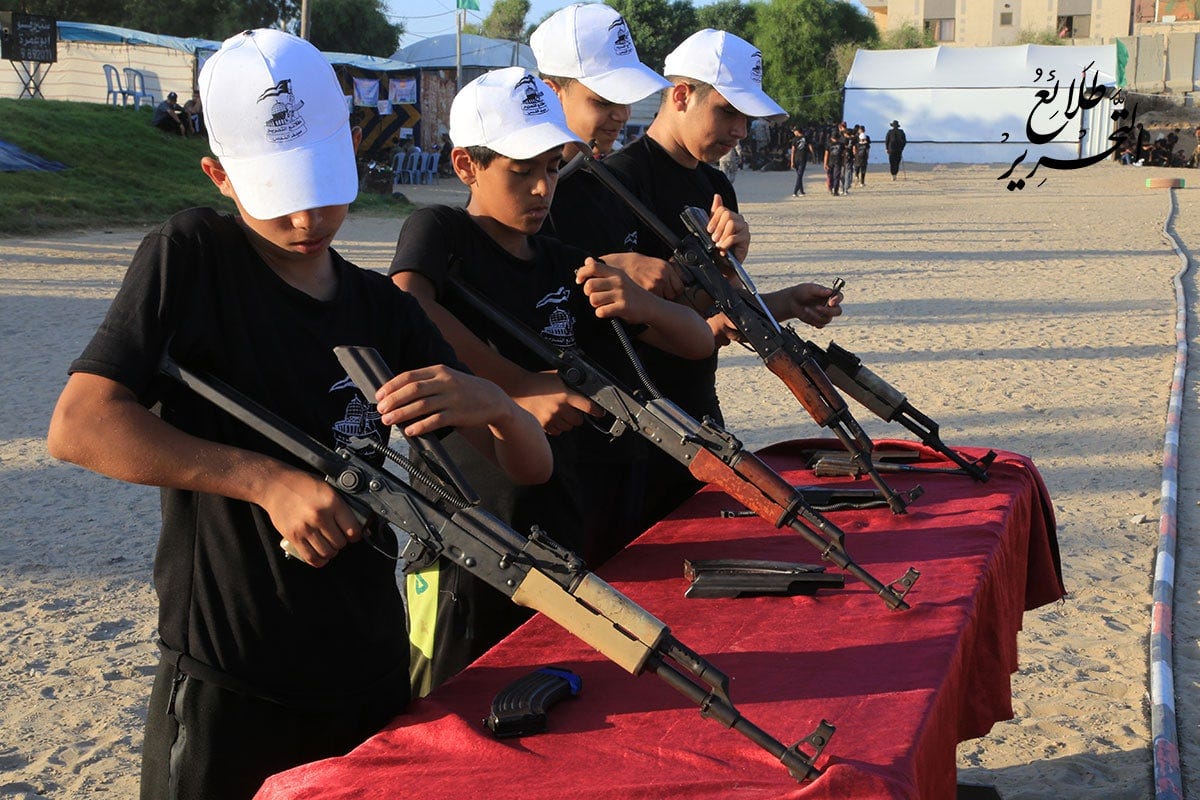
But if we genuinely want to understand why children suffer in conflicts, we have to examine not only what their enemies do to them, but also what the adults responsible for their welfare expect of them. Saying that children deserve to live is easy. The far more revealing question is what the adults around them are willing to do to ensure that they actually can.
Children do not exist in a vacuum. They live in families, communities, cultures, and societies governed by adults who make decisions on their behalf. Those adults, whether parents, political leaders, or military commanders, have responsibilities that cannot simply disappear the moment a child becomes the subject of a heartbreaking photograph.
And this brings us back to the larger problem with using children to win arguments: When someone points to a suffering child, our first instinct should be compassion. But compassion should not prevent us from asking who made the decisions that contributed to that suffering, what responsibilities each party bears, and what could realistically prevent it from happening again.
Children’s innocence does not mean adults are innocent. And recognizing adults’ responsibility does not mean children deserve to suffer. Both truths can exist at the same time.
And this is where the manipulation becomes especially insidious. A person who says, “Wanting children to live isn’t antisemitic,” is making a statement that is literally true. Wanting children to live is not antisemitic. Criticizing Israeli government policy is not inherently antisemitic either.
But if the statement is being used to suggest that accusations of antisemitism are simply attempts to silence people who care about children, it becomes something else entirely: a straw man.
The actual debate about antisemitism concerns things like demonizing Jews, holding Jews collectively responsible for Israel’s actions, applying discriminatory standards, glorifying violence against Jews, and recycling longstanding antisemitic ideas under contemporary political language. Those accusations cannot be dismissed simply by announcing that you care about children.
That’s how serious conversations work: We evaluate what people actually say, not the moral identities they claim for themselves. Yet modern society has created an entire culture in which people seem to believe that claiming the most compassionate position automatically makes them right. “I care about children.” “I believe in human rights.” “I don’t want innocent people to suffer.”
Wonderful. So do most people. Now what? What are you proposing? What are the consequences? What are the trade-offs? What happens if your preferred solution fails? What would you tell people whose safety depends on a different outcome?
Two people can love children equally and disagree passionately about education policy. Two people can care about public safety equally and disagree about policing. Two people can be equally horrified by war and disagree about whether military force is sometimes necessary to prevent even greater violence. Disagreement is not evidence of indifference.
In fact, one of the most troubling developments in contemporary discourse is the growing belief that the more emotionally devastating an argument sounds, the less scrutiny it deserves. Mention a dead child, and suddenly everyone is expected to stop asking questions.
But children are not arguments. Their suffering is not a logical shortcut. Their innocence does not transform every political demand made in their name into a morally correct one. And their lives are far too important to be reduced to rhetorical ammunition.
Of course we should care about children in Gaza. And in Israel. And in Ukraine, Sudan, Yemen, and everywhere else children suffer because of decisions made by adults. We should care enough to demand serious answers rather than satisfying slogans. We should care enough to distinguish genuine humanitarian concerns from attempts to manipulate emotions. And we should care enough to understand that sometimes two people can want exactly the same good outcome while disagreeing profoundly about how to achieve it.
The moment someone tells you that disagreeing with their position means you don’t care about children, they’ve stopped making an argument. They’re trying to make you feel guilty for asking questions. So the most important question we should ask in return is this: If your position is so morally compelling, why do you need to hide behind children to defend it?
What is telling is that the argument could easily be turned around: what kind of society is it that not only abdicates the care of its own children, but actually delegates their well-being to the goodwill of the enemy it swore to destroy? How does the whole world not come together to reject such an aberration against nature and civilization, instead of indulging it and supporting it in deed, and often in word?
We aren't asking to spare our own children at the expense of Palestinians, we just refuse to sacrifice our own children to their claims.