


Please consider supporting our mission to help everyone better understand and become smarter about the Jewish world. A gift of any amount helps keep our platform free of advertising and accessible to all.
This is a guest essay by Vanessa Berg, who writes about Judaism and Israel.
You can also listen to the podcast version of this essay on Apple Podcasts, YouTube Music, YouTube, and Spotify.
When the Pope speaks, countries listen. Because they recognize the authority of the Pope and the civilizational weight behind the office he represents. There is a baseline respect, even in disagreement.
When the Jewish state speaks — when it warns European governments that antisemitism is surging, that Jewish communities are increasingly in danger, that Israelis no longer feel safe traveling there, that the Mossad has to look after Jews in Europe because local agencies are not, that something is breaking — the response is not respect. It is dismissal, condescension, and, increasingly, punishment.
Israel is not merely ignored; it is scolded. Arms deals are suspended. Defense agreements are publicly rolled back, as seen last week when the Italian prime minister declared that “… the government has decided to suspend the automatic renewal of the defense agreement with Israel.” Israeli companies are excluded from defense industry fairs. European states move to recognize a Palestinian state unilaterally, not as part of a negotiated framework, but as a symbolic rebuke. These are not the actions of allies; they are the actions of actors attempting to selectively impose consequences.
And all of this unfolds against a backdrop that should alarm anyone paying attention: In virtually every major European country, antisemitism has surged to levels not seen in generations. Jewish schools require heightened security. Synagogues operate under protection. Open expressions of Jewish identity are, once again, being quietly recalculated for safety.
Israel sees this clearly. So does Ukraine. Last week, President Volodymyr Zelensky signed a landmark law which officially criminalizes antisemitism, including public incitement, hate speech, Holocaust denial, and violence against Jewish individuals or institutions. The worst offenses yield between three and eight years in prison. Europe, for the most part, does not see this so clearly — or chooses not to. This is the core asymmetry: Israel treats Europe like an ally, while Europe increasingly treats Israel like a problem to be managed.
Even under Right-wing governments, Israel has maintained a baseline of diplomatic respect toward European states, including those led by ideological opponents. That is what alliance means. You do not need alignment on every policy, every election outcome, or every cultural issue. Alliances are built on shared strategic interests, mutual respect, and a commitment to a stable and coherent world order.
But that framework is eroding.
So much of Europe today is drifting into something narrower and more brittle: an ideological bloc that increasingly defines legitimacy through adherence to a specific leftist worldview. On Israel, that worldview manifests as a near-automatic suspicion: Israel is presumed excessive in its use of force, uniquely responsible for regional instability, and perpetually in need of correction by external actors who bear little of the consequences.
That posture is not just misguided; it is unserious.
It ignores the strategic reality that Israel is one of the most reliable democratic allies Europe has in a volatile region. It overlooks Israel’s disproportionate contributions in intelligence, counterterrorism, technology, and defense — areas where European security has directly benefited. And it underestimates the cost of treating a frontline state as a diplomatic liability rather than a strategic asset.
More dangerously, it sends a message internally within Europe: that Jewish concerns, even when articulated by the world’s only Jewish state, can be deprioritized without consequence. That message does not stay confined to foreign policy; it seeps into domestic culture.
So what is Israel supposed to conclude?
There comes a point where a relationship stops being strained and starts being structurally misaligned. Europe’s pattern of behavior — symbolic gestures against Israel, material constraints on its defense, and a persistent unwillingness to confront its own internal antisemitism with seriousness — suggests that point may already have been reached.
“Goodbye” does not have to mean severing diplomatic ties or abandoning cooperation entirely. Neither you nor I know the behind-the-scenes downsides of outright disengagement. I’m sure Israeli officials will adequately weigh the pros and cons, which exist in every relationship. But it does mean recalibrating and recognizing that Europe, as it currently behaves, is no longer a dependable strategic partner in the way it once aspired to be.
As for Israel, it has options. It can deepen ties with countries that demonstrate consistent alignment, whether in Eastern Europe, Asia, Africa, and elsewhere. Israel does not need European weapons; it values them because they reflect a broader framework of cooperation — interoperability with allied militaries, shared research and development, and the political signal that comes with being treated as a trusted partner.
But tomorrow, Israel and Arab states like the United Arab Emirates and Bahrain could rather easily build and operate dozens of defense manufacturing plants; the Arabs have the money, Israel has the technology. Europe acts like it has a monopoly on allyship, but in reality, it is increasingly just one option among many, and this one is producing diminishing returns.
Strip away Israeli intelligence sharing from Europe and watch the margins of safety narrow — terror threats identified later, plots disrupted less often, more attacks successfully carried out. Remove access to Israeli defense technology and joint development, and European militaries lose a proven edge in areas like missile defense, unmanned systems, and battlefield adaptation. Cut off the flow of Israeli innovation across medicine, agriculture, water management, and cybersecurity, and Europe doesn’t just lose convenience; it loses compounding gains that quietly strengthen public health, food resilience, and digital security.
We know what real allyship looks like. Just yesterday, Argentine President Javier Milei arrived in Israel and, together with Israeli Prime Minister Benjamin Netanyahu, launched the “Isaac Accords” in Jerusalem, meant to create a framework for strengthening ties between Israel and countries in the Western Hemisphere. The Milei initiative will bring together “the descendants of Isaac and nations of the Judeo-Christian tradition, in defense of freedom and democracy, and in the fight against terrorism, antisemitism, and drug trafficking,” according to a joint statement.
Members of the accord will coordinate against “Iran’s attempts to expand its terrorist networks and operational presence across the Western Hemisphere,” the statement said. “The initiative also seeks to foster coordination and alignment in international forums and to promote a framework to expand cooperation in innovation, technology, trade, and economic openness.”
One would assume that Europe — the birthplace of the Enlightenment and many of the moral frameworks it still claims to uphold — would be the source of such clarity. Israel and Europe are just a few thousand kilometers away. Instead, this initiative came from an Argentine president who flew 12,000 kilometers to make it official.
The contrast is telling; it suggests that what Europe often presents as universal values are, in practice, selectively applied. Principles like human rights, moral responsibility, and democratic integrity seem to carry weight only when they align with prevailing political preferences. That feels a lot like fascism to me.
Of course, Europe wants everyone to think Israel is the issue here. Spain’s prime minister uses the Jewish state to cover up longtime accusations of his family’s corruption. The Europeans go on and on about Israel’s “Right-wing government,” but “Right-wing” is not a slur; it is the outcome of elections in which 70-percent of Israelis vote. Even then, Israel still sustains a plethora of liberal institutions, including social healthcare, access to education, equal rights for all minorities, free and fair elections, and so forth.
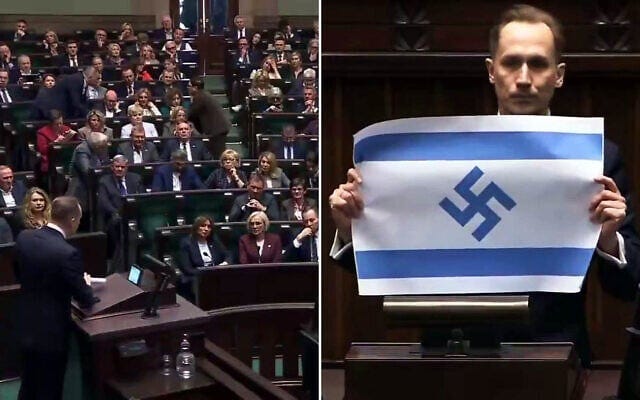
“Yeah but Ben-Gvir and Smotrich are extremists!” they say. Nitpicking Israel’s most extreme politicians is meaningless; there are extreme politicians in every country. Just last week, Far-Right Polish lawmaker Konrad Berkowicz called Israel the “new Third Reich” and displayed an altered Israeli flag bearing a swastika during a speech in parliament.
I can list dozens of extremist politicians in America, the UK, Canada, Germany, South Africa, you name it. But they mostly get a free pass while Israel’s more extreme politicians are held up as proof that the entire system is beyond the pale, and the country is treated as if it is uniquely defined by its fringes.
The double standards that Europe imposes on Israel are absurd. What was once imposed on Jewish individuals in European countries is now applied to the Jewish state. The scale has changed, but the pattern has not.
I recall an Uber driver explaining to me in 2016, in the run up to the Donald Trump-Hillary Clinton presidential election, he preferred Hillary “but I don’t like the way she dresses. She’s always wearing pantsuits. What can’t she wear a dress?”
This is an obvious display of sexism, because this man would never make a comment about a male candidate's attire. The same goes for Europe: The double standards they apply to Israel are, undoubtedly, antisemitic. What was once imposed on Jewish individuals in European countries is now applied to the Jewish state. The scale has changed, but the pattern has not.
Thankfully, Israel is in a position to stop seeking validation from governments that have made clear, through both action and attitude, that they are less interested in partnership than in pressure. Alliances are not sentimental; they are functional. They either serve the interests of both parties, or they do not.
And right now, for Israel, they do not.
The left in general refuses to even acknowledge reality. Same with the Israeli left actually. Funny they forget that the Mullahs and progressives worked together to bring down the Shah and once they succeeded the Mullahs killed all the progressives. Will they ever learn?
European governments are toothless paper tigers desperately trying to convince themselves they have any international influence. They’re a pathetic bunch lacking vision and decisiveness, completely alienated from their people. Their sanctimonious righteousness is a charade and Israel should say good riddance.