


Please consider supporting our mission to help everyone better understand and become smarter about the Jewish world. A gift of any amount helps keep our platform free of advertising and accessible to all.
This is a guest essay by Hen Mazzig, an Israeli writer, speaker, and social media influencer who lives in the UK.
You can also listen to the podcast version of this essay on Apple Podcasts, YouTube Music, YouTube, and Spotify.
Editor’s Note: The Eurovision Song Contest is a massive, glitzy European music competition that has served as a vital cultural bridge and collective celebration for Israel since 1973. For Israeli pop culture, it is a deeply cherished institution where iconic victories (from Dana International to Netta) have mirrored the nation’s shifting identity, resilience, and pride on the international stage.
For a moment on Saturday night, Israel was in first place at Eurovision.
I was watching from London, refreshing the votes on my phone. The public count had just come in for Israel — 220 viewer points on top of a strong jury score — and for a brief minute, the leaderboard rearranged itself: Israel at the top, Bulgaria second.
A boy from Ra’anana (a city just north of Tel Aviv), in a leather jacket, was briefly the winner of a contest a thousand artists had spent a year demanding he be excluded from.
The crowd in the arena booed.
You could hear it through the broadcast, the sound of a room realizing what the rest of Europe had just done in private. Then Bulgaria’s televote came in, the order corrected, and the night was over. Bulgaria won, Israel came second. By the time I’d brewed a pot of tea, the headlines were already calling it a defeat.
What happened on Saturday in Vienna is one of the most revealing political events in Europe this year, and almost nobody is going to tell you what it means.
The 70th Eurovision Song Contest was almost the same as the previous: sequins, key changes, the whole camp ritual that turned the most-watched non-sporting broadcast on earth into a punchline decades ago.
This year, the ritual was haunted. For months, activists had promised that Vienna would be the site of a reckoning. Three-thousand protesters would form a wall of bodies around the arena. The world would see Europe reject Israel in real time.
A few hundred showed up on Saturday. A similar protest earlier in the week drew a couple of dozen for what was supposed to be the great anti-Israel rally of the European spring.
Inside the arena, the production team braced for chaos. Noam Bettan, Israel’s 28-year-old contestant, had spent months rehearsing his performance against simulated boos played through his in-ear headphones so his voice wouldn’t crack when the crowd turned against him. Try to think of another industry where the artist trains for hostility before the performance; there isn’t one.
Eurovision has become a war zone with a glitter cannon.
Five countries — Spain, Slovenia, the Netherlands, Iceland, and Ireland — had pulled out entirely to boycott Israel’s participation. It was the largest political boycott Eurovision has seen in more than 50 years. Their broadcasters made the decision for their audiences, on their behalf, with no public vote. The very people who had spent a year demanding Israel be silenced silenced their own people first. Almost no one found this strange.
Look at who stayed in.
Norway recognized a Palestinian state two years ago and still showed up to sing. Belgium is currently lobbying the European Union to sanction Israel, and still showed up to sing. These are countries with serious cultural traditions, countries whose histories taught them what it costs to silence an artist. They disagreed with the Israeli government as loudly as anyone in Europe, and they still understood that disagreement is not the same thing as a boycott.
You can criticize a country’s government and still let its singer compete. Norway and Belgium got that right; Spain didn’t.
Spain boycotted, and then, when its broadcaster did cover the contest, it broke European Broadcasting Union rules on air by putting a political slogan on screen during the live broadcast. The countries with the moral confidence to disagree played by the rules; the country that wanted to perform its disagreement broke them. Tell me which has more integrity.
Noam Bettan is the son of French immigrants. He grew up in Ra’anana. He has the kind of face Israeli mothers describe as a good boy, which means handsome enough to be on a billboard and earnest enough to be at the Shabbat table.
The night before the final, he was photographed praying the Kiddush1 in a Vienna hotel, while 200 protesters chanted outside. There is something almost unbearable about the image of a young Jewish man making the blessing over wine while the city outside negotiated whether he was allowed to participate in Eurovision.
He performed third. His song was “Michelle,” a love song about a fictional woman, sung in a voice that, against every prediction, did not crack. The crowd that was supposed to drown him out sang along. There were boos. There were also thousands of people in that arena who had come specifically for him, who waved flags he wasn’t allowed to bring on stage, who shouted his name when the cameras cut to him in the green room.
He finished his performance, thanked Europe, and then he said, on live international television, Am Yisrael Chai — the people of Israel live.

Boycotting art is not new. Threatening artists is not new. We could easily be living in a world today where Picasso was erased because he painted Guernica against Franco, or a world where Michelangelo was buried because the Church decided his nudes were pagan, or where Beethoven was silenced because his politics offended the wrong court.
Every one of those artists had a political agenda. Picasso was a communist, Michelangelo was a heretic by half the standards of his age, and Beethoven dedicated and undedicated symphonies based on who was invading whom.
Noam Bettan had one agenda: to sing on behalf of his country.
He didn’t write a protest song or call out a government. He sang a love song called “Michelle” in a leather jacket on a stage in Vienna. And a coordinated international movement spent a year trying to make sure he couldn’t.
This is a categorical shift, and we should name it. The boycott campaigns of history we now teach as cautionary tales were aimed at artists whose art was political. The campaign against Noam was aimed at an artist whose only offense was the passport on his entry form. There was no song to object to and no statement to denounce. There was only a young man with a microphone and the wrong nationality.
If you can boycott an artist for existing, you have abandoned the principle that art is judged on its merits. You have decided that some artists are not entitled to be heard at all. We used to call that a blacklist, and we used to feel proud of ourselves for opposing it.
We have one now: It is pointed at Jews.
When you stop and ask what the campaign against Noam was actually about, you arrive at a question that should not need to be asked in 2026: Should Jews be allowed to sing in Europe? A thousand artists signed letters saying no. Five countries, their public broadcasters, and the activists outside the arena said no. Europe, in the privacy of its own televote, said yes.
Eurovision works in two parts. National juries, panels of music industry professionals whose names are kept secret, award half the points. The public, voting privately by phone, awards the other half. The system was designed to balance critical expertise against popular taste. This year, it accidentally became something else: a referendum on whether Europe’s institutions still represent Europe.
There is something the headlines missed entirely: Eurovision doesn’t vote once. It votes three times. There are two semifinals before the final, each one a separate count of juries and public across the participating countries. Israel performed in the second semifinal earlier in the week, and Noam topped it — first place, the highest score of any country in his group.
Three nights later, in the grand final, Europe voted again and put him second only to a once-in-a-decade Bulgarian dance hit. Twice in one week, in separate votes, with separate juries and separate publics, Europe placed the Israeli at the top of his group.
Once is a moment, twice is a verdict, now the final itself.
The juries went first. Last year, most of them boycotted Israel and refused to award a single point. The boycott was so coordinated that it became a story in itself. This year, 22 of the 34 national juries gave Israel points. Poland’s jury gave the maximum 12. Ukraine, Moldova, Albania, Austria, and Lithuania all gave eight or above. The boycott broke quietly — no press release, no apology for last year, no admission from anyone in the industry that they had been wrong. The juries simply, individually, decided they couldn’t keep doing it.
Then came the public vote, the part that the institutions can’t control. One-hundred and seventy million people in their living rooms, with their phones, voted privately — no public broadcaster to please, no activist to perform for, no coworker to justify it to on Monday morning. just a person and a button.
Israel finished third in the public vote out of 37 countries — 220 points from the audiences of Europe. Six countries (France, Finland, Azerbaijan, Switzerland, Portugal, and Germany) gave Noam the maximum 12 points from the public. Look at that list. No bloc, no shared diaspora. Six different corners of the continent, plus a Muslim-majority country, plus Germany, which, given its history, has every institutional reason to keep its distance from Israeli politics and every emotional reason not to.
Total result: 343 points, good for second place for Israel’s second year running.
Here is something almost nobody reported: On Eurovision’s official Instagram account, the platform where the institution itself chooses what to amplify, Noam Bettan’s performance was the most-watched video of the entire contest. The contestant a thousand artists wanted banned, who five countries boycotted, who the New York Times tried to frame as a marketing operation rather than a musician, was the contestant that the most people chose to watch.
That is the audience telling you, in raw numbers, what they wanted to see.
To understand why this matters, you have to understand how Eurovision actually works. Voting patterns are one of the most studied datasets in European cultural sociology. Bookmakers factor them into odds. Researchers build models around them. They have a name: bloc voting.
Greece and Cyprus give each other 12 points so reliably that it has become a running joke. They’ve done it for decades, on shared history and a shared grievance over Turkey. The Nordics cluster, exchanging high points like family members passing dishes at a table. The former Yugoslav states fought each other in living memory and still award each other points, because culture moves more slowly than politics. The Baltics are a bloc.
These aren’t conspiracies; they’re soft power maps. They show you who Europeans feel cultural proximity to, who has neighbors, and who has a community willing to vote on autopilot.
Think of Eurovision voting like a high school cafeteria — everyone has a table. The Nordics sit together, the Yugoslavs sit together, and Greece and Cyprus have been best friends for years.
Israel sits alone.
There is no Israeli bloc because there is no Israeli neighborhood. The closest countries geographically are Lebanon, Syria, Jordan, and Egypt — and none of them compete. The countries with the largest Jewish populations after Israel itself are the United States and France, and the United States doesn’t compete either. Israel walks into Eurovision every year as the kid with no lunch table, hoping someone across the room will wave them over.
And what just happened is the kid with no table got picked third by the entire cafeteria. Every point Israel earned, it earned on its own. There was no bloc to inherit and no neighbor returning a favor.
The campaign against Israel framed every Israeli high finish as suspicious — bought, driven by bots, or manipulated by the state. The New York Times wrote two stories suggesting exactly that, and admitted in both that there was no evidence for any of it.
Eurovision’s public vote is the most honest political instrument in Europe. There is no polling bias, no social desirability effect, just a phone and a button and a private moment of preference. When Europeans were given that private moment, they chose Israel third out of 37 countries, despite everything.
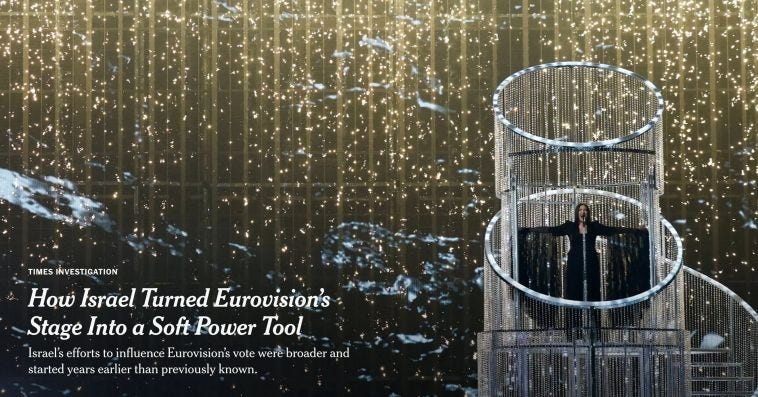
Which brings us to the New York Times.
The Times spent the last week of the Eurovision cycle publishing what it called “an investigation” into Israel’s Eurovision campaign. The piece suggested, without ever quite saying so, that Israel had used Google ads and state-backed promotion to manipulate the public vote. The phrase used was: “embraced Eurovision as a soft power tool.”
Buried in the article was a sentence that should have killed the story before it ran. There was no evidence Israel had used bots or covert tactics to manipulate the vote.
Every country promotes its Eurovision act. Every Eurovision entrant films a glossy postcard showcasing their country’s most beautiful locations, with no mention of unemployment or government corruption. Israel did what every country does; the Times turned it into a scandal.
The night of the final, the Times posted an Instagram carousel summarizing the contest, featuring 10 photos. Every other country got a performance shot:a singer mid-note, an artist on stage, a moment from their three minutes in front of Europe. Israel got Noam holding a flag. He wasn’t singing or on stage. He was a photograph of a man and a symbol. The caption explained that the contest had been overshadowed by protests over Israel’s participation.
The Times could not bring itself to show an Israeli singing. It could only show a Jew holding a flag, captioned with controversy.
Imagine the New York Times covered the Olympics this way. Every American gold medalist photographed with a flag rather than crossing a finish line. Every French victory paired with a paragraph about what activists thought of France. Every profile of an Chinese athlete spending more time on what the country had done wrong than on what the athlete had accomplished.
We would notice. We would suspect, correctly, that the people making those editorial choices had a position they were not quite willing to say out loud. That is how the New York Times covers Israel — and not just at Eurovision, but always.
The pattern in Times coverage of Israel is not random or coincidental. It is a house style. The institution has developed, over the years, a way of writing about Israel that treats it as a perpetual exception. In the New York Times’ rendering, every other country is a contestant, and Israel is a problem.
In the actual contest, Europe voted for Israel third. One of the most-read newspapers in the world could not bring itself to tell its readers that. So it told them, instead, that he was something to apologize for.
“Official Europe” (meaning the broadcasters and the activists and the newspapers and the artists’ letters) spent a year insisting that Israel should be banned, ostracized, treated as a pariah. “Actual Europe” (meaning the people in their living rooms with their phones) voted Israel third out of 37.
That gap is the most important political fact on the continent right now.
A traditional Jewish blessing recited over wine or grape juice to mark the holiness of Shabbat and major Jewish holidays

Noam and his team performed with humanity and love — he and Israel are class acts. Am Ysrael Chai 🫶🫶
So right! The disappointed Israel boycotters blame the popular vote for the failure to take Israel down. Regardless that the popular voting was already geared down to punish Israel. Absolutely pathetic!! The Jews consist of less than 0.1% of European population. So, it cannot be the Jews voting for Israel. The point here obviously is the deep disappointment of the Jew bashers who must realize that their giant continent wide campaigns are not producing wanted results. The silent guy from the buss stop still votes Israel.