


Please consider supporting our mission to help everyone better understand and become smarter about the Jewish world. A gift of any amount helps keep our platform free of advertising and accessible to all.
This is a guest essay by Kaitlin Kehler, a writer, content creator, and author.
You can also listen to the podcast version of this essay on Apple Podcasts, YouTube Music, YouTube, and Spotify.
In the Hasidic world, there is a phrase for when somebody stops being observant: off the derech.
It means off the path.
A young man stops wearing his payos. A young woman puts on jeans. The family lights a candle, or doesn’t. Cousins are dispatched. The community is, depending on which corner of the Hasidic world we’re discussing, somewhere between concerned and devastated.
It is a serious matter. It is also, when you think about it, a remarkably efficient piece of social technology.
I bring this up because I have come to suspect, over the past year and a half, that the secular world has its own version of going off the derech. We just haven’t named it yet.
I grew up in Boise, Idaho, in a household more curious than religious, surrounded by Catholics and Mormons. None of it took. I went to a Baptist university in Waco, Texas, for college, and that did not take either. I spent the years that followed looking, in earnest, for something that would.
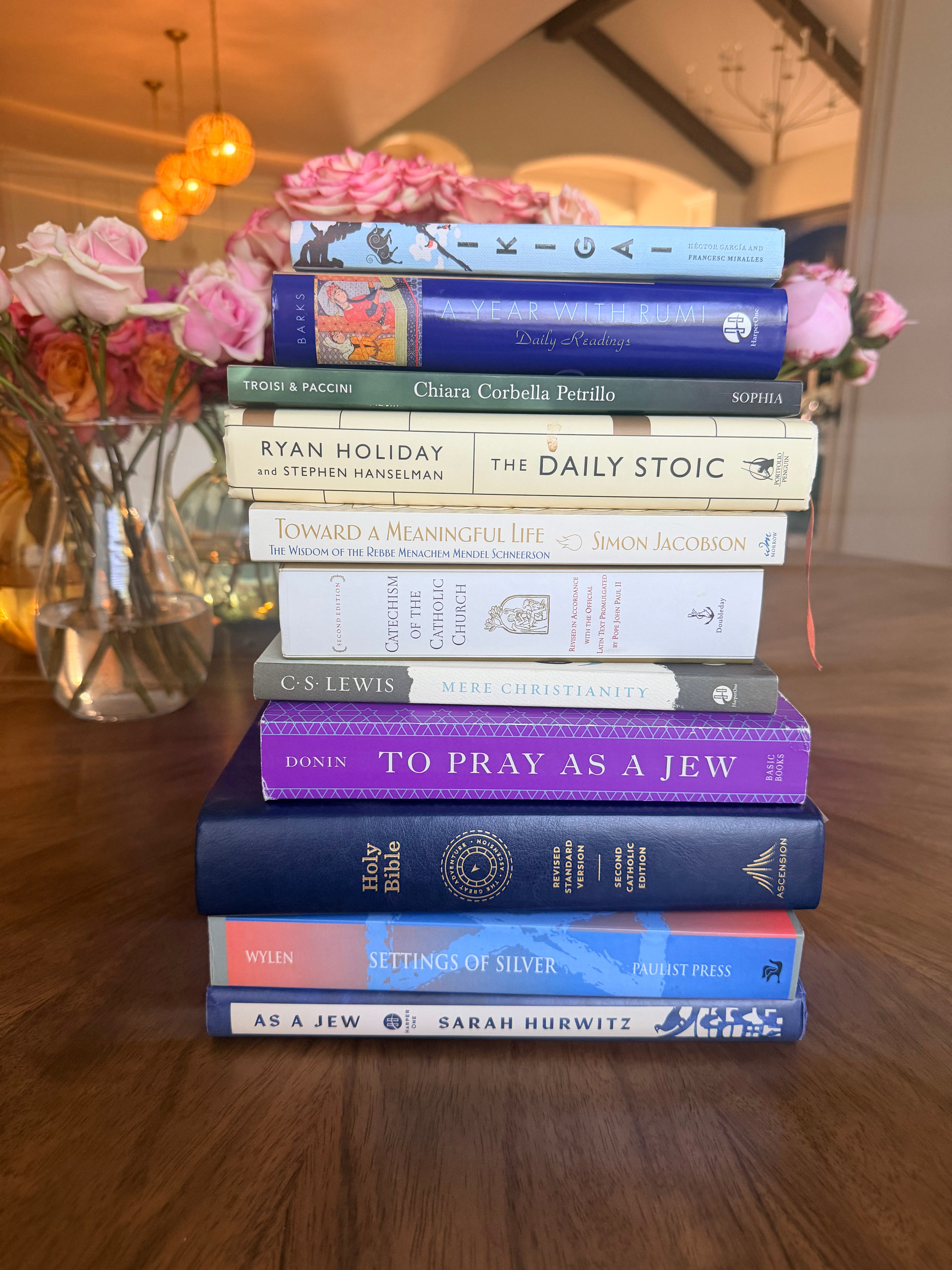
I read Eastern philosophy in Hong Kong, dabbled in manifestation and the wider spiritual-but-not-religious world, and spent time at an ashram in India. I sat with the Bahai for a season. I read every Stoic I could find, returned to Marcus Aurelius for years, and gave him to anyone who would accept him.
I came within a hair of becoming a real Catholic in my late twenties, talked back into the church by a brilliant friend in New York, and out of it by a single sentence about transubstantiation, which I will tell you about another time. None of it held.
Until, about a year and a half ago, it did. I am in the middle of converting to Orthodox Judaism. I had been a tourist in every spiritual tradition I could afford to visit, and a serious student in several. Orthodox Judaism is the first one I have not wanted to leave.
When I first told my friends I was converting to Judaism, they were thrilled. Many of them are non-practicing Jews themselves, and they took my interest as a kind of vote of confidence in their tribe, particularly welcome at a moment when much of the world has given up on them.
And what a tribe.
Disproportionately represented in arts, sciences, literature, and Hollywood — at the forefront of every American “progressive” cause my friends still hold dear. Reform Judaism in particular comes with most of the cultural capital and very little of the embarrassment. You can be Reform without believing in God. You can be Reform and an atheist. You can be Reform and a feminist and a tenured public intellectual. You cannot, anymore, be a Zionist it seems. With that one caveat, it is the right kind of Jewish.
So when the Reform conversion process began, the texts came in. “Mazel tov!” “So happy for you!” “What can I bring to the Shabbat dinner?”
And yet, as I got deeper into the Reform process, I began to wonder what exactly I was converting to. My rabbi was an atheist who did not keep kosher. I went looking for answers in Reform books and Reform podcasts. What I found, again and again, was a very specific Jewish experience being processed: being Jewish, but not quite sure what that meant, and feeling a little weird about it.
Maybe you had gone to camp but had no other point of contact. Maybe you had a Jewish grandmother with very particular mannerisms, and felt camaraderie with other Jew-ish people who knew exactly which mannerisms. Maybe you loved pastrami sandwiches and “Curb Your Enthusiasm.”
I loved the Jewish People. I wanted to be one of them. But I could not relate to any of this, and I had begun to long for the underlying texts and traditions that had made Jews Jewish in the first place.
So I started exploring Orthodox content.
I had been reading religious books for 20 years by then, and I was hard to impress. The first Orthodox book I picked up was, by any reasonable account, incredibly dry. I want to be clear that I was reading it on purpose. It was about the logistics of Jewish life — which prayer to say when you see lightning, which dishes touched dairy and which touched meat, why those two things could never share a plate. The book did not treat any of this as up for debate.
I expected to find the explanations for the more questionable rules embarrassing. After all, what is actually wrong with eating a cheeseburger? Whatever the rationale was, I was sure it would not survive contact with a rational adult. I was, as always, hunting for the exit ramp. Every religion I had studied gave me one eventually. The argument that fails. The historical inconvenience. The leap that asks you to suspend too much for too thin a reason.
Instead, I read explanation after explanation and the rolling never came. I was agreeing. I was, against my will and against every reflex I had walked in with, finding that this very dry book about the very weird rules of Jewish life made more sense to me than anything I had read in my life.
For the first time, my neshama (Hebrew for “soul”) lit up. Most people’s neshama has the dignity to wake up to something with romance — music, a sunset, a particularly devastating prayer. Mine woke up to a chapter on plate management.
This is not to say I had stopped having questions. I had not. I had only stopped looking for the exit. Orthodox Judaism has its share of hard things. The entire rabbinic tradition is built to wrestle with them out loud, century after century, rather than pretend they aren’t there — an imperfect system I could understand and get behind.
It took months before I formally began the conversion. That part is for another essay. But that night was the spark.
I honestly wasn’t sure what would happen next. I knew I was feeling something I’d never felt before, but I had no idea what to do with it. So my research continued. I started attending Orthodox services. I started reading Torah. I started studying parsha. I started talking to multiple rabbis every day. My life became, voluntarily and very quickly, all about Judaism. I was not coerced. I was not, despite popular concern, isolated from anyone. I had simply found the thing I had been looking for since I was twelve, and the thing wanted my whole attention, and I was happy to give it.
Are you okay?
That is the question I started getting, gently, from people who had previously been thrilled about the Reform conversion. Depending on the friend, it would modulate to “Did something happen?” or “Are you looking for community?” or, my personal favorite, asked over an oat milk latte by a woman who had recently gotten extremely into a specific ayahuasca facilitator, “Is this a phase, maybe?”
The list of acceptable reasons for a 30-something woman to start keeping kosher turns out to be quite short. Trauma is in. Grief is in. A divorce would have worked. A near-death experience would have worked beautifully. I read the texts and I find them compelling, and I happen to believe in God is not on the list. It is so far off the list that when I tried it once, the friend across the table from me did the face you make when somebody tells you they have started dating a man they met on the internet who lives in a country you cannot easily locate on a map.
Soon enough came the helpful warnings, delivered with the urgency of friends staging an intervention. Did you know they shave women’s heads? Did you know they don’t let women leave? Don’t educate them? Don’t even let women ride bicycles? Every single concern, when I traced it back, came from some Netflix show about a specific Hasidic sect. Real abuse happens in those communities, and the women who left them have important stories. Many have spent years online explaining why these shows still get even those small worlds wrong.
People who leave a community are usually its loudest critics. When even they say the portrayal is inaccurate, that is worth knowing. Mainstream Orthodox Judaism, the world I am joining, bears almost no resemblance to any of it. For now I will only say that the Orthodox women I have met are among the most highly educated and most accomplished, professionally and personally, of any community I have ever belonged to.
Someone asked if I had been radicalized. Someone else asked, with real and tender concern, whether I had access to outside information. A friend wondered, delicately, whether my husband knew. (My husband, I should mention, is Jewish.) The most charitable theory making the rounds was that I was doing it for networking. Apparently I was on a long con to break into the Upper West Side bagel scene. Multiple people suggested I was doing it for the “social media views.”
There was a dinner where I showed up in a dress that was, technically, fully modest. I had bought it years before, because I liked the look of it. I felt the looks. I heard the whispers. My covered elbows had apparently become a political statement. The dress had not changed. The elbows had not changed. But I had crossed a line, and people no longer knew how to talk to me.
What I had failed to appreciate, before all this, is that there are basically two kinds of Jewish you are allowed to be in good secular standing. There is culturally Jewish, which is essentially a personality type, and which is admirable. And there is Reform, which is a religion you can practice without changing your life, and which is also admirable. There is no third box that says believes any of it. To occupy that box, especially as a convert, is to be doing something the secular world cannot find a flattering name for, so it reaches for the names it has on hand: indoctrinated, brainwashed, radicalized, going through something.
Almost every Jewish practice I have taken on has a more expensive, less Jewish, infinitely more socially acceptable cousin in the wellness world I came from — same impulse, same shape, different branding.
A 48-hour water fast is biohacking. A 25-hour fast on Yom Kippur is medieval. A $4,000 silent meditation retreat is working on yourself. Forty-five minutes of morning prayer is rigid. A gratitude journal, leather-bound and recommended by a podcast, is evolved. Saying the “Modeh Ani” prayer when you open your eyes is psycho.
A digital detox weekend at a resort where you surrender your phone into a velvet pouch is restorative. Putting the phone away from sundown Friday to sundown Saturday, every single week, is a cult. Tracking your cycle using a smartphone app is body literacy. Tracking your cycle for the laws of family purity is patriarchal. Microdosing for clarity is a personal practice. A blessing before eating an apple is excessive. Reading Marcus Aurelius every morning is intellectually serious. Learning daf yomi is indoctrination.
The yearning is the same. The architecture is the same. We have not stopped wanting any of this. We have just gotten embarrassed about wanting it with a tradition attached, so we have outsourced the tradition to more modern organizations and causes — and the man with the podcast about cold plunges. We spend a great deal of money to do, badly, what people have been doing for thousands of years, for free, and considerably better.
Here is the part I keep coming back to. When a Hasid leaves their community, the family worries he has been seduced by the outside world. When a secular convert joins an Orthodox community, her friends worry she has been seduced by the inside world. The mechanics are completely identical. We are on the path. They are off it.
Are you sure you’ve thought about this? Don’t you remember who you are? Is this maybe a phase?
I am, technically, going on the derech. According to the people I came from, I am very much off it — and I am not coming back.

Mazel Tov, Kaitlin. Our family grew up Episcopalian with youth groups, confirmation, mission trips and I taught Sunday school when my 2 children were that age. Fast forward my daughter converted after 2 years of discernment, a year studying at a school in Jeruselum ( My visit was wonderful.).
Fast forward I am blessed with 4 grandchildren from my daughter and son-in-law. They are living an active Orthodox life out west within a supportive family community. I made an effort to understand and learn ( while making awkward errors along the way) and respect their life and have found that their community is warm and welcoming. Even to this non-Jewish grandmother. I wear modest clothing amongst them when visiting.
While her journey is her story, I have found some peace in their rituals.
Welcome!