


Please consider supporting our mission to help everyone better understand and become smarter about the Jewish world. A gift of any amount helps keep our platform free of advertising and accessible to all.
This is a guest essay by Stacy Gittleman, an award-winning journalist.
You can also listen to the podcast version of this essay on Apple Podcasts, YouTube Music, YouTube, and Spotify.
The United States of America has just received the bodies of the most recent casualties of this war against the Islamic Republic of Iran, six service members killed in an Iranian strike that hit a makeshift operations center in Kuwait.
The United States eliminated the military draft after the Vietnam War, scarred by the 58,220 body bags that carried young American soldiers home from Asia to their final resting place. In the 20-year War on Terror that followed the attacks of September 11th, more than 7,000 U.S. troops were killed and tens of thousands more were physically and psychologically wounded. Given those experiences, it is understandable why many Americans are wary of new military conflicts, including the current confrontation with Iran, unless they clearly understand why the stakes are so high.
In the United States, less than one percent of the population serves in the military. In a country of 330 million people, only about 1.3 million are on active duty. So unless one’s family is military, or they live in a military town, chances are Americans do not have any personal connection or degrees of separation from anyone who is or will be serving in this war. Hence why most Americans feel distant to the military, the military families, and the theaters in which they serve.
Contrast that with Israel, a population of a little over 10 million. At any given moment, 69 percent of eligible Israeli Jewish men from ages 18 to 21 are conscripted in military service. At any given time, 34 percent of the IDF is comprised of women. That includes combat and ranking officer positions. Also serving are Druze, Christians, and Muslims, the latter of whom serve on a voluntary basis.
Jews from around the world, from America to the United Kingdom to Australia to Canada, come to serve in the IDF as well. They are known as “Lone Soldiers” because, unlike most Israeli soldiers who can leave their base for Shabbat for some family time, laundry, and home cooked meals, “Lone Soldiers” soldiers are there, voluntarily, purely for the love of serving Israel, but don’t have immediate family there and the support it brings.
As Americans, our general disconnect with the military means that we do not feel each soldier’s death on a visceral level. In the United States, on Memorial Day, there are no sirens that sound across the nation, asking us all to stand, wherever we are, including along the side of a highway, to remember our war dead. We are just too big. We are just too disconnected from one another. Memorial Day in America marks the first weekend of summer. We have mattress sales. I have an invitation to attend a wedding.
In Israel, it is essentially the complete opposite. The country is tiny, and its society close enough, that the loss of a single soldier reverberates through the entire nation. On Yom HaZikaron (Israel’s Memorial Day), a siren sounds across the country and everything stops. Cars pull over on highways. People step out of buses and shops. Conversations halt mid-sentence. For two minutes, an entire nation stands in silence. The stillness is not symbolic; it is deeply personal. Almost everyone knows someone who was killed, someone who served with them, or someone whose child never came home.
The names being read are not distant figures from history. They are classmates, neighbors, cousins, and friends. Israel’s wars have never been abstractions fought by a professional military class far removed from civilian life. They have always been fought by the sons and daughters of the nation itself.
That reality collapses the distance between the battlefield and the home front in a way that is almost impossible for Americans to fully grasp. In Israel, the fallen are not anonymous. They are part of the fabric of everyday life.
But unlike what Jew-haters want to tell you, Israelis are not war-thirsty people. They are not genocidal baby killers. Israelis and Jews have more songs and prayers about peace and living, creating peace, and pursuing peace than I can count. No Israeli mother or father wants to have to send their son or daughter into the military during what should be the best and carefree years of their life.
But to live, they must.
Unlike America, where we have the largely unnoticed and underappreciated comfort of going through life with no enemies wishing our destruction right on our borders, where we never have to think about how much time we have to take a shower or have our sleep disrupted so we can head to our bomb shelter, tiny Israel has enemies right on their borders. And the enemies on their borders are terrorist proxies funded by the Islamic Republic of Iran, Qatar, and even Turkey.
In Israel, nearly everyone I have known in the years following October 7th has attended at least one funeral or paid a shiva call for a soldier killed in action. Some have lost count on how many they have had to attend. At Mount Herzl, Israel’s official national cemetery, they had to dig a whole new section to bury those killed in action. Many of them were killed before they reached the age of 30.
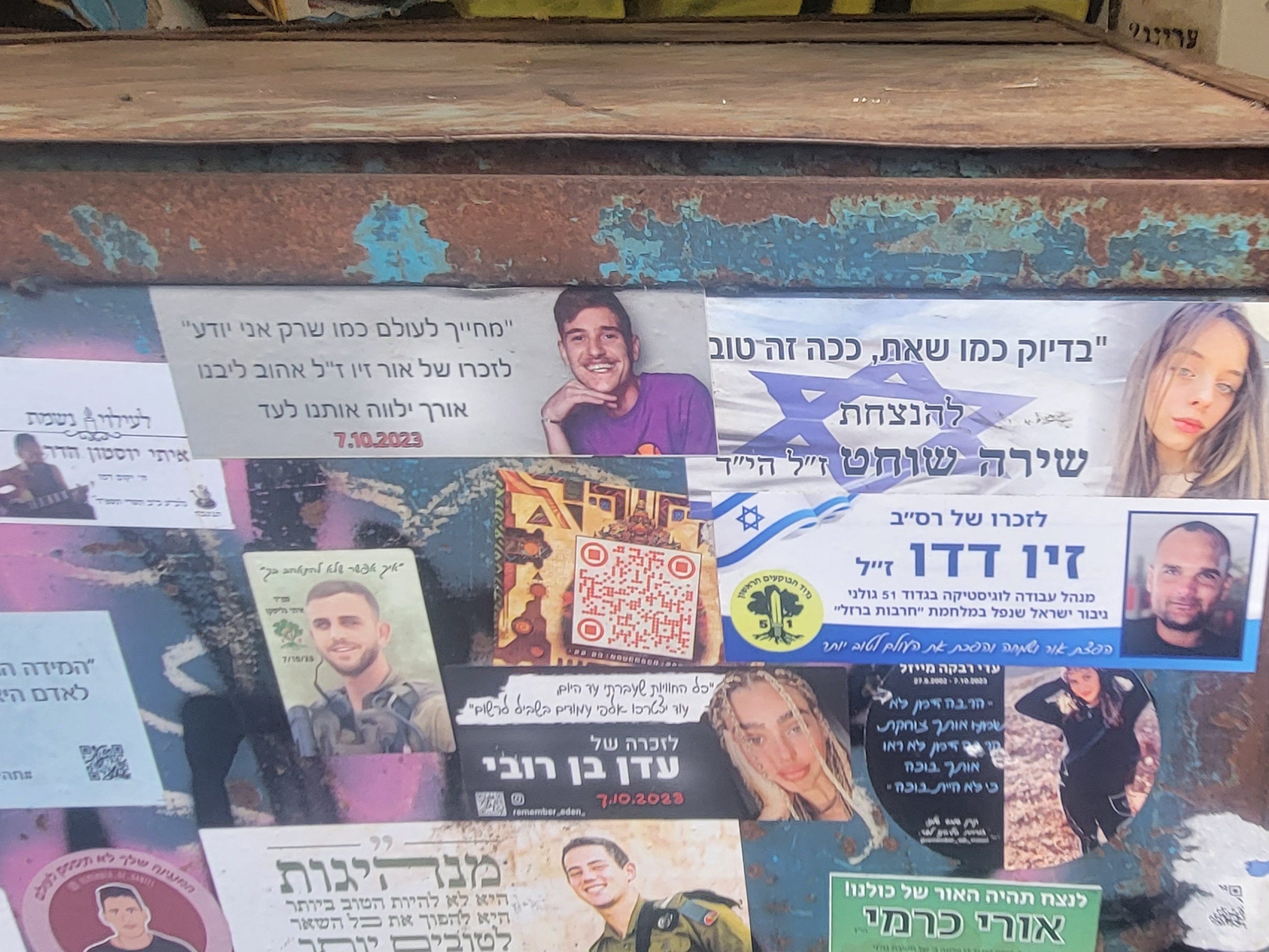
To try to process all of this, Israel’s longest war, in which the country has lost nearly 900 soldiers (equivalent to 29,700 U.S. soldiers per capita) and many others are wounded, they’ve been making stickers. From my travels in Israel in January, as the country teetered on another war against Iran, I noticed Israelis blanketing any blank surface with stickers.
These stickers bear the face of a loved one killed in action, with their birth date and the date they were killed. They cover the surfaces at bus and train stops. They coat every pillar and empty surface near what was, until this past January, Hostages Square outside the Tel Aviv Art Museum.
At one point, during the height of war and the hostage crisis, the Times of Israel reported that this almost became a second inner conflict, a competition, or maybe a joint understanding of differing kinds of pain: the placement of the posters of the hostages versus the placement of the stickers of the fallen.
At one point, they seemed to ask, how many soldiers are we willing to lose for the sake of a few dozen hostages? And the answer, though so excruciatingly painful, was obvious. Because Israelis, despite their internal squabbles and arguments, are one family with one shared destiny.
I wish Americans could get back to feeling like that. I wish young Americans, like their counterparts in Israel, felt a sense of purpose, a sense of national belonging that did not involve embracing Islamist ideologies our soldiers in the Persian Gulf are fighting against. Young Americans, young Europeans, would you fight for your country if the threat were existential?
In his new book, “On Democracies and Death Cults: Israel and the Future of Civilization” bestselling author Douglas Murray goes into much depth on the atrocities of October 7th — how the Far-Left, infiltrated by anti-Western thought largely funded by Iran, has poisoned the minds of younger generations to the point that very few would consider fighting for their country, because they believe the “imperialist” and “colonialist” West is just not worth fighting for.
Murray argues that many young people in Western democracies have been influenced by ideologies that project accusations of colonialism and genocide onto Israel, rather than identifying the “death cult” extremism of groups like Hamas, one of Iran’s many terror proxies in the Middle East.
This week, from New York to Michigan, activists (paid perhaps) waved the flag of Iran’s Islamic Revolutionary Guard Corps, chanting in opposition to American and Israeli incursions against the Islamic Revolutionary Guard Corps.
The activism of people in their 20s in the West is getting ludicrously performative.
Since the afternoon of October 7, 2023, they have switched out their flags from Palestinian to Venezuelan, and now they dare to wave the flag of our enemy, the Islamic Republic of Iran. All the while, the American flag, the flag that gives them all these freedoms of expression, freedom of assembly, freedom of sexual orientation, women who speak, who can sing, who can show their hair, is nowhere to be seen.
On Wednesday, in a rare break of rank, a former Marine came in uniform to the Congressional floor in Washington, D.C. During a hearing of the United States Senate Armed Services Committee, Brian McGinnis, a U.S. Marine Corps veteran, was forcibly removed after interrupting proceedings to protest Washington’s military involvement in the conflict with Iran.
McGinnis, who is also associated with the anti-Israel group “Code Pink” and has run as a Green Party candidate for the U.S. Senate in North Carolina, clung to a door frame as officers attempted to remove him from the chamber as he shouted, “No one wants to fight for Israel!” and “From the Shores of Montezuma, Free Palestine!” before being dragged out by United States Capitol Police.
If only he knew. If only he was taught.
Those six American servicemen who died in Kuwait were only the latest casualties, only the most recent American blood spilled by the Islamic Republic of Iran and its proxies.
In just one example, on October 23, 1983, 220 Marines, 18 U.S. Navy sailors, and 3 U.S. Army soldiers lost their lives in the Marine Barracks at the Beirut Airport. I was 15 when that happened. I remember the footage of a Marine kneeling by the bombed barracks, holding the hand of a dying Marine, the only part of his body that was visible as he lay dying buried in the rubble. As one surviving Marine said this week, this war was not unprovoked. After 47 years, it was a long time coming.1
However this war lasts, it is going to be difficult. There will be losses. But how many visual reminders will we see in America of our fellow Americans who are willing to serve this country and sacrifice their lives? How many will notice, beyond the rise of gas prices at the pump?
We should remember what their sacrifice means — and stand behind the Americans and Israelis who are fighting so the rest of us can continue living in freedom.
“Survivor of Iran-backed barracks bombings in Beirut says war a ‘long time coming’.” WHAM ABC 13.

Born in 1952 and grew up in a country chock full of WWII and Korean war vets and while they'd rarely speak of their ordeals, such as my career Soldier Dad who was at Chosin Reservoir in '50, their examples of true service and sacrifice were always out there. For example, I'm named for my Uncle Rich who was killed in August 1942 at the Battle of Savo Island. Even with Vietnam the disenchantment took quite awhile to coalesce and then took the country a long time to recover. Israel has been at war of one form or another since 1948 with a much smaller population and that DOES make it much more personal. May all those who died for Éretz Yisra'él, RIP.
Your last paragraph says it all....thank you.