


Please consider supporting our mission to help everyone better understand and become smarter about the Jewish world. A gift of any amount helps keep our platform free of advertising and accessible to all.
This is a guest essay by Mitch Schneider, who writes about Israel, from Israel.
You can also listen to the podcast version of this essay on Apple Podcasts, YouTube Music, YouTube, and Spotify.
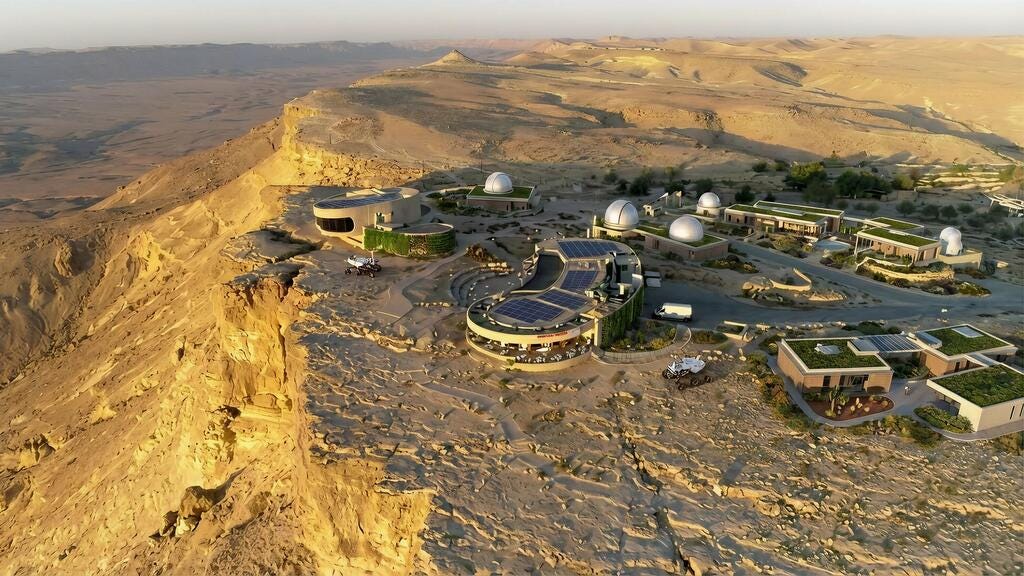
In late January, Israel announced Space City: a 100-million shekel ($27 million) project transforming Mitzpe Ramon into the country’s largest civilian space research campus.
Mitzpe Ramon is a remote desert town of 5,500 people in the Negev (southern Israel). It is situated on the northern ridge overlooking the world’s largest erosion cirque, known as the Ramon Crater. The formation is 40 kilometers long, 2–to–10 kilometers wide, and 500 meters deep.
Despite the way it looks, this dramatic formation was not created by a meteor strike or a volcanic blast. Its story is far older — and far more patient.
Hundreds of millions of years ago, the Negev lay beneath the waters of the ancient Tethys Ocean. As the sea gradually retreated northward, it left behind a curved, hump-like ridge. Over immense stretches of time, water flow and shifting climate slowly wore that ridge down, smoothing and reshaping it through steady erosion.
Around five million years ago, a far more decisive transformation began. The formation of the Arava Rift Valley altered regional waterways, redirecting rivers that began cutting into the softer rock beneath the surface layer. The interior eroded more quickly than the harder rock above it, hollowing out the structure from within. As the basin deepened, its walls appeared to rise higher by contrast. Layer after layer of ancient geology was exposed, revealing rock formations at the bottom that date back as much as 200 million years.
Modern settlement in Mitzpe Ramon began much more recently. In 1951, it started as a modest camp for workers constructing Highway 40, Israel’s second-longest road. By 1956, young families began putting down roots. Throughout the 1960s, immigrants from North Africa, Romania, and India joined them, and the town developed into the southernmost of the Negev’s planned development towns.
Life in those early years demanded resilience. Food and supplies arrived only once a week by truck, often in the form of ice blocks and basic provisions. The community’s single schoolhouse served children of all ages in one classroom. The first homes were simple prefabricated asbestos barracks, later replaced by rows of small stone houses and, eventually, apartment buildings beginning in the early 1960s. Growth accelerated again after the completion of Ramon Airbase in 1982, built to replace Israeli bases in the Sinai that were evacuated following the 1979 Israel–Egypt peace agreement.
NVIDIA is a partner in Space City. The Israeli government is backing it. And it’s being built in one of the most isolated places in the Negev because the isolation isn’t a limitation; it’s the infrastructure.
The Ramon Crater, where Space City is being built, has been validated as one of the best Mars-analog sites on Earth. When Austria’s Space Forum needed to run a month-long Mars simulation with astronauts from 25 countries, they evaluated sites globally and chose Israel.
Most countries would use that for temporary research. Israel is building permanent infrastructure. Here’s why that matters.
For 75 years, Israel treated the Negev as a challenge to overcome. Remote. Harsh. Difficult to develop. The kind of place that required massive investment just to make it livable.
Then the space economy accelerated, and Israel recognized something fundamental: The Negev’s isolation isn’t a bug.
Deep-space missions don’t need proximity to Tel Aviv. They need Mars-analog terrain, extreme isolation, environments that simulate the conditions humans will face on other planets. Israel spent decades building infrastructure in the Negev for national development reasons. That infrastructure now happens to be exactly what the global space industry desperately needs and cannot replicate elsewhere.
Space City isn’t a metaphor. It’s national infrastructure designed for missions beyond Earth’s orbit, and every component serves a specific role in Israel’s deep-space strategy.
The mission control facilities being built can monitor and control deep-space missions — payloads going to the Moon, Mars, and beyond. Most countries can track satellites in Earth orbit. Deep-space mission control, the capability to run missions beyond Earth’s orbit, exists in maybe five countries globally. Israel is building it in the Negev, creating infrastructure that will serve both Israeli missions and international partners who need that capability.
The Mars analog laboratories, developed in partnership with NVIDIA, combine physical testing in Mars-like terrain with advanced digital simulation. This is where the NVIDIA partnership becomes critical. NVIDIA isn’t just a technology company. They’re the global leader in AI and robotics infrastructure, with 5,000 employees in Israel generating over $30 billion annually in revenue from their Israeli R&D centers. When NVIDIA calls Israel their “second home,” they’re not being sentimental. They’re describing strategic reality.
Through the partnership, Space City gains access to NVIDIA’s Physical AI and Robotics experts, development tools, training programs, and AI infrastructure. Startups testing robotics for Mars missions get direct consultation from engineers who build the systems that power autonomous vehicles and industrial robots worldwide. Technologies validated in Ramon Crater simulations can be refined using NVIDIA’s digital platforms, creating a development cycle that doesn’t exist anywhere else: physical Mars-analog testing combined with the most advanced AI simulation capabilities in the world.
The EXPAND accelerator program, currently in its third cohort, operates on a precise investment model: Each selected company receives $600,000 ($300,000 from CreationsVC matched by $300,000 from the Israeli Innovation Authority). Over three months, companies work with mentors from NASA, the space industry, and now NVIDIA’s AI experts, developing what is known as “dual-value” technologies: solutions that work on Earth today and scale to deep-space applications tomorrow.
That dual-value model is the key to everything Space City is building. The technologies aren’t theoretical. They’re commercial products generating revenue now, with clear paths to deep-space applications when the market matures. Which, based on NASA’s Artemis timeline, is happening faster than most people realize.
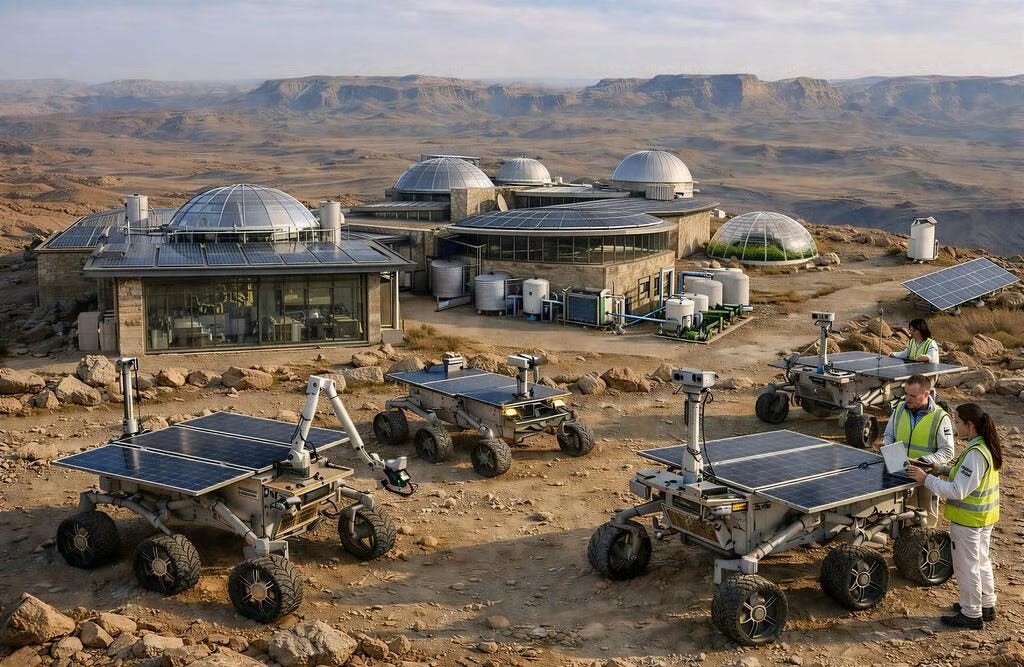
When NVIDIA evaluates partnership opportunities, they don’t partner with remote desert towns. They partner with centers of excellence. Israel built the infrastructure first. NVIDIA came second.
The isolation that makes Mitzpe Ramon feel remote is exactly what you need to simulate space conditions. When you’re testing systems for Mars, you want actual isolation. Actual extreme environments. Actual limitations on resources and support.
The Ramon Crater’s terrain doesn’t just look like Mars. It has geological and ecological features that mirror Martian conditions so closely that international research teams have used it for decades to understand planetary environments we can’t physically access. Studies conducted in the crater have helped scientists learn about Mars without ever leaving Earth.
Israel didn’t wait for NVIDIA’s validation. Israel built Space City because the strategic logic was sound: If you control the infrastructure that deep-space missions require, you control critical access points in the market. NVIDIA recognized what Israel had already executed.
“Our goal is to turn the crater into an international center for analog and technological experiments, which will attract researchers and companies from all over the world,” said Gila Gamliel, Israel’s Minister of Innovation, Science, and Technology.
Not from Tel Aviv. Not from Israel’s existing tech hubs. From all over the world, to Mitzpe Ramon.
The NVIDIA partnership isn’t about supporting Israel’s space ambitions out of goodwill. NVIDIA partners with centers of excellence that advance their core technologies. They chose Mitzpe Ramon because Israel built something that matters to their business: a testing ground for AI and robotics in the most demanding environments imaginable.
And the timing isn’t coincidental.
NASA’s Artemis II mission launches in March. It’s a 10-day flight with four astronauts, the first crewed mission around the Moon in 54 years. Artemis III follows in 2027 with the first lunar landing since Apollo 17. These aren’t experimental missions. They’re the beginning of permanent lunar infrastructure.
Commercial Lunar Payload Services missions are launching right now. Blue Ghost touched down in March 2025. Multiple companies are bidding to deliver equipment, habitats, and systems to the lunar surface over the next 24 months. The global space economy is projected to reach $1.8 trillion by 2035, and most of that growth won’t come from satellites in Earth orbit. It will come from deep space: lunar economy, Mars preparation, asteroid mining, space manufacturing.
Countries that wait until there’s a Mars mission to develop Mars technologies will be too late. By then, the intellectual property is owned. The talent is trained elsewhere. The companies are established in other ecosystems. The market consolidates around whoever built the infrastructure first. Israel built the infrastructure while other countries were still forming committees to study feasibility.
Space City is training the engineers who will design Mars habitats, funding the startups creating technologies that work on Mars and generate revenue on Earth today, and building the intellectual property that every space agency will eventually need to license — not because Israel predicted the exact timing of Artemis missions, but because Israel recognized that deep-space infrastructure takes decades to build, and whoever builds it first controls access.
When the deep-space economy reaches $1.8 trillion, Israeli companies will own critical pieces of it. Israeli policymakers understood industrial strategy: Build the ecosystem before the market matures, and you control the market when it arrives.
How do you generate energy when there’s no infrastructure? You develop solar panels so thin and light they can be deployed as sheets, turning any surface into a power source. On Earth, that means energy in disaster zones, remote areas, and places conventional solar can’t reach. On Mars, it means the difference between survival and failure.
How do you build structures when there’s no supply chain? You create 3D-printing technology that works with whatever materials are locally available. On Earth, that means custom medical implants and construction in isolated regions. On Mars, it means using Martian rock to build habitats.
How do you grow food in the most hostile environment imaginable? You design agricultural systems that work in extreme isolation with minimal resources. On Earth, that means feeding communities in deserts and polar regions. On Mars, it means not starving.
Israeli startups aren’t using Mars as a marketing gimmick. They’re using Mars-level challenges to create technologies Earth desperately needs. The deep-space application isn’t the product. It’s the forcing function that creates solutions conventional approaches can’t match.
Space problems are Earth’s hardest problems, amplified. Solve them, and you’ve built something that works anywhere.
For over a century, Jewish National Fund-USA has invested in making the Negev livable: 260 million trees planted, water infrastructure, communities built in hostile terrain — the kind of long-term development work that doesn’t show immediate returns. That century of investment is now converging with national strategic priorities in ways nobody predicted.
The Tech Hub JNF-USA opened in March 2024 isn’t just creating jobs. It’s providing the physical infrastructure that enables Israel to position the Negev as indispensable for deep-space research. The isolation that made development difficult now attracts NVIDIA partnerships and international research teams. The extreme environment that required decades of agricultural and water innovation is now the testing ground for technologies that will sustain human life on Mars.
This is what happens when you commit to national development for decades, not election cycles. Israel didn’t wait for the Negev to be economically viable before investing. Israel invested, and the investment is paying dividends nobody anticipated.
The remoteness that made economic development challenging became exactly what international researchers need for deep-space simulation. The extreme environment that limited growth became a testing ground validated by 25 countries for Mars missions. The peripheral location that lost young people to major cities like Tel Aviv became a global destination attracting partnerships that most tech hubs can’t secure.
Space City creates the kind of jobs that retain and attract talent: NVIDIA experts consulting on robotics development, international researchers testing technologies for lunar missions, startup founders building companies that will power the deep-space economy, infrastructure that turns a town of 5,500 into a node in the global space industry.
When Artemis II launches in March, Israel won’t be watching from the sidelines. Israeli engineers will have spent years developing technologies in Ramon Crater that mirror the environments those astronauts will encounter. Israeli startups will be building systems that future lunar missions require. Israeli infrastructure will be positioned to support the deep-space economy before most countries understand it exists.
This needs a love button.. I see from the comments, I'm not alone. This makes me even more proud of what Israel has contributed to our world.
Remarkable developments in a very harsh environment. Israel is creating a Space City and I wonder when they will be launching rockets manned or not independent of any other country. Meanwhile the Arabs are developing a better camel, in comparison.