


Please consider supporting our mission to help everyone better understand and become smarter about the Jewish world. A gift of any amount helps keep our platform free of advertising and accessible to all.
This is a guest essay by Nachum Kaplan, a longtime journalist and commentator who writes the newsletter, “Moral Clarity.”
You can also listen to the podcast version of this essay on Apple Podcasts, YouTube Music, YouTube, and Spotify.
The Jewish nation is stronger now than at any point in its long and storied history, including the First and Second Temple eras.
It is easy to lose sight of this with resurgent antisemitism sweeping the world, Israel perpetually in the diplomatic firing line, and the Middle East convulsed by war, but it remains one of history’s most remarkable achievements.
For over three millennia, the Jewish People have endured exile, persecution, and near-annihilation, yet they have not only survived, but thrived. Today, Israel stands as a testament to Jewish resilience, ingenuity, and unbreakable will. Militarily, economically, technologically, demographically, and politically, the Jewish People have never possessed anything approaching their present strength.
This is not just optimism. The ancient kingdoms of Israel and Judah, though grand in their time, were ultimately fragile, falling to Assyrian and Babylonian conquest. The Second Temple period ended in Roman destruction and exile. Modern Israel, however, is a regional military power, a technological powerhouse, and the sovereign center of a Jewish population larger than anything the ancient Jewish commonwealths could have imagined.
To appreciate Israel’s strength fully, consider the previous two Jewish commonwealths’ weaknesses. Their demise also holds important lessons for Israel and Jews today.
The First Temple period was one of glory and collapse. King David united the tribes; Solomon built the Temple. Yet, within a generation of Solomon’s death, the kingdom split. Israel, the Northern Kingdom, fell to Assyria in 722 BCE. Judah barely lasted another century before Babylon razed Jerusalem.
Internal divisions mattered. The tribes fractured, weakening collective resolve. That remains a salient reminder to Israelis today, and to diaspora Jews, even if the analogy should not be pushed too far. Jewish history contains enough warnings about internecine conflict without inventing new ones.
First Temple Israel’s alliances with stronger powers also proved fickle. Small nations have always discovered that friendship between states is rarely sentimental. It lasts for as long as interests overlap.
Then there was moral decay. Prophets such as Isaiah and Jeremiah warned of corruption, idolatry, and social injustice, yet the people did not repent. The First Commonwealth had moments of greatness, but it lacked the unity and long-term strategic capacity required to endure.
After the Babylonian exile, Jews returned under Persian rule, rebuilt the Temple, and later established the Hasmonean dynasty. But again, disaster struck. King Herod’s grandeur masked growing Roman control and Judea eventually became a vassal of a superpower it could not possibly match. Sectarian strife (among Pharisees, Sadducees, Zealots, and others) weakened the society from within. The Great Revolt of 66 to 73 CE ended with the Temple’s destruction. The Bar Kokhba revolt six decades later ended in blood-soaked catastrophe.
The Second Commonwealth had spiritual vigor and periods of sovereignty, but it lacked the military, economic, and political weight to survive Roman might.
Modern Israel is different. It has vulnerabilities, enemies, and political dysfunction, but it has greatly surpassed its previous incarnations.
In antiquity, Judea was a modest agrarian society. Its wealth was concentrated around agriculture, taxation, pilgrimage, and trade. Modern Israel’s economy reached approximately $611 billion in 2025, with annual GDP per capita above $60,000. That is a staggering economic transformation for a country whose population only recently passed 10 million.
Nor is this simply an economy of consumption and services. Israel’s great comparative advantage remains the stuff produced between people’s ears. Israeli high-tech generated approximately $85 billion in exports in 2025, accounting for 58 percent of the country’s exports. Israeli technology companies raised nearly $15 billion, while exits reached roughly $84 billion when major transactions completed in 2026 are included. Israel ranked as the world’s fourth-largest hub for startup fundraising in 2025, behind San Francisco, New York, and Boston, and ahead of London, Paris, and Singapore.
Artificial intelligence, cybersecurity, defense technology, quantum computing, semiconductors, and deep tech increasingly dominate the ecosystem. The cliche of Israel as the “Start-Up Nation” now understates the matter. Israel has matured from a country that produces clever little companies into one that produces globally important technology businesses, strategic industries, and infrastructure on which other countries depend. Waze, Mobileye, Check Point, Wiz, CyberArk, and dozens of other companies have reshaped their respective industries.
The First Temple’s wealth paled in comparison. The Second Temple’s economy ultimately existed at Rome’s pleasure. Today, Jewish prosperity is not principally dependent upon the tolerance of somebody else’s emperor.
The same transformation is visible in technology. The ancient Israelites were innovators in agriculture, architecture, administration, and law, but their technological reach was constrained by their era. Their descendants have shattered those constraints. Israel pioneered modern drip irrigation, became a world leader in desalination, built one of the planet’s most sophisticated cybersecurity sectors, and turned defense technology into an industry of enormous strategic importance.
In 2025, Israeli defense exports reached an all-time record $19.2 billion, up almost 30 percent in a year, more than double their level five years earlier and roughly four times their level a decade earlier. Missile, rocket, and air-defense systems accounted for the largest share. Then, in August 2026, Israel signed a circa 3-billion-euro deal to construct Greece’s multi-layered Achilles Shield air-defense network using Israeli systems including David’s Sling, SPYDER, and BARAK MX — one of the largest export agreements in Israel’s history.
Israel’s loud-mouthed critics are prominent among its clientele. Countries may criticize Israel at the United Nations and then purchase Israeli systems to protect their cities, aircraft, ships, networks, and soldiers. International relations has always contained a certain amount of theater. Procurement departments tend to be more practical.

The most dramatic difference between the ancient and modern Jewish commonwealths, however, is military power. The First Temple had Solomon’s grandeur, and the Second Temple had Herod’s expansion, but neither possessed the capacity to defend itself against the great imperial powers surrounding it. Today Israel possesses one of the world’s most sophisticated and effective armed forces.
The ancient Israelites knew war. David felled Goliath, the Maccabees overthrew Seleucid rule, and Bar Kokhba led a bloody ill-fated revolt against Rome. Yet Jewish military victories in antiquity were repeatedly followed by catastrophic defeats against powers possessing vastly greater manpower and resources. No more.
Israel has not just survived but won wars in 1948, 1967, 1973, Lebanon, Gaza, and an extraordinary series of confrontations since October 7, 2023. The 12-day war against Iran in June 2025 demonstrated something that would have sounded fantastical a generation earlier: Israeli aircraft operated extensively over Iran, struck nuclear and ballistic-missile infrastructure, penetrated Iranian air defenses, and killed numerous senior military commanders and nuclear scientists. The U.S. subsequently struck Iranian nuclear facilities as well.
Israel aimed to deter Iran’s nuclear and ballistic missile threats. The Jewish state certainly put Iran’s nuclear program back a few years, but it has not eliminated it.
Iran’s nuclear infrastructure was badly damaged, as were important elements of its ballistic-missile capability, but there remains continuing uncertainty over Iran’s stockpile of highly enriched uranium. By June 2026, assessments of whether Tehran’s nuclear ambitions had been extinguished remained unresolved.
Then came something still more extraordinary.
On February 28, 2026, Israel and the U.S. launched another major campaign against Iran. The conflict widened dramatically, involving Iranian retaliation towards America’s Gulf state allies, Hezbollah and other regional actors becoming more active, disruptions to the Strait of Hormuz, and repeated attempts at ceasefires. Seven months later Washington and Tehran are still using intermediaries to explore how the conflict might finally end.
So this is not a story in which Iran has magically ceased to be dangerous. It is one in which the strategic relationship between Iran and Israel has been turned on its head.
For decades, Tehran built Hezbollah, funded Hamas and Palestinian Islamic Jihad, cultivated militias in Iraq and Syria, armed the Houthis, expanded its missile arsenal, and constructed a regional architecture designed to surround Israel with fire. After October 7th, Israel demonstrated that it could not just hit Tehran’s proxies, but it could take the war to Iran itself. That is historically astonishing.
The Jewish state that did not exist in 1945 now possesses the intelligence, airpower, missile defense, cyber capabilities, long-range strike capacity, and strategic alliances required to conduct sustained military operations 2,000 kilometers from home against one of the Middle East’s largest states.
Not to mention Israel’s intelligence capabilities, which still read like something from “Mission: Impossible.” The killing of Hamas political chief Ismail Haniyeh in a Tehran safehouse in 2024 showed the extraordinary depth of Israeli intelligence penetration. The September 2024 pager-and-radio operation against Hezbollah incapacitated thousands of operatives before Israel killed Hezbollah leader Hassan Nasrallah in Beirut days later.
Israeli intelligence penetration of Iran has likewise repeatedly demonstrated knowledge of the movements of senior commanders, security officials, scientists, facilities, and weapon systems inside one of the world’s most security-conscious states.
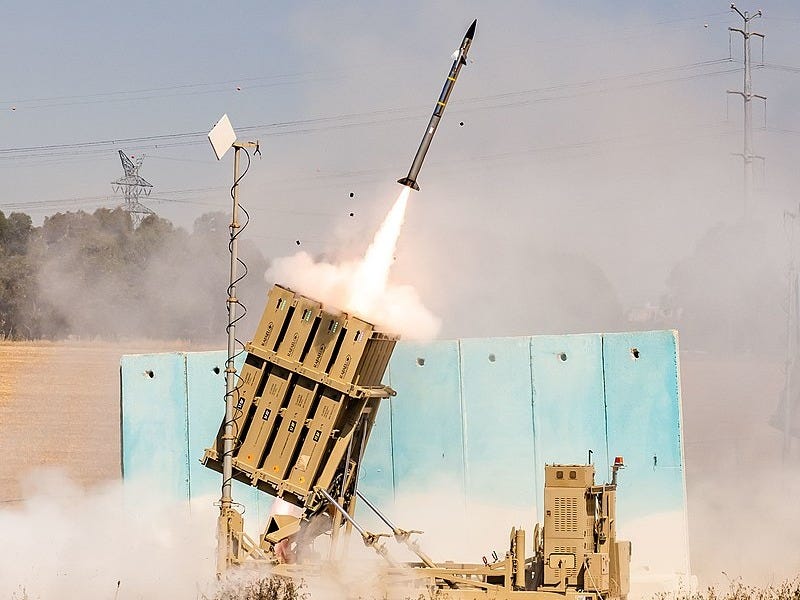
Technological innovation underpins much of this power. From the Merkava tank to Iron Dome, David’s Sling, Arrow, advanced drones, cyberwarfare, satellites, electronic intelligence, and autonomous systems, Israel has converted a security predicament into an industrial ecosystem. And unlike the Jewish rebellions of antiquity, modern Jewish military power is not an insurgency against somebody else’s empire. It is sovereign power.
The change in Gaza is equally profound. The October 2025 ceasefire resulted in the return of the final 20 living Israeli hostages. In January 2026, Israel recovered the remains of Ran Gvili, the last hostage still in Gaza. For the first time since October 7, 2023, no Israeli hostage remained there.
Gaza itself remains unresolved. Hamas is hugely weakened but has not simply disappeared; reconstruction remains stalled; and violence has continued despite the ceasefire. Israel will almost certainly need to fight in Gaza again given that U.S. President Donald Trump’s Gaza peace plan has little chance of working. Yet the hostage question that haunted Israeli society for more than two years finally ended.
To understand what all this means historically, return to the basic comparison: The First Temple fell to Babylon, and the Second Temple fell to Rome.
Modern Israel has instead survived repeated conventional wars, terrorism, missile bombardment, diplomatic pressure, economic boycotts, and the most murderous attack on Jews since the Holocaust — and emerged with a larger economy, an expanding population, an internationally significant technology sector, and a defense industry selling nearly $20 billion of equipment a year.
That does not mean Israel is invulnerable, but that vulnerability is no longer the defining condition of Jewish existence.
For much of Jewish history, there was a question mark hanging over survival. Unlike many forms of prejudice, antisemitism has repeatedly developed an exterminatory dimension. Pogroms, expulsions, massacres, and the Holocaust reinforced the image of the Jew as history’s eternal victim.
Israel changed that psychology. Israelis, while tired of war, are confident in ways few Jews have ever previously been. No more reliance solely upon the mercy of kings, caliphs, presidents, police commissioners, university administrators, or newspaper editors. The Jewish People possess sovereignty, an army, intelligence services, industries, diplomatic relationships, and the ability to act on their own behalf.
The diplomatic picture is more complicated than either Israel’s supporters or detractors admit, but its peace treaties with Egypt and Jordan remain intact. The Abraham Accords with the United Arab Emirates, Bahrain, and Morocco survived the Gaza war and then survived the much wider confrontation with Iran. The UAE in particular continued substantial investment, technological cooperation, and security ties with Israel. Prime Minister Benjamin Netanyahu visited Abu Dhabi last month.
Saudi Arabia remains the missing prize. Riyadh has not normalized relations with Israel and continues to link normalization to progress toward “Palestinian statehood.” As recently as last week, Saudi Arabia refused an Israeli request to send military aircraft into the kingdom to collect Israeli passengers whose civilian flight had made an emergency landing there after an attempted hijacking. Saudi medical staff treated the Israeli passengers, though, producing photos that went viral.
That illustrates the transformation. The question is no longer whether every Arab state must ultimately seek Israel’s destruction. The argument is over the terms on which additional Arab states might live, trade, negotiate, coordinate, and perhaps eventually normalize relations with it. None of this is peace in the sentimental sense, but it reflects a Middle East increasingly treating Israel as a permanent strategic fact.
Then there is demography. On the eve of Israel’s Independence Day in 2026, the country’s population stood at 10.244 million, including 7.79 million people classified by the Central Bureau of Statistics as “Jews and Others.” Israel’s population has grown more than twelvefold since independence.
Israel also remains the only OECD country with fertility above replacement level. OECD data put its total fertility rate at approximately 2.8 children per woman, compared with an OECD average around 1.5. This is not just because ultra-Orthodox Jewish families have many children. Secular Israelis also have more children than the replacement rate. Nations that believe they have no future do not normally produce large numbers of children.
Nor has the economy collapsed under the weight and expense of three years of continuous war. The Iran conflict pushed Israel’s economy into contraction during the first quarter of 2026 and imposed formidable fiscal costs. Yet the Bank of Israel’s July forecast still projected economic growth of approximately four percent for 2026 and 5.5 percent in 2027.
There has also been a Jewish cultural renaissance that would have been unimaginable two centuries ago. Hebrew, once preserved principally as a sacred and literary language, is the vernacular of millions. Israeli scientists, writers, entrepreneurs, musicians, filmmakers, physicians, engineers, and academics participate in global culture through a society functioning overwhelmingly in the language of Isaiah and Jeremiah.
The First Commonwealth ended in exile and the second in massacre. The Third Commonwealth has suffered invasion, terrorism, political upheaval, diplomatic hostility, and war, yet it remains stronger than ever.
Israel is politically divided, and October 7th exposed failures that will be debated for years. There is no virtue in pretending otherwise, but national strength is the capacity to absorb failure without growing weaker or disappearing. That distinction separates modern Israel from almost every previous period of Jewish history.
Israel’s friends may criticize it and its enemies keep threatening to annihilate it. Neither alters the underlying historical transformation. The Jewish People have entered an era unlike any other in our history: no longer a minority living at others’ discretion, but a people possessing a sovereign center capable of defending itself, creating wealth, absorbing immigrants, producing technology, projecting military power, and shaping the strategic environment around it.
Jews are now participants in history rather than its objects.
And the core of its power, YHWH.
We need to have more children - and, of course, children who remain connected to Jews and the God of Avraham Yitzhak and Yaakov. The non Jew countries continue to tell us we are chosen people and ,using their methods (ignorance, greed, and violence, they will enforce once again, as in the past 1000 years, the prophesy of their greatest prophet, Bilaam: "they are a people who dwell alone."