


Please consider supporting our mission to help everyone better understand and become smarter about the Jewish world. A gift of any amount helps keep our platform free of advertising and accessible to all.
This is a guest essay by Hether Warshauer, a writer.
You can also listen to the podcast version of this essay on Apple Podcasts, YouTube Music, YouTube, and Spotify.
Some say that making Aliyah (immigrating to Israel) is “easy.”
My hypothesis is simple: It isn’t.
But “hard” doesn’t really capture it either. Making Aliyah is a category of its own. The last year and half has been stressful and culturally different from how I grew up, but even amid all the chaos, immigrating to Israel is still the best decision I’ve ever made.
Last week, we had dinner with my rabbi from America, whose family is in Israel for Thanksgiving break. We talked for hours while they peppered us with questions about our day-to-day and what making Aliyah has actually been like. It felt good to share our story face-to-face and catch up. As we said goodbye, everyone remarked that my husband and I seem different now: happier and lighter than we ever were in the United States.
To recap, my American-Israeli husband and I moved to Northern Israel in August 2024. He did the classic diaspora boomerang. Born and raised in the States, he lived in Tel Aviv in his 20s, moved back to the U.S. in his 30s, met and married me, and then convinced me to immigrate to the Middle East while he returned for round two. (Okay, to be fair, we convinced each other.)
It’s been a whirlwind. Since we moved, I’m happier and healthier. Israel consistently ranks among the top-10 happiest countries in the world, even while living through war and terrorism. People here live long, supported lives. There’s community regardless of your level of observance. There’s accessible healthcare. There are fresh fruits and vegetables, buses that get you where you need to go, and a green space around nearly every corner. The sea air actually does something for the soul. Education is universal, all thanks to our actual Israeli taxes. And for Americans who still insist their tax dollars pay for my prenatal care, please learn how the foreign aid budget and federal appropriations process work.
Now for the day-to-day things that make this move worth it.
I don’t have to drive across Atlanta in rush hour to scour three different supermarkets for kosher-for-Passover items. Or visit the Israeli import store when I’m craving a pizza boureka. My blood pressure dropped at least 10 points the moment I stopped chasing down the last tin of KfP macaroons in Fulton County. Here, I go to the shuk (farmers market) and then the grocery store. That’s it.
I love the visually stunning picture of a variety of jelly donuts in every bakery and cafe in the weeks leading up to Hanukkah. I no longer risk setting my postage stamp-sized kitchen on fire every December. Plus, look at them! I mean, did my sad jelly donuts ever have a chance?!
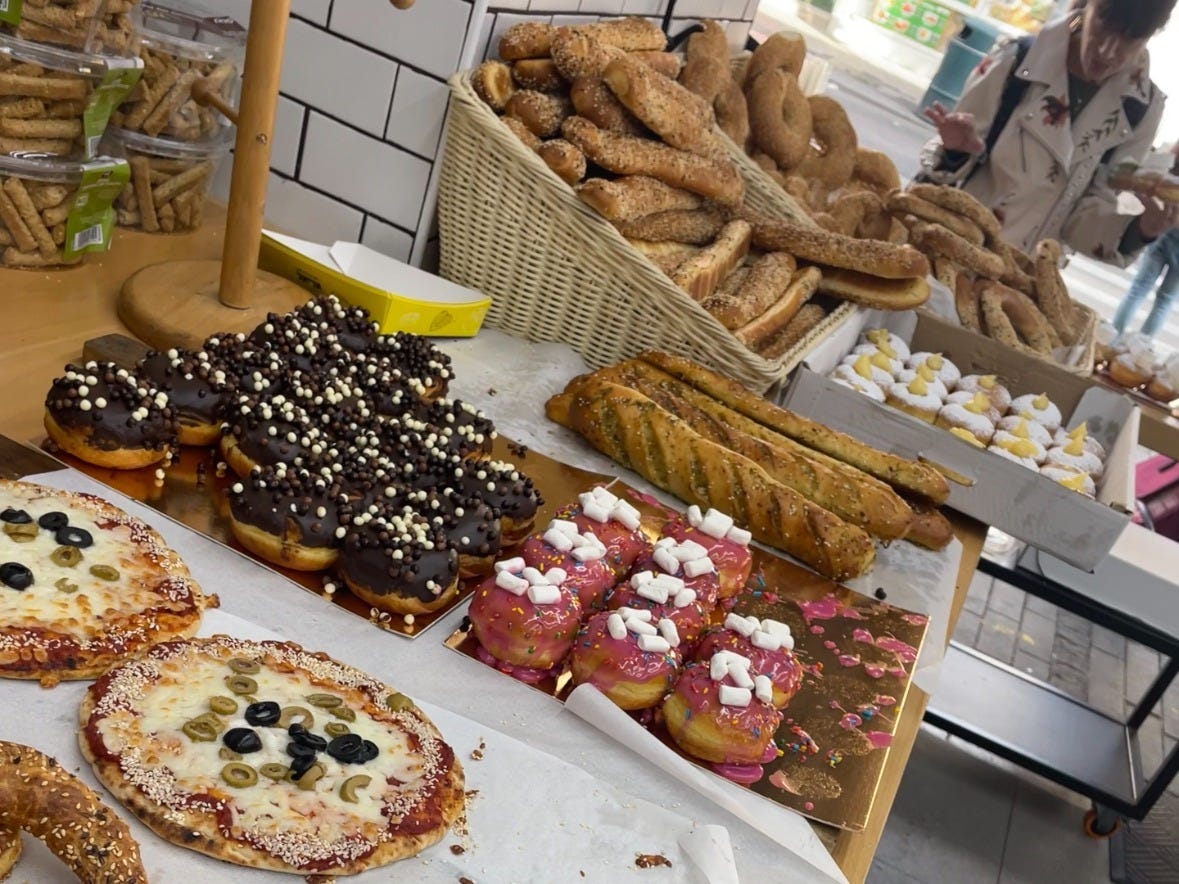
I love that I found an excellent hair stylist on the first try who knows how to cut thick, curly hair. No up-charge for the Curly Girl Method required. I might not have been born Jewish, but my hair clearly missed the memo.
There’s joy in small wins like successfully navigating the market in Hebrew or giving a stranger directions. I can read labels in the shuk and bus timetables. I understand slang at least 15 percent of the time, which in my opinion is almost a passing grade. My Hebrew is slow, but little by little, it’s improving.
Making Aliyah means learning to embrace the tiniest bit of Israeli chutzpah. It’s walking into an interview for a job I was wildly qualified for, asking them to take a chance on me despite my questionable Hebrew, and watching them actually do it.
Some lunch breaks I sit by the Mediterranean just because it is there.
Aliyah means that we’re all in on the joke. My dogs’ names, Golda and Moshe, spark chuckles instead of accusations of white supremacy. One neighbor watched them tussle under the Shabbat table and announced they were fighting over who was responsible for Yom Kippur. Another neighbor saluted Moshe. To be fair, he carries himself like a pup who expects diplomatic protocol. Golda was, and always will be, unimpressed.
One of my favorite parts of living in Israel is learning. Obviously, there are layers upon layers of historical record outside my front door, but there is also a rich tapestry of people who’ve built the history. I work with women whose families came from Morocco, Tunisia, Yemen, Syria, Iraq, Iran, Georgia, Uzbekistan, and India, and with women whose families survived the Holocaust in Hungary, Germany, Poland, and Russia, or whose families who’ve lived in Jerusalem, Hebron, and Safed long before the modern State of Israel existed.
They’ve shared their food, holidays, memories, and traditions with me. I’ve shared Southern Jewish food with them. We exchange recipes, stories, and a fair amount of unsolicited life advice, which is basically the national sport.
And speaking of learning, I went to my first Moroccan-Israeli wedding and saw a guy wearing shorts on the dance floor. That single moment redefined a “Black Tie” dress code for me. (Israelis are notorious for underdressing to formal events like weddings.)
It’s the feeling of excitement when you learn that someone you love is coming to visit and you start planning what you’ll show them before they even book their plane ticket. My mom is planning her first trip to Israel next summer and the tentative itinerary is nearly six pages long.
By the way, have y’all ever had an Israeli hotel breakfast? It’s literally the best thing ever.
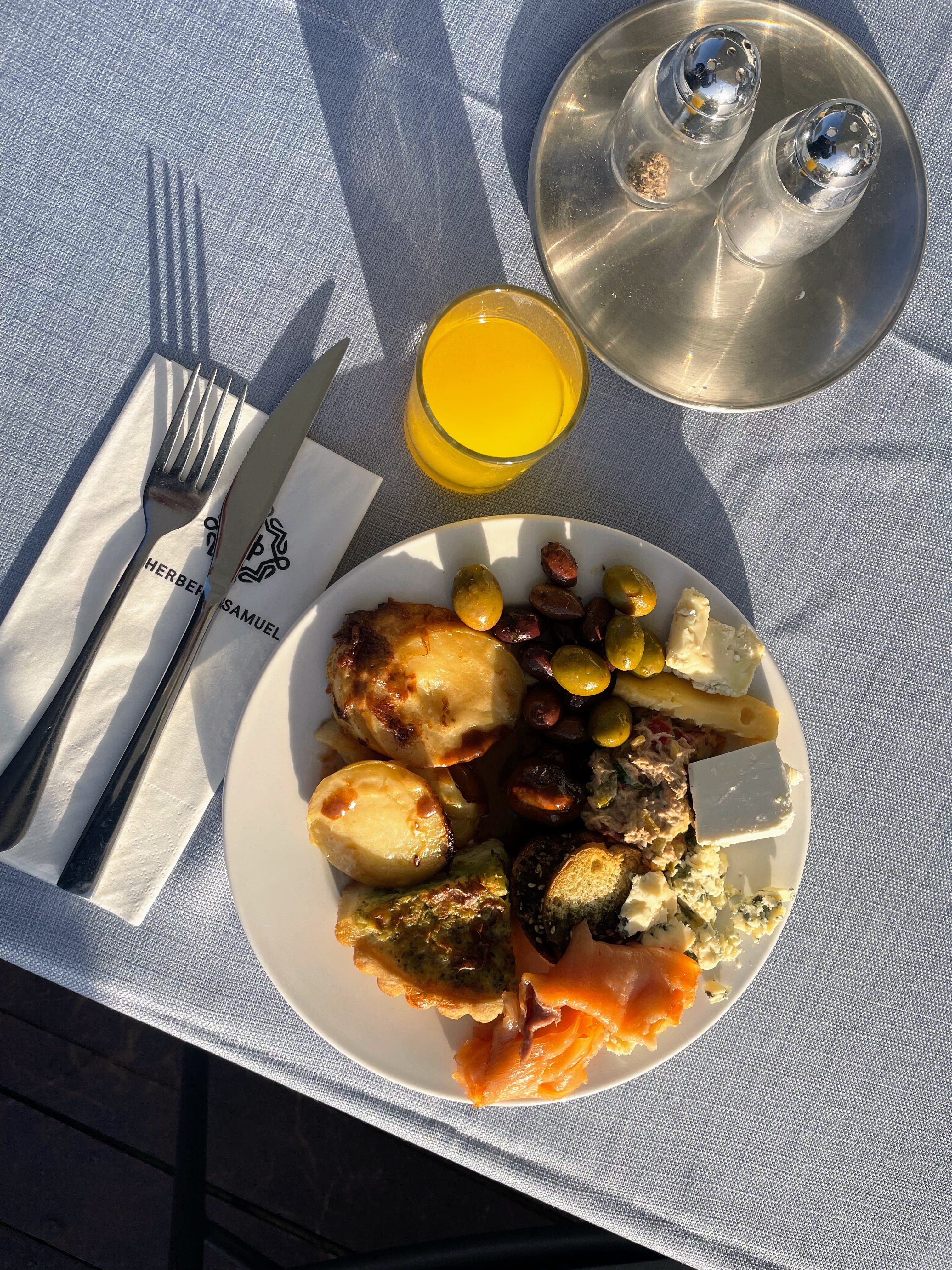
Then there’s this, which makes it on both the list of pros and cons: There is no Amazon Prime. I no longer let the algorithm delude me into thinking I need a cold-foam frother or a 17-step Korean skincare routine to be a functioning adult. I purchase 99 percent of things I need in person, which makes me more intentional. My home is calmer and less cluttered. Life is simpler and less shaped by impulse buys.
Making Aliyah means that our family is able to grow. We made the initial decision to move to Israel for world-class fertility treatment. And it worked. I am in my second trimester, and our little Science Baby is growing while we find our footing. I will always remember the moment we got the pregnancy test result. I was at work and my hands shook as I opened the Maccabi app. When I saw the word “positive,” it felt like years of grief and sadness about infertility finally loosened their grip. For the first time in a long time, planning our future didn’t feel like an exercise in futility.
We get to raise Jewish children in a life filled with ambient Judaism. They’ll grow up seeing mezuzot on every door and having Shabbat dinner every Friday. They’ll count Hanukkah by the menorahs in every window, not just ours. They’ll know the rhythms of Chol HaMoed (the intermediate days between Passover and Sukkot, which is vacation time in Israel). They’ll feel the sirens on Yom HaShoah (Israel’s Holocaust Remembrance Day) and Yom HaZikaron (Israel’s Memorial Day) in their bones, the way all Israelis do. They’ll be bilingual in English and Hebrew and able to read the ancient words of our people without translation.
It means that we don’t have to pay for a sense of community. No synagogue dues. No JCC membership. No tuition bill just to give your kid a Jewish education. Jewish life in Israel doesn’t require a subscription or payment plan.
I no longer live Jewish life on someone else’s calendar. I don’t burn through vacation days or apologize for taking off during the High Holidays because no one else is working either. In my old life, I was heavily shamed, with the threat of HR involvement, for taking Yom Kippur off (even with advanced approval) because of something “urgent” until I reminded my boss that disciplining someone for observing a religious holiday was a very bad look. The embarrassment on that phone call was palpable. Here, no one asks why Jews eat that “weird cracker” on Passover because everyone already knows. I am not the token Jew in the room, and instead, I get to be part of the story instead of explaining it.
Aliyah taught me honesty. Growing up in the South, people said I was too blunt, too opinionated, and too much “for a girl.” I spent years censoring myself, but Israel seems to have cured me. Israelis don’t really sugarcoat anything, and I’m learning to match their honesty.
I learned resilience I didn’t know I had. Every hurdle in the obstacle course has made me all the more certain that I chose the right life. In 15 months, I’ve built a new home, a partnership with my husband in a new place, and a burgeoning writing career that finally feels like it fits. I no longer feel trapped by what (or who) other people think I should be.
My reish (a Hebrew letter) will always out me as an Anglo and my Hebrew will probably always have an accent, but I’m happily building a life. I breathe easier here and my soul feels settled. I don’t have to explain my holidays or beliefs or why someone should treat me like a human being. Instead, I’m surrounded by people who get it even when we disagree about mostly everything else.
Aliyah hasn’t made my life easier, but it’s made my life more real, more honest, and more aligned with who I am. I’m truly grateful to this place and its people — my people — for the incredible opportunities I’ve had here in just a year and a half.
So, no, making Aliyah isn’t easy, actually. But it is still the best decision I’ve ever made.
This piece was delicious. If I wasn’t so old I’d consider it myself.
I think your journey has changed your life in beautiful ways.
I’m a South African Catholic with a Jewish great grandad on Mum’s side.
I love that you have such peace in your faith.
I have many Jewish friends who have family there.
They all say exactly what you do.
Kindest regards and mazeltov on your bravery to make such a huge move.
Carol Power
Johannesburg
South Africa